

![MultipartFile resource [file_data]](/assets/img/articles/заглавна-минерални-елементи.jpg)
Under field conditions, symptoms of damage to cereal plants are most commonly observed in cases of deficiency of the main macronutrients – nitrogen, phosphorus and potassium.
NITROGEN
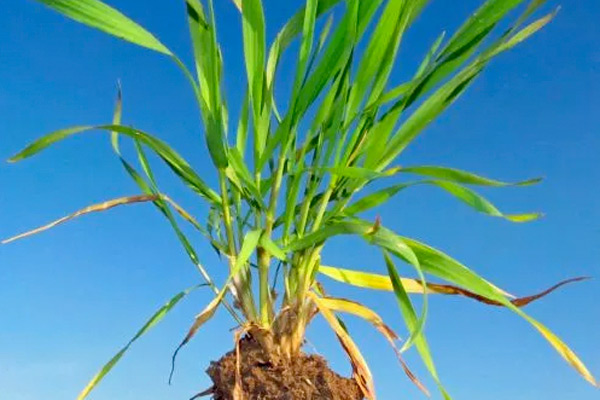
In the case of nitrogen deficiency, the leaves of young plants develop a yellowish‑green coloration, which gradually turns into an intense yellow. The leaf tips begin to die, with the damage gradually extending towards the base. When the deficiency of this element is less pronounced, the stand is extremely uneven. Specific symptoms of nitrogen deficiency appear when top dressing of the crops has been carried out inadequately. In the areas where the passes of the machine have not overlapped, the plants are severely chlorotic. These symptoms are known as technological stripe disease.
High rates of nitrogen fertilization may lead to etiolation (fading, tenderness) of the plants, which in turn causes physiological lodging of the stand. At high nitrogen rates combined with insufficient soil moisture, scorch symptoms appear on the plants, usually starting from the lower leaves. High rates increase the susceptibility of cereal crops to powdery mildews and rusts.
PHOSPHORUS
In the case of phosphorus deficiency, plant growth and tillering are delayed. Usually the leaves retain their dark green colour and less frequently acquire a purplish hue. The death of the oldest leaves starts from their tips and gradually covers the entire surface.
POTASSIUM

The absence of potassium causes marginal scorch on the leaves of all cereal crops. In the early stages of their development, the tips and edges of the oldest leaves first turn yellow, then brown, and die. In the case of potassium starvation in barley, in addition to marginal scorch, red‑brown spots develop on the leaves. The stem weakens and lodging of wheat is often observed. The grain remains shrivelled and undernourished. Potassium contributes to thickening of the epidermis, as a result of which plants become more resistant to fungal diseases, and their overall adaptability to environmental stress factors increases.
In early spring, yellowing of the lowest wheat leaves is often observed, followed by scorch and drying. This damage occurs as a result of reutilization of the nutrients, i.e. their redirection from the lower to the upper leaves of the plant. This phenomenon is common at high air temperatures, when plant growth resumes in spring, while soil temperature is low and inhibits the normal functioning of the roots and the supply of mineral elements to the plant.
Yellow, mealy grains in wheat
The kernels of some wheat varieties with a vitreous fracture may, at the time of threshing, be mottled with lighter, pale yellow, opaque spots. Some kernels are entirely altered, soft and mealy. The observed symptoms are due to differences in the structure and composition of the endosperm, which contains less protein and more starch compared with normal grain. Such kernels are difficult to mill and the separation of bran is incomplete. The causes of the occurrence of yellow or mealy grains are an unfavourable balance between the elements nitrogen, phosphorus and potassium.
Measures for control of yellow, mealy grains
- Nitrogen fertilization limits or completely eliminates the symptoms, whereas fertilization with potassium or phosphorus fertilizers enhances the manifestation of the disorder;
- High‑yielding and high‑quality wheat varieties, which require considerable amounts of nitrogen fertilizers, have an increased tendency to form yellow, mealy grains.
As a rule, the symptoms of nutrient deficiency with respect to the main macro‑ and micronutrients are exacerbated under conditions of soil and atmospheric drought. In recent years their significance has increased as a result of global climate change, a trend which will continue in the future. Balanced fertilization with macro‑ and micronutrients is necessary, in accordance with soil nutrient status and the species and varietal requirements of the crop.
Symptoms of nutrient deficiencies must be assessed on young plants before they have reached a height of 15–20 cm, since later it is impossible to restore their normal development even after the application of the respective required fertilizers. Furthermore, symptoms of mineral starvation at later stages of plant development are masked by the occurrence of diseases and damage of diverse nature, which greatly complicates diagnosis.