

![MultipartFile resource [file_data]](/assets/img/articles/бамя-заглавна-1.jpg)
Summary
Okra (Abelmoschus esculentus L.) Moench is a nutrient-rich, economically important vegetable crop grown in various regions of the world. The aim of this publication is to present an overview of the origin, distribution, morphological and biological characteristics, cultivation and yield of this crop in Bulgaria.
Okra - Abelmoschus esculentus (L.) Moench is widely distributed from Africa to Asia, in Southern Europe, the Mediterranean region and the whole of the Americas. It is cultivated as an important vegetable crop, grown mainly for the young immature fruits in the tropical, subtropical and warm temperate regions of the world. Okra is a nutrient-rich vegetable that is an important source of carbohydrates, proteins, vitamins A, B1 and calcium, potassium, dietary fibre and mineral substances. The high mucilage content in the immature fruits has many health benefits and is used in confectionery products and for paper production. The dry fruits are used as a remedy for ulcers, for relief of haemorrhoids, against chronic dysentery and urogenital disorders. The oil content in the seeds is up to 40%, rich in unsaturated fatty acids such as linoleic acid, tryptophan, lysine.
Distribution
The native range of okra is tropical Africa (Ethiopia and Sudan). In Bulgaria it is grown as a vegetable crop in limited quantities in the warmer southern regions. It is one of the most thermophilic crops, cannot grow in shade, and prefers moist soil. It requires deep, moisture-retentive and fertile chernozem and loess soils. It does not tolerate heavy and cold soils. It is a melliferous and ornamental plant.
It is grown for its fruits, which at a young stage are very tender and tasty. They are used for some dishes specific to Bulgarian cuisine, for sterilised and frozen preserves, pickles and for drying.
Botanical characteristics
Okra is an annual plant whose root system is relatively strong, with a very well-developed taproot.
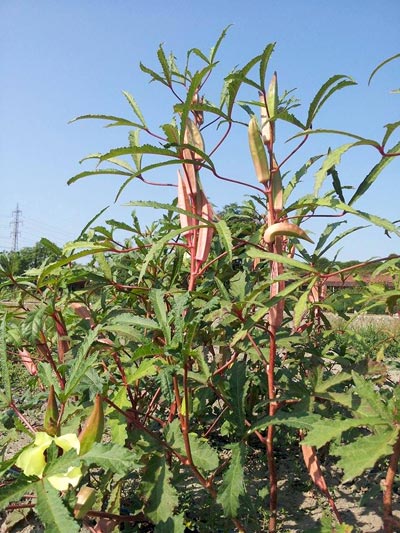
The stem is erect, woody at the base. Most often, lateral branches are formed from the basal nodes. Their number varies from 2 to 7 and depends on the cultivar and the size of the feeding area. The stem and branches are covered with stiff hairs. The colour of some cultivars is green and only at the end of the vegetation period (when it gets colder) slight anthocyanin spots appear on the nodes on the side exposed to the sun. In other cultivars, the red colour is observed on all parts of the plant from emergence.
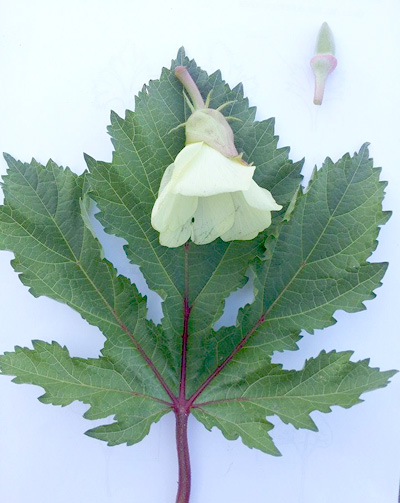
The leaves are simple, alternately arranged on the stem. The lowest ones are almost entire, the middle ones – most often palmately five-lobed, and the upper ones – also five-lobed but deeply incised. The leaf margin is shallowly serrated. The leaf colour is green or anthocyanin-greenish, and the veins are green or red.
The flowers are large (4–5 cm in diameter), with short (1–3 cm) pubescent pedicels. They are borne singly in the leaf axils. The sepals are 8–10, pointed, narrow, long; before the flowers open they become wrinkled. The petals are 5, rarely 6 or 7, large and lemon-yellow in colour. At the base they have a raspberry-red spot.
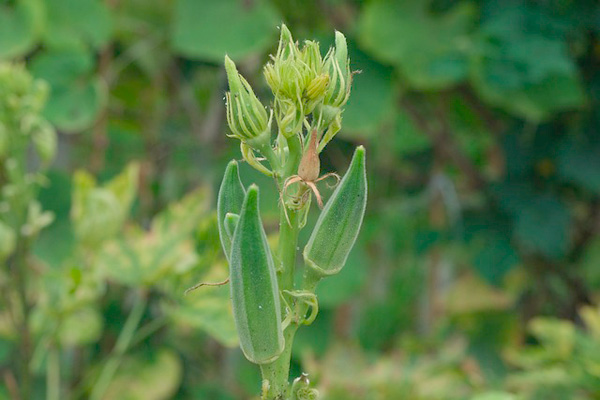
The fruit is a multi-locular pyramid, most often strongly elongated and pointed towards the apex: the length at technological maturity is from 3 to 5 cm, and at botanical maturity – from 7 to 20 cm. The width is about 2–4 cm. The number of fruits per plant at regular picking at technological maturity ranges from 24 to 60, and in seed production stands, which are not harvested – from 13 to 16. When ripening, the fruit splits along the ribs and the seeds fall out. They are rounded, oil-green, with an average diameter of 5 mm and a thousand-seed weight between 55 and 75 grams.
Biological characteristics
Okra is a thermophilic plant. Its seeds germinate at a soil temperature not lower than 15oC. Therefore, it is sown in the field later than all other spring vegetable crops (after 15 May). Adult plants tolerate low temperatures around 0oC, but the growth rate is very slow. Okra is also demanding in terms of soil moisture. To obtain more tender fruits and higher yields, it should be grown under irrigated conditions. Only on moisture-retentive and well-supplied soils with nutrients can it be grown without irrigation. The best results are obtained on chernozem and loess soils.
After emergence, okra develops slowly, but when the weather warms up, the growth rate is extremely fast and fruiting continues until the first frosts. The crop tolerates fertilisation with fresh farmyard manure if it is applied in the autumn. Top-dressing with mineral fertilisers during the vegetation period has a beneficial effect on the quantity and quality of the yield. When sown around 1 June, emergence begins around 6 June, flowering – around 25 July, and the first harvest – around 1 August. The vegetation period (to botanical maturity) is 105–120 days. It is extremely susceptible to powdery mildew and aphids.
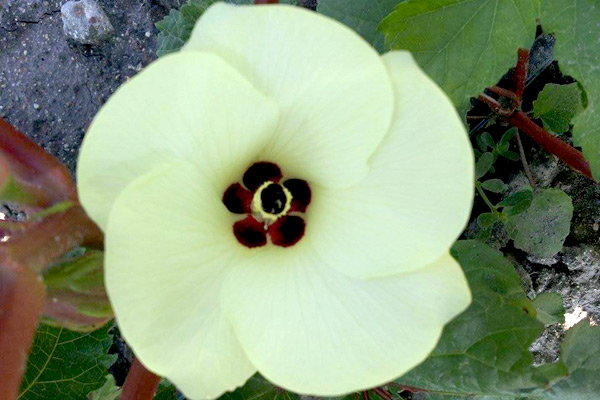
The flowers of okra open in the morning hours – the highest percentage (60%) between 8–11 a.m. In the afternoon the petals remain half-open, begin to wilt and by evening they curl up, losing their bright lemon colour and darkening to varying degrees. They do not fall off after flowering, but twist and protect the young ovary.
Observations show that okra is predominantly a self-pollinating plant. Depending on the climatic conditions during the year, the percentage of cross-pollinated plants varies from 2 to 6%. Cross-pollination is most likely carried out by insects. In seed production stands, it is necessary to provide spatial isolation of 600 m in open areas and 400 m where there are natural barriers.
Cultivation of okra
Areas designated for okra cultivation are prepared so that the seeds are sown on weed-free and loosened soils. Due to the late sowing, after deep ploughing and incorporation of farmyard manure, several cultivations and harrowings are also necessary. On large areas it is sown at a spacing of 60–80/8–10 cm during the first half of May, when acacia usually begins to bloom and there is sufficient warmth. The seeding rate is 3–5 kg/ha.
The main care during the vegetation period includes hoeing, irrigation, top-dressing with nitrogen fertilisers and, if necessary, plant protection. Compared with other vegetable crops, okra is attacked by few diseases (powdery mildew) and pests (aphids).
At the first signs of powdery mildew on okra, spraying with some of the fungicides used to control powdery mildews in vegetable crops is recommended. Against aphids, insecticides registered for use in this crop can be applied.
Okra begins fruiting about two months after sowing. The fruits are harvested at marketable maturity, at a length of 4–5 cm. The fruiting period continues until the first autumn frosts.
Early-maturing cultivars produce the first yield 7 weeks after sowing. The developing fruit should be harvested at the age of 7–8 days. Earlier harvesting reduces yields due to suboptimal fruit weight. Delayed harvesting reduces yields because overmature fruits become fibrous and are difficult to sell. Therefore, okra fields are harvested at intervals of 2–3 days. For seed production, the entire crop can be harvested at once. Intensive contact with the slightly hairy fruits and plants can cause skin irritation.
A popular cultivar in Bulgaria is okra cv. Lyaskovska Medioran, a high-yielding cultivar for consumption fresh or processed. The plant is 120 cm tall, covered with hairs, green. The fruits are dark wine-red, thin, tender, pointed, five-ridged, almost always with a curved tip. Average length about 15 cm.
Okra yields are usually low (2–4 t/ha) due to extensive cultivation.
References
1. Anwar F, Umer R, Zahid M, Tahira I, Tufail H, Sherazi. 2011. Inter-varietal variation in the composition of okra (Hibiscus esculentus L.) seed oil. Pakistan Journal of Botany, 43(1): 271-280.
2. Arapitsas, P. 2008. Identification and quantification of polyphenolic compounds from okra seeds and skins. Food Chemistry, 110: 1041-1045.
3. Maurya, R. P., Bailey, J.A. and Chandler, J. S. 2013. Impact of plant spacing and picking interval on the growth, fruit quality and yield of okra [Abelmoschus esculentus (L.) Moench]. American Journal of Agriculture and Forestry, 1(4): 48-54
4. Ndaeyo, N.U., Edu, S.U. and John, N.M. 2005. Performance of Okra as affected by organic and inorganic fertilizers on A Ultisol In: Orheruata A. M. Nwokoro, S. O., Ajayi, M. T. Adekunle, A. T. and Asomugha G. N. (eds). Proceedings of the 39th Annual Conference of the Agricultural Society of Nigeria, pp. 206-209.
5. Prasad, K. and Sharma, R. K. 2010. Classification of promising okra (Abelmoschus esculentus) genotypes based on principal component analysis. J. Trop. Agric. and Fd. Sc. 38(2): 161– 169.
6. Reddy, T.M., Haribhau, K., Ganesh, M., Chandrasekhar, R.K. and Begum, H. 2012. Genetic divergence analysis of indigenous and exotic collections of okra [Abelmoschus esculentus (L.) Moench]. Journal of Agricultural Technology, 8(2): 611- 623.
7. Saifullah, M. and Rabbani, M. G. 2009. Evaluation and characterization of okra [Abelmoschus esculentus (L.) Moench] genotypes. SAARC J. Agri. 7 (1):92-99.
8. Saifullah, M. and Rabbani, M. G. 2009. Evaluation and characterization of okra [Abelmoschus esculentus (L.) Moench] genotypes. SAARC J. Agri. 7 (1):92-99.
9. Tripathi, K.K., Govila, O.P., Ranjini, W. and Vibha, A. 2011. Biology of okra [Abelmoschus esculentus (L.) Moench]. Serious of crop specific biology document. Ministry of Environment and forests government of India and department of biotechnology ministry of science and technology government of India p.22.
10. CABI Compendium, doi:10.1079/cabicompendium.1950, CABI International, Abelmoschus esculentus (okra), (2022)