

![MultipartFile resource [file_data]](/assets/img/articles/боб-заглавна.jpg)
Summary
Leguminous vegetables – green bean (Phaseolus vulgaris (L.) Savi.), garden pea (Piasum sativum L.) and broad bean (Vicia faba L.) are considered vegetables due to their higher water content, water-soluble vitamins and mineral salts, richness in nutrients and lower calories. In the present publication, our aim is to present the most important morphological and biological characteristics of these crops. We propose a cultivation technology and activity calendar, as well as the most widespread cultivars.
Leguminous crops belong to the family Fabaceae (or Leguminosae) and comprise more than 19 thousand genera. They are mainly divided into: a) Oilseed legumes, characterized by a higher fat and calorie content; b) Pulses – crops in which the dried edible seeds of the plants are consumed; and c) Fresh legume crops, consumed as fresh vegetables.
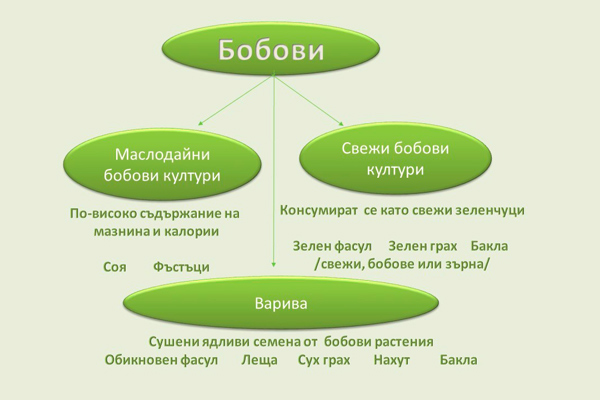
Legume crops – classification
Fresh legume plants are characterized by a high water content, water-soluble vitamins and mineral salts, richness in nutrients and lower calories; when frozen they preserve all the nutritional properties of the fresh product with very slight losses, which brings them, in these characteristics, close to vegetable crops, and therefore they are considered vegetables.
Here belong green (garden) bean (Phaseolus vulgaris (L.) Savi.), garden pea (Piasum sativum L.) and broad bean (Vicia faba L.).
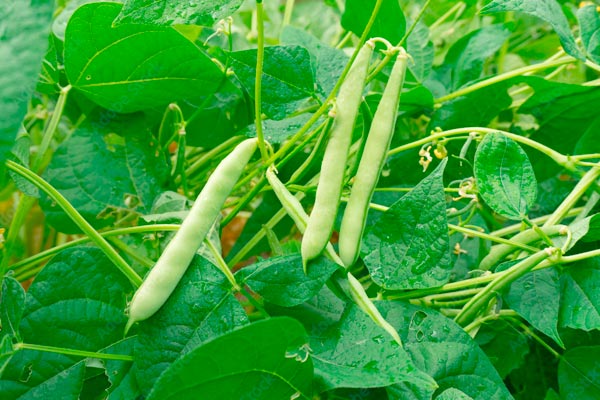
green (garden) bean (Phaseolus vulgaris (L.) Savi.)
All three crops have a bushy growth habit. The stem is erect to semi-erect in pea, erect and twining in bean, and erect in broad bean. Plant height differs between species and cultivars:
- in pea it is 115-250 cm for tall cultivars, 70–115 cm for short cultivars and 40-50 cm for dwarf ones;
- in bean there are low bushy forms (25-45 cm), semi-climbing (up to 1.5 m) and climbing over 2 m;
- the stem of broad bean reaches from 40 to 120 cm.
Low-growing cultivars of all three crops are characterized by earlier maturity.
The common feature of representatives of the three genera is the papilionaceous flower type, developing in the leaf axils and attached on pedicels. The flower consists of a five-lobed calyx and a five-petalled corolla, coloured white, cream, pale pink, pink or violet. The corolla is composed of an upper petal, or standard, two lower lateral petals that form the keel, and two lateral petals forming the wings. There are 10 stamens, 9 of which are fused into one bundle and one is free.
The fruit is a pod, consisting of an outer fleshy layer made up of parenchyma cells, and an inner leathery layer composed of sclerenchyma cells forming a parchment layer. The presence of this layer makes the pods of pea and common bean unsuitable for shelling (in pea the green, fresh seeds are used). In sugar pea and in garden (green) bean cultivars this layer is absent and the pods are consumed in fresh (green) state.
By shape, pods can be straight, round, flat, cylindrical, curved, sabre-shaped, sickle-shaped, blunt- or sharp-pointed, and by size – small or large.
Seeds are round, angular, smooth or wrinkled, with green and cream-grey colour in pea; spherical, elliptical, elongated, cylindrical, kidney-shaped, semi-flat and flat in bean, with very diverse colouring. Broad bean seeds have an irregularly rounded shape. The thousand seed weight (of 1000 air-dry seeds) varies widely – from 100 to 500 grams in pea, from 150 to 1000 grams in bean and from 1700 to 2000 grams in broad bean.
The biological characteristics of garden pea and broad bean are closer to each other, while those of green bean differ. The first two crops belong to long-day plants and to crops of moist and cool climate, whereas bean is a thermophilic short-day plant.
Broad bean is fairly frost tolerant, withstanding down to -4oC, therefore in the southern regions it is sown as an autumn crop. It is quite moisture-loving, especially from emergence to flowering. Under dry conditions plant height and vegetative mass are reduced and seeds are poorly filled.
Pea seeds germinate at different temperatures – smooth-seeded cultivars at 1-2oC, and wrinkled-seeded cultivars at 4-8oC. For germination and onset of growth, pea seeds need a large amount of water – from 100 to 110% of their own weight for smooth-seeded types and up to 150% for wrinkled-seeded cultivars.
The optimum temperature for germination of bean seeds is 18-22oC. Therefore, in our country sowing is around 15 April, when soil temperature permanently exceeds 10oC.
Cultivation technology and activity calendar
Technological elements
Place in crop rotation: as predecessors, crops are selected that free the land early and allow timely and proper soil tillage. They are not demanding towards the preceding crop, but show intolerance to themselves and therefore should not be sown after themselves for at least three years. Good predecessors are cereal and forage crops.
Soil tillage: all three crops require light soils rich in lime. High-quality deep ploughing in autumn, followed by timely seedbed preparation, is a decisive condition for good and uniform plant emergence in spring.
Fertilization: As legume crops, they respond weakly to nitrogen fertilization. Depending on soil fertility, planned yields and the preceding crop, different fertilization rates are recommended. The entire amount of phosphorus, potassium and magnesium fertilizers is applied before ploughing, and all or part of the nitrogen fertilizers – before the last pre-sowing tillage or simultaneously with sowing.
Seed material: healthy seeds typical of the cultivar, with the required germination capacity, are selected in accordance with the Bulgarian State Standard (BDS). An important condition for obtaining high yields is ensuring the required number of plants per unit area (one square metre).
Sowing: Broad bean – in autumn (November) in the southern regions of the country and in early spring – end of February in the remaining regions; with a sowing rate ensuring 17-33 germinating seeds per 1 sq. metre;
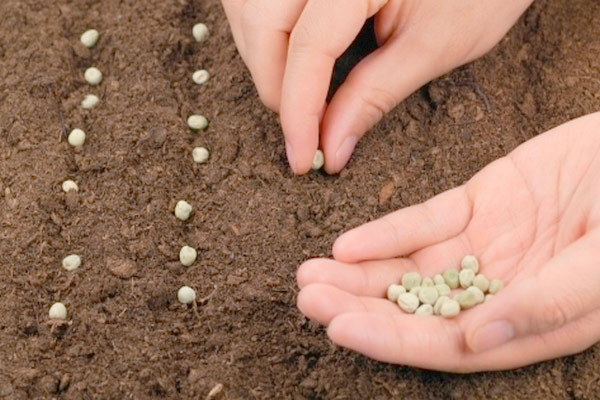
Garden pea is sown at the first opportunity at the end of February and in the first days of March. The sowing rate should ensure 100 germinating seeds per 1 sq. metre;
Green bean – after 15 April, when the soil temperature at 10 cm depth rises permanently above 12oC and sowing continues until 20 July; with a sowing rate ensuring 25-35 germinating seeds per 1 sq. metre.
Sowing rate: calculated in accordance with the thousand seed weight and the required number of plants per unit area. It ranges for: broad bean from 12 to 25 kg/da; pea from 16 to 25 kg/da and bean – 12-16 kg/da.
Sowing patterns: depending on the area, irrigation method and level of mechanization, sowing is in hills, in rows and in bands. Hill sowing is mainly used in home gardens, with 2-6 seeds per hill depending on the crop. Row sowing: broad bean is mostly grown in single-row stands with 60 cm spacing between rows; narrow-row sowing (15-20 cm) in pea ensures better stand density; bean is sown at 60 cm distance between rows. Band sowing is applied in pea and bean in various patterns depending on the irrigation method and harvesting machinery.
Post-sowing crop management
Weed-free stands are an important condition for mechanized harvesting. The most successful weed control is achieved by combined use of herbicides and inter-row cultivation. Mainly soil-applied herbicides are recommended, used immediately before or after sowing and before crop emergence. The choice of appropriate herbicides is made according to the approved national list for their selectivity in grain legume crops.
The water requirements of garden legumes and the specific climatic conditions in the country necessitate carrying out a minimum of 3 to 5 irrigations during the vegetation period.
An important cultivation measure in pea and bean is the control of pea and bean weevils. Control of these two pests is carried out at the beginning of flowering, at full flowering and at the ripening of the first pods with appropriate products. A minimum of three treatments is needed, and in case of higher infestation levels, spraying may reach 5-6 applications and continue until the stage when seeds start to harden. These two pests can destroy up to 100% of the crop.
Systematic control of aphids in broad bean (black bean aphid and pea aphid) is necessary; in some years pea aphid and stem weevils can cause serious damage in pea stands, and in bean – greenhouse whitefly, black bean aphid and tobacco thrips.
Garden legume crops are attacked by a large number of viral, bacterial and fungal diseases, but depending on soil-climatic and production conditions, not all of them are of economic importance. Economically important are: in broad bean – ascochyta blight, fusarium wilt, botrytis; in pea – ascochyta blight, root rot, fusarium wilt, powdery mildew; in bean – bacterial blight and halo blight, anthracnose, root rot, common and yellow bean mosaics.
The plant protection system against diseases and pests includes both important agrotechnical measures and timely harvesting within shortened timeframes and without losses; regular field inspections to determine species composition, appearance and density of harmful organisms; conducting chemical treatments according to economic threshold levels and the warnings issued by local forecasting services.
When applying plant protection products, it is necessary to strictly observe the pre-harvest intervals in accordance with the planned harvest dates. Current information on plant protection products and fertilizers, soil improvers and growing media authorized for placing on the market and use can be found on the website of the Bulgarian Food Safety Agency (BFSA): www.babh.government.bg
Harvesting
Depending on the biological characteristics of the crop and the cultivar, harvesting is carried out when:
- green pods are formed in broad bean, without the seeds inside having grown; harvesting is done regularly, without allowing pods to become over-mature;
- 70-80% of the green pods in pea and bean are at technological maturity, a small proportion of 5 to 10% are slightly over-mature, and 10-15% are at the beginning of this maturity stage.
Earlier harvesting is not recommended, because yield is reduced, while later harvesting deteriorates product quality.
Cultivars
When choosing a cultivar, information is needed on: productivity, lodging resistance, duration of the vegetation period, thousand seed weight, intended use, reaction to the most important diseases and pests under natural infection, winter hardiness and quality characteristics.
In the official variety list of cultivars of agricultural and vegetable plant species recognized for certification and trade on the territory of the Republic of Bulgaria for 2024 are included:
For Broad bean – Field bean - Vicia faba L. (Partim) - only one winter cultivar for seed, Kasos, as a forage crop;
For the species Garden pea – Pea - Pisum sativum L.: cultivars with wrinkled seeds: ABS Anka, Bolero, Marsi; cultivars with round seeds – Ran 1; sugar – Sladeya;
For the species Bean – French bean - Phaseolus vulgaris L.: low-growing (bush) cultivars: ABS Lara, Evros, Lorin, Nikos, Asya, Gina, Kierion;
The Maritsa Vegetable Crops Research Institute is the only institute in Bulgaria where a research and breeding programme on garden legume crops is carried out. Over the years, more than 40 cultivars of garden pea and garden bean have been developed, combining good productivity, high taste and technological qualities, and improved resistance to economically important diseases and pests in the country.
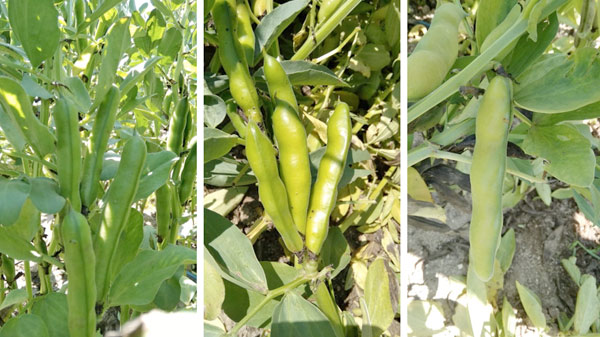
Broad bean – local population from the village of Dink, accession Ang 2 and line No. Fb 6 from IFR-Pleven
Garden pea cultivar MARSI
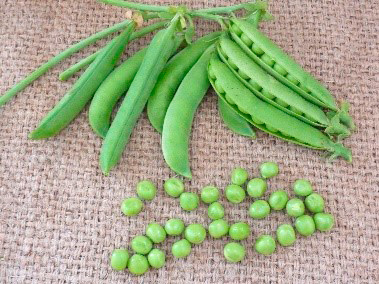
Developed through inter-varietal hybridization at VCRI “Maritsa” - Plovdiv.
A medium-late cultivar with a vegetation period from emergence to technological maturity of 68-70 days.
The stem is erect, strong, 75-80 cm high. Leaves are of normal type, most often with 2 pairs of leaflets, medium-sized, dark green, without serration or with very slight serration, with well-developed stipules. Flowers are white, two per peduncle, more rarely one. The first pod is set at the 15th-16th node. Pods are arranged in pairs on the fruiting peduncle. They are slightly, sabre-shaped curved, with a sharp tip, 8-10 cm long, containing 8-10 well-formed dark green seeds. At an average dry matter content of 23.1%, it has an average processing yield of 41.7% and an average seed size of 8.9 mm. It has a slow carbohydrate metabolism and a technological maturity period lasting from 3 to 5 days.
Seeds are drum-shaped and drum-angular, wrinkled, cream and cream-green, with a thousand seed weight of 180–190 g.
It is suitable for freezing, and after six months of storage it retains excellent organoleptic qualities and colour characteristics.
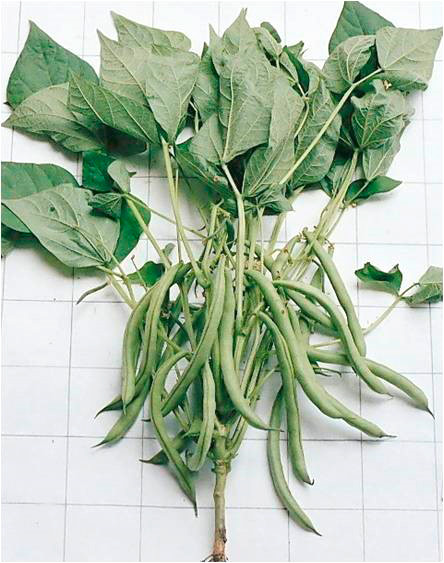
Garden bean cultivar Evros
Developed at the Vegetable Crops Research Institute - Plovdiv. Certificate No. 11089
Highly productive, vigorous and very well adapted to the agro-climatic conditions of the country. Plants have a determinate growth type with a height of 50-55 cm, with a strong and erect stem and a medium-sized bush. It has cylindrical, long (13-15 cm), straight, green pods without strings, extremely suitable for frozen vegetable mixes, whole frozen pods and canning. Pods reach technological maturity in 50 days and retain their good taste and appearance for a long time due to their slow ripening dynamics. Seeds are white, kidney-shaped, medium-sized. The cultivar „Evros“ has combined resistance to: halo blight (Pseudomonas syringae pv. phaseolicola - races 1 and 6); anthracnose (Colletotrichum lindemuthianum - races 6 and 81); rust (Uromyces appendiculatus - races 20-0, 20-2 and 20-3); two economically important viruses – Bean common mosaic virus (BCMV) and Bean common mosaic necrosis virus (BCMNV). It has medium field resistance to common blight (Xanthomonas axanopodis pv. phaseoli).
References
- FAOSTAT. 2017 (http://www.fao.org/faostat/en/#data/QC Accessed July 2, 2019).
- Pasev, G. 2014, Identification of viruses on bean in the South-Central region of Bulgaria. Plant Science No. 4-5, pp. 24-29.
- Pasev, G., Kostova, D. and Turina, M. 2014. A New Virulent Isolate of Clover Yellow Vein Virus on Phaseolus vulgaris in Bulgaria. Journal of Phytopathology 162:703-711.
- Smither-Kopperl, M. 2019. Plant Guide for fava bean (Vicia faba). USDA-Natural Resources Conservation Service, Lockeford Plant Materials Center. Lockeford, CA 95237.
- USDA, Agricultural Research Service, GRIN-Global Website. 2019. National Germplasm Resources Laboratory, Beltsville, Maryland. URL: https://npgsweb.ars-grin.gov/gringlobal/search.aspx. Accessed 12 August 2019.
- Kalapchieva Sl., 2021a. Survival and winter hardiness of garden pea cultivars, Journal of Science „New Knowledge“ 10-1, (2021), (Academic Publishing House „Talent“ University of Agribusiness and Rural Development Bulgaria), p. 94-100, ISSN 2367-4598 (Online) ISSN 1314-5703 (Print) http://science.uard.bg
- Kalapchieva, 2017. A new garden pea cultivar – Paldin, Agronom, 2 (162), 31.