

![MultipartFile resource [file_data]](/assets/img/articles/Берлин-месе-1.jpg)
The world’s leading trade fair Fruit Logistica, which always brings together in early February (7–9 February 2024) in Berlin representatives of the fruit and vegetable sector, has achieved yet another record edition. Fully in line with this year’s motto “The heartbeat of the global fresh produce trade”, the exhibition provided 26 exhibition halls where 2,770 exhibitors from 94 countries showcased trends in this sector. From the development of new varieties of vegetables and fruit and their processing into quality food, to their successful sale, including the development of logistics, which is part of the overall process from production to end consumer and the creation of new foods and markets.
This year the Berlin forum reports an increase in the number of Italian and Spanish exhibitors, and China has reserved almost three times more space than last year and more than before the pandemic.
Interest from the Middle East and North Africa was also strong.
“The fruit and vegetable trade industry is facing multiple challenges and increased costs that threaten its profitability. In times like these, companies need more partners than in the past. And that is why they come to the international trade fair,” said Kai Mangelberger, Director of FRUIT LOGISTICA, at the opening.
Bulgarian participation at FRUIT LOGISTICA 2024 offered trade visitors from all over the world who came to Berlin the opportunity to see technological innovations in greenhouse production.
At the national collective stand, producers from “EkoFrut K i K” EOOD, “Deiv-2007” EOOD, farmer Petya Nanovska, “Geosemselect” OOD, “Amitsa” OOD and others presented themselves. The Bulgarian participation was organized by the Bulgarian Association of Greenhouse Growers (BAPOP), with the support of the Ministry of Agriculture and Food and the State Fund “Agriculture”.
Bulgarian producers focused on greenhouse solutions, which were one of the key topics of this year’s exhibition. They showcased their achievements in the application of modern equipment and technologies for temperature and light control, plant pollination, automated harvesting and storage systems, which create optimal conditions for cultivation and a sustainable supply of healthy and high-quality produce to the market.
Global innovation hub
The trade fair in Berlin has built its image as an innovation hub in the fruit and vegetable sector with a rich programme of lectures, interviews and discussions.
For the first time this year, a new discussion stage “Farming Forward” was created, where a variety of meetings were held with international and renowned partners such as the CEA Alliance and Wageningen University & Research on the topics “Smart Farming”, “Advanced Greenhouse Technology” and “Controlled Environment Agriculture” (CEA).
The FRUIT LOGISTICA Innovation Award (FLIA) was presented for the eighteenth time in 2024.
Since its inception, the Berlin award has established itself as the most prestigious innovation award in the international fresh produce industry, from the development of products for fresh consumption to their successful placement in retail chains.
In addition to the FLIA awards, this year for the first time the FLIA Technology Award was also presented for outstanding innovations in the field of technology.
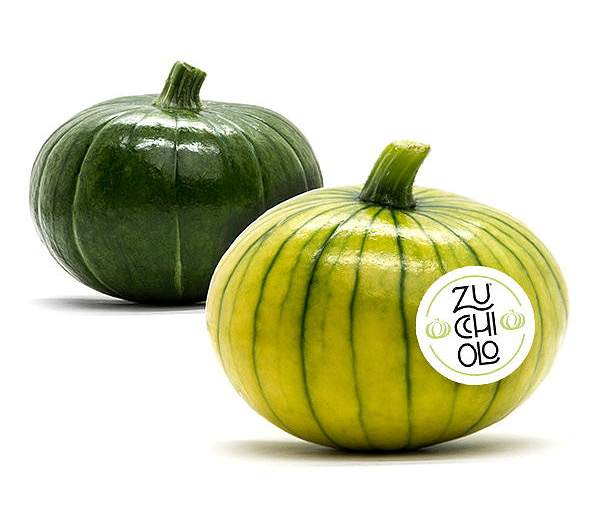
Vegetable concept from Spain – first place in the FLIA Awards
Zucchiolo is a vegetable that marks the beginning of a new product category on the European market. It is distinguished by its versatility and is suitable both for direct consumption and for the preparation of various dishes. Zucchiolo has an oval shape and a harvest weight of about 250 g.
“Zucchiolo is a new vegetable concept. It originates from a cucumber typical of South America, which is a cross between a courgette and a cucumber, hence the brand name we have given it, which consists of the Italian words zucchini and cetriolo,” explained Alfredo Sánchez-Jimeno, Marketing and Product Development Manager at Beyond Seeds Biotech Group.
Over the past five years, the team from Beyond Seeds and the Ifapa Agricultural and Horticultural Research Institute has succeeded in adapting the new vegetable to greenhouse production. The plant is a hybrid between a cucumber variety typical of South America and a courgette. In fact, it is an alternative for growers who cultivate both vegetable types. It has a short vegetation cycle and varieties have already been developed for both autumn–winter and spring cultivation. Yields are quite high, about 9–11 t/ha, with a planting density of about 8,500 plants per hectare. In addition to adapting it to greenhouse cultivation, scientists have developed a three-colour range of varieties – dark green, light green and yellow zucchinis.
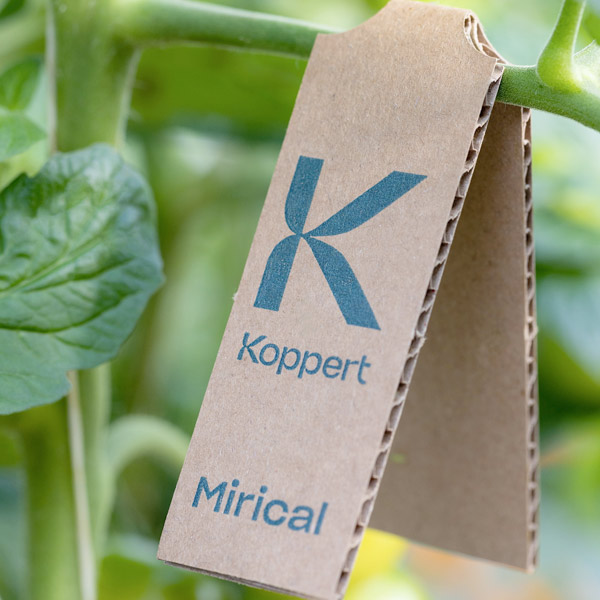
In the field of technologies, first place was awarded to the biological whitefly control system.
Mirical – optimal whitefly control with a revolutionary biological agent release system
The change in product packaging from a plastic bottle to specially designed strips of corrugated cardboard, which form a natural habitat for the predatory bug Macrolophus pygmaeus, has created a highly efficient and sustainable release system that is much easier to use. The cardboard strips are fully compostable, resulting in 99% less plastic.
Mirical strips are easy to distribute and are hung on a stem of a fully grown plant. In addition to saving labour and making dosing more accurate, the strips can now be easily located for monitoring purposes.
Macrolophus pygmaeus is a predatory bug widespread in the Mediterranean, where it is able to overwinter. The predatory bug is a natural enemy of greenhouse whitefly (Trialeurodes vaporariorum), tobacco whitefly (Bemisia tabaci), eggs and larvae of the tomato leaf miner (Tuta absoluta) and other moths. It also feeds on two-spotted spider mites (Tetranychus urticae), aphids and leaf miner fly larvae (Liriomyza spp.).
Trends in the vegetable sector
In recent years, the participation of the Netherlands at FRUIT LOGISTICA Berlin has made a strong impression, not only in the development of new vegetable and fruit varieties, but also in creating a different approach to food and opening new markets.
A key focus in the tomato varieties displayed at this year’s exhibition was the fight against viral diseases, which in recent years have had a strong impact on yield and supply.
ToBRFV belongs to the group of tobamoviruses and is closely related to Tobacco Mosaic Virus (TMV) and Tomato Mosaic Virus (ToMV). Its main hosts are tomatoes and peppers. ToBRFV is able to overcome Tobamo resistance in tomatoes (Tm2², Tm1). This means that all tomato varieties bred before 2022 are susceptible to the virus.
ToBRFV was first reported in Jordan and Israel in 2014. Since then the virus has been detected in the United States, Mexico, China and several countries in Europe and the Middle East. Since 1 November 2019, ToBRFV has had quarantine status in the EU.
For science it is clear that the only way out of the heavily compromised tomato crops in recent years is the development of new resistant varieties. Major vegetable breeding and seed production companies such as Rijk Zwaan and Syngenta have successfully taken on this task.
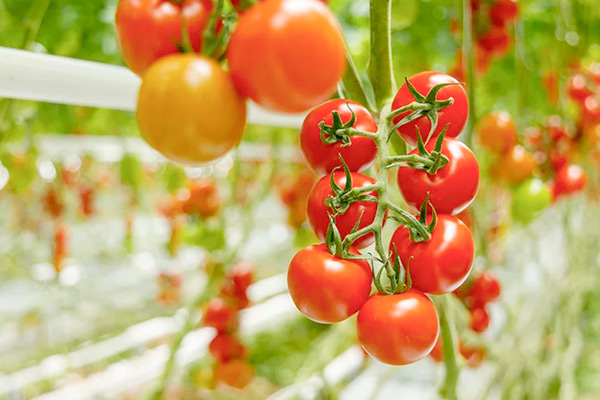
Tomatoes labelled Rugose Defense from Rijk Zwaan, which were the main attraction at the fair in Berlin, are tomato varieties with high resistance to Tomato Brown Rugose Fruit Virus (ToBRFV).
The varieties have been extensively tested before being released onto the market. Many of Rijk Zwaan’s partners have already moved from trial cultivation to commercial cultivation. When selecting Rugose Defense varieties, attention is paid not only to high resistance, but also to all other cultivation and post-harvest characteristics.
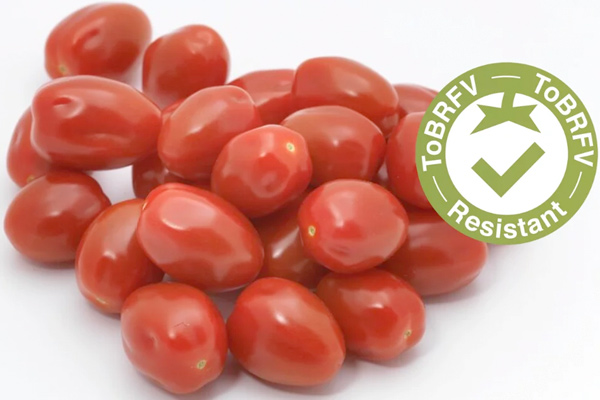
The rugose virus affects all tomatoes, but especially specific market segments, such as small oval snacking tomatoes. That is why Syngenta has launched four new baby-plum varieties on the market: Adorelle, Emyelle, Sycibelle and Crystelle, with genetic resistance, which offer high yield potential and maintain the quality and taste that growers and consumers expect. They are suitable for greenhouse production.
The new virus ToLCNDV (Tomato Leaf Curl New Delhi Virus) causes up to 90% yield loss in cucurbit crops, which makes the search for resistant varieties imperative for growers.
First identified in India, Tomato Leaf Curl New Delhi Virus (ToLCNDV or New Delhi Virus) is a serious threat to all cucurbit producers. Years ago, Syngenta identified this virus as a potential problem for melon, squash and cucumber crops and at the exhibition presented its solutions – the cucumber Siriana and the courgette varieties Delfos and Alpha, with resistance to ToLCNDV.