

![MultipartFile resource [file_data]](/assets/img/articles/химична-борба-заглавна.jpg)
Summary
The control of fungal phytopathogens in wheat cultivation is essential for achieving high and stable yields. The application of agronomic methods and the use of resistant varieties to protect plants from diseases is in many cases insufficient, making it necessary to use various fungicides. The correct choice of product, rate and timing of application has a significant impact on the control of pathogens.
Diseases in wheat are one of the main factors for obtaining high and stable yields. Wheat production in our country is annually accompanied by various types of diseases that have a major impact on yield. Viral and bacterial diseases develop relatively rarely in the country and do not lead to yield reduction beyond economically acceptable levels.
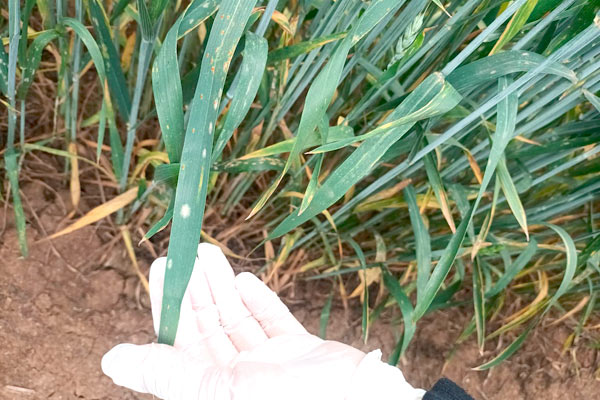
Powdery mildew and brown rust
Fungal diseases such as the different types of rusts, septoria leaf blotch, powdery mildew and fusarium play a major role. Their control is carried out by various methods – immunoselection, agronomic practices and chemical protection. Immunoselection is related to the use of resistant varieties in production that provide protection against a given phytopathogen. The agronomic method involves a number of measures aimed at limiting the spread of diseases through appropriate crop rotation, destruction of plant residues, volunteers, alternate hosts of the pathogens, balanced fertilization, etc. The chemical method of control uses various types of chemical products called fungicides.
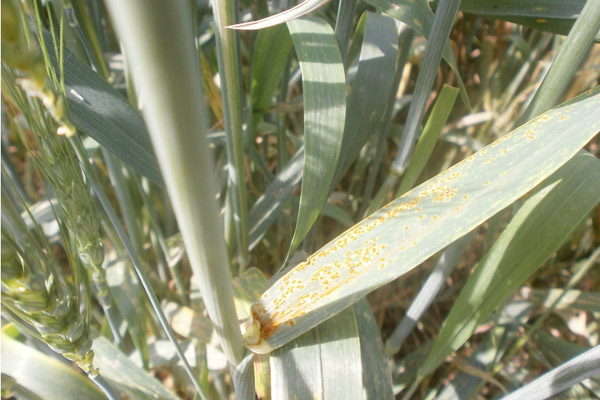
Brown rust
In this publication, attention will be paid to some active substances contained in commercial products that are used to control the main fungal pathogens in wheat. The wheat growth stage at which the active substance is applied and the rate must comply with the recommendations of the commercial manufacturer of the product.
Azoxystrobin
Commercial products with the active substance azoxystrobin are selective with broad-spectrum and systemic action against the main fungal pathogens in wheat. The active substance belongs to the group of strobilurins and acts as an inhibitor of mitochondrial respiration by binding to the Qo site of cytochrome b, disrupting the energy cycle in the fungal pathogen and thereby affecting the growth of mycelium and spores. It is distributed translaminarly in the plant. It has preventive and curative action.
Disease: brown rust, powdery mildew and early leaf blight
Application: Twice at 14-day intervals from the beginning of stem elongation to the end of flowering of the crop
Tank-mix compatibility with other products: Yes
The use of an active substance from the strobilurin group is not recommended in the following vegetation period.
Metconazole
It has systemic action. It inhibits ergosterol biosynthesis and destroys the pathogen’s cells, thus stopping its development.
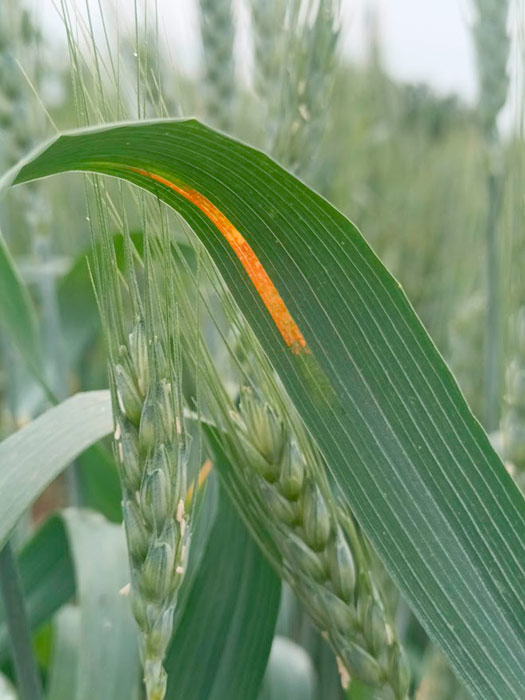
Yellow rust
Disease: brown rust, yellow rust, black rust, powdery mildew, septoria leaf blotch
Application: beginning of stem elongation – end of heading
Tank-mix compatibility with other products: It can be mixed with most herbicides, insecticides and foliar fertilizers used in practice, but before use it is advisable to carry out a compatibility test.
Metrafenone
It has systemic, preventive and curative action. The active substance belongs to the benzophenone group. It acts on different stages of the life cycle of fungal pathogens. It reduces the rate of spore germination. It causes deformation of the mycelial hyphae that are already present in the plant tissues.
Disease: powdery mildew, parasitic lodging
Application: from tillering to the end of flowering
Tank-mix compatibility with other products: Yes
Mefentrifluconazole
The active substance has systemic action. It belongs to the group of sterol biosynthesis inhibitors (SBI) and the subgroup of demethylation inhibitors (DMI). It moves systemically in plant tissues and, upon reaching the pathogen, blocks its biochemical processes and in particular ergosterol biosynthesis. The result is inhibition of growth and destruction of the cell membrane. Mefentrifluconazole has the ability to adapt and act even against resistant forms of diseases.
Disease: brown rust, yellow rust, early leaf blight
Application: from the beginning of stem elongation to the end of flowering stage
Tank-mix compatibility with other products: Yes
Tebuconazole
The active substance is one of the most widely used in commercial products worldwide on many crops for the control of a broad spectrum of diseases. It is characterized by preventive and curative action. The active substance suppresses ergosterol biosynthesis in the membrane of the fungal cell (DMI), thereby preventing the development of the pathogen’s mycelium.
Disease: powdery mildew and rust species
Application: 1st application – from flag leaf to the end of heading; 2nd application – from flowering to late milk ripeness
Tank-mix compatibility with other products: Yes
A large proportion of commercial products contain more than one active substance for the control of wheat diseases. Below are listed various combinations of active ingredients.
Bixafen + Prothioconazole
Commercial products with these active substances are systemic fungicides with a broad spectrum of action. Bixafen belongs to the group of carboxamides, and prothioconazole belongs to the triazoles.
Disease: septoria, powdery mildew, brown rust, yellow rust, leaf blight, fusarium head blight
Application: from the beginning of stem elongation to the end of flowering stage
Tank-mix compatibility with other products: It must not be mixed with organophosphorus insecticides.
Bixafen + Tebuconazole
Broad-spectrum, systemic. Bixafen belongs to the newest group of active substances – carboxamides (pyrazole-carboxamides subgroup) and inhibits the activity of enzymes from complex II in the mitochondrial respiratory chain of fungi. Tebuconazole is from the group of azole fungicides and its function is to interrupt ergosterol biosynthesis in fungi. The active ingredients act preventively by hindering the development of fungal spores and curatively by blocking existing latent infections in crops and preventing their further development and spread.
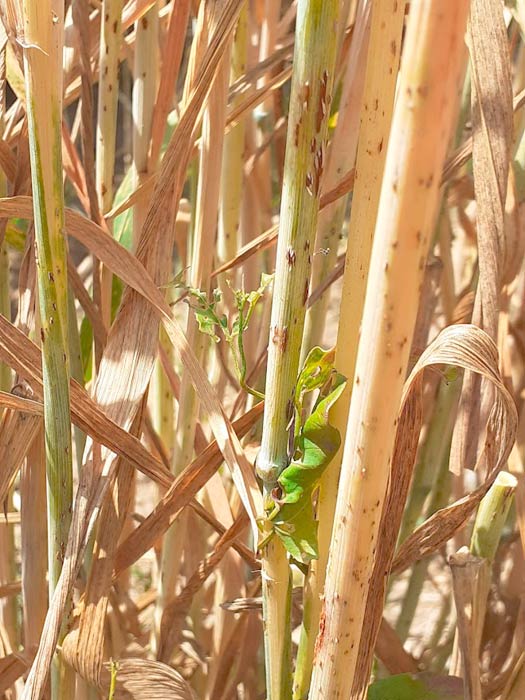
Black rust
Disease: early leaf blight, powdery mildew, brown rust, black rust, leaf blight, fusarium head blight
Tank-mix compatibility with other products: Yes
Application: from the beginning of stem elongation to the end of flowering stage
Kresoxim-methyl + Mefentrifluconazole
Kresoxim-methyl is a strobilurin with quasi-systemic action that inhibits mitochondrial respiration in the cells of pathogens. Mefentrifluconazole belongs to the group of sterol biosynthesis inhibitors (SBI) and the subgroup of demethylation inhibitors (DMI). After treatment it moves systemically in plant tissues and, upon reaching the pathogen, blocks its biochemical processes and in particular ergosterol biosynthesis. The result is inhibition of growth and destruction of the cell membrane. Another part of the active substance accumulates under the wax layer of the leaves in the form of reservoirs that remain protected from environmental influences.
Disease: early leaf blight, powdery mildew, brown rust, yellow rust, yellow-brown spots, foot rot
Application: from the beginning of stem elongation to the end of flowering of the crop.
Tank-mix compatibility with other products: Yes
Prothioconazole + Proquinazid
An excellent synergism is observed between the two active substances. Proquinazid has contact and locally systemic action, providing perfect and long-lasting protection. It strengthens the crop’s immune defence. Prothioconazole provides powerful protection through complete systemic action, preventing infections and stopping existing ones.
Disease: early leaf blight, brown rust, yellow rust, powdery mildew, yellow-brown spots, foot rot, fusarium head blight
Application: 5 tillers – full flowering
Tank-mix compatibility with other products: Yes
Prothioconazole + Tebuconazole
The combination of active substances provides preventive, curative and eradicative effect, which makes it suitable for use in various problematic situations.
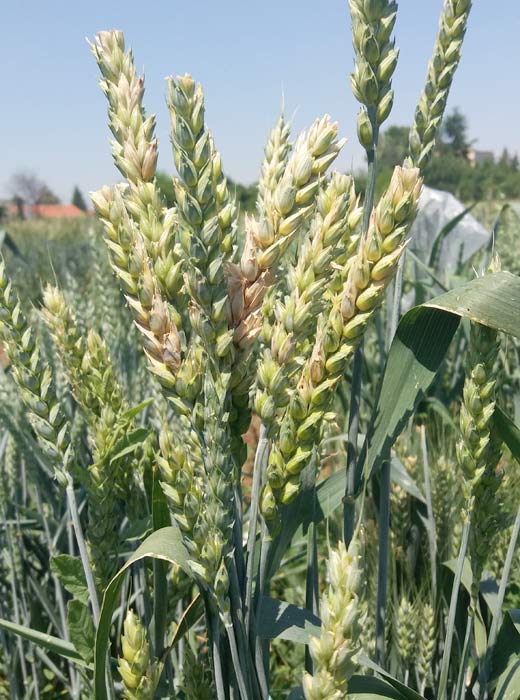
Fusarium head blight
Disease: septoria leaf blotch, brown rust, yellow rust, foot rot, fusarium head blight
Application: from the end of tillering stage to the end of flowering stage
Tank-mix compatibility with other products: Yes
Fenpicoxamid + Prothioconazole
The combination of fenpicoxamid and prothioconazole provides preventive, stopping and curative action against all economically important diseases. It is transported translaminarly and acropetally through the plant vessels, ensuring complete absorption and a long period of protection. Fenpicoxamid acts by inhibiting mitochondrial respiration of the pathogen through blocking electron transfer in the respiratory chain.
Disease: powdery mildew, yellow-brown spots, fusarioses, brown rust, yellow rust, snow mould, early leaf blight, glume blotch of the ear
Application: beginning of stem elongation to the end of flowering
Tank-mix compatibility with other products: Yes
Fluxapyroxad + Pyraclostrobin
The combination of the two active ingredients rapidly, effectively and persistently inhibits the development of fungal pathogens, as well as prevents the penetration of germ tubes of disease agents into plant tissues.
Disease: powdery mildew, septoria leaf blotch, brown rust, yellow rust
Application: visible 5 tillers to the end of flowering
Tank-mix compatibility with other products: Yes
Prothioconazole + Fluopyram + Bixafen
The active substances fluopyram (group – pyridylethylamides) and bixafen (group – carboxamides) suppress the activity of enzymes from complex II in the mitochondrial respiratory chain of fungi. They penetrate the plant through the leaves and move systemically via the xylem (acropetally), and also have translaminar properties. Prothioconazole causes morphological and functional changes in the cell membrane of the fungus. The active ingredients have a preventive effect – hindering the development of fungal spores, a curative effect – blocking existing latent infections in crops and preventing their further development and spread, and an eradicative effect.
Disease: early leaf blight, brown rust, yellow rust
Application: From the beginning of stem elongation stage to the beginning of flowering stage
Tank-mix compatibility with other products: Yes
Prothioconazole + Spiroxamine + Tebuconazole Systemic, broad-spectrum with preventive, curative and eradicative effect. The active substance spiroxamine is from the spiroketalamine group; it stops sterol biosynthesis in pathogens at two new sites in the chemical chain, improves the absorption of triazoles and their proper distribution in the plant.
Disease: leaf spots, brown rust, yellow rust, powdery mildew, net blotch, snow mould
Application: from the end of tillering stage to the beginning of flowering stage
Tank-mix compatibility with other products: Yes
A common practice is the combination of pesticides for simultaneous control of several types of pests. Their application alone is relatively rare. Mixing achieves greater economic efficiency. The spectrum of action of the applied pesticide products is broadened, for example fungicides with insecticides, herbicides. The fungicide active substances listed above can be mixed with most herbicides and insecticides used in practice, but before use it is advisable to follow the recommendations of the fungicide manufacturer and to carry out a compatibility test. Compatible are those products that do not change the physico-chemical properties of each of them and possess the same biological efficacy as when applied alone, and do not exhibit phytotoxicity on the treated crop. Physical incompatibility is manifested by the formation of sediment or separation of solid particles on the surface.
References:
- Rodrigues, E. , Lopes, I., Pardal, M. (2013), Occurrence, fate and effects of azoxystrobin in aquatic ecosystems: a review, Environment international, 53, 18-28.
- Grayson, B., Boyd, S., Sampson, A., Drummond, J., Walter, D. (1995), Effect of adjuvants on the performance of the new cereal fungicide, metconazole, I glasshouse trials, Pesticide science, 45(2), 153-160.
- Opalski, K., Tresch, S., Kogel, K., Grossmann, K., Köhle, H., Hückelhoven, R. (2006), Metrafenone: studies on the mode of action of a novel cereal powdery mildew fungicide, Pest Management Science: formerly Pesticide Science, 62(5), 393-401.
- Ishii, H., Bryson, P., Kayamori, M., Miyamoto, T., Yamaoka, Y., Schnabel, G. (2021), Cross-resistance to the new fungicide mefentrifluconazole in DMI-resistant fungal pathogens, Pesticide Biochemistry and Physiology, 171, 104737.
- Zubrod, J., Bundschuh, M., Feckler, A., Englert, D., Schulz, R. (2011), Ecotoxicological impact of the fungicide tebuconazole on an aquatic decomposer‐detritivore system, Environmental Toxicology and Chemistry, 30(12), 2718-2724.
- Sverdrup, L., Bjørge, C., Eklo, O., Grung, M., Källqvist, T., Klingen, I., Øvrebø, S. (2013), Risk assessment of the fungicide Aviator Xpro EC 225 with the active substances bixafen and prothioconazole. Opinion of the Panel on Plant Protection Products of the Norwegian Scientific Committee for Food Safety, VKM Report.
- https://www.cropscience.bayer.bg/Products/Fungicides/Zantara
- Chen, L., Shen, Y., Cui, Y., Zhang, H., Yang, A., Fan, G., Gao, H. (2022), The occurrence and damage of wheat powdery mildew in desert oasis area and the control efficiency evaluation of fungicides, Xinjiang Agricultural Sciences, Vol. 59, No. 5, 1189-1195.
- https://www.corteva.bg/produkti-i-reshenia/rastitelna-zashtita/Verben.html
- Lehoczki‐Krsjak, S., Varga, M., Szabó‐Hevér, Á., Mesterházy, Á. (2013), Translocation and degradation of tebuconazole and prothioconazole in wheat following fungicide treatment at flowering, Pest management science, 69(11), 1216-1224.
- https://www.cropscience.bayer.bg/Products/Fungicides/Prosaro
- https://prz.bg/preparat/%D0%BF%D1%80%D0%B8%D0%B0%D0%BA%D1%81%D0%BE%D1%80-%D0%B5%D0%BA/
- Edwards, S. (2022), Pydiflumetofen co-formulated with prothioconazole: a novel fungicide for fusarium head blight and deoxynivalenol control, Toxins, 14(1), 34.
- https://www.cropscience.bayer.bg/Products/Fungicides/Soligor