Bulgarian horticulture – a speck of dust in the world treasury of knowledge, skills and crafts
Author(s): доц. д-р Славка Калъпчиева, ИЗК "Марица" Пловдив
Date: 17.01.2024
4642
![MultipartFile resource [file_data]](/assets/img/articles/заглавна-градинарство.jpg)
Prof. DSc Stefan Bachvarov in „Bulgarian Horticulture – Historical Notes“ says: „Among the contribution of our people to the world treasury of knowledge, skills and crafts, a special place is occupied by the development of horticulture. On the basis of the horticultural achievements of the peoples who have inhabited our lands since antiquity, a specific culture for the production of vegetables and vegetable seeds has been created, which, enriched and adapted to our agro-climatic conditions, has been transferred to other countries as well.“
According to numerous historical monuments, the cultivation and use of vegetable plants for food was known to civilized peoples.
The Thracians are the oldest inhabitants of our lands. Besides being brave warriors, they cultivated mainly cereals, some fruit species and to a lesser extent vegetables.
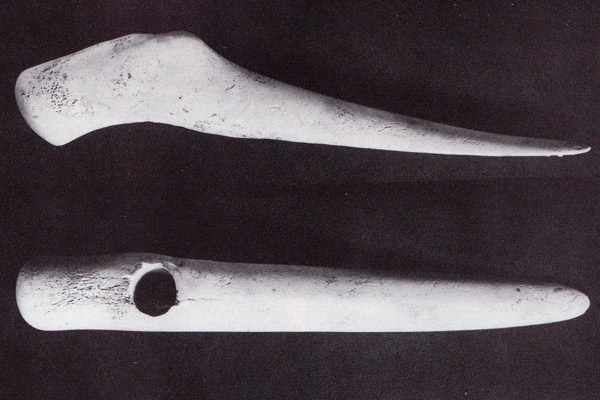
Sokha (ard)
In the prehistoric necropolis near Devnya, archaeologists discovered a "sokha" made of deer antler – the earliest digging and furrowing implement of agricultural labour.

Model of a sickle made of gold
A metal sickle has been found, similar in shape to the present-day one. The first data on vegetable production in our lands date back to Roman times. The Romans did not know potatoes, nor did they know what tomatoes were. But they produced sufficient quantities of onions, garlic, turnips, carrots, leeks, peas and lentils. „Lentils in general were held in special esteem, because they were considered the food that gives strength“.

On the Art of Cookery
Apart from archaeological excavations, this information has reached us also from frescoes preserved in Roman villas (COLUMELLA), in scenes depicting banquets, from mosaics and from a culinary treatise by Apicius, who lived in the time of Tiberius, that is, in the first half of the 1st century AD, and whose treatise is entitled „On the Art of Cookery”.
There is abundant information on the development of agriculture in the most significant work of our literature in the 10th century, the „Hexameron“ by John the Exarch of Bulgaria. From this period also dates one of the fundamental monuments of horticultural culture – the anonymous Byzantine encyclopaedia „Geoponika“.
The legacy of Bulgarian gardeners to this day
At the end of the First and during the Second Bulgarian Empire, with the introduction of the Christian rite of fasting, the presence of numerous references to vegetable production in the Bulgarian lands is explained. In the medieval church iconography of the „Last Supper“ in the Boyana Church, some vegetables are depicted – turnip, leek, garlic.
In the Ottoman Empire, almost until the Liberation of Bulgaria, agriculture developed, but lagged significantly behind the agriculture of other countries in Western Europe. Nevertheless, vegetable consumption increased; competition emerged among vegetable growers, which necessitated the creation of horticultural „guilds“ – professional organizations. According to official kadı registers in Sofia, during the 17th, 18th and 19th centuries there existed 63 guilds. Under No. 17 is recorded the „Vegetable growers’ guild, only from reaya-Bulgarians, who sold vegetables: bulb onions, parsley, spinach, etc., officially called by the authorities „ZARZAVATCHIYAN“ or „SEBZARZAVATCHIYAN“.
From Ottoman sources (mainly from regulations on levies and customs duties) and from registers of the population and the land owned and taxed, it is evident that the population produced significant quantities of vegetables, part of which were sold on the market and therefore a market fee – BACH – was paid.
THE LAW ON THE MARKET BACH IN VELIKO TARNOVO from the 16th century reads:
„….If vegetables and onions come to market in the said town of Tarnovo, from a cart with four wheels four akçe bach shall be taken, and from a cart with two wheels – two akçe bach.”
In the first two decades after the Liberation of Bulgaria, the nature of production did not change. Here is what the public agronomists (INSPECTORS) wrote in their reports in the 1890s: N. N. Popov (1896, Burgas) „…the vegetable gardens are located along rivers and fountains and yielded many and various types of vegetables…“; Zh. Zhekov (1911, Varna) „…VEGETABLE GROWING is developing in low riparian areas, .. The district is not devoid of such places..“; H. Abadzhiev (1896, Pleven) „…Vegetable growing in the Pleven district is quite well developed…, it begins and ends in the most ordinary way, when the weather gets warm.“
It becomes clear that in the 18th and 19th centuries, even before the Liberation, the cultivation of pepper and beans had begun, as well as of tomatoes and potatoes brought from America, and from Western Europe – chicory, various cabbage crops, except for head cabbage, etc. Wild-growing plants were widely used – sorrel, dock, orache and dandelion. Vegetables were grown under irrigated and non-irrigated conditions with traditional and primitive agrotechnics. Methods to accelerate production were applied only in seedling production – baskets, old containers, etc., filled with well-rotted manure and placed under sheds. The varieties were mixtures or populations. Seeds were produced independently and exchanged among gardeners.
The French traveller Jacques Cheneau, who travelled through Thrace in 1576, says: „…in every garden there is a wooden wheel, turned by a horse that is not led by anyone…It draws water from a large excavation, and this water is distributed according to the wishes of the gardeners..“
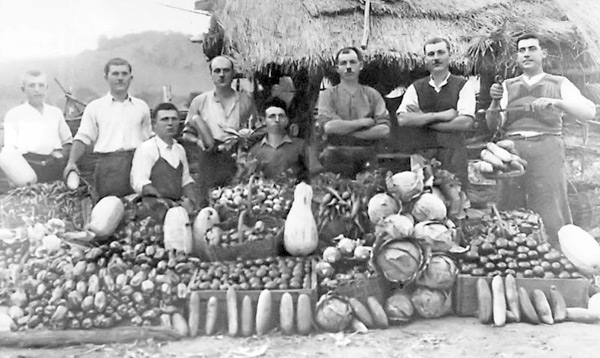
Vegetables ready for the market, Hungary, 1930s
Due to the depopulation of vast territories in the Balkan Peninsula conquered by the Ottomans, GURBETCHIYSTVO (collective practice of a specific craft) spread on a large scale. Thus “…having learned the art of gardening in Constantinople, they (the Lyaskovets seasonal migrant workers) – 3,500 people (newspaper „Macedonia“ – 1856) – moved into new regions – Brasov, Bucharest (Romania), Iasi – capital of the vassal principality of Moldova; Belgrade, Smederevo, Kragujevac (Serbia – 1853); Zagreb (Croatia); in 1887 (author’s note Tsani Gintchev) near Saint Petersburg, in Omsk, Novosibirsk (Russia); later in 1905 – in the vicinity of Tashkent (Uzbekistan), Germany, France, Poland, Italy, the Czech lands. For the Czech people, the Bulgarian gardener became a symbol of diligence, which has been immortalized in many sayings: „Industrious as a Bulgarian“, „He toils like a Bulgarian“, „A Bulgarian and a horse know no rest“. The first group of Bulgarian gardeners left for America in 1901 and, according to the newspaper „Bulgarian Gardener“, by 1930 there were 221 gardeners working in the USA, 367 in Canada, 1,027 in Argentina, 222 in Uruguay. The first to leave for distant Australia did so in 1928, and the largest number of gardeners settled in the town of Virginia, 40–50 km from Adelaide.
Bulgarian gardeners occupy a special place in Hungary. There is evidence of the first cooperative from 1860 in the town of Meduze – Banat. Following a survey in 1888, I. Geshov reported that, according to official statistics, 5,457 gardeners in 329 cooperatives had gone to Austria-Hungary. Hungarian researchers of Bulgarian horticulture in Hungary emphasize the indisputable contribution of Bulgarian gardeners to the transformation of small-scale Hungarian and petty-commodity vegetable production into a stable one!
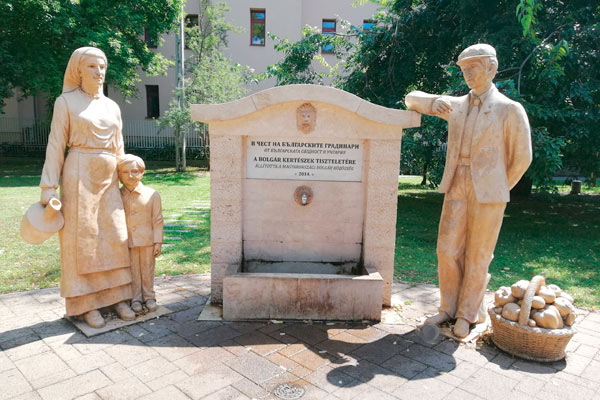
Monument-fountain – Bulgarian gardener with his wife and child, Hungary
It was also the Bulgarians who introduced eggplant as a crop in Hungary. The contribution of the native gardeners did not go unappreciated by the authorities. In Budapest, in the 14th district, where most Bulgarians lived, streets were named „Bulgarian Gardener“, „Pepper“, „Eggplant“. A commemorative plaque was also erected in honour of the native gardeners.
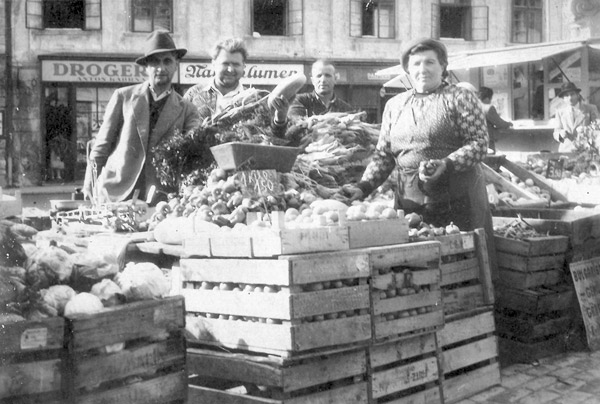
At the market in Vienna – gardeners from Polikraishte in Austria
The experience of the constantly expanding gardening emigration shows that Bulgarian gardeners successfully coped with this extremely important and difficult task – the development and adaptation of technology for commercial vegetable production to different geographical regions.
Here are some original practices: The main principle observed by Bulgarian gardeners when opening new gardens is: „When you make a garden, look back. As long as you can see the factory chimneys, keep driving in stakes. Do not go any farther.“ Following this unwritten rule, Bulgarians gradually formed rings of vegetable gardens around almost all larger cities.
In choosing and preparing plots, they preferred river valleys, non-flooded terraces with fresh, rich soils and shallow groundwater; they uprooted trees and shrubs, collected stones and plant residues, corrected ravines and built dikes.
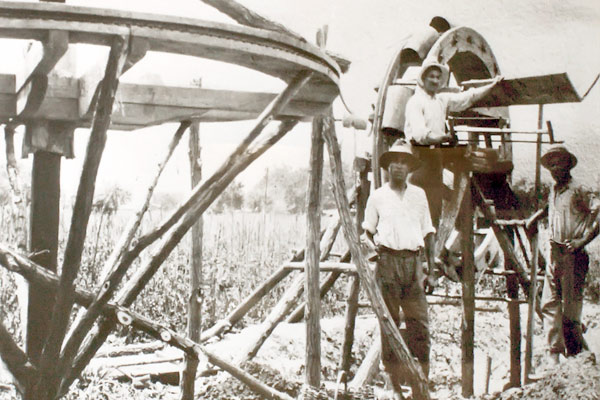
Construction of a dolap. Turkey, 1930s
Irrigation water was obtained in two ways – by flowing water (salma) and by a water wheel (dolap). The merit of our master gardeners lies in the improvement of the dolap system and, above all, in connecting the water obtained with a system of water distribution channels – kavali (furrows) and fitarii. Owing to their experience, they determined with great accuracy the irrigation rate and the intervals between irrigations, which differed for the individual crops and according to their developmental stage.

Museum of Migrant Gardening – Lyaskovets
Manuring with farmyard manure, its collection, composting, timing and methods of application have changed, except that at that time it was carried with stretchers or baskets.
According to Ts. Gintchev, by 25 March gardeners sowed seedlings in hotbeds, using seeds germinated in one of three ways: in fresh horse-heated manure, in troughs with well-rotted manure and in an oven. In the mid-19th century, various cultivation structures were already known.
Bulgarian gardeners strictly observed some basic rules of agrotechnics: Sowing dates – early cabbage, kohlrabi, beet, pepper, eggplant, and later – bulb onions and leeks; these were followed by cucumbers, which, together with courgettes, they forced in warm beds and hills. During the vegetation period, to accelerate ripening they pinched the tips of cucurbits – stimulating the formation and rapid growth of first- and second-order branches; in tomatoes and eggplant they pinched the tops after a certain number of fruit sets and removed lateral shoots (suckering) in tomatoes. Tomatoes and climbing beans were tied to stakes. They hoed and irrigated (sherbetuvane); They made intensive use of the land by: growing two or more crops – one after another; simultaneously, in the fitariya the slower-developing crop, and along the kavali the faster ones – lettuces, carrots, radishes; by utilizing all irrigation furrows.
Inseparably connected with Bulgarian horticulture is the production of vegetable seeds
Pioneers in seed production were the gardeners from Lyaskovets, whose efforts were directed towards increasing the winter hardiness of some heat-loving crops and their drought tolerance. They established the advantages of autumn planting of stecklings of a large number of biennial crops – cabbage, onion, leek, parsley, and the impossibility of planting at this time the more heat-demanding ones – celery, carrots, turnips. Widely known are Mosko Kalinkov and Grandpa Marinko from Lyaskovets, creators and disseminators of the early pepper variety Kalinkov, still grown today, and of the well-known in the recent past variety Marinkovski. It is no coincidence that the main onion varieties are Lyaskovski and Samovodska Kaba. Most importantly, they produced and sold seeds with high sowing quality and varietal authenticity. Varieties disseminated after the Liberation include: Onion: Lyaskovski, Samovodska Kaba; cabbage: Likorishko White, Likorishko Grey, Buzovsko, Marnopolsko, Lemsko, Kyose Ploeshko, Novosadsko, Monokanka; pepper: Kalinkov and Marinkov, Shipka (Dzhulyunska).
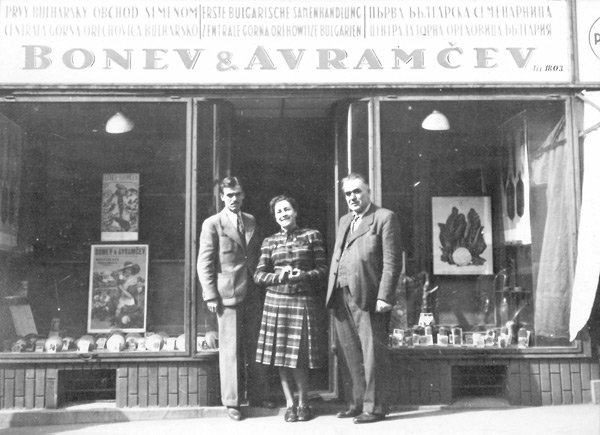
In front of the seed shop of Bonev and Avramchev in Bratislava
The main seed production companies registered were: in 1855 – “Stefan N. Boyadzhiev” with 10 t of pepper seeds, cabbages – 10 t, parsley – 500–600 kg, leek 5–10 t, tomatoes – 500–600 kg, peas about 20 t, spinach – 15–20 t, cucumbers 3–5 t; in 1865 “Hristo G. Kochemidov”; BANK ”D. A. Burov & Co.”, station, reg. 1935; “Stoyan Kapnilov & Son”, and others. The Bulgarian Agricultural Society established in 1937 a seed production farm in the village of Proslav, Plovdiv region, with 485 decares of land.
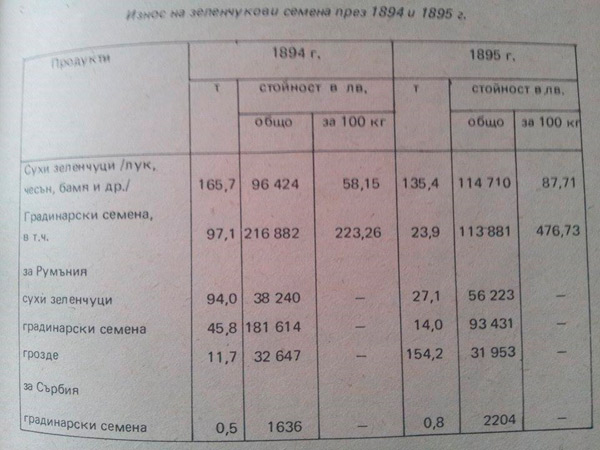
In the period between the First and Second World Wars, in 1922, a law for the encouragement of agriculture was adopted, in 1932 regulations for varietal seed production in the country were drafted, and only in 1942, as a result of the efforts of the teams from the Institute of Horticulture in Plovdiv, the Department of Horticulture at the Agronomy-Forestry Faculty and the Bulgarian Horticultural Professional Union, the first Seed Production Act in the history of the country was adopted.
The development of vegetable production between the two world wars is divided into two periods – recovery and upsurge. The area under vegetable crops in 1937 increased by 57%, and total production by more than 2.1 times; in 1943 – by 35.2%, respectively. One of the important factors for the upsurge was the establishment of two model agricultural schools in Sadovo and Ruse in 1883 and, at the beginning of the 20th century, also in Pleven, Kyustendil, Pazardzhik, Vidin, as well as the first agricultural experimental stations: 1903 – Sadovo; 1903 – Obraztsov Chiflik near Ruse; 1910 – Sofia Experimental Station; 1921 – Agronomy Faculty at Sofia University; 1935 – Department of Horticulture; 1930 – State Agricultural Station with a Vegetable Production Department in Plovdiv.
In summary, we can say that some original practices, forming the basis of modern agrotechnics, have reached us, as well as varieties that have proven themselves over the centuries: pepper: Kalinkov, Dzhulyunska Shipka; onion: Lyaskovski, Samovodska Kaba; cabbage: Likorishko, Kyose; tomatoes: Large Pink, Large Red; turnip: Winter White and Black; beans: Raykin, Rogach.
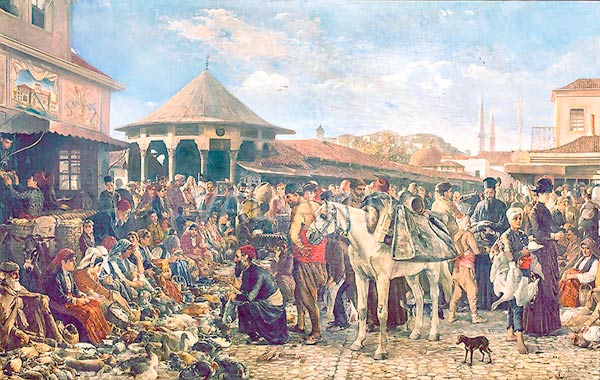
„Market in Plovdiv“, 1885, Mrkvicka – Ethnographic Museum, Plovdiv
And let us conclude with a thought by Tsani Gintchev, who wrote the first textbook „Catechism of Agriculture“ in 1870: „Nowhere can one see so clearly the rapid growth of plants as in the garden. When the gardener sleeps in his garden, at night he hears how his onions grow; when the onions are watered, they straighten their leaves and rustle as when a dry twig is broken. In the evening the gardener notes how far the foam of the water on the watered onions has reached, and in the morning he sees that from this foam three fingers higher a new heart of the stalk has grown, which is tender and whitish, because the gracious sun has not yet shone upon it to imbue it with the clear greenery of chlorophyll“.
photos: Museum of Migrant Gardening – Lyaskovets