

![MultipartFile resource [file_data]](/assets/img/articles/интеркропинг-1.jpg)
Mixed crops / intercropping
The joint cultivation of vegetable crops in mixed stands is a useful practice in gardening, primarily with the aim of increasing the biodiversity of plant species, which has a positive effect in several directions: land is used more efficiently, conditions are created for biological plant protection as a result of the specific properties of certain plant species, and the structure and fertility of the soil are improved. The establishment of mixed crops is not a novelty in crop cultivation and is characterized by several specific features: it is applicable to small areas, mechanization of work processes is difficult, and the application of chemical plant protection products is complicated due to the diversity of plant species and their specific pests. However, this is extremely favorable for organic farming, where the combined cultivation of suitable species is a desired and sought-after approach as an alternative means of plant protection. Research on this type of crops is mainly focused on preserving the quality of the produce from the harmful influence of diseases and pests, as well as on protecting human and soil health. The combination of plant species characterized by a specific varietal and species architecture of the stem, as well as characteristics and depth of the root system, has a positive effect on the water-retention characteristics of the soil. Soil fertility is the basis of agricultural systems and plays a key role in determining the quantity and quality of food.
Types of mixed crops according to the methods of crop cultivation
Several cultivation technologies are applied: row intercropping; strip intercropping; relay intercropping; temporal intercropping; mixed intercropping and trap cropping.
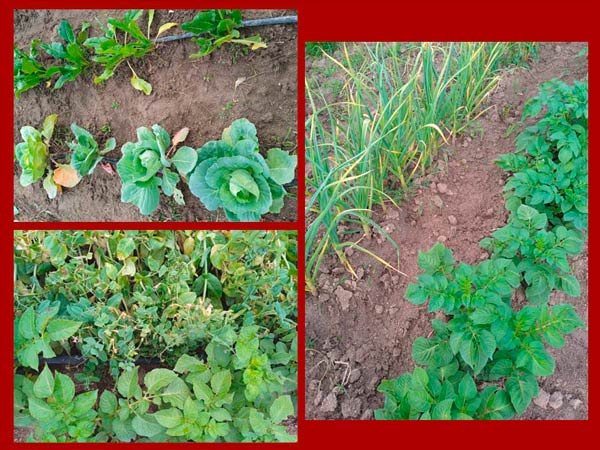
Row intercropping. Plants of each species are grown in rows. They may vary by being arranged in single or several rows. The ratio between the cultivated species may differ, for example one or two rows of the main crop and two, three or four rows of the accompanying crop.
A very good combination is one row of a vegetable crop with several rows of legumes. The benefit is additional nitrogen fixation by leguminous plants in symbiosis with bacteria of the genus Rhizobium.
The two crops grown under this system have an almost identical period of joint vegetation. It is more effective to apply cultivation in a single row of the respective crop. Examples of this type of cultivation are potatoes with garlic, potatoes with garden pea, and head cabbage with chard.
Strip intercropping. This technology allows mechanized sowing in strips. It is more applicable to industrial crops and to a lesser extent to vegetables, mainly those intended for cultivation by direct sowing. This cultivation option requires larger areas for machine maneuvering. The main and accompanying crops are grown in an equal ratio of rows. The two crops have an almost identical period of joint vegetation.

Relay intercropping. By this method, the main and the accompanying crop are grown on the same area for a short period of joint vegetation. The technological time of sowing of one crop does not coincide with that of the other crop. Usually, the sowing/planting of one crop takes place at the end of the vegetation of the other, in accordance with their biological requirements. With this method, care must be taken to ensure that one crop does not shade the other, which can be achieved by a suitable orientation of the cultivation rows. Examples of this type of intercropping are potatoes with garden bean, tomatoes with garden pea, tomatoes with garlic, tomatoes with garden bean.
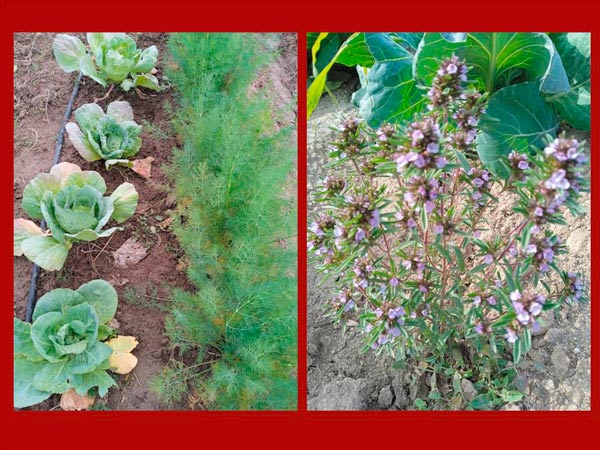
Temporal intercropping. In this method of combined cultivation, plants are grown in rows and have different ripening times. When the fast-growing plant is harvested, the slow-growing one has more space for development. The two crops are planted at the same time, but the accompanying crop is harvested earlier than the main one. Examples are head cabbage with dill, head cabbage with savory, potatoes with garlic.
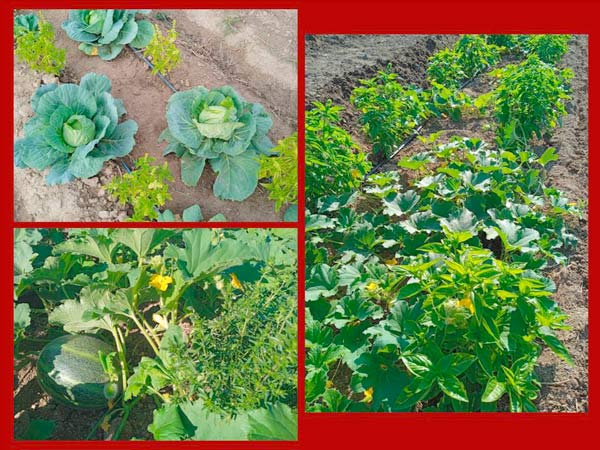
Mixed intercropping. The plant species are grown without clearly defined rows within the joint area. The plants may be grown in a checkerboard pattern, alternating every one or two species according to their habitus. The main and the accompanying crop have joint vegetation. In some cases, the accompanying crop is harvested earlier than the main one. Examples of this type of cultivation are melons with basil, melons with savory, head cabbage with basil, head cabbage with savory.
Trap cropping. Trap crops are used to attract and capture pests with the aim of protecting the main crop. Marigold (Tagetes), pot marigold (Calendula) and others are often used.
Specific features of mixed crops
Mixed crops differ from widely used traditional monoculture technologies. The combination of plant species must provide sufficient space, access to light and a feeding area, without allowing mutual suppression of growth and competition for nutrients.
In intercropping systems, a precise selection of crops must be made, taking into account the choice of plant species, methods of their joint cultivation, market demand and supply, and the capacities of the farm/holding. The arrangement of crops must be consistent with their biological and botanical characteristics. It is advisable to alternate crops in rows with shallow and deeper root systems. The second type of plants helps to move nutrients from the deeper soil layers and will not compete with those having a shallower root system.
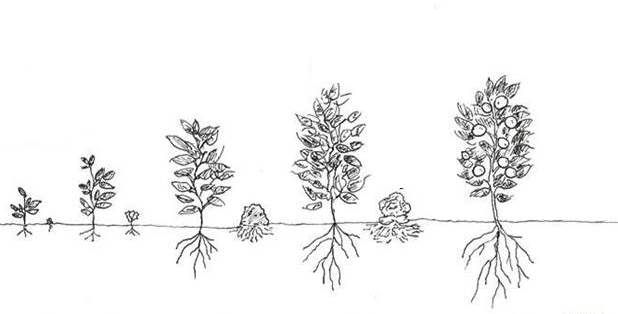
Example of combining two plant species with different root systems
At the same time, plants are characterized by a specific root system, which may be: taproot, fibrous, or a modified root, and which influences in a specific way the structural condition of the soil.
The habitus of the species also affects soil qualities. The cultivation of plants such as garden pea can serve as a living mulch that preserves moisture and microbiological activity in the surface soil layer. Also, plants with a larger habitus create preconditions for shading the surface and protecting it from direct sunlight, which quickly dries it out and destroys beneficial microorganisms in these parts.
The combination of main and accompanying crops provides the opportunity for better spatial arrangement and use of the areas. In this way, the degree of weed infestation is reduced and the crops are protected from the harmful effects of weeds.
Joint cultivation is becoming increasingly important in order to improve soil quality and increase crop productivity. Scientific studies show that the microbiological composition of the soil, soil enzyme activity and yields can be influenced by management practices in the crops. Soil enzyme activity, the quantity of microorganisms and the content of nutrients in the soil are higher in combined cultivation systems than in monocultures.
What happens to the soil in areas with vegetable crops under traditional cultivation and what is the advantage of mixed crops?
In monoculture crops, the porous structure of the soil is lost due to the dense arrangement of large particles as a result of the pressure exerted by tyres or agricultural machinery, and a compacted layer is formed on the soil surface. In general, the resistance to penetration in the 0–30 cm soil layer is lower than in the subsurface layers (depth 30–60 cm). The subsurface layers contain fewer macroporous particles due to the pressure of the upper soil layer. Penetration resistance is closely related to air and water movement in soils.
Soil quality can be significantly improved under conditions of mixed cultivation, which leads to a significant change in soil structure and influences the water balance in the soil. Soil fertility in combined cultivation systems may be higher than in monoculture cultivation, especially when using legumes (garden pea, garden bean, faba bean). The amount of organic matter in intercropping systems is increased compared to monoculture cultivation; productivity is also positively affected and most of the properties of soil fertility are maintained for at least three to four years, especially with appropriate rates of mineral fertilizer application. Combined cultivation can be an effective cropping system for sustainable agriculture with precise fertilizer use.
Soil fertility plays an important role in the sustainability of agricultural and natural ecosystems and is defined as the ability to maintain plant productivity and the water–air properties of the soil. It is assumed that combined cultivation of crops can maintain soil fertility by increasing the input of below-ground biomass derived from the yield of above-ground biomass, as well as below-ground biodiversity as a result of the diversity of above-ground crops.
Examples of combined cultivation variants of vegetable crops in scientific trials and the results obtained from them:
Mixed crop variant
Cucumbers (Cucumis sativus L.) – garlic (Allium sativum) and cucumbers (Cucumis sativus L.) – onion (Allium cepa L.)
Effect
The garlic–cucumber system has a stronger effect on the soil fungal community than the onion–cucumber system. Mixing cucumbers with onion or garlic increases cucumber productivity and improves the soil environment.
Source
https://www.sciencedirect.com/science/article/abs/pii/S1164556311000483
Mixed crop variant
Cauliflower (Brassica oleracea L. var. botrytis) with common lettuce (Lactuca sativa L. var. longifoila), curly lettuce (L. sativa L. var. crispa), onion (Allium cepa L.) and bean (Phaseolus vulgaris L. var. nanus).
Effect
Cauliflower mixed with other vegetables such as common and curly lettuce, bean or onion achieves higher yields and is characterized by higher economic returns compared to monoculture cultivation.
Source
https://www.sciencedirect.com/science/article/abs/pii/S1161030103001540
Mixed crop variant
Head cabbage (Brassica oleracea L. var. capitata) with common lettuce (Lactuca sativa L. var. longifoila), curly lettuce (L. sativa L. var. crispa), radish (Raphanus sativus L.), onion (Allium cepa L.) and bean (Phaseolus vulgaris L. var. nanus)
Effect
Combined cultivation of cabbage has higher efficiency in the use of land and resources than cultivation as a monoculture. In mixed cultivation, an
additional yield is obtained from the accompanying crops – bean, common and leafy lettuce and onion. Radishes have an adverse effect on cabbage growth and yield.
Source
https://www.tandfonline.com/doi/abs/10.1300/J064v28n04_04
Mixed crop variant
Pumpkin (Cucurbita maxima), coriander (Coriandrum sativum), red amaranth
Amaranthus gangeticus), radish (Raphanus sativus), mustard (Brassica campestries), jute (Corchorus capsularis) and spinach (Spinacia oleracea).
Effect
All combined cultivation systems give better results than monoculture cultivation. The best option in terms of higher productivity, better use of land and time, as well as maximum economic return is the cultivation of spinach with pumpkin.
Source
It can be concluded that through combined cultivation of vegetables with legumes, additional nitrogen is provided in the soil; other accompanying crops control soil loss due to erosion, suppress weeds and improve organic matter content. It should be noted that the risk of crop failure as a result of severe pest infestation is reduced and the efficiency of land use is increased.
photos: Chief Assistant Professor Dr. Tsvetanka Dincheva