

![MultipartFile resource [file_data]](/assets/img/articles/заглавна-въшки-1.jpg)
Aphids on fruit crops (fam. Aphididae)
Aphids are an underestimated problem for fruit crops in our country, but they appear every year and, especially in years with more frequent rainfall, are considered pests of major economic importance. They cause damage by sucking sap and injecting saliva containing growth regulators, which results in weaker or stronger curling and deformation of the attacked parts. Under heavy infestation, the damaged leaves dry up and fall, the shoots become distorted and lag in their development, and the fruits remain small and deformed.
Some species excrete abundant amounts of “honeydew” on which sooty mould fungi develop, thereby disrupting physiological processes. Other species transmit viral diseases to plants, which further increases their harmful impact.
Control of aphids is carried out on the basis of monitoring for their appearance and population density, as well as that of their entomophagous natural enemies.
Economic injury level (EIL). Chemical control is required at 10-15% infested shoots before flowering and 8-10% infested shoots after flowering.
The following plant protection products are authorised: a.s. tebufenpyrad - Shirodo 25 g/da; a.s. flonicamid - Teppeki 14 g/da, Afinto 14 g/da, Hinode 14 g/da; a.s. pyrethrins - Abanto 75 ml/da, Chrysant EC 75 ml/da, Natur Breaker 75 ml/da, Pyreguard 75 ml/da for apricots, peaches, plums and cherries; a.s. flupyradifurone - Sivanto Prime 90 ml/da for apples and pears; a.s. spirotetramat - Movento 100 SC 0.075-0.12% for apples and pears and 0.075-0.1% for apricots, peaches, plums and cherries; a.s. sulfoxaflor - Closer 120 SC 20-40 ml/da for apples, pears, quinces, peaches and cherries; a.s. azadirachtin - Oikos 100-150 ml/da, Neemik ten 260-390 ml/da for apples.
In April, pome fruit species progress from the phenological stage “flower bud burst” – “pink bud” to the phenological stage “flowering”.
Pome fruit species
Apple

● Codling moth
Moths of the first generation start flying at the end of apple flowering. The females lay their eggs singly, mainly on the upper side of the leaves. The damage is caused by the larvae, which bore into the fruits and feed on the fruit flesh around the seed chamber.
Control: Chemical treatment is carried out at the beginning of egg laying with hormonal insecticides (chitin synthesis inhibitors) and against the larvae before they bore into the fruits.
Economic injury level (EIL) - 3-5 adults/trap/week.
Authorised plant protection products: a.s. spinetoram - Delegate 250 WG 30 g/da; a.s. chlorantraniliprole - Coragen 20 SC 16-30 g/da, Voliam 16-30 ml/da; a.s. cypermethrin - Cyperfor 100 EC 30 ml/da, Sherpa 100 EC 30 ml/da, Afikar 100 EC 30 ml/da, Efcymertrin 10 EC 30 ml/da and others; a.s. emamectin benzoate - Affirm Opti 200 g/da; a.s. spinosad - Sineis 480 SC 20-30 ml/100 l water; a.s. Granulovirus – CpGV-V22 3 x 10¹³ granules/litre - Madex Twin 10 ml/da;
● Apple sawfly
In spring, shortly before or during apple flowering, the females pierce the calyx cups of the flowers with their ovipositor and lay a single egg at the base of the filament stalks. The false caterpillars bore under the skin of the forming young fruits and make an arcuate gallery under the upper epidermis, which often becomes corky as the fruit grows.
Control strategy:
Beating of branches is carried out early in the morning to determine the density of the sawflies.
Chemical control is directed against adults before egg laying and against the false caterpillars.
EIL adults 2-3 per 100 beaten branches.
No authorised plant protection products are available. The preparations approved for control of fruit moths may be used.
● Apple blotch leafminer moth
The flight of the moths begins in April and coincides with the onset of flowering of winter apple cultivars. The females lay their eggs on the underside of the leaves. The larvae cause damage by entering the parenchyma tissue of the leaf, on which they feed directly under the laid egg, forming a round mine.
Control strategy: Chemical control is carried out at the beginning of larval hatching.
EIL: at the phenological stages “fruit set” and “fruit growth” - 2-3 eggs and mines per leaf.
Authorised plant protection products: a.s. chlorantraniliprole - Coragen 20 SC 16-30 g/da, Voliam 16-30 ml/da; a.s. emamectin benzoate - Affirm Opti 200 g/da; a.s. cypermethrin - Cyperfor 100 EC 30 ml/da, Sherpa 100 EC 30 ml/da, Afikar 100 EC 30 ml/da, Efcymertrin 10 EC 30 ml/da and others.
Pear
● Pear psylla
Pear psylla becomes active early in spring, moves onto the trees and develops on the buds and young shoots. Psyllids of the first generation appear at the end of April–beginning of May. Adults and nymphs suck sap from the buds and leaves, excreting abundant honeydew; the shoots turn black and they transmit a mycoplasma disease, as a result of which pear trees dry out and die.
Control strategy: Chemical control is directed against adults and nymphs. EIL: at the phenological stage bud burst green cone - “mouse ear” - 2-3 individuals/100 buds; at bud stage - nymphs and adults on 2-3% infested rosettes.
Authorised plant protection products: a.s. tebufenpyrad - Shirodo 25 g/da; a.s. spirotetramat - Movento 100 SC 0.12-0.15%; a.s. spinosad – Sineis 480 SC 30-35 ml/100 l water and others;
The phenological stage of development of stone fruit species is “white bud” - “full flowering” - “fruit set”.
Stone fruit species
Plums
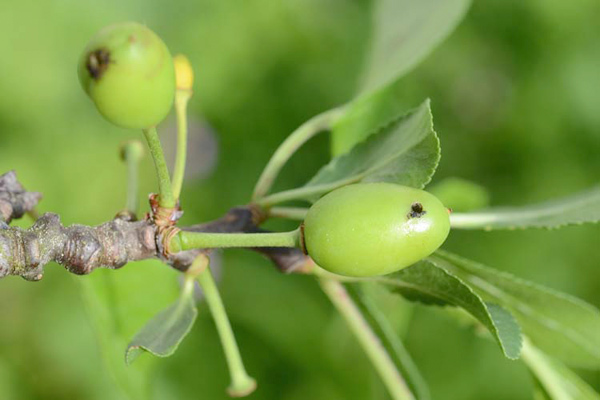
● Fruit sawflies
Sawflies appear before flowering of the earlier plum cultivars. The females lay their eggs in the green sepals or in the calyx of the flowers. The false caterpillars bore into the young fruitlets and destroy them, and until completion of their development they attack several young fruits and feed on their interior.
Control strategy: Post-flowering spraying should be carried out (when 2/3 of the petals are wilted but have not fallen) against the false caterpillars, before they bore into the young fruits.
EIL: bud stage–flower rosettes–up to the beginning of flowering: adults 2-3 per 10 beaten branches.
No authorised plant protection products are available. The preparations approved for control of fruit moths may be used.
● Plum fruit moth
Adult moths emerge in the first half of April. The females lay their eggs on the fruits in the evening at temperatures above 13-14oC. The damage is caused by the larvae, which feed on the fruit flesh around the stone.
Control strategy: Chemical treatment is carried out at the beginning of egg laying with hormonal insecticides (chitin synthesis inhibitors) and against the larvae before they bore into the fruits.
EIL - 2-3 moths/trap/week.
Authorised plant protection products: a.s. spinetoram - Delegate 250 WG 30 g/da; a.s. chlorantraniliprole - Coragen 20 SC 16-30 g/da, Voliam 16-30 ml/da; a.s. emamectin benzoate - Affirm Opti 250 g/da.
Peaches, apricots
● Oriental fruit moth
The flight of the moths begins at the beginning of April, at average daily temperatures of 14oC. The females lay their eggs singly, on the underside of the leaves and on the young shoots. The damage is caused by the larvae, which lead to wormy fruits and mining of the shoot tips.
Control strategy: Chemical treatment is carried out at the beginning of egg laying with hormonal insecticides (chitin synthesis inhibitors) and against the larvae before they bore into the fruits.
EIL: during the vegetation period: 10-15 moths/trap/week
Authorised plant protection products: a.s. spinetoram - Delegate 250 WG 30 g/da; chlorantraniliprole - Coragen 20 SC 16-30 g/da, Voliam 16-30 ml/da; a.s. emamectin benzoate - Affirm Opti 200-225 g/da; Granulovirus – CpGV-V22 3 x 10¹³ granules/litre - Madex Twin 10 ml/da.
Cherries
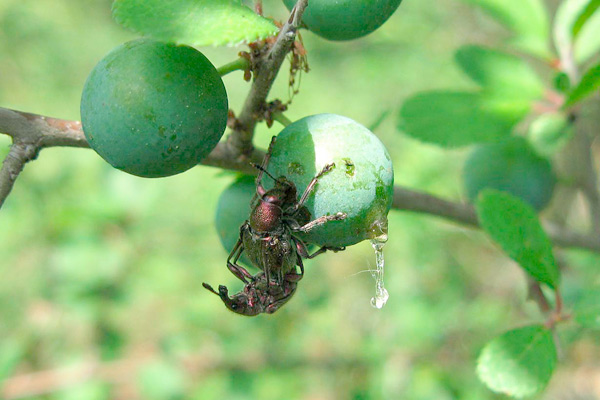
● Cherry weevil
Mass emergence of the weevils occurs after flowering, when the average daily temperature is above 15oC. In the green fruits, the females make galleries and lay a single egg at the bottom, after which they close the galleries with a plug. The larvae feed and develop in the stone of the fruits without affecting the fleshy part.
Control strategy: Treatments are directed against the adults, after flowering. The pest is detected early in the morning by branch beating.
EIL: 3 weevils/10 twigs/tree.
No authorised plant protection product is available. The preparations approved for control of fruit moths may be used.