

![MultipartFile resource [file_data]](/assets/img/articles/plant-1.jpg)
The focus of the scientific and practical conference, part of the events dedicated to the 40th anniversary of the establishment of the Faculty of Plant Protection and Agroecology of the Agricultural University in Plovdiv, held on 7 November, was the contemporary trends in the development of plant protection. The meeting outlined the horizons of future cooperation between science and business, where the traditions of the past work in unison with the dynamics of the present and jointly face the challenges of the future.
The emblematic Fifth Lecture Hall of the Faculty of Plant Protection and Agroecology (FPPA) was the venue of the event, which focused the professional interest of the national elite in plant protection. Present were lecturers, researchers, experts, farmers, students and journalists from agricultural media.
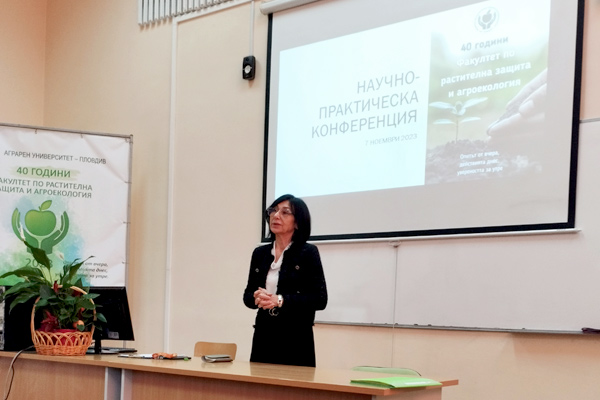
Prof. Dr. Vili Kharizanova, Dean of the Faculty of Plant Protection and Agroecology
The main report on the topic was delivered by Prof. Dr. Vili Kharizanova, Dean of the Faculty of Plant Protection and Agroecology. Climate change and the loss of biodiversity are the world’s No. 1 global threat. In 2020, the EU launched the European Green Deal and the strategies for its implementation – to reduce Europe’s contribution to climate change, to transform agriculture towards sustainable levels of production, and to protect the natural environment and biodiversity.
Innovations in the agrochemical and seed industries, together with fundamental and applied research conducted by universities and research institutes, create opportunities for improving techniques and practices for the protection of agricultural crops. One of the sensitive topics is undoubtedly synthetic pesticides. Public pressure and the needs of agricultural producers necessitate change. As part of the European Green Deal, the Commission proposes measures to reduce the use of synthetic pesticides, increase organic farming, and develop innovative plant protection methods that are gentle on nature and human health.
The discussion on the future of plant protection in the EU – part of the broader discussion on the future of food production and the prevention of climate change
Prof. Kharizanova recalled the fact that despite the doubling of conventional plant protection products (PPPs) in Europe since 1980, the impact on the environment has decreased significantly through the application of highly restrictive policies for their registration, the banning of certain active substances, the replacement of broad-spectrum PPPs with more specialized pesticides, and the use of modern plant protection technologies. The objective fact must not be neglected that without the application of PPPs (including biopesticides), the food security of 11 billion people, which is the expected world population by the end of the century, is seriously threatened! What are the effective alternatives for plant protection and yield increase? Biocontrol includes all methods, tools, measures and means for plant protection based on the use of beneficial organisms, as well as their mechanisms and interactions that govern the relationships between biological species in a natural environment.
Vili Kharizanova: Organic plant protection and integrated plant protection “work” in favour of nature, not against it, and fit into the vision for the future of agriculture
Over the last decade, Prof. Kharizanova noted, the rate of introduction of new biological products has exceeded the rate of introduction of conventional PPPs. Nevertheless, in crop production systems there is a limited number of options for biocontrol of the main pests, diseases and weeds. This situation will change very soon. A large-scale scientific and exploratory “offensive” is underway. Semiochemicals, “smart” DNA insecticides, immunostimulants, plant microbials, digital and remote sensing methods for monitoring are already a realistic prospect and horizon.
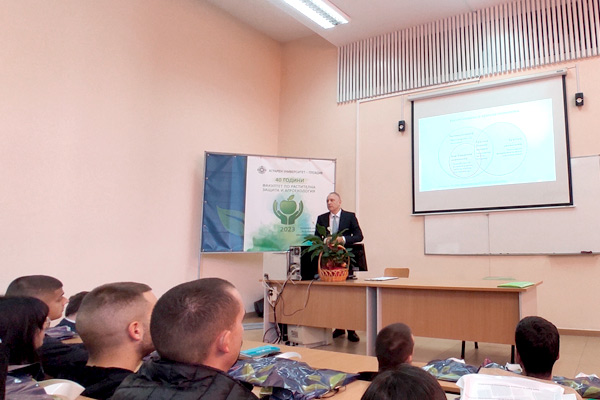
Prof. Dr. Vladislav Popov, Vice-Rector of the Agricultural University in Plovdiv
Prof. Dr. Vladislav Popov, Vice-Rector of the Agricultural University in Plovdiv, presented to the highly professional audience his interpretation of the challenges facing organic farming in Bulgaria in the context of the European Action Plan for the Development of Organic Production. The benefits of this type of production are in several directions: social, demographic, economic – development of rural areas, reducing the depopulation of villages, generating additional income for producers, and health benefits for consumers, fewer synthetic pesticides, resilience of biodiversity.
A telling example of stimulating new business models is the collaboration between Brezovo Municipality and the Agricultural University in Plovdiv for the implementation of the visionary project “Development and promotion of the economic potential of Brezovo Municipality through the creation, promotion and positioning of the brand ‘Bio-Brezovo’”. An Advisory Centre for organic farming, organic livestock breeding and beekeeping will manage local resources on the principles of organic agriculture.
Prof. Popov’s commentary on the European biodiversity strategy, whose objectives are achieved through organic production, was precise, well-argued and analytical. What is the position of Bulgarian organic farming? In recent years, an alarming trend has been observed. Bulgaria is among the three EU countries that receive the largest subsidies for organic production. Thanks to this financial injection, our country ranked among the leaders in the EU in the production of several organic products: wine, honey, rose and lavender oil. We are on the verge of losing these achievements. And even more, because the areas for organic production are decreasing. The reasons for this untenable situation are administrative and managerial. The lack of a long-term vision is a barrier to the introduction of quality certification, control, information services, a decision-support system and the guaranteeing of consumer trust.
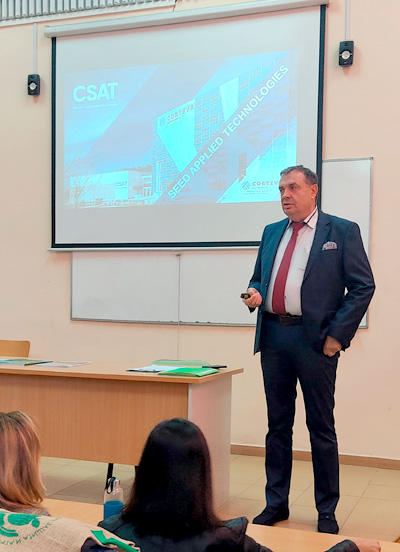
Ivan Drazhev, Marketing Manager of Corteva Balkans, Product Manager of Corteva Agriscience Bulgaria
Managers from the representative offices of some leading multinational trading companies from the agrochemical and seed industries – Syngenta, Corteva Agriscience, BASF, Summit Agro, Adama, Enza Zaden, Panamin – took special part in the highly prestigious forum. They presented part of their companies’ corporate projects for their active participation in the European Union’s Green Deal. These projects include the synthesis and formulation of new pesticide products that meet the high EU eco-standards for environmental and human health safety, new broad-spectrum biopesticides, resilient varieties and hybrids, and digital systems and platforms for managing plant protection practices – screening, diagnosis, therapy.
The scientific and practical conference conveyed clear messages. The European agricultural space, of which Bulgaria is a part, is undergoing active transformation. The EU Green Deal is a large-scale project, selected very carefully, with high expertise, a clear vision of tomorrow, with wisdom and foresight. European agriculture has substantial resources and remarkable potential that accelerate every revolutionary undertaking. A reasonable balance between conventional pesticides and biopesticides is a fundamental guarantee for achieving sustainability, growth and security in agricultural production on the Old Continent under conditions of a changing climate and more active and more aggressive harmful activity of pests, diseases and weeds.
The new pace and realities require a new way of thinking and a change in behavioural patterns. This process calls for creativity!