Research with Microbial Biostimulants at the Agricultural University – Plovdiv
Author(s): проф. Андон Василев, от Аграрния университет в Пловдив; доц.д-р Йорданка Карталска, Аграрен университет, Пловдив; гл. ас. д-р Катя Димитрова, Аграрен университет, Пловдив; Димитър Петков, Агредо ООД
Date: 31.03.2023
2944
![MultipartFile resource [file_data]](/assets/img/articles/изследване-1.jpg)
Systematic studies on the effect of various microbial biostimulants on agricultural crops are being conducted at the Agricultural University – Plovdiv (Sapundzhieva et al., 2009; Panayotov et al., 2010; Kartalska, 2010; Panayotov et al., 2012; Stoeva et al., 2015). The obtained results generally prove the presence of positive effects, but at the same time show their strong dependence on a number of factors – type of product, stages and doses of application, climatic conditions, etc. This has motivated the implementation of additional research. Presented here, in brief, are results on the effect of the microbial biostimulant Nuptak (manufacturer: Daymsa, Spain) on wheat grown under different nitrogen nutrition regimes. The product Nuptak contains the bacterium Priestia megaterium (Figure 4).
Nuptak is a microbial biostimulant that contains a specially selected free-living, nitrogen-fixing bacterium. The developed product is the result of substantial research work, through which a careful selection has been made of the strain of the species Priestia megaterium used, which possesses specific qualities and is characterized by high activity. The strain can develop within a wide temperature range from 5°C to 48°C, with an optimal temperature between 20°C and 35°C. It develops well at pH from 4.5 to 8 and has shown very good tolerance to salinity conditions and high calcium carbonate content. It retains its viability when dissolved in water with a high content of mineral substances (hard water). The ability of the strain to form spores enables the survival of the bacterium under adverse environmental conditions, drought, very high temperatures and exposure to ultraviolet radiation.
The bacterial strain is characterized by a high nitrogen-fixing capacity and a wide range of biostimulating activities without forming nodules on the plant roots. In addition to the nitrogen-fixing activity of the strain, which has been proven by genetic analyses and the presence of the respective genes (nifH and nifDK) associated with the functioning of the enzyme nitrogenase, further biostimulating effects have been established, such as synthesis of phytohormones (synthesis of auxins – indole-3-acetic acid), which stimulates plant growth. The amount of released indole-3-acetic acid measured in in vitro experiments reaches 160 μg/ml. The bacterial strain in Nuptak further improves plant stress tolerance through the synthesis of ACC deaminase, as well as increasing the solubility of immobilized nutrients (phosphorus and iron).
The product is applied to the soil and acts in the rhizosphere zone. The use of the biostimulant can complement the effect of mineral nitrogen fertiliser. It is offered in solid state, granular form, and can be transported and stored without special requirements for up to 24 months.
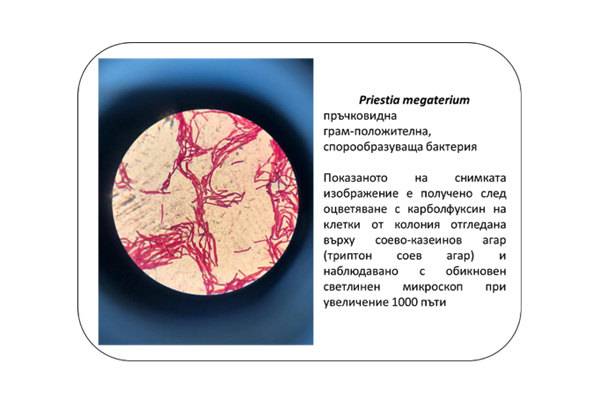
Colonies of the bacterium Priestia megaterium, the active component of the microbial biostimulant Nuptak
The field trial with Nuptak was conducted at the Training and Experimental Station of the Agricultural University – Plovdiv in 2021/2022. It was established with wheat, variety Lazuli, at a sowing rate of 550 viable seeds per square metre. It includes 5 treatments, laid out in 4 replications, with a plot size of 18.2 m2. The treatments of the trial are presented in Table 2.
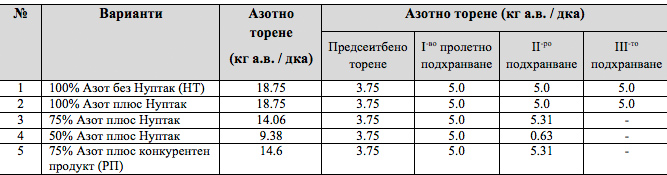
Table 2. Treatments of the field trial
The soil in the selected experimental plot has a low content of total mineral nitrogen (10–15 mg/kg) in order to allow a clearer expression of the nitrogen-fixing capacity of the tested microbial biostimulant. Nitrogen nutrition includes pre-sowing fertilisation and several top dressings during vegetation with ammonium nitrate (Table 2). The treatments in the trial were fertilised with 18.75, 14.06 and 9.38 kg active substance nitrogen per decare, representing 100, 75 and 50%, respectively, of the set nitrogen rate. The product Nuptak (NT) and the competing product (CP) were applied at the tillering growth stage of the plants at a dose of 100 grams per decare. The method of application was spraying a working water solution with a knapsack sprayer at a volume of 20 litres per decare. Part of the obtained results are presented in Table 3.
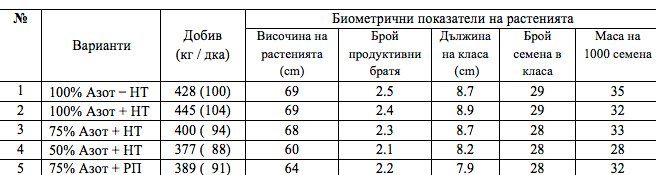
Table 3. Effect of the microbial biostimulant Nuptak on yield and structural elements of productivity of wheat, variety Lazuli, grown under different levels of nitrogen nutrition. In brackets – % of the control (treatment 1)
Overall, the climatic conditions during the vegetation period were not favourable for the growth and development of the wheat, with the late spring drought having a particularly negative effect. The grain yield from the control treatment (treatment 1) is 428 kg per decare. The application of the microbial product Nuptak in the treatment with 100% N (treatment 2) increased the yield by 4%. The wheat yields in the treatments with nitrogen fertilisation reduced by 25% (treatment 3) and by 50% (treatment 4) are lower than the control treatment (treatment 1) by 8 and 12%, respectively. The obtained results for wheat yield show that the application of the product Nuptak to some extent compensates for the reduced nitrogen nutrition. The studies undertaken this year, which include microbiological, agrochemical and physiological analyses, will further reveal the nature of the positive effect of this biostimulant.
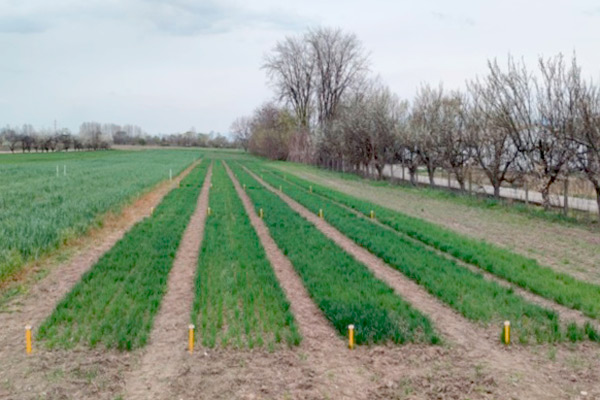
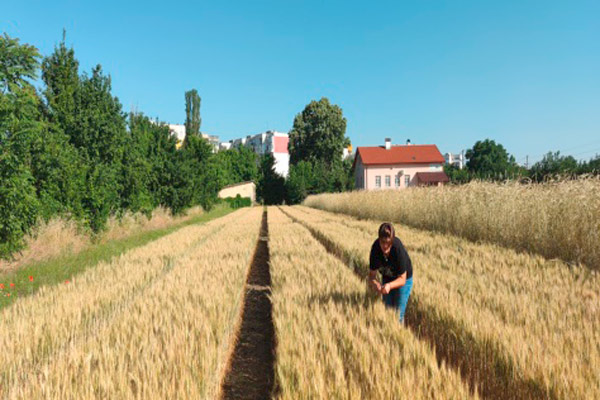
Photos 1 and 2. General view of the field trial with wheat grown under different nitrogen nutrition regimes and treated with the microbial product Nuptak