

![MultipartFile resource [file_data]](/assets/img/articles/есенни-грижи-1.jpg)
During the dormant period of fruit species, a number of preventive plant protection measures are carried out, using mainly agrotechnical and mechanical methods. Their implementation significantly reduces the number of pesticide treatments during the following vegetation period, which contributes to the preservation of beneficial fauna and to obtaining high-quality produce without pesticide contamination. Some of the mandatory measures for this period are as follows:
- Dead trees are uprooted, removed and burned, thereby destroying the accumulated infection from bark beetles, wood-boring insects, plum pox, bacterial blight and many other pests;
- Old and cracked bark on the trunk is removed and burned – this is where codling moths, some species of mites and others overwinter;
- Caterpillar nests and dried and mummified fruits remaining on the trees are collected and destroyed. They are a source of infection from certain defoliating caterpillars, almond seed wasp, brown rot and others;
- The dried and infested stems and shoots of currant and raspberry attacked by currant clearwing moth, Agrilus spp., gall midge, raspberry moth, grey leaf spot, anthracnose, Didymella and others are cut out, removed and burned.
- Soil tillage plays an essential role in the control of diseases, pests and weeds. After carrying out the mechanical plant protection measures, the areas are ploughed or dug to a depth of 18–20 cm in the row, and near the trunks – 8–10 cm. In this way the leaves and the infection present on them (apricot shot-hole and leaf spot (Gnomonia), apple and pear scab, red leaf spot of plum etc.) are buried, a significant part of the overwintering forms of many pests is destroyed, and unfavourable conditions are created for their overwintering.
- In basin, semi-mountainous and mountainous regions, where there is a risk of frost damage, the trunks and thick scaffold branches of the trees are whitewashed before the onset of cold weather. This avoids uneven heating during the day and reduces the risk of freezing injury.
- To protect young trees from hares, field mice and other rodents, they are wrapped with available materials – corrugated cardboard, polyethylene materials, etc.;
- Outdoor storage sites for fruit planting material are fenced with wire mesh against hares, and for the control of rodent-like pests that damage the roots and the root collar, suitable ready-made baits are placed.
Pome fruit species – apples, pears
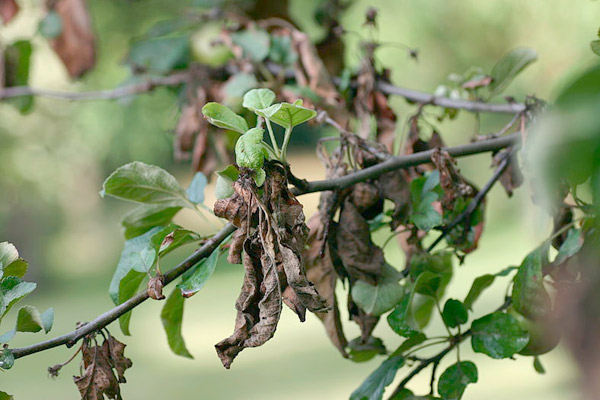
Fire blight
In our country this disease is of the greatest economic importance because of the losses it causes mainly to pome fruit species – pear, quince, apple. Infected trees are recognised by the characteristic young shoots curved in a hook shape from the tip downwards and dried, as well as branches with dried, blackened leaves and fruits that remain on the trees and do not fall off.
Methods and means of control
Agrotechnical measures:
Sanitary pruning for removal of infected shoots and branches
- During the winter dormancy period, diseased branches and twigs are cut 15–30 cm below the point of damage, collected in bags and burned. Pruning wounds are covered with white latex paint or oil-based paint with the addition of 1% copper-containing fungicides. In the case of intensive sanitary pruning, trees are sprayed with copper-based products;
- Cankers on trunks and thick branches are carefully scraped off with a sharp knife and the wounds are covered with white latex paint or oil-based paint with the addition of 1% copper-containing plant protection product. The scrapings from the cleaned cankers are burned;
- Pruning tools are disinfected after each cut with 10% bleach or methylated spirit diluted with water in a ratio of 3:1.
Chemical control:
Winter spraying with copper-containing fungicides authorised for this purpose.
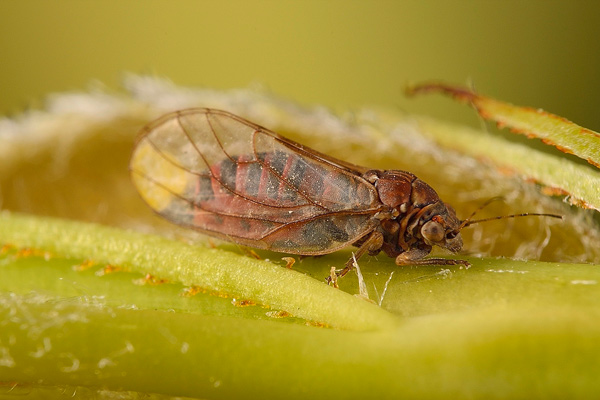
Pear psylla
Pear psylla is widespread throughout the country and occurs at high population densities in almost all pear orchards. It damages only pear. Cultivars with long and prolonged shoot growth are more severely attacked. In addition to the main damage (sucking sap from buds, floral parts, leaves and fruits), it transmits a mycoplasma – the causal agent of a disease that leads to stunting and death of pear trees. During the period May–October, the psyllids lay their eggs singly or in chains on the upper and lower leaf surfaces, close to the veins. The adults of the fifth generation appear at the end of September – beginning of October. With decreasing temperatures in November, they move to overwintering sites – under the cracked bark of trees or under fallen leaves.
It is necessary, in the period from the end of September to the beginning of October (after harvesting the fruits) and when a high density of adults and larvae is recorded, to carry out spraying with authorised insecticides against the fifth generation of the pest. This treatment will reduce the population density for the following year.
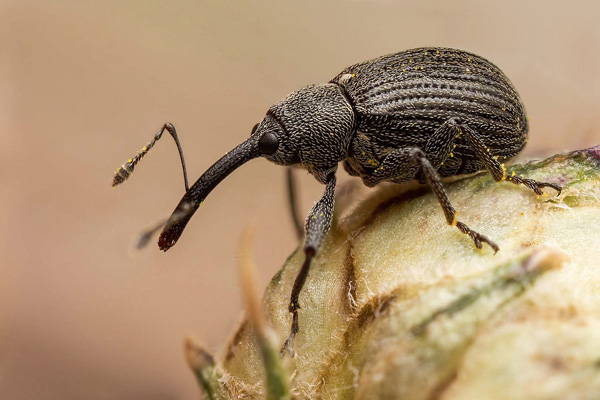
Pear bud weevil
This pest develops one generation per year and attacks only pear. Usually in the third ten-day period of September – beginning of October, activation of the beetles is observed. They feed on leaf and fruit buds for 10–12 days. Damaged fruit buds of pear do not develop, dry out and fall off in spring. In warm and calm weather, egg-laying begins. The females lay their eggs by boring a channel in the mixed buds and placing one egg at the bottom of each. The eggs laid in autumn remain to overwinter and the larvae hatch from them the following spring. Larval development takes place entirely inside the buds.
Due to the concealed mode of larval development, control is carried out and is effective only when directed against actively feeding adults, before egg-laying. Therefore, from the end of September, pear trees must be monitored and assessments made periodically. To detect the beetles, it is necessary to place a sheet under the tree canopy, and if after vigorous shaking of the branches more than 5 to 8 beetles are counted, chemical control is necessary.
Treatments against pear psylla also affect the pear bud weevil.
Stone fruit species – peaches, apricots, plums, cherries are treated with authorised copper-containing plant protection products (at 70% leaf fall) to protect them from bacterial blight, shot-hole, peach leaf curl, plum pockets, early brown rot, etc.