

![MultipartFile resource [file_data]](/assets/img/articles/микробиални-1.jpg)
Plant biostimulants are a new group of products with increasing application in agriculture. According to Regulation (EU) 2019/1009 of the European Parliament and of the Council of Europe of 5 June 2019, plant biostimulants are preparations that affect plant nutrition processes independently of the nutrient content in them, with the aim of improving one or more of the following characteristics of plants or their rhizosphere:
- nutrient use efficiency;
- tolerance to abiotic stress;
- quality traits;
- availability of confined nutrients in the soil or rhizosphere;
In conventional agriculture, crops receive their main nutrients from synthetic fertilizers, which in certain cases poses a risk of environmental pollution. In its strategy “From Farm to Fork” (2020), the European Commission set the objective of reducing the use of mineral fertilizers by 20% by 2030. This objective, together with the rising prices of mineral fertilizers, increases the pressure on the agricultural sector to find new and more sustainable ways of producing plant-based foods. Plant biostimulants fit well into this strategy, as they contain natural substances obtained through further processing of waste products or renewable natural resources, as well as beneficial microorganisms.
Depending on the raw materials used, plant biostimulants are divided into several groups, the main ones being: (1) protein hydrolysates, (2) humic and fulvic acids, (3) seaweed extracts, (4) combined products, (5) microbial preparations (including biofertilizers), etc.
The idea of creating microbial biostimulants is derived from the natural ability of organisms to form long-term and diverse relationships in the environment. Plants coexist and interact with the microorganisms associated with them throughout their entire life cycle. These may be free-living or symbiotic microorganisms, such as many bacterial and fungal species.
Microbial biostimulants contain single strains of microorganisms or a consortium of microorganisms. They mainly include (1) rhizobacteria (PGPR) and other plant growth-promoting bacteria (PGPB) and (2) arbuscular mycorrhizal fungi.
Natural associations of microorganisms with plants in the rhizo- and phyllosphere
The rhizosphere is a biologically active soil zone located around plant roots (up to 1 mm distance). It is a specific ecosystem that differs from the bulk soil both in terms of the number and the types of rhizosphere microorganisms inhabiting it. This specific niche is strongly influenced by the roots and the products they release into the environment: various exudates, lysates, mucilage, secreted substances and dead cell material, as well as gases, including respiratory CO2. On the other hand, depending on the type and degree of interaction, microorganisms affect the roots (and consequently the plants) by improving mineral nutrition and inducing tolerance to environmental stress factors and diseases.
Three distinct but interacting components can be distinguished in the rhizosphere: the rhizosphere (soil), the rhizoplane and the root itself (Figure 1). The rhizosphere is the soil zone influenced by root exudates, while the rhizoplane is the root surface, including firmly attached soil particles.
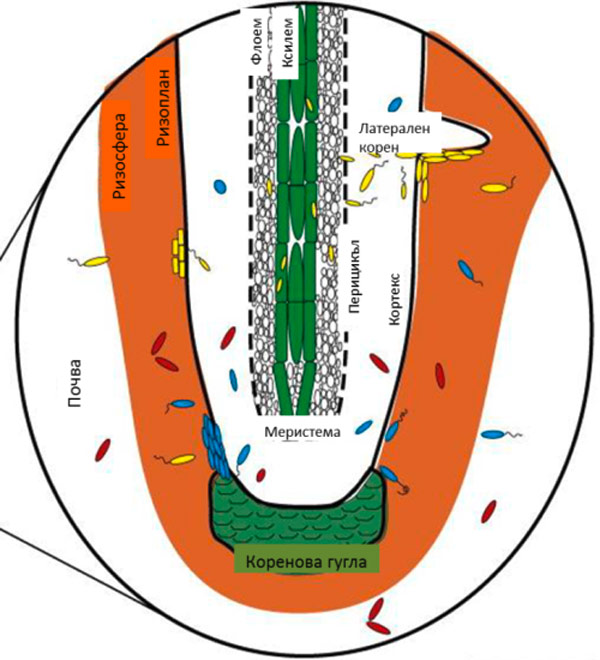
Microorganisms in the rhizosphere, rhizoplane and roots of plants
Along with rhizosphere microorganisms, endophytic microorganisms in the phyllosphere also exert an influence on plants. In the symbiotic association “endophytic microorganisms–plants” the host (plants) protects and nourishes the endophyte, while the latter produces biologically active metabolites that enhance growth and protect plants from pathogens and herbivorous species (Figure 2). Among these endophytes, representatives of fungi from the classes Ascomycetes and Deuteromycetes constitute the largest group.
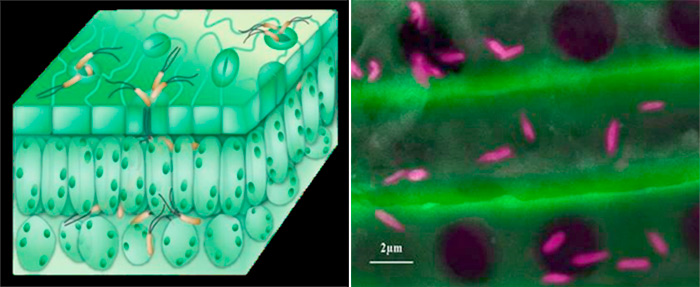
Endophytic microorganisms in plant leaves
Over the past two decades, more than 100 species of endophytic microorganisms have been successfully cultured and subjected to detailed studies, which has led to the chemical and biological evaluation of a large array of natural products with beneficial properties.