

![MultipartFile resource [file_data]](/assets/img/articles/заглавна-картофи-1.jpg)
Experienced gardeners know that the second potato crop is the one suitable for winter and spring consumption – along with medium-early production. For growing potatoes as a second crop, areas freed from early vegetables such as spinach and zucchini are used, as well as cereals, legumes and other crops harvested by mid-July.
The advantages of the second potato crop are that it can be stored for a longer period and remains sound until spring, and its tubers provide high-quality seed material for the following season. For a second crop, potato varieties (Nadezhda, Agria, Impala, Desiree, Arinda, Bintje, Concorde, Trezor, etc.) are selected which have a shorter vegetation period, sprout more quickly, do not waste energy on prolonged stem development, but set tubers.
Potatoes maturing at lower temperatures are less susceptible to diseases and pests such as the potato stem nematode and the Colorado potato beetle, for which the weather in September is already cold, but the tubers are often attacked by the potato tuber moth.
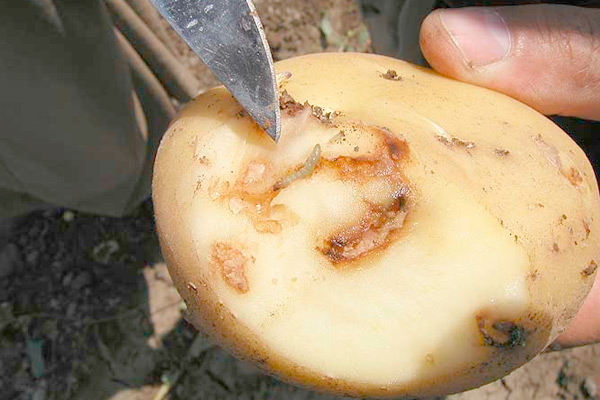
Potato tuber moth
The pest attacks potato tubers in the period from “leaf mass wilting” until harvesting or during storage in potato stores. Infection of tubers in the field occurs when larvae hatch from eggs laid on the leaves, fall onto the soil surface and reach the tubers through cracks, or enter the tubers from the dried stems, or the moths lay eggs directly on the tubers protruding from the soil.
In potato stores the females lay eggs on the tubers, and the caterpillar usually bores in around the eyes of the tubers, feeds on the fleshy part beneath the skin, forming galleries over which the epidermis of the tuber sinks and forms a groove. In some cases the caterpillar bores into the interior of the tubers. During feeding it forms galleries filled with brown excreta and webbing mixed with fine potato particles. The galleries vary in length and are 2 to 5 mm wide. In heavily infested tubers there are many galleries filled with excreta on which various microorganisms develop and completely destroy the tubers.
Control
Agrotechnical measures against the potato tuber moth include:
- Timely harvesting of the crop and destruction of plant residues;
- Chemical treatment of the leaf mass before mowing, to be carried out in the evening with a contact product with a short pre-harvest interval;
- Immediate removal of the tubers to the storage facilities, not allowing them to remain in the field overnight;
- Destruction of tubers with visible damage;
- Storing potatoes in warehouses at a temperature below 9 ˚C, since the moth does not lay eggs below this temperature;
- Separate storage of seed potatoes from those intended for consumption.
Second-crop potatoes are harvested after the first frosts at the end of October and the beginning of November, with this timing depending on the climatic conditions of the region. The tubers are graded, dried and placed for storage in suitable premises.

Wooden crates are ideal for potato storage
Potatoes for storage
Tubers intended for seed material are stored for 6 to 9 months, and those for consumption and feed – until the time of their use. The following are stored: well-ripened tubers with sound skin, without mechanical damage and injuries; free from fungal and bacterial diseases and pests; well dried, without excess moisture. Storage facilities must be well cleaned of old potatoes and disinfected. Disinfection can be carried out with a solution of 1 part 40% formalin to 40 parts water or a 3% solution of copper sulfate. During storage the tubers should be inspected periodically and those affected by dry and soft rot and those attacked by potato tuber moth caterpillars should be removed. Optimal storage conditions: temperature 2-4ºC and relative humidity 90%, ensuring good ventilation.