

![MultipartFile resource [file_data]](/assets/img/articles/хинап-заглавна-1.jpg)
Cereals and vegetables are a rich source of calories and nutrients, but many people today subsist solely on a cereal-based diet, which deprives them of valuable micronutrients even if they receive a sufficient amount of calories. Increasing the diversity of crops on global and local markets is one of the main challenges facing agriculture, especially under conditions of a changing climate. The so‑called “orphan crops” are underutilized and neglected species that have local importance, particularly for smallholder farmers. They are often overlooked by researchers despite their valuable characteristics, which are promising for emerging markets. Some of them also have potential as functional foods and can conquer new markets.
Why do we need transformative adaptation strategies?
Climate change is one of the global challenges facing humanity today, as temperatures continue to rise, triggering numerous extreme weather events such as heatwaves, droughts, and floods. These climate challenges are unfolding rapidly, causing socio‑economic insecurity and health challenges, especially in marginalized communities. Moreover, the changing climate exerts additional pressure on an already stressed resource base, reducing the resilience of agro‑ecosystems which partially ensure food and nutrition security in rural communities. Addressing these challenges requires a paradigm shift from current incremental adaptation strategies to transformative alternatives that place equal emphasis on human health and nutrition and environmental sustainability.
In the context of marginalized farming communities, a transformative adaptation strategy is defined as one that causes disruptive, yet desirable and sustainable change in the social‑ecological state of the system.
The intensity of climate change has a greater impact on food security in the short term than in the long term. Depending on the speed and direction of these trends, adaptation to this change must be rethought as a continuous and transformative process rather than a periodic and incremental one. Under continuously changing conditions, transformative adaptation is required to build resilience and ensure sustainable food systems.
What are “orphan crops”?
The term “orphan crops” is often used to denote crops that may have originated elsewhere but have undergone extensive domestication at the local level, thereby giving rise to local variations, i.e. “naturalized/local crops”. Underutilized local and traditional crops are often characterized by limited use compared to their potential. Consequently, they have poorly developed and poorly understood value in food chains, which varies according to geographical and socio‑economic settings.
They offer a number of new opportunities in the context of climate change.
Some of the advantages that “orphan crops” can offer include:
- they are suitable for harsh local conditions;
- they provide dietary diversity and improve agrobiodiversity in farmers’ fields and home gardens;
- they create market niches in local economies;
- they serve simultaneously for the use and protection of local knowledge.
Orphan crops can also reduce the contribution of agriculture to environmental pollution. They are more resistant to diseases and pests, can grow on soils of lower quality and require lower levels of fertilizer and pesticide inputs.
Jujube is an example of an “orphan crop” that would be suitable under conditions in Bulgaria
Jujube (Ziziphus jujuba) belongs to the buckthorn family (Rhamnaceae), which includes over 80 plant species. Its best‑known representative that has been introduced into cultivation is the jujube.
It originates from north‑western China and Afghanistan, where it has been cultivated for over 4,000 years. It is widespread in India and the countries of Central Asia. It was introduced into the Mediterranean and the Balkans by the Romans, and even today in Bulgaria some of its primitive forms can be found in the wild along the Black Sea coast and near old Roman fortresses. Gaius Plinius Secundus (Pliny the Elder) mentions in his “Natural History” that, by order of Octavian Augustus, jujube was brought from Syria to Italy and from there to other parts of the Mediterranean.
Jujube played a major role in the diet of many peoples in antiquity,
when cereals were not yet cultivated everywhere. It was used to make bread and various dishes. At the beginning of the 20th century, large‑fruited Chinese cultivars were introduced into America and Algeria, from where they spread to other Mediterranean countries.
As a millennia‑old fruit crop in China, jujube has great importance in the Chinese diet due to its complex nutritional properties. Nearly 1,000 cultivars and local genotypes are grown in China on over 2 million hectares in low‑input production systems.
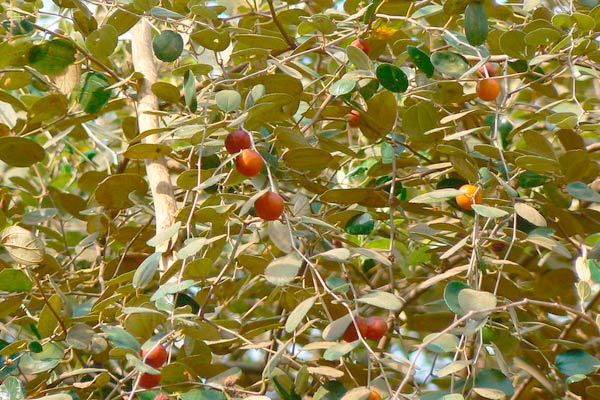
Fruiting jujube plant
What are the benefits of jujube fruits?
The plant is a subtropical fruit tree reaching a height of 4–5 metres. Its fruits differ from those of other species by their high content of dry matter (up to 48%), which allows them to be used not as a delicacy but as a high‑calorie food product with a high content of vitamins, trace elements, pectins, and antibiotics.
Jujube surpasses our common fruit species by 2–4 times in terms of dry matter and sugar content.
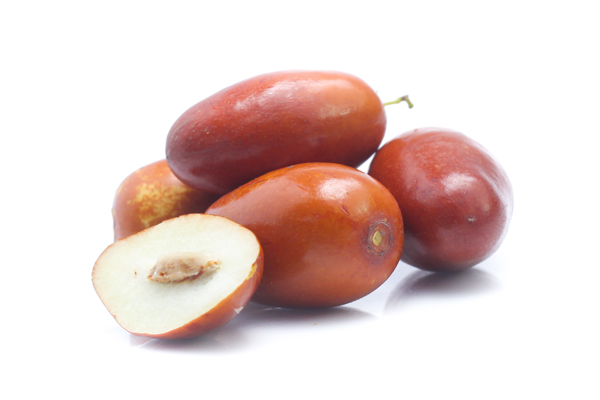
Jujube fruits
During the period of bud formation and the beginning of flowering of the trees, jujube leaves contain more vitamin C than is found in fresh lime fruits. In the Caucasus and India, the leaves are also used to feed silkworms, which at the same time produce high‑quality fibres. Interestingly, jujube leaves have the ability to suppress the sensitivity of taste receptors. After chewing a leaf, a person loses the ability to perceive sweetness and bitterness for up to half an hour.
Jujube fruits have an important nutritional effect because they are extremely wholesome.
This beneficial effect is due to the complex composition of sugars, vitamins, amino acids, and other substances. Dried jujube fruits can also be used as a raw material source for other products.
In addition, jujube wood is very hard, heavy, strong, with a beautiful bright yellow colour and dark red heartwood. It polishes excellently and is used for making musical instruments and carved items.
The attractive ornamental appearance of some cultivars also makes jujube suitable for use in landscaping urban areas.
What are the specific aspects of jujube cultivation?
Jujube is a slow‑growing tree, 4–5 m tall, but it can also grow as a shrub. It can reach an age of 200–250 years. The plant is thermophilic and light‑loving. It requires a hot summer, warm autumn, and mild winter, although some cultivars withstand temperatures down to -30 °C. The jujube root develops faster than the above‑ground part of the plant. Thanks to this, it is able to tolerate severe drought and bear fruit under low rainfall conditions.
Flowering is abundant with a strong and delicate aroma. It requires insect pollination. It produces numerous root suckers, and this characteristic is used through the application of jujube for stabilizing gullies and landslides, and for afforestation of dry, barren slopes.
To prevent sunscald, the height of the trunk should be minimal and the short fruiting shoots that form should not be removed.
The non‑synchronous, prolonged flowering leads to great diversity in the fruits. The more heat is available, the earlier ripening begins and the more fruits are set. In addition, it flowers late, which provides protection against damage from spring frosts.
Seeds of large‑fruited jujube cultivars are practically non‑viable, which is why valuable cultivars can only be propagated vegetatively: by budding, grafting, rooting of green or hardwood cuttings, or by using grafting techniques.
On the territory of Bulgaria, jujube is not attacked by economically important pests and diseases and therefore does not require chemical treatment.

Jujube as part of park landscaping
Considering that in Bulgaria jujube can be grown using organic farming methods, this gives high value to this crop. Jujube trees are drought‑resistant, tolerant to salinity, and can be grown on sandy soils. With high resistance to extreme temperatures, both very low and very high, jujube is the fruit tree recommended for addressing the effects of climate change and for improving the quality of poor soils.
The cultivation of fruit trees of the genus Ziziphus (jujube) may be a solution for food security and income for residents of arid and semi‑arid regions of the country, whose share will inevitably increase in parallel with the climate changes we are observing. The plants are extremely rich in nutrients and can be used as a complete food in fresh or processed form, as well as being an export commodity. These plants can be successfully and efficiently cultivated in marginal ecosystems and can be used to alleviate food insecurity and in poverty‑reduction programmes. Their cultivation should be promoted through public policies, especially in areas where water resources are scarce.
Roman Rachkov is part of the Klimeteka editorial team. He is an agronomist, a specialist in tropical and subtropical agriculture, and a long‑standing expert in integrated and organic plant protection. He is Chair of the Bulgarian Association for Biological Plant Protection and has interests in the field of invasive insect species in Europe.