

![MultipartFile resource [file_data]](/assets/img/articles/съхранение-ябълки-2.jpg)
Soft rot develops rapidly and affects the entire fruit, which is easily mashed when pressed. On the decayed tissue, more precisely around the injured part, white to pale green sporulating tufts initially appear, which later acquire a blue-green colour and cover a larger part of the rotten surface.
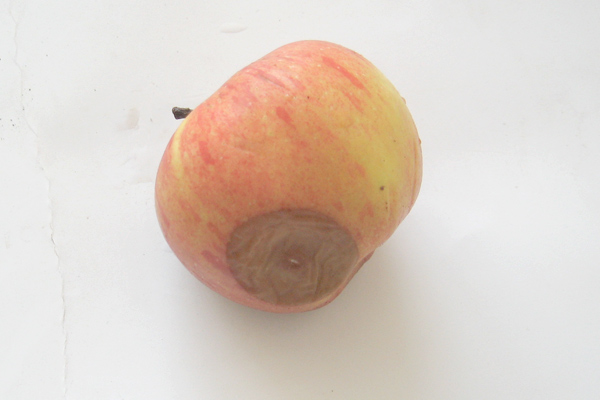
Fruits that are not entirely affected are also unfit for consumption, since the healthy tissue has an unpleasant mouldy and alcoholic odour. For the same reason, healthy fruits that are adjacent to the rotten ones are also unpleasant for consumption.
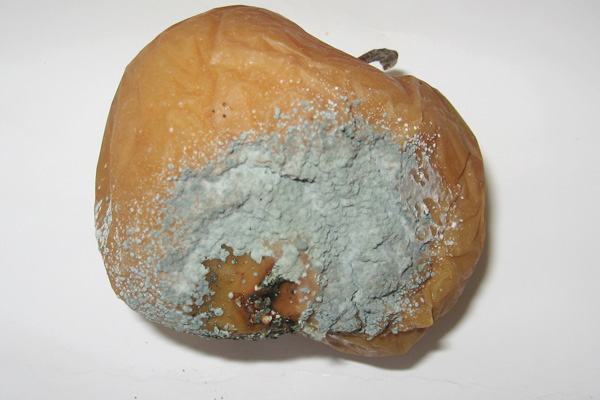
The fungus Penicillium expansum is a saprophyte and penetrates the fruits through wounds and lenticels. Most often, the “entry points” for the pathogen are damage caused by scab, codling moth, fruit tortrix moths, weevils and mechanical injuries from hail, harvesting and sorting.
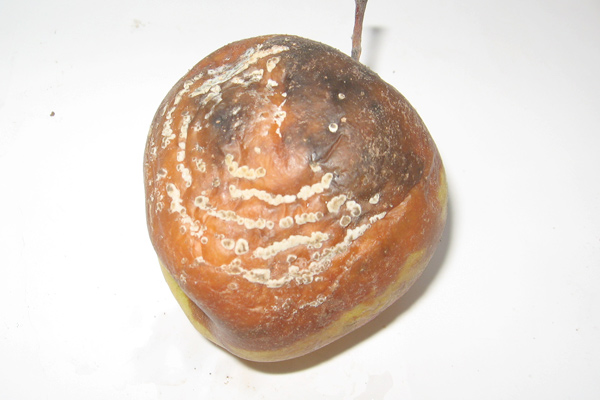
Brown rot infects apple fruits from fruit set until their consumption. On infected fruits, circular brown spots appear, under which the tissues are decayed. This tissue is firm and dry. Under humid conditions, ochre sporulating tufts form on the brown spot, arranged in concentric rings. Usually, infected fruits during storage acquire a shiny black colour and lack sporulating tufts.
The fungus Monilinia fructigena mainly infects the fruits through wounds and more rarely through the lenticels.
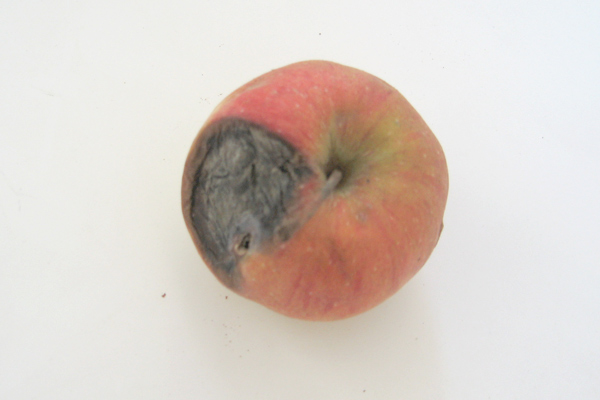
Black rot infects the fruits already in the orchard, but the disease develops very slowly on green fruits. During storage, small cinnamon-brown spots appear around the site of damage or the lenticels, which gradually enlarge and encompass the entire fruit. Later, the damaged part turns black and becomes covered with small, black, round fruiting bodies. When the fruit is cut, it can be seen that the rot has penetrated conically to the seed cavity. When comparing the consistency of the decayed part from black rot and brown rot, it can be seen that in the case of black rot the decayed tissue is firmer than in brown rot.
Alternaria rot is caused by a fungus that is a weak parasite. It develops on dead or weakened tissues. It infects the fruits already in the orchard. On affected apples, small brown to black spots appear, most often around an injured part. Under high humidity, the spots are covered with a dense black mould growth. A characteristic feature of Alternaria rot is that it develops relatively slowly.
The causal agent of grey mould penetrates the fruits through wounds. On infected apples, pale brown spots appear, on which, under high humidity, a grey mould growth is formed. Often, during storage under inappropriate conditions (high relative air humidity and high temperature), the fruiting bodies of the fungus – black sclerotia – appear.
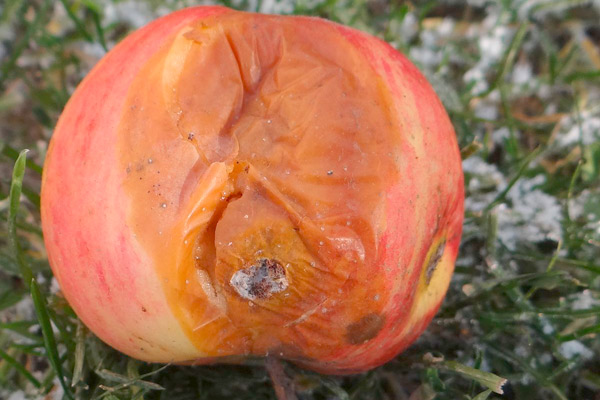
Bitter rot has two forms of manifestation – external and internal. In the external form, a brown spot appears on the infected fruit around an injury, which later becomes covered with mould bearing pink pustules. The internal form of the disease is not noticeable, as the fruit shows no symptoms and appears healthy. When cut, however, it can be seen that the seed cavity is rotten and filled with a whitish mould growth with small pink pustules. In both forms of the disease, the apples are unfit for consumption due to their bitter taste and unpleasant mouldy odour. This rot is characteristic of apple cultivars with an open calyx such as Florina and others.
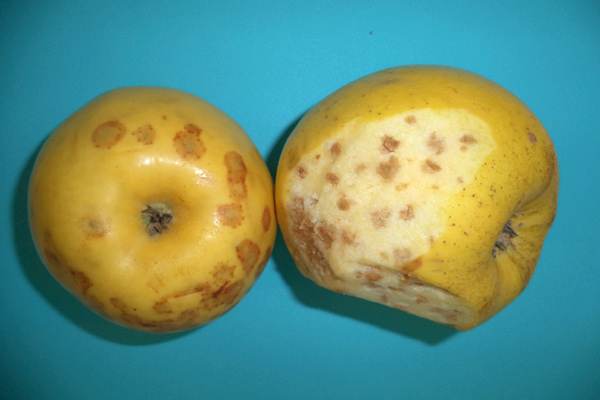
The non-infectious disease bitter pit appears as early as during the ripening period of the apples and later also during their storage. The affected fruits are dotted with numerous dark sunken spots, which are most often concentrated in their lower part. Subsequently, the spots become more intensely coloured: in red-coloured fruits they acquire a dark red colour, while in yellow and green-coloured fruits the spots become light green to green. The damaged fruits look as if they have been hit by hail. Sometimes the affected apples have no external symptoms and do not differ from healthy ones, but when cut, brown pits scattered among the healthy fruit flesh can be seen. The bitter pits represent dark brown spongy tissue with a bitter taste.
The causes triggering this non-infectious disease have not yet been precisely established despite numerous studies on the problem in a number of countries where apples are grown. The results of research show that the cause of the occurrence of bitter pit is a deficiency of calcium in the fruits. It is assumed that this deficiency is due to its withdrawal from the leaves. The problem, however, is very complex and can hardly be explained solely by calcium deficiency. A number of researchers believe that in this case the ratio between calcium, magnesium, potassium and nitrogen is of greater importance.
It has been established that bitter pit occurs most frequently in fruits from orchards with low yield or from young trees, as well as on fruits that are harvested before or after their optimum picking maturity. Warm and dry weather during July and August also increases damage from bitter pit. Large fluctuations in soil moisture as a result of prolonged drought followed by heavy irrigation during fruit enlargement, excessive irrigation before harvest, unbalanced fertilisation with N, P2O5 and K2O, the application of only high nitrogen rates, and severe pruning increase the incidence of bitter pit.
Measures to prevent apple rots during storage: control of diseases and pests during the vegetation period; balanced fertilisation, pruning in accordance with the requirements of the cultivar and avoidance of water stress in the trees; harvesting at the most favourable dates for each cultivar; only healthy and undamaged fruits should be kept for storage; storage in cold rooms where the required temperature and humidity are maintained; rotten fruits should be removed in due time.
For the protection of apple fruits from fungi causing rot during storage, in our country the fungicides Bellis – 80 g/da and Geoxe WG – 30–40 g/da are approved for pre-harvest treatments.
To reduce losses from bitter pit, during the vegetation period two to three treatments with CaCl2 – 0.6 % should be carried out. The first spraying is conducted about one month before harvest, and the subsequent ones – at intervals of 10–12 days. In addition to CaCl2, in recent years the chemical industry has also placed on the market foliar fertilisers containing Ca. To reduce losses from bitter pit during fruit storage, dipping the fruits in CaCl2 – 2.5 % before placing them in storage is recommended.