

![MultipartFile resource [file_data]](/assets/img/articles/слива-заглавна-1.jpg)
In the fertile Dobrudzha region, close to the sea, alongside grain production, blue plums are also grown. Father and son cultivate 80 decares of plum orchards.
Gradually, the purple fruit is becoming a traditional crop for the area, which is why the joy of this year’s harvest turned into an Open Day of the plum orchards in the village of Dropla, Balchik municipality, at the beginning of September, where they hope to turn the celebration into an annual event.
The plantations were established under a European project six years ago, and in the area a water reservoir and a borehole for irrigating the orchards have been constructed. The fruit growers have chosen three varieties for their orchards.
“Stanley”, a favourite variety of the Bulgarian consumer, because the fruits are large and suitable both for fresh consumption and for processing. They ripen at the beginning of September. The variety is tolerant to sharka (plum pox), is slightly affected by red leaf spots and moderately by rust.
“Jo-Jo” – a variety which is also well known and has excellent taste qualities. “Jo-Jo” plums are also suitable for direct consumption, processing and drying. The variety is known to be resistant to the plum pox virus and fungal diseases.
The Serbian variety “Čačanska Lepotica”, whose trees bore fruit for the first time this year in the orchards of the Marinov family, has large fruits with an average weight of 30-40 g, oval, dark blue, with abundant bloom, with greenish-yellow, firm, juicy, pleasantly sweet-sour flesh. It is suitable for freezing and drying and is tolerant to plum pox. It is resistant to rust, highly susceptible to red leaf spots, does not suffer from brown rot and is sensitive to late spring frosts.
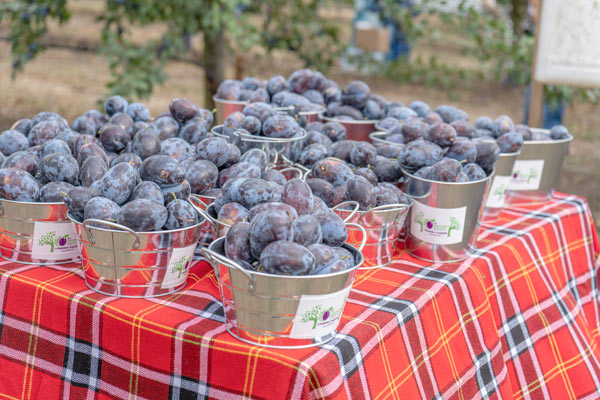
With these three varieties, a good harvesting period is achieved and the preferences of customers are satisfied.
The plum variety „Pagane“ – the pride of the Fruit Growing Institute in Plovdiv
“In one’s lifetime a person should plant at least one tree. Here in the orchards, we planted four thousand trees. We managed to fulfil this small goal in our lives,” shares Martin Marinov, who, together with his father, manages the plum orchards in Dobrudzha. On average, one tree yields between 60 and 80 kg of blue plums, and the raw material is mainly delivered for processing – for plum mousse or for rakia, but it is also used for direct consumption.
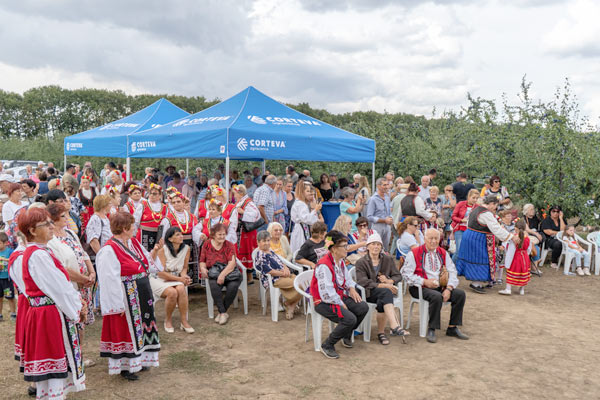
At the Open Day of the plum orchards in the village of Dropla, the entertaining side of the event was not forgotten either – dishes with blue plums competed with the masters of plum jam, and humorous messages involving the tasty purple fruit managed to amuse the audience. “The bigger the pole you have, the more plums you will knock down,” “It is unforgivable to waste blue plums for marmalade when they make such aromatic rakia,” “Looking for helpers to shake the neighbour’s plum tree,” “A real man falls to his knees only when he is picking plums for rakia” and many others.
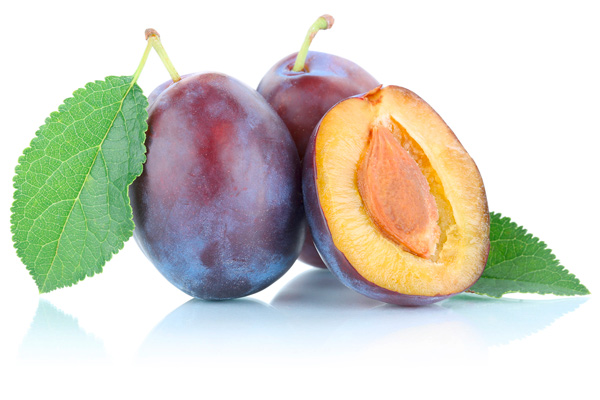
Interesting facts about plums
- Plums are among the first fruits cultivated by humans. The earliest records of plums date back to 479 BC. In 65 BC, Pompey the Great brought plum trees to Rome, and subsequently Alexander the Great spread them in the Mediterranean region.
- The plum is one of the main agricultural crops in our country. Plum fruits, both fresh and processed, are among the traditional agricultural products with which our country enters foreign markets.
- The plum is widespread throughout the country, but the highest concentration is achieved in the Lovech district, the Gabrovo region, the Plovdiv region, the Stara Zagora region, the Vratsa region, the Shumen region and the Smolyan region.
- The main variety in our country is the Kyustendil blue plum. It is known under the name Winter plum or Madzharkinya. It has been grown since the 17th–18th century, along with a large number of local rakia varieties.
- The plum is rich in antioxidants, organic acids, pectin, etc.
- In 2022, the largest share of the harvested areas with fruit trees was occupied by cherries – 24%, followed by plums and mirabelle plums – 21%. The areas with young fruit plantations not yet in bearing are 9.2 thousand ha. The largest relative share of young plantations is occupied by walnuts – 39%, followed again by plums and mirabelle plums – 17% (according to Agrostatistics No 424 – April 2023).
- And last but not least, this year on 22–24 September in Troyan the jubilee 30th edition of the Bulgarian Plum Festival will be held – a tradition full of taste and good mood.
photos © Pro News Dobrich