

![MultipartFile resource [file_data]](/assets/img/articles/зеле-сортове-1.jpg)
Cabbage crops belong to the family Brassicaceae (Cruciferae) and for the most part are varieties belonging to the species Brassica oleracea L. The more widely distributed and cultivated crops in our country are: white cabbage, savoy cabbage, Brussels sprouts, cauliflower, broccoli, kohlrabi and Chinese cabbage. The produce from these vegetables is of high biological value and has good taste qualities.
White cabbage, Brussels sprouts, broccoli and cauliflower contain many valuable biologically active substances and have a proven anti-ulcer effect. Recently, scientists have established that they also contain substances that inhibit the development of cancer cells. Their vitamin C content is almost twice as high as that of lemons. They also contain vitamins E, B1, B2, B6, U, and choline with strongly pronounced anti-atherosclerotic properties. The content of vitamin A, provitamin D and vitamin H is a factor for the development of the normal microorganisms present in the intestinal tract. Therefore, it is advisable to consume brassica crops when taking antibiotics. Cabbage is extremely rich in antioxidants and that is why it is considered a food that helps to increase immunity. Its indisputable taste qualities have long since made it a favourite food of Bulgarians, who consume it both fresh and in traditional recipes. Sauerkraut is rich in vitamin C. Specialists recommend that cabbage also be consumed raw, with red cabbage being a richer source of trace elements. The digestive system is positively affected by the consumption of this vegetable, thanks to its high fibre content. Cabbage also contains large amounts of potassium, magnesium, phosphorus, calcium, iron and other microelements. The inner leaves and the core of the cabbage contain the highest amounts of vitamins, proteins and sugars. Cabbage is a dietary food, particularly suitable for weight-loss diets because of its low energy value and high water content.
In Bulgaria, among the brassica crops, white cabbage and cauliflower have the widest distribution, while broccoli and kohlrabi are produced on smaller areas. The economically usable organs of these crops differ: in white cabbage it is the head, in cauliflower and broccoli the marketable product is the curd (flower head), and in kohlrabi the stem tuber is consumed.
Diseases
For brassica crops, the economically important pathogens are those causing mosaic, bacterial diseases, damping-off in seedlings, clubroot, downy mildew, black leaf spot and sclerotinia (white) rot.

Mosaic (Cauliflower mosaic virus (Brassica virus 3)
It occurs in all types of brassica crops. Under the conditions of our country, it is of greater importance for cauliflower and white cabbage. The virus is inactivated at 780C for 10 minutes. It is transmitted by aphids. The first symptoms are characterised by chlorosis of the leaf veins, the tissue immediately around them remaining dark green, while the rest becomes pale. When infection occurs early, plants are stunted and deformed. The virus survives in plant residues and on overwintering cruciferous weeds. It is not seed-borne. In the field, mass infection is carried out by the aphids Myzus persicae and Brevicoryne brassicae.
Control
Cleaning the seedbed and the areas intended for planting from cruciferous weeds; Observance of spatial isolation from other brassica crops; Systematic control of vectors – aphids; Removal of the first diseased plants.
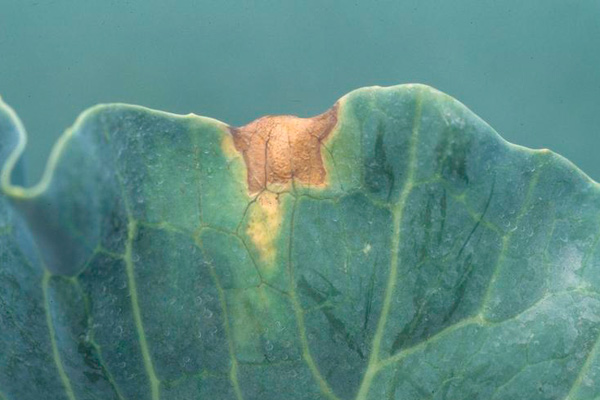
Black rot (bacterial disease) (Xanthomonas campestris pv. campestris (Pam) Douson).
The bacterium is spread by rain droplets or insects. When infected seed is sown, it either does not germinate, or the young sprouts rot. On the cotyledons of plants emerging from infected seeds, chlorotic areas are observed and the vegetative apex dies. Secondary infection occurs in the field through the hydathodes of the leaves. The first symptoms are expressed in blackening of the veins from the tip towards the base of the leaf. The tissue between them becomes pale and dies. A characteristic symptom is the presence of V-shaped spots. In cross-section of the leaf or stem, the vascular bundles appear black. The plants are stunted, do not form heads and sometimes die. On cauliflower curds, black spots of rotting tissue develop. The disease develops in a temperature range of 5o – 39oC and humidity above 50%. Until the next season, the bacterium survives in seeds, plant residues and in the soil. It is of greater importance for cauliflower and late white cabbage.
Control
Introduction of a 3-year crop rotation; Sowing of certified, treated seed on new or sterilised substrate; Optimal density of seedlings and stands; Irrigation with water free from the pathogen; Removal of the first diseased plants; Upon appearance, spraying of plants and soil with PPP – Serenade ASO SC 400-800 ml/ha; Funguran OH 50 WP 0.15%.
Damping-off in seedlings
It is caused by the fungi Pythium spp., Fusarium spp. and Rhizoctonia solani. The pathogens survive in the soil or in plant residues for an indefinite period. When infection occurs before emergence, plants die immediately after they appear above the soil surface. If infection occurs after emergence, plants also die, but somewhat later. At the base of the stem, slightly below and above the root collar, dark sunken spots are observed. They may expand, encompass the whole plant and cause its death. The destructive capacity of the disease depends on the inoculum level and environmental conditions. Cool and cloudy weather, high air and soil humidity, compacted soils and high plant density favour its development. Only healthy plants should be selected for transplanting. The pathogens survive as mycelium, chlamydospores and sclerotia in plant residues and in the soil.
Control
Sowing of certified, treated seed in new or sterilised substrate; Irrigation with water free from pathogens; Removal of the first diseased plants; Burning of infection foci with a 2% solution of CuSO4 or ammonium nitrate (3-4 l/m2); Irrigation of adjacent healthy plants or the entire stand with PPP: Infinito SC 0.16%; Propplant 722 SL 0.25% (3-4 l/m2); Proradix 3 x 12.5 g/ha.
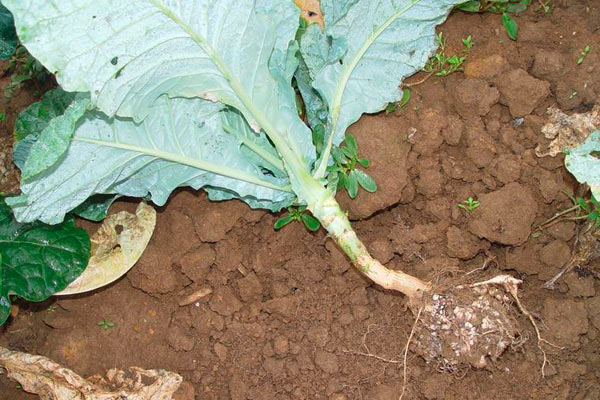
Clubroot in cabbage (Plasmodiophora brassicae Woronim).
This is one of the most dangerous diseases of brassica crops. It most often occurs on heavy and acidic soils. Symptoms of the disease can be observed in all stages of plant development. Plants infected at the seedling stage have a chlorotic appearance. They wilt during the warm hours of the day and restore their turgor at night. Later, they die. Plants infected in the field are stunted, the heads remain small and poorly nourished. Their roots bear tumour-like swellings of different size and shape, which are initially pale yellow but later darken, break off and rot. They hinder the transport of water and nutrients to the aerial parts. Above the damaged area, secondary roots are formed, but they cannot ensure normal plant development. The pathogen forms spores that overwinter in plant residues or in the soil. In spring, after a series of transformations, it penetrates through root hairs and induces hypertrophy and hyperplasia. As a result, tumour-like swellings are formed. Mass infection occurs at high soil moisture – 75-90% of field capacity and temperatures of 18-24oC. For germination, the spores require an acidic environment. Under conditions favourable for the development of the pathogen, losses can reach 70-80%.
Control
In case of established infection, introduction of an 8-year crop rotation with legumes; Liming of the soil with 1-2 t/ha saturated lime or 0.5-1 t/ha ground limestone; Irrigation with water free from the pathogen; Removal of plant residues at the end of vegetation.
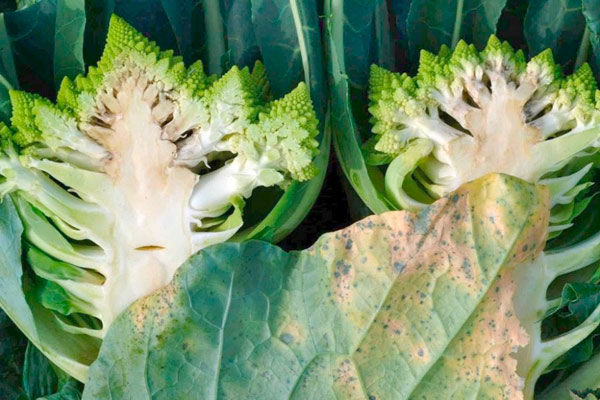
Downy mildew (Peronospora parasitica (Fr) Tul.)
The disease is widespread in regions with a cooler climate. In our country, it is more damaging in seedlings for early production and in autumn on late cabbage. The first symptoms appear on seedlings as sunken spots, which on the underside of the leaves are covered with a loose whitish coating of the fungus spores. Later, the coating disappears and the spots become necrotic. Under severe attack, young plants may die. In adult plants, the outer leaves of the heads are first affected. Numerous ashy-grey, coalescing spots appear on them. Sometimes deeper parts of the heads can also be attacked, which leads to rapid rotting of entire heads. In seed production fields, the pathogen attacks flower stalks, pedicels and pods, and from there the seeds. The fungus survives until the next growing season as oospores in plant residues. It also overwinters in heads from seed production stands. These are probably the primary sources of infection. It also survives in seedbeds. Mass infection occurs at a temperature of 16oC, and at 20-24oC the pathogen develops in host tissues. In late brassica crops, it first and most severely damages broccoli.
Control
Sowing of certified, treated seed in new or sterilised substrate; Irrigation with water free from pathogens; Optimal density of seedlings and stands; Upon appearance or under favourable conditions, treatment with PPP: Bordeaux mix 20 WP 375-500 g/ha; Infinito SC 160 ml/ha; Legado 80-100 ml/ha; Savial forte 45-250 ml/ha; Sivar 80-100 ml/ha; Phytosarcan 45-250 ml/ha; Phosica 45-250 ml/ha.
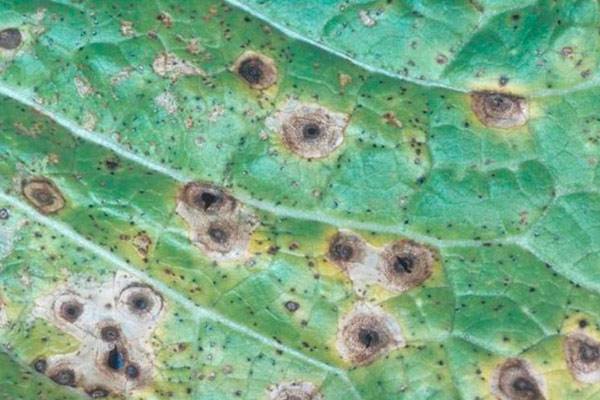
Black leaf spot (Alternaria leaf spot) (Alternaria brassicae (Berk) Sacc.)
The disease is widespread and attacks almost all species of the family Cruciferae. Plants are infected at all stages of their development. It is of greater importance in seed production stands. The first symptoms on seedlings are small black spots on the stems, and the plants may soon die. Those that survive and are transplanted in the field are severely retarded in growth and their yield is significantly reduced. On all parts of adult plants, small spots appear, which rapidly enlarge and reach 1 cm in diameter. They are grey-black with a concentric structure. In wet weather they are covered with a black coating of fungal sporulation. On flower stalks and pods, the spots have various shapes, most often elongated. Under severe attack, pods become deformed, the pathogen penetrates through their walls, reaches the seeds and infects them. The optimum temperature for infection is 25 – 30oC. Under favourable conditions, the incubation period is very short – 2-3 days, so the disease can destroy a large part of the seed crop in a short time. Until the next growing season, it survives in seeds and as mycelium and spores in plant residues.
Control
Sowing of certified, treated seed on new or sterilised substrate; Irrigation with water free from pathogens; Optimal density of seedlings and stands; For seed production, selection of healthy plants (heads); Removal of the first diseased plants; Treatment with PPP under favourable conditions and after the appearance of the disease: Dagonis 100 ml/ha; Zoxis 250 SC 80-100 ml/ha; Ortiva Top SC 100 ml/ha; Tazer 250 SC 100 ml/ha.

Sclerotinia rot in brassicas (white mould) (Sclerotinia sclerotiorum De Bary)
The disease attacks brassica species and varieties intended for fresh consumption, storage and processing. It can cause significant losses during storage, transport and keeping of produce. It prefers cool and humid regions. Brassicas may be infected at all stages of their development, but usually the first symptoms appear in the middle of the growing season. The first symptoms appear on the stem at the soil surface level, at the base of the leaves, or where they touch the soil. Such symptoms may also be observed on heads at commercial maturity. Initially, circular water-soaked spots appear, which soon become covered with a fluffy white mycelial growth. Gradually, the fungus colonises the entire head, which rots and is covered with white mycelium. Later, large black sclerotia are formed in it, by which the pathogen overwinters in the soil and plant residues. Under dry conditions, they retain their viability for more than 10 years. Fungal hyphae have also been found in seeds of some brassica plants. Cool, moist conditions favour the development of the disease, although the fungus develops over a wide temperature range. The development and spread of the disease are favoured by monoculture cultivation of brassica crops and non-observance of crop rotation.
In our country, the disease was first described in 1961 by Elenkov and Hristova. In the following years, it almost disappeared. In 2010, in the Maritsa Vegetable Crops Research Institute, Plovdiv, an attack on white cabbage and broccoli was established, and since then it has appeared almost every year.
Control
Introduction of at least a 4-year crop rotation in soils with established infection; Sowing of certified, treated seed in new or sterilised substrate; Irrigation with water free from pathogens; Removal of the first diseased plants; Planting in well-aerated, well-drained sites; Orientation of rows in the direction of prevailing winds; Treatment with registered PPP: Serenade Aso SC 500-1000 ml/ha; Contans WG 200-400 g/ha.
Pests
Mole cricket (Gryllotalpa gryllotalpa L.). It has one generation per year. It overwinters as larva, nymph and adult in the soil. It leads a subterranean lifestyle. Early in spring, with warming of the weather, it appears close to the soil surface. It feeds on roots and stems. It gnaws young plants at the base. It makes tunnels in the soil, undermining and lifting the plants. Damaged plants sometimes die. It is often found in plots where farmyard manure has been applied.
Control
Upon appearance and detection of damage, against adults and larvae some of the following products may be applied: Belem 0.8 MG/Colombo 0.8 MG 1.2 kg/ha.
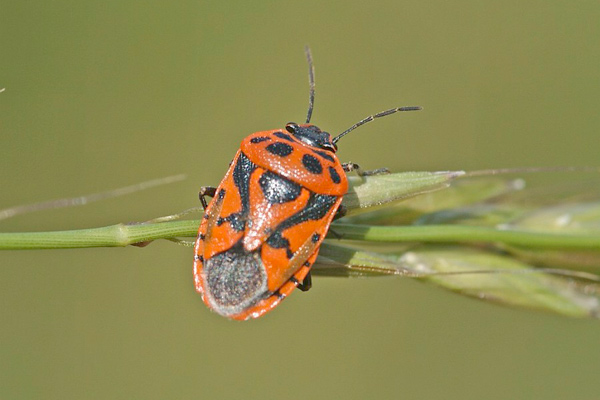
Harlequin cabbage bug (Eurydema ornata L.). It develops one and partially a second generation. It overwinters as an adult under plant residues. It appears as early as the end of March. Both adults and nymphs cause damage by sucking sap from the young tender parts of brassica plants, and the tissues at the site of feeding die. Yellowish-white spots appear on the leaves, which later darken and dry out. Damaged plants lag behind in development, form small heads, which are often tasteless.
Control
Upon appearance of the pest and detection of more than 2 adults per plant, treatment may be carried out with the products: Deka EC/Desha EC/Dena EC/Poleci/Decis 50 ml/ha; Meteor 80-90 ml/ha (100 l water).
Cabbage root fly (Delia brassicae Bouche). The fly has three generations per year. It overwinters as a pupa in the soil. Flight begins in April. It lays its eggs on the soil surface or around the root collar of brassica plants. The larvae gnaw the roots superficially, make spiral tunnels and bore into the main root. The outer leaves become pale, acquire a bluish-violet hue and droop downwards. Attacked plants lag behind in development and die.
Control
At the beginning of adult flight and egg-laying, when 6-8 eggs/plant are detected, treatment may be carried out with the products: Deka EC/Desha EC/Dena EC/Poleci/Decis 50 ml/ha (the soil surface around the plants is also sprayed). Two to three sprayings are carried out at 7-10 day intervals. Application of the product Force 1.5 G 1000 g/ha (in broccoli, cauliflower, Brussels sprouts) and Force 1.5 G 300-500 g/ha (in white cabbage, kohlrabi) at transplanting may also be carried out.
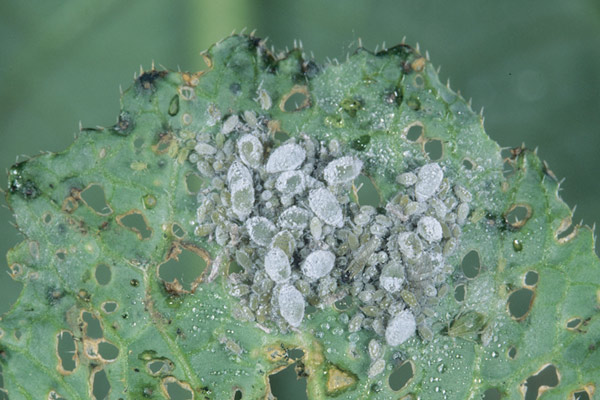
Cabbage aphid (Brevicoryne brassicae L.). It develops 18-20 generations per year. It overwinters as an egg on cabbage for seed production, on plant residues and wild cruciferous plants. Larvae hatch at the end of March – beginning of April at an average daily temperature of 12-14oC. Aphids multiply massively on early cabbage around mid-July. Infestation of late cabbage begins in August, with a peak from late August to early September. Heavily infested plants do not form heads or, if they do, the heads remain small and contaminated, unfit for consumption.
Control
When 5% infested plants are detected in medium-early cabbage and 2% infested plants in late cabbage, treatment is carried out with some of the following products: Deka EC/Desha EC/Dena EC/Poleci/Decis 50 ml/ha; Decis (Dicide) 25 ml/ha; Meteor 80-90 ml/ha (100 l water).
Flea beetles (Phyllotreta sp.). They develop one generation per year. They overwinter as adults under plant residues, in the upper soil layer and other sheltered places. They prefer younger plants. They scrape off the upper epidermis and parenchyma. As tissues grow, the leaf becomes perforated and torn. Damaged leaves dry out and fall. Plants lag behind in development, give low yields and die. The larvae of most species feed on the main root, making a longitudinal groove along the cortex or a tunnel around the root collar.
Control
Upon appearance and detection of damage, against adults at 10 individuals/m2 after transplanting or 10% destroyed leaf area during vegetation, treatment may be carried out with the products: Deka EC/Desha EC/Dena EC/Poleci/Decis 30 ml/ha; Meteor 60-70 ml/ha (100 l water).
Aboveground cutworms
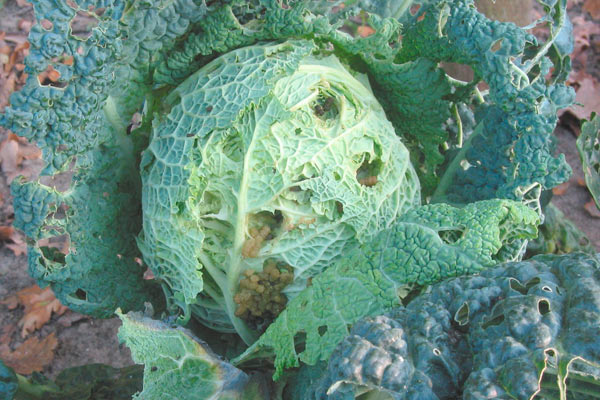
Cabbage moth (Mamestra brassicae L.). It develops two to three generations per year. It overwinters as a pupa in the soil. Moths of the first generation fly in late April – early May. Moths of the second generation fly from the second half of June until the end of July, and of the third – from the second half of August to the first half of September. The caterpillars make feeding damage on leaves and heads. After hatching, they live on the underside of the leaves, later skeletonise the leaves leaving only the thick veins and then penetrate into the head. Damaged heads have an unpleasant smell.
Garden moth (Mamestra oleraceae L.). It develops two generations per year. It overwinters as a pupa in the soil. Flight of moths of the first generation begins in late April – early May. Moths of the second generation fly in July-August. The caterpillars cause the damage. Initially, they window the leaves, later they eat the entire leaf blade without affecting the thick veins. Unlike the cabbage moth, garden moth caterpillars do not penetrate into the head.
Control
Treatments are carried out upon appearance and detection of damage against caterpillars at 12-15 individuals/100 plants in medium-early cabbage and 15-18 individuals/100 plants in late cabbage. Some of the following insecticides may be used: Deka EC/Desha EC/Dena EC/Poleci/Decis 30 ml/ha; Altacor 35 WG 8-10 g/ha; Exalt 200 ml/ha; Decis (Dicide) 25 ml/ha; Meteor 60-70 ml/ha (100 l water); Dipel 2X 100 g/ha; Dipel DF 75-100 g/ha.
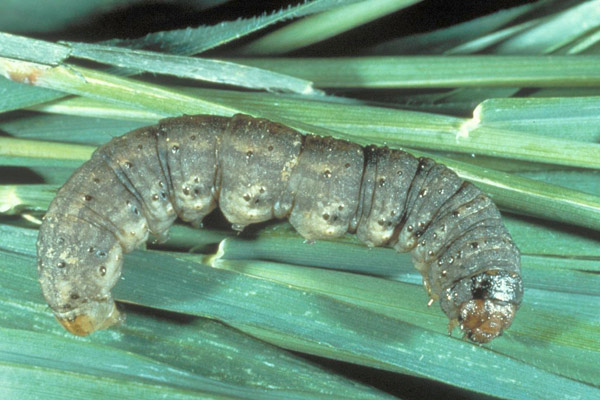
Ypsilon cutworm (Agrotis ypsilon Rott)
Soil-dwelling cutworms (Grey worms).
These include the winter cutworm (Agrotis segetum Schiff.) and the ypsilon cutworm (Agrotis ypsilon Rott). The winter cutworm has two generations per year and overwinters as a mature caterpillar in the soil. The ypsilon cutworm has three full generations per year and a partial fourth, overwintering as a pupa and mature caterpillar in the soil. Young caterpillars feed by gnawing the leaves from below without affecting the upper epidermis. Older caterpillars hide during the day just below the soil surface, under clods of earth, and feed at night on leaves, making holes and later eating the entire leaf except for the thickest veins. Mature caterpillars hardly leave the soil, gnawing the stems below its surface. The caterpillars are earth-grey to black, smooth, shiny, with a greasy lustre, and can often be found near plants coiled into a “ring”.
Control
Good ploughing, regular soil cultivation and weed control are important measures in the fight against these pests. The economic injury level is 1 individual/m2 after transplanting and 2 individuals/m2 after head formation. Spraying against caterpillars is carried out with Meteor 60-70 ml/ha (100 l water); Dipel DF 75-100 g/ha.
White cabbage butterflies
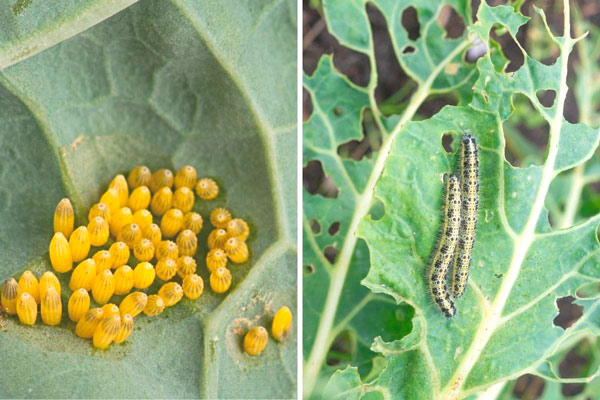
Large white cabbage butterfly (Pieris brassicae L.). It develops three to four generations per year. Butterflies appear in late April – early May. They are active during the day in warm and sunny weather. Young caterpillars live together up to the second instar. They feed on leaves without affecting the upper epidermis. Older caterpillars eat the leaves completely, together with the thin veins, skeletonising them and leaving only the thick veins.
Small white butterfly (Pieris rapae L.). It develops two to three generations per year. Butterflies fly in late April – early May. Young caterpillars feed on leaves without affecting the upper epidermis, then they make round holes, and later eat the entire leaf except for the thick veins. Damaged tissues rot and have an unpleasant smell.
Control
After transplanting the crop, when more than 1% severely infested plants or 2-3 caterpillars/plant are detected, treatments may be carried out with Altacor 35 WG 8-10 g/ha; Exalt 200 ml/ha; Decis (Dicide) 25 ml/ha; Meteor 60-70 ml/ha (100 l water); Citrin Max/Cyperkill 500 EC/Cypert 500 EC/Poli 500 EC 5 ml/ha; Dipel 2X 100 g/ha; Dipel DF 75-100 g/ha.
Diamondback moth (Plutella maculipennis Curt.). It develops four to six generations per year. Moths of the first generation fly at the end of April – beginning of May. Under our conditions, the second generation is the most harmful. Damage is caused by the caterpillars, already in the seedling stage. They mine the leaves under the epidermis. In cabbage seedlings, they eat the growing point. Older caterpillars damage outer and inner leaves of the head and consequently heads remain small and deformed.
Control
Against caterpillars, when 10% of the leaf area is damaged after head formation, treatments are carried out with: Altacor 35 WG 8-10 g/ha; Exalt 200 ml/ha; Meteor 80-90 ml/ha (100 l water); Dipel DF 75-100 g/ha.
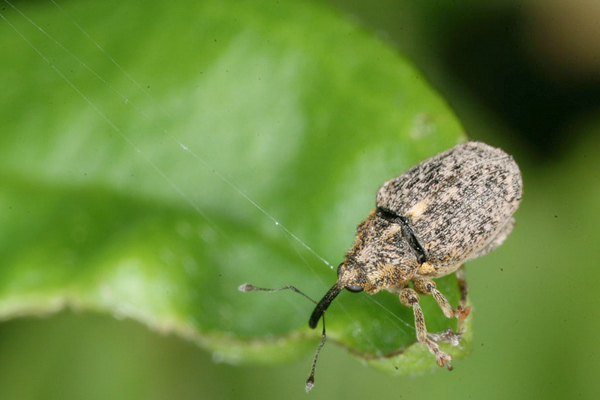
Cabbage stem weevil (Ceuthorrhynchus quadridens Panz.). It develops one generation per year and less often a partial second generation. It overwinters as an adult under plant residues, in the soil and other sheltered places. In spring, at the end of March, the beetles leave their overwintering sites. The weevils first feed on wild, and later on cultivated cruciferous plants. The damage is caused by the larvae. They bore tunnels in leaves, petioles and stems. The tunnels are filled with excrement. The larvae feed on the inner tissues of the stem, which becomes hollow. Leaves of attacked plants fall off, and the damaged stem is soft and brown in colour.
Control
Chemical control is carried out when a density of 1 beetle/plant is established after transplanting or 3 larvae/plant during vegetation. The insecticides Citrin Max/Cyperkill 500 EC/Cypert 500 EC/Poli 500 EC 5 ml/ha may be used.
Slugs (Limacidae). Slugs are highly polyphagous pests. They occur at higher densities in years with warm and wet springs. They develop several generations per year. They are moisture-loving nocturnal non-insect pests. They make irregular feeding damage on leaves. They enter formed heads, make openings in the form of various longitudinal strips, leave slime trails and contaminate the produce. The heaviest slug infestation is observed in late production of white cabbage.
Control
Upon appearance and detection of damage to plants, application of Karakol 5 GB 0.7 kg/ha; Limatak 500 g/ha is carried out.
In some years, damage in brassica stands may be caused by thrips, and in seed production there may be attacks by rapeseed blossom beetle and chafer beetle.
The system for control of pests in brassica crops includes the following measures:
- crop rotation and spatial isolation;
- high agronomic standards in crop cultivation, ensuring uniform development and good stand density;
- collection and destruction of plant residues after harvest in autumn;
- deep ploughing, mechanically destroying overwintering caterpillars, pupae and other stages;
- use of healthy and hardened seedlings;
- regular soil cultivation during vegetation;
- optimal irrigation regime;
- weed control during vegetation;
- regular field inspections to establish species composition and density of pests;
- implementation of chemical treatments according to economic injury thresholds.
Before treatment, add a wetting agent (adjuvant) to the spray solutions with plant protection products in brassica crops. Strictly observe the pre-harvest intervals according to the planned harvest periods.
Up-to-date information on plant protection products authorised for placing on the market and use can be found on the website of the Bulgarian Food Safety Agency (BFSA): https://bfsa.egov.bg/wps/portal/bfsa-web/registers