

![MultipartFile resource [file_data]](/assets/img/articles/домати-болести-заглавна-1.jpg)
The cultivation of tomatoes (Solanum lycopersicum) in our country is traditional. In the 1980s, the open-field areas in Bulgaria were about 280–300 thousand decares, the average yields about 3,000 kg/decare, and the total production reached its maximum between 800 and 900 thousand tons. From 1990 to 2000, production decreased more than twofold – down to 409 thousand tons. In the following 4 years, until 2004, it shrank another two times to 213 thousand tons, and then by 2011 – to only 103 thousand tons.
The intensive and often monocultural cultivation of vegetable crops in protected cultivation facilities and in the open field leads to massive accumulation of pathogenic microorganisms. The development and productivity of tomatoes are determined by many abiotic and biotic factors, including a large number of phytopathogenic bacteria. The dynamic changes in the natural bacterial populations in recent years, the widespread use of newly introduced hybrids and cultivars, and the exchange of seeds have led to the emergence and spread of new virulent races and combinations. Despite the application of crop rotation, the use of various methods for seed disinfection and spraying of the foliage during vegetation with copper-based products, bacterial diseases are a serious problem in crop production every year. Economically important bacterial diseases in our country are bacterial canker and bacterial speck, and of lesser importance are bacterial wilt and pith necrosis.

Bacterial canker (Clavibacter michiganensis subsp. michiganensis (Smith))
Bacterial canker is a widespread disease of tomatoes in various parts of the world and causes significant losses in both field and greenhouse production.
The first symptoms are observed on the lowest leaves, which turn yellow and dry out partially or completely, while the leaflets on the opposite side remain normally green. Later, the disease spreads to the upper levels of the plant, the apex wilts, especially during the hot hours of the day, and finally the whole plant dries up. The vascular bundles turn brown, disintegrate and become hollow. In severe cases, longitudinal cracks appear on the stem and petioles, and sometimes the formation of aerial roots is observed. Systemically, the infection penetrates into the interior of the fruit, turning the placenta around the seeds into a yellow, slimy mass, and yellow-brown streaks can be seen in the flesh. The fruits are small and sometimes drop prematurely. The local form is expressed in a characteristic spotting of the fruits, known as “bird’s eye”. On green fruits, small, whitish, circular spots (3–4 mm in diameter) appear with a darker center, which may subsequently crack. When the fruits ripen, the halo around the center becomes yellow-pink.
The bacterium is preserved in the seeds and in the plant residues in the soil until their decay. In plants, the bacterium penetrates through wounds caused by mechanical damage – pricking out, transplanting, hoeing, pinching out, etc. Once it has entered the plant, it develops in the vascular bundles and moves through them to all organs. The optimum temperature for its development is 24–27°C and the optimum humidity is 80%.
Control includes the use of disinfected seeds, disinfection of the soil and the manure-soil mixture by steaming or solarization. Seed disinfection by fermentation of the pulp for 96 hours; soaking fresh seeds in a 0.8% acetic acid solution for 24 hours at a temperature of 20–21°C, or in 3% hydrogen peroxide for 25–30 minutes. When symptoms appear during vegetation, diseased plants are removed and destroyed far from the plantation.

Bacterial speck (bacterial leaf spot) (Xanthomonas vesicatoria, X. euvesicatoria, X. gardneri, X. perforans)
Bacterial speck is a serious disease affecting tomatoes and peppers. The great diversity among the pathogens causing this disease makes them a threat to crop production worldwide, including in Bulgaria, where the disease has become a major problem. Their wide distribution is mainly due to infected seeds.
Leaf spots are watery, asymmetrical, dark brown, solitary or coalescing, surrounded by a light yellow band, clearly outlined on the underside of the leaves and translucent to transmitted light. Ring-shaped necrosis affects the flowers and petioles. On ripening and ripe fruits, the spots are solitary or coalescing, brown, sunken, surrounded by a light band, and the skin tears like a small collar.
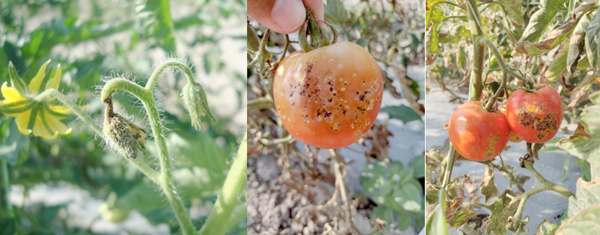
Symptoms of bacterial speck on flowers and fruits
They are transmitted by seeds and persist in plant residues in the soil. They attack many cultivated and wild plant species. Once on the plant, the bacterium develops epiphytically and then penetrates through natural or artificial openings. After penetrating the plant tissues, it multiplies very rapidly and accumulates a large amount of inoculum. During vegetation it is dispersed by water during rain or overhead irrigation. It is particularly strongly spread during rain accompanied by wind. A favorable temperature for development is between 20 and 35oC, and the optimum – 26oC.
Control of the disease includes sowing healthy or disinfected seeds; removal and destruction of all plant residues at the end of vegetation. Spatial isolation between tomatoes and peppers. In case of forecast for heavy rains or immediately after them, treatment with copper-containing plant protection products.
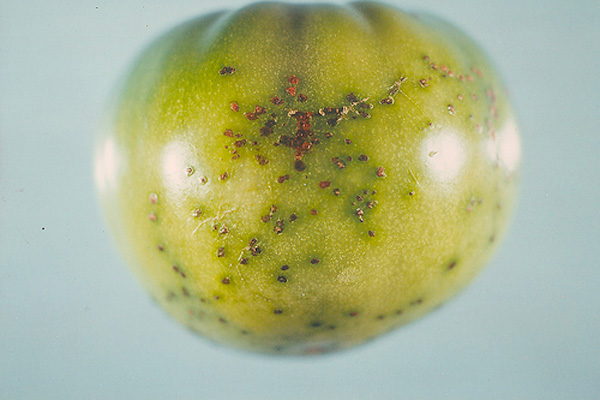
Black bacterial speck (Pseudomonas syringae pv. tomato (Okabe))
Black bacterial speck is a widespread disease of tomatoes in our country. The spots on the leaves are small, watery, chlorotic with a necrotic center, translucent to transmitted light; the veins are covered with necrotic elliptical spots. On the petioles and stems, watery, brown, elliptical spots with a dark periphery and a light center are formed. The spots on the fruits are small, black, pinpoint, raised, coalescing and forming a scab. They appear on green and developing small fruits.
The bacterium is preserved in plant residues until their complete mineralization, as well as in seeds. It develops optimally between 18 and 24°C. It attacks a large number of wild species. The bacterium is spread by water during rain and overhead irrigation, as well as by production implements. High relative air humidity and especially the water film on the plant surface favor the development of the disease.
Control of the disease is achieved by sowing healthy or disinfected seeds; removal and destruction of all plant residues at the end of vegetation. In case of forecast for heavy rains or immediately after them, treatment with copper-containing plant protection products. A two- to three-year crop rotation should be observed on areas where the disease has been recorded. Treatment with Taegro at 18.5–37 g/decare.

Bacterial wilt (Ralstonia solanacearum (Smith) Yabuuchi et al. (Syn. Pseudomonas solanacearum E. F. Smith))
Diseased plants have a chlorotic appearance and adventitious roots. Infected plants wilt and die quickly. In cross-section of the stem, it can be seen that the vascular bundles are darkened, but not destroyed and hollow as in bacterial canker. A whitish bacterial exudate oozes from the infected tissues. Moist and heavy soils are more favorable for infection than dry and cold ones. The species attacks over 250 species from 50 families. It is preserved in the soil and especially in non-mineralized plant residues. The bacterium is spread by water and on plants – during agronomic practices. The bacterium penetrates through wounds caused by nematodes, insects, production implements, as well as through the sites of emergence of secondary roots.
Control measures for the disease are the same as for bacterial canker in tomatoes: rotation with cereals or species from the family Cruciferae, and especially with cauliflower.
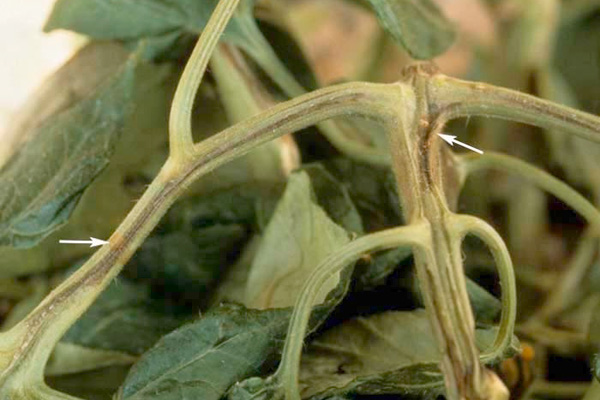
Pith necrosis (Pseudomonas corrugata)
The first manifestations are observed on the stems, which are thickened. The plant apex stops growing, the leaves are chlorotic and wilt during the warm hours of the day. On the stems, elongated brown streaks are observed. In longitudinal section of the stem, it is found that the pith is severely affected. The tissue in the diseased areas is necrotic, brown in color, dry in appearance, and sometimes decomposed. Severely infected plants die completely.
It is preserved in the root system or in the seeds of many plants without causing any visible symptoms in them. It is spread during rain, irrigation by overhead sprinkling, during various manipulations by workers, as well as with the nutrient solution in hydroponic cultivation. The bacterium can also be preserved and spread by infected tomato seeds. Favorable conditions for disease development are: cloudy and humid weather, waterlogging during irrigation, excessive nitrogen fertilization, the presence of a water layer on leaves and stems, wounds from removed leaves, etc.
Control is achieved by: reducing humidity in the greenhouse and preventing the presence of a water layer on the plants and waterlogging of the soil; reducing nitrogen fertilization and increasing potassium fertilization; carrying out agronomic practices when the surface of leaves and stems is dry; pulling out and carefully removing from the crop the severely affected plants; not ploughing diseased plant residues into the soil. Treatment of plants with copper-containing products.