

![MultipartFile resource [file_data]](/assets/img/articles/15-август-2023.jpg)
On 15 August the Orthodox Church observes one of the 12 greatest Christian feasts – the Dormition of the Most Holy Mother of God and Panagia – the elevation of the bread, which is traditionally celebrated in the Kyustendil region.
According to tradition, this is the day on which the Mother of God, at the age of 64, departs from earthly life and goes to her Son. Three days before her death, Archangel Gabriel informs her that God has wished to take her into His kingdom, so that she may reign eternally with Him. Jesus, however, did not wish to take with Him His earthly father, Joseph the carpenter. Her last wish is to see the Holy Apostles together. In a miraculous way they are transported to the doors of her home in Jerusalem. Three days later, Jesus Christ Himself, in heavenly glory, surrounded by angelic hosts and saints, descends from the heavens for the soul of the Holy Mother of God. She is buried in a cave near Gethsemane and the entrance is closed with a stone. When a few days later it is opened so that the late Apostle Thomas may venerate the saint, they find only her shroud. Rising from the table, the apostles hear angelic singing and see in the clouds the Most Pure Mother of God, surrounded by angels, who says to them: “Rejoice, for I am with you all the days.”
The great feast is observed with solemn services in Orthodox churches throughout the country.
According to folk tradition, the feast is called Great Mother of God (Golyama Bogoroditsa), as opposed to Little Mother of God (Malkata Bogoroditsa), when the Nativity of the Mother of Christ is celebrated.
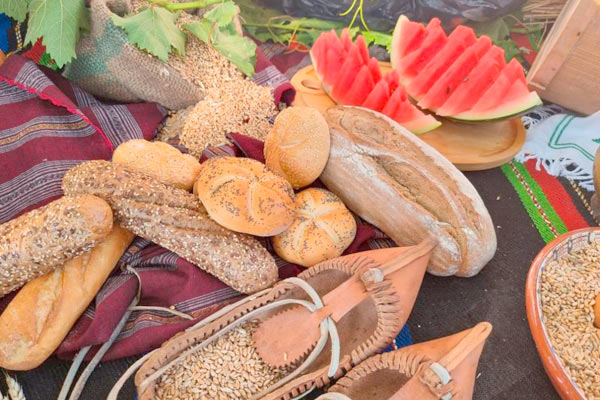
On Great Mother of God, after the solemn liturgy in church, ritual breads are blessed, which women then distribute for health and for their deceased relatives. Believers seek the protection of the Holy Mother of God in the problems of everyday life.
The obligatory dishes on the festive table are freshly baked round loaf decorated with an ornament, chicken stew, boiled wheat, maize and pumpkin. Watermelon and grapes must also be eaten. Fish is permitted. Believers donate to the church candles, homespun cloth, a tablecloth, a towel and money.
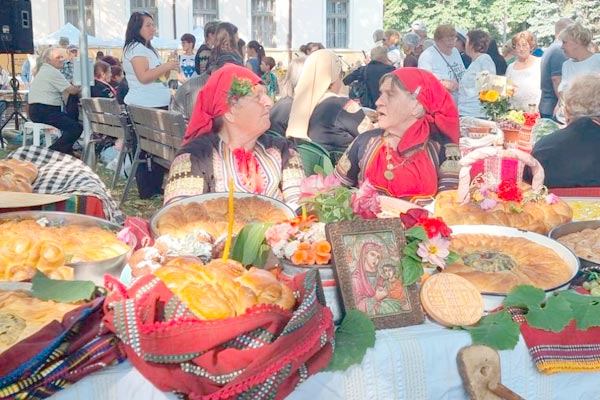
Traditional preparation of the Mother of God bread in Kyustendil
“Panagia” is the name by which the Mother of God is called, as well as the elevation and ritual breaking of the bread, its sharing and eating together.
“Panagia” is the practice of Christ and the Apostles, of the ancient church community, which has passed through ages and different cultures – preserved by our forefathers and brought down to our time through the feasts of the Church and folk tradition.
“Panagia” are the medallions with images of the Mother of God, which the hierarchs wear.
For the 16th time in Kyustendil, the Municipality and the Archdiocesan Vicarage, with the participation of community centres, mayoralties, amateur groups and ensembles, are organizing the feast "Panagia – Elevation of the Bread", which according to the canon takes place on Great Mother of God.
The feast "Panagia" is also held in other places in the country – around churches and chapels dedicated to the "Dormition of the Mother of God" and represents a cultural event for presenting the Bulgarian Orthodox tradition and church fine and vocal art.
"Panagia" in Kyustendil reveals the ancient tradition, which has passed through time, preserved by our forefathers and carried to the present day by folk faith and through the feasts of the Church and folk tradition. The August feast is dedicated to the skill of how to knead and bake bread in a clay baking dish (podnitsa) and how the "Woman-Mother" passes on the secret of bread to the most distinguished girls.
The feast already began on Monday, when in the church "St. Demetrius" the traditional kneading of the Mother of God bread took place and children’s bread-making workshops were opened. On 15 August the focus was the Exhibition of ritual breads, which continued throughout the day.
photos: © BNR