

![MultipartFile resource [file_data]](/assets/img/articles/овощна-август-1.jpg)
In the fruit orchard in August
DISEASES
In the July calendar, we recommended that in apple orchards where scab infection has not occurred, spraying against this disease should not be carried out. This recommendation is also valid for August. In the presence of infection on leaves and fruits and with frequent showers in August as well, the risk of late infections persists and may lead to an increase in the degree of fruit infestation, which necessitates spraying.
For apple cultivars that are susceptible to powdery mildew, control of this disease also continues. For simultaneous control of both diseases, it is best to use fungicides that are effective against both pathogens, such as: Bellis - 80 g/da, Sulgran - 750 g/da and Kumulus - 600-900 g/da against powdery mildew, and Chorus 50 WG - 0.03%, Difcor 250 EC - 15 ml/da, Coprathion Duo - 300 g/da, Scab - 300 ml/da and Captan 80 WG - 150-180 g/da against scab. For simultaneous control of both diseases, Flint Max 75 WG – 0.02%, Score 250 EC – 0.02%, Luna Experience – 20-75 ml/da, Thiovit Jet 80 WG - 600 g/da, Revyona - 200 ml/da are also suitable.
Cultivars resistant to scab – Prima, COOP-10, Frolina, Liberty, Jonafree, Jonathan, Pioneer, Macfree, Pilot, Topaz, Novamak, Sava, Rubinola, etc., are sprayed only against powdery mildew.
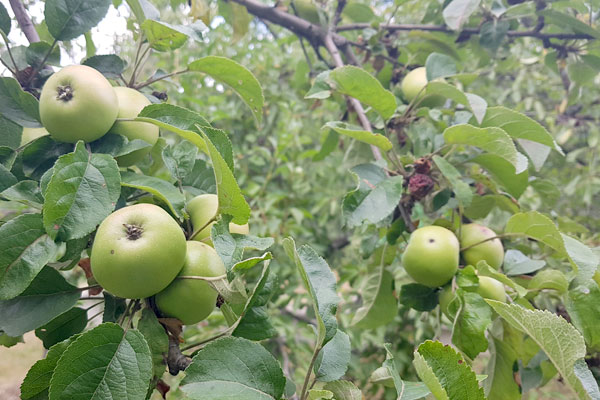
In August, treatment is also carried out against bitter pit/spot/ in apple. Damage from this non-infectious disease on apple is observed during the ripening period and later during storage. The affected fruits are dotted with numerous dark sunken spots, which are most often concentrated in the lower part of the fruit. Later they become more intensely coloured; in red-coloured fruits they acquire a dark red colour, while in yellow- and green-coloured fruits they become light green to green. Sometimes the affected apples have no external symptoms and do not differ from healthy ones, but when cut, brown pits scattered among the healthy flesh can be seen. Bitter pits represent dark brown spongy tissue with a bitter taste. To prevent this disorder, treatment is carried out two to three times with CaCl2 - 0.6%. The first spraying is carried out about one month before harvest, and the subsequent ones at an interval of 10-12 days.
In pear, as in apple, where there is no scab infection, no spraying against this disease is carried out in August. In pear orchards where infection has occurred, treatments against scab must continue. For control of this disease the following are approved: Difcor 250 EC - 15 ml/da, Luna Experience – 20-75 ml/da, Captan 80 WG – 150-180 g/da, Thiovit Jet 80 WG - 600 g/da.
Fungicide sprays in quince are against brown rot and brown leaf spots, for which Chorus 50 WP – 0.03% or Luna Experience – 20-75 ml/da is used.
In sweet cherry and sour cherry, after harvest, one treatment is carried out against blight leaf spot (cylindrosporiosis) with one of the fungicides: Signum WG - 30 g/da, Score 250 EC – 0.03%, Syllit 40 SC - 0.15%, Delan 700 WDG - 0.05% and Flint Max WG - 30 g/da. This spraying is carried out only in orchards where infection has occurred and the meteorological conditions (temperature and humidity) in August are favourable for development of the disease.
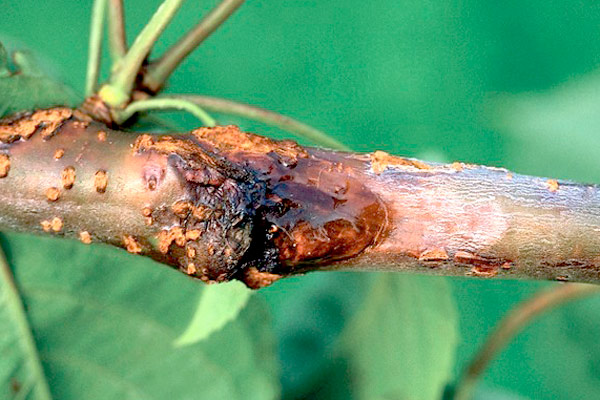
Immediately after harvest, upon establishing damage from bacterial canker /blight/, caused by the bacterium Pseudomonas syringae, in sweet cherry and sour cherry, infected branches and twigs are cut out. This period is most suitable for carrying out sanitary pruning, because the trees are in active vegetation and the plants’ defence capacity is higher, while the bacterium has low activity and during this month does not cause new infections. After pruning, the wounds are coated with oil-based paint.
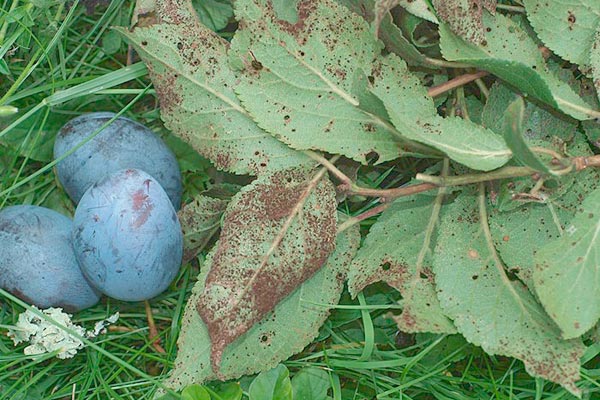
In plum, in August control is carried out against late brown rot and rust. Against brown rot, spraying is done with one of the fungicides: Difcor 250 EC – 20 ml/da, Captan 80 WG – 150-180 g/da, Chorus 50 WG – 0.045%, Geoxe - 40-60 g/da. Against rust, Signum WG – 45 g/da is approved, which is also effective against brown rot. Against rust in plum, Signum WG – 45 g/da is approved, which also acts against brown rot. Early-ripening plum cultivars are sprayed with fungicides with a short pre-harvest interval. Chorus, which has a 28-day pre-harvest interval, is not used against late brown rot. Treatment with Luna Experience, which is approved for use in other stone fruit species, may be carried out.
Most of the peach cultivars widespread in our country have a ripening period from 10 to 30 August, and no spraying is carried out on them. For cultivars with a ripening period at the end of August – beginning of September, it is necessary to treat against brown rot with Delan 700 WDG – 0.05%, Chorus 50 WG – 0.045% or Luna Experience – 63-75 ml/da. Luna Experience is very suitable for this spraying, as it is also effective against powdery mildew and has the shortest pre-harvest interval.
Temperatures in August are high, which necessitates that spraying during this period be carried out early in the morning or late in the evening.
PESTS
If necessary, control of pests is carried out with plant protection products with a short pre-harvest interval, in accordance with the ripening and harvest period of the fruits.
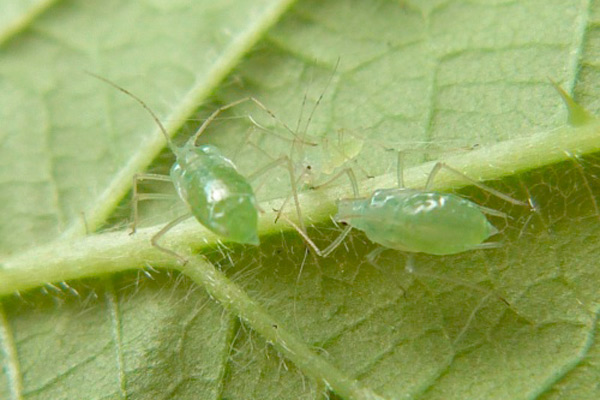
Aphids in fruit crops (fam. Aphididae)
Adults and larvae continue to cause damage by sucking sap from the leaves and from the terminal parts of the shoots. In August, high air temperatures and low atmospheric humidity suppress the multiplication of aphids.
Control: Spraying is undertaken at the economic threshold of harmfulness (ETH):
- Apple and pear: colonies of Aphis spp. - 10-15 per 100 shoots; colonies of Dysaphis spp. - 5 per 100 shoots.
- Peach: colonies – species of Myzus spp., Brachycaudus spp. - 5% infested shoots; colonies – species of Hyalopterus spp. - 15% infested shoots.
- Plum: colonies – species of Hyalopterus spp.- 15 per 100 twigs or 15% infested shoots
Approved plant protection products: a.i. tebufenpyrad - Shirudo 25 g/da; a.i. flonicamid - Teppeki 14 g/da, Afinto 14 g/da, Hinode 14 g/da; a.i. pyrethrins - Abanto 75 ml/da, Krisant EC 75 ml/da, Natur Breaker 75 ml/da, Pyreguard 75 ml/da for apricot, peach, plum and cherry; a.i. flupyradifurone - Sivanto Prime 90 ml/da for apple and pear, a.i. spirotetramat - Movento 100 SC 0.075-0.12% for apple and pear and 0.075-0.1% for apricot, peach, plum and cherry; a.i. sulfoxaflor - Closer 120 SC 20-40 ml/da for apple, pear, quince, peach and cherry; a.i. azadirachtin - Oikos 100-150 ml/da, Neemik Ten 260-390 ml/da for apple.
Pome fruit species
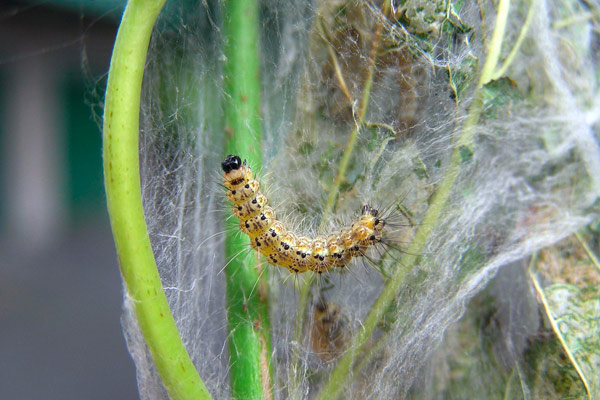
Fall webworm
In August, the development and harmful activity of the second generation of the pest continues. At first the caterpillars live in groups and feed on the leaves, skeletonizing them. Later they divide into small groups, wrap the leaves with web threads and form a nest. In case of mass infestation, the branches are entangled in web threads.
Control: At low density, the caterpillar nests are mechanically cut out, removed from the plantation and burned. Control is carried out against the caterpillars.
Approved plant protection products: All approved insecticides for control of codling moth and spotted tentiform leafminer, as well as bioproducts based on Bacillus thuringiensis, may be used.

Codling moth
From August to the end of September, the harmful activity of the caterpillars of the second generation continues. After hatching, they bore into the fruits and feed on the seeds in the seed chamber. As a result, the fruits fall prematurely. Damage from the caterpillars of this generation is the greatest.
Control: Chemical treatment is carried out at the beginning of egg laying with insect growth regulators and against the caterpillars before they bore into the fruits.
Economic threshold of harmfulness (ETH) - for the second generation: 1.5-2% fresh entries into the fruits.
Approved plant protection products: a.i. spinetoram - Delegate 250 WG 30 g/da; a.i. chlorantraniliprole - Coragen 20 SC 16-30 g/da, Voliam 16-30 ml/da; a.i. cypermethrin - Cyperfor 100 EC 30 ml/da, Sherpa 100 EC 30 ml/da, Aficar 100 EC 30 ml/da, Efcymetrin 10 EC 30 ml/da; a.i. emamectin benzoate - Affirm Opti 200 g/da; a.i. spinosad - Sineis 480 SC 20-30 ml/100 l water; a.i. Granulovirus – CpGV-V22 3 x 10¹³ granules/litre - Madex Twin 10 ml/da;
Spotted tentiform leafminer
In August, the third generation of the pest develops. The caterpillars bore into the parenchyma, making concentric circles, which they fill with excrement. As a result of the damage, the leaves fall, which affects fruit enlargement.
Control: Chemical control is carried out at ETH: 2-3 eggs and mines per leaf.
Approved plant protection products: a.i. chlorantraniliprole - Coragen 20 SC 16-30 g/da, Voliam 16-30 ml/da; a.i. emamectin benzoate - Affirm Opti 200 g/da; a.i. cypermethrin - Cyperfor 100 EC 30 ml/da, Sherpa 100 EC 30 ml/da, Aficar 100 EC 30 ml/da, Efcymetrin 10 EC 30 ml/da, a.i. chlorantraniliprole 45 g/l + abamectin 18 g/l - Voliam Targo 063 SC 75 ml/da and others.
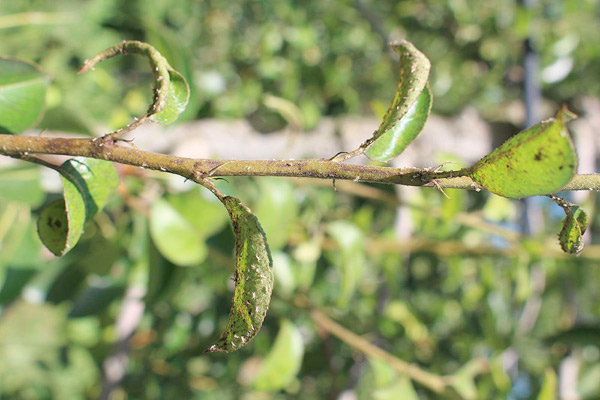
Pear psylla
During the month, mixed populations of adults, larvae and nymphs of the pest. are observed. They form dense colonies and suck sap from leaves, shoots and fruits, excreting “honeydew” on which sooty fungi develop. The affected leaves and shoots blacken, and the fruits lose their market value. Pear psylla causes not only direct damage but also transmits a dangerous mycoplasma disease that leads to drying and death of pear trees.
Control : From July to September, chemical control is carried out at ETH : 20-25% infested shoots or one larva per twig.
Approved plant protection products: a.i. tebufenpyrad - Shirudo 25 g/da; a.i. spirotetramat - Movento 100 SC 0.12-0.15%; a.i. spinosad – Sineis 480 SC 30-35 ml/100 l water and others;
San Jose scale
In August, the third generation of the pest develops. On the fruits red, round spots appear, in the centre of which the scale of the insect can be seen; on the branches and trunks, anthocyanin spots are observed.
Control: Setting pheromone traps to detect the appearance of adults. Control is directed against the larvae at ETH: 10 per 100-cm twig or 2-3 infested fruits.
Approved plant protection products: a.i. sulfoxaflor - Closer 120 SC 40 ml/da.
European red mite
In August, harmful activity of the summer generations of the European red mite is observed. Damage is caused by larvae, nymphs and adults. They suck sap from the leaves, resulting in reduced chlorophyll content, which adversely affects photosynthesis. Under severe infestation, leaves dry up prematurely and fall.
Strategy for pest control: Treatment is carried out at ETH:
- Apple: 3-4 mobile forms per leaf.
- Pear: 3-4 mobile forms per leaf - at the beginning of fruit growth; 5-7 mobile forms per leaf - after the beginning of fruit growth.
- Peach - 4-5 mobile forms per leaf.
- Plum - 3-5 mobile forms per leaf.
Approved plant protection products: a.i. abamectin 18 g/l - Vertimec 018 EC 100 ml/da in apple, a.i. chlorantraniliprole 45 g/l + abamectin 18 g/l - Voliam Targo 063 SC 75 ml/da, a.i. hexythiazox 31.2 g/l + fenpyroximate 62.4 g/l - Nissorun Plus 120 ml/da.
Stone fruit species
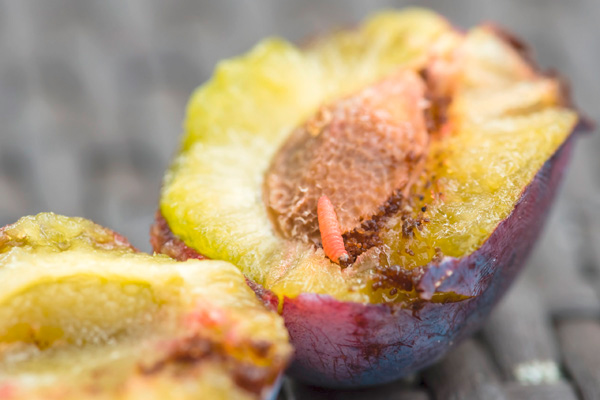
Plum fruit moth
In August, the moths of the third generation of the pest fly. The caterpillars bore into and feed on the fleshy part of the fruit, making galleries directed towards the stalk. The damaged fruits stop growing, acquire a violet tint and fall together with the caterpillars.
Control: Chemical treatment is carried out at the beginning of egg laying with insect growth regulators and against the caterpillars before they bore into the fruits.
ETH for the second generation: 1.5-2% fresh entries into the fruits;
Approved plant protection products: a.i. spinetoram - Delegate 250 WG 30 g/da; a.i. chlorantraniliprole - Coragen 20 SC 16-30 g/da, Voliam 16-30 ml/da; a.i. emamectin benzoate - Affirm Opti 250 g/da.
Oriental fruit moth
In August, the moths of the fourth generation fly and lay eggs. The caterpillars bore into the fruits. In stone fruit species, the caterpillars feed on the fleshy part, which subsequently becomes sunken and soft. In pome fruit species, unlike the codling moth, the caterpillars feed on the fleshy part without affecting the seeds.
Control: Chemical treatment is carried out at the beginning of egg laying with insect growth regulators and against the caterpillars before they bore into the fruits.
ETH:
-during the vegetation period – 10-15 moths/trap/week;
-young orchards – 2-3% infested shoots by the caterpillar;
-fruit-bearing orchards - 5% damaged shoots or 2-4% infested fruits by the caterpillar.
Approved plant protection products: a.i. spinetoram - Delegate 250 WG 30 g/da; a.i. chlorantraniliprole - Coragen 20 SC 16-30 g/da, Voliam 16-30 ml/da; a.i. chlorantraniliprole 45 g/l + abamectin 18 g/l - Voliam Targo 063 SC 75 ml/da; a.i. emamectin benzoate - Affirm Opti 200-225 g/da; Granulovirus – CpGV-V22 3 x 10¹³ granules/litre - Madex Twin 10 ml/da.
Peach twig borer
In August, the caterpillars of the third generation of the pest cause damage by destroying the interior of young fruits, and in larger fruits they make a short gallery in the fleshy part.
Control: Upon reaching ETH: 3% damaged shoots and fruits by the caterpillar.
Approved plant protection products: a.i. chlorantraniliprole - Coragen 20 SC 16-30 g/da, Voliam 16-30 ml/da; a.i. chlorantraniliprole 45 g/l + abamectin 18 g/l - Voliam Targo 063 SC 75 ml/da; a.i. spinosad - Sineis 480 SC 20 ml/da.
Cherry leaf sawfly
In August, sawflies of the third generation fly. After hatching, the false caterpillars move to the upper side of the leaves and skeletonize them, gnawing the upper epidermis and parenchyma without affecting the lower epidermis. The damaged leaves turn yellow, brown and fall.
Control: Treatment is carried out against the false caterpillars immediately after hatching.
Approved plant protection products: There are no officially registered products; all insecticides for control of plum fruit moth and peach twig borer may be used.