

![MultipartFile resource [file_data]](/assets/img/articles/белокрилка-заглавна-1.jpg)
With the ongoing climate change, a large part of the insect vectors of viral diseases manage to overwinter and preserve the infection, thereby infecting many vegetable crops at the very beginning of vegetation, which negatively affects the final results. The relationship host plant – virus – vector is quite complex and still a challenge for science. Monitoring is a main and important element in the overall crop protection system. It is necessary to regularly survey the fields not only to detect pests, but also to observe the plants as a whole. Symptomatology is the signal that makes us think that there is a problem in the crop.
Sucking insects, thrips, whiteflies as well as aphids, in addition to the direct damage to plants, can also cause indirect losses as vectors of viral diseases. Viruses that are often transmitted lead to significantly greater losses than those caused as a result of pest damage. To reduce the risk from them, regular monitoring must be carried out and the necessary plant protection measures must be taken in a timely manner.
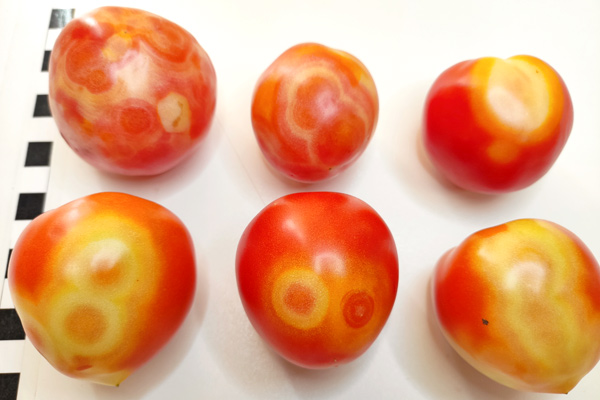
Tomato spotted wilt virus (TSWV)
Some of the most common viral diseases in vegetable crops transmitted by pests are: Tomato infectious chlorosis virus (TICV) – vector greenhouse whitefly (Trialeurodes vaporariorum); Beet pseudo-yellows virus (BPYV) - vector greenhouse whitefly (Trialeurodes vaporariorum); Cucumber mosaic virus (CMV) – vector peach potato aphid (Mysus persicae); Tomato spotted wilt virus (TSWV) - vector western flower thrips (Frankliniella occidentalis) and onion thrips (Thrips tabaci).
Growers most often notice the symptoms when they are in an advanced phase and are most distinct compared to normally developed plants in the crop. In different crops, although symptoms have their nuances, to a greater or lesser extent we can characterize them as follows: symptoms related to changes in leaf coloration or in their shape and size; symptoms related to coloration of fruits, their shape and size; symptoms affecting the overall development of the plant.
Where and when should we look for the first signs of a viral disease?
Naturally, as soon as emergence and development of the first leaves start, vegetable plants become a target of attack by various pests. For example, in pepper and tomato, the cotyledons are the first organs on which we can observe chlorotic spots and/or chlorotic concentric rings resulting from infection with tomato spotted wilt virus conveniently transmitted by thrips. At later stages of development, during transplanting or shortly thereafter, we can observe small brownish spots on tomato leaves, which increase and cause the so-called bronzing, often leading to plant death before flowering. In pepper at seedling stage we can detect the mentioned concentric chlorotic rings or fine mosaic and netting of the leaves. On pepper and tomato fruits, spotting in the form of the above-mentioned concentric rings predominates, which may also become necrotic.
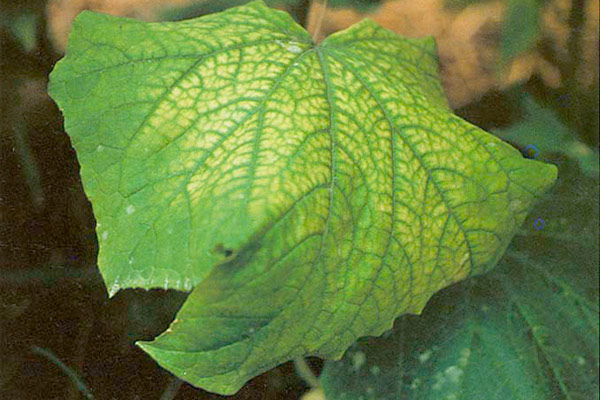
crinivirus (tomato yellows)
Over the last 20 or more years in Bulgaria, a phenomenon has been observed in greenhouse tomatoes, associated with vein clearing of the young leaves and strong yellowing of the interveinal areas of the older leaves. Such a phenomenon is most often associated with physiological disorders and imbalance in plant nutrition with macro- and microelements. However, the presence of whitefly in the crop alerts for the occurrence of crinivirus (tomato yellows). Similar yellowing can also be observed in representatives of the Cucurbitaceae family – cucumbers, melons, pumpkins, resulting from infection with a virus from the same group.

Another common symptom on plant leaves is the so-called mosaic. It usually affects the apical young leaves, which may be mottled in shades of green or in yellow and green. The mosaic is often accompanied by leaf deformation in the form of blisters on the leaf blade (convex and/or concave). Similar phenomena are observed in almost all vegetable crops. In more severe cases, the individual lobes of the leaves become pointed, and the leaf blade is strongly reduced; then we speak of leaf filiformity. A particularly problematic case during fruit harvesting is the occurrence of deformations of various sizes and coloration. For example, in zucchini, the fruits are often covered with scabs and/or other malformations in addition to their reduced size. In other cases (pepper, tomato), necroses in the form of sunken or raised deformations with light or darker coloration compromise the commercial appearance of the fruits. The cause of the above-described symptoms are viruses (for example cucumber mosaic virus), transmitted by various species of aphids.
Let us consider the diversity and specificity of the different pests – vectors of viral diseases:
Aphids
Aphids damage plants by sucking sap from their vegetative parts. They prefer younger and tender plant tissues. They concentrate on the shoot tips and branches, on leaves and flower buds. Damage: deformation; chlorosis; leaf drop; stunting in growth and development; contamination of the produce – with cast skins and “honeydew”, sooty saprophytic fungi, disruption of photosynthesis; vectors of viral diseases.
Common aphid species in vegetable crops:
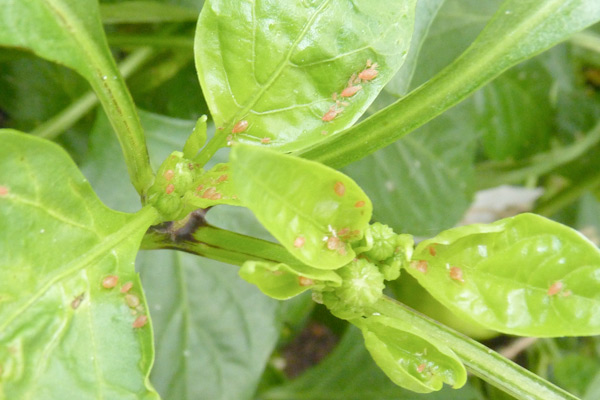
Peach potato aphid (Myzus persicae Sulz.)
The peach potato aphid has adapted to continuous parthenogenetic reproduction. The number of generations can reach 47. In the open it overwinters as egg on peach. It damages pepper, tomato, eggplant, potato, lettuce, cabbage, etc. M. persicae is the most important vector of viral diseases, and it has been proven to transmit over 100 plant viruses. It is a vector of cucumber mosaic virus. This virus is transmitted by another 60 aphid species including Acyrthosiphon pisum and Aphis craccivora.
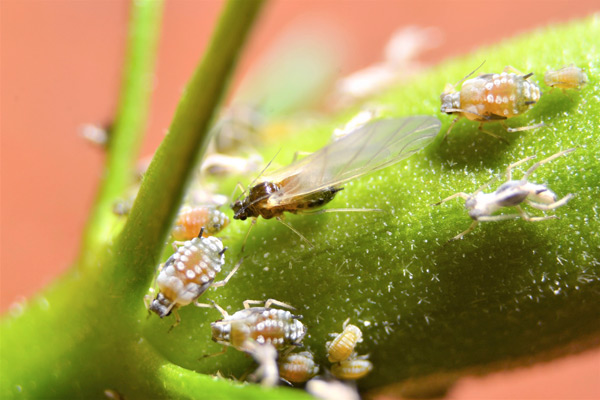
Cotton aphid (Aphis gossypii Glov.)
The cotton aphid overwinters as wingless female and larva in ant nests. On cucumbers it develops 31 generations, and on pumpkins in the open up to 18. It is a highly polyphagous species. Among vegetable crops it heavily attacks pumpkins, cucumbers, watermelons, melons, beans, etc. It is a vector of viral diseases such as common bean mosaic and potato mosaic.
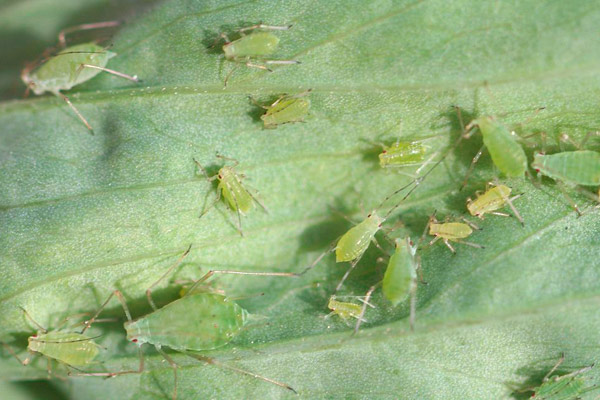
Pea aphid (Acyrthosiphon pisum Harr.)
At mass infestation, the pea aphid causes the most severe damage at the beginning of flowering of peas. It damages pea, vetch, broad bean, sainfoin and others. It is a vector of the viral disease pea mosaic.
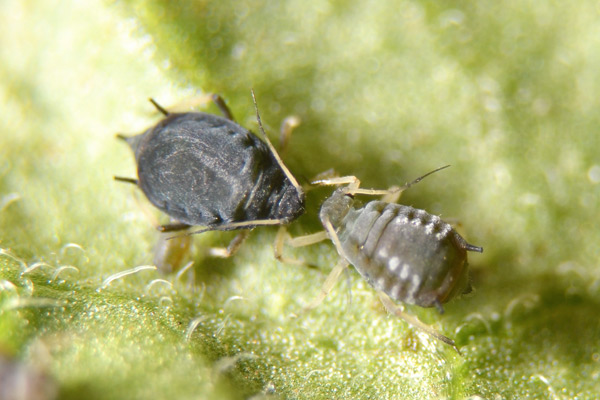
Black bean aphid (Aphis fabae Scopoli)
Hosts are bean, broad bean, tomato, pepper and others. Its primary hosts are spindle tree and guelder rose. It develops 6-7 generations. The black bean aphid is a vector of bean yellow mosaic virus (also transmitted by 20 other aphid species including Acyrthosiphon pisum, Macrosiphum euphorbiae, Myzus persicae) and common bean mosaic virus (also transmitted by Acyrthosiphon pisum, Aphis craccivora, Myzus persicae).
Aphids are characterized by sexual and asexual reproduction. The sexual generation appears in autumn. The aphids lay fertilized overwintering eggs. In spring, larvae hatch from them, adults called fundatrices. The fundatrices reproduce larvae parthenogenetically, forming fundatrigenous generations. The offspring of the fundatrices consist of wingless forms, which reproduce without fertilization (virginoparae), and winged viviparous females (migrants). In migrating aphids the migrants move from the primary host to secondary hosts. There, by parthenogenetic reproduction, they give rise to a number of generations called virginogenetic. In non-migrating aphids, the migrants move to plants of the same species. In autumn, when the weather cools, winged forms called remigrants appear in the colonies; in migrating aphids they return to the primary hosts and give birth to sexual individuals. When they give birth to females and males, they are called sexuparae; when they give birth only to males – androparae; and when they give birth only to females – gynoparae. Sexual females are often wingless. After fertilization they lay the overwintering eggs. Such aphids overwinter as egg on the primary host for the given species and have a holocyclic type of development. Another type of aphids reproduce only parthenogenetically without overwintering on primary hosts. They exhibit an anholocyclic development.
A large part of plant viruses depend on vectors for their transmission and survival. Insects are the most common vectors and among them aphids participate in the transmission of 50% of insect-transmitted viruses. Aphids are exquisitely designed for their role as vectors. They are distributed worldwide and there are more than 200 identified vector species. A number of characteristics of aphids contribute to their success as vectors of plant viruses. These include:
- The polyphagous nature of some aphid species, which allows them to feed on a wide range of plant hosts (wild and cultivated species), which they infect with viruses;
- The ability to reproduce parthenogenetically, facilitating rapid production of large numbers of offspring;
- The sucking mouthparts facilitate the delivery of virions into plant cells without causing visible damage.
According to their mode of transmission, phytopathogenic viruses are divided into three main groups: Persistent; Non-persistent; Semi-persistent. This classification is based on the period during which vectors that have acquired the virus remain viruliferous. Later, the concepts of circulative instead of persistent and stylet-borne instead of non-persistent viruses were introduced, which more accurately express the mechanism of transmission.
Persistent viruses
The characteristic features of persistent viruses, apart from their prolonged retention in the organism (sometimes until the death of the vector), are as follows:
- For the virus to be acquired, the vector must suck sap for a longer time (10-15 min acquisition period or period of acquisition).
- For the vectors to become infectious, another period must elapse, called the incubation, latent or circulative period, from 1/2 to 14 days.
- This is followed by a period of virus retention – retention period during which the vector is infectious. It is also prolonged, often until the death of the insect. In larvae it covers all their stages; during moulting they do not lose their infectious capacity. In infectious individuals the presence of virus in the haemolymph (blood) and also in other organs can be detected.
Vectors of persistent viruses occur in all groups, most often leafhoppers, thrips, whiteflies, mites and nematodes – unlike non-persistent viruses, which are transmitted mainly by aphids.
Non-persistent viruses
They are present in the body of the vector for a short time (a few hours) and are characterized by the following:
- The virus is acquired by the vector within a few seconds, which is facilitated by prior starvation;
- Immediately afterwards the vector is capable of infecting other plants, for which a short (often a few seconds) period of sap sucking on them is sufficient;
- The acquired infectious capacity is also lost quickly – sometimes after 30 min. The infectious capacity is also lost after larval moulting. No viral particles can be detected in the haemolymph or other organs of the infectious insect.
This group comprises the largest number of vector-transmitted viruses known so far. The different persistence of retention depends on the virus species, the vector species, the donor plant of the virus, in which it occurs in different concentrations, and the time of its infection. The vectors are aphids.
Semi-persistent viruses
They occupy an intermediate position. They differ from persistent viruses in that the vector loses its infectiousness during moulting, and from non-persistent viruses in having a longer period of virus acquisition and retention. The period of virus acquisition is 5-10 min. The acquired infectiousness is retained for up to several days.
This group includes cauliflower mosaic virus, which under certain conditions can be transmitted both in a non-persistent and in a persistent manner. It is massively spread by aphids (mainly the peach potato aphid and the cabbage aphid).
Transmission of viruses by vectors may be:
- External transmission – carried out solely due to contamination of the stylet of the vector (corresponds to non-persistence);
- Regurgitative transmission – the acquired virus is retained for a prolonged period in the foregut of the vector and is transmitted to a healthy plant after regurgitation of the stomach contents;
- Circulative transmission – for the vector to become infectious, the acquired virus must pass along a certain pathway (circulate) within the body of the vector and reach the mouthparts, without replication of the virus necessarily occurring;
- Propagative transmission – the acquired virus replicates in the body of the vector, which as a result remains highly infectious for a prolonged period.
The mechanism of virus acquisition, retention and transmission is best studied in persistent viruses. It has been established that the virus particles acquired during sucking move to the intestinal tract. Through its walls they pass into the haemolymph, from where they return to the salivary glands and are injected into healthy plants via the saliva.
In many cases (mainly in leafhoppers and nematodes, and among aphids – in potato leaf roll virus) it has been proven that the acquired virus replicates in the haemolymph and in some organs of the vector. This process explains the properties of persistent viruses: the need for prolonged sucking, the presence of an incubation period, and the prolonged (often until the end of life) retention of the virus in the vector. It also explains the varying degrees of transmission of one and the same virus by different vector species, as well as the existence of forms in which some vectors cannot transmit a given virus. In the latter case, the acquired virus particles cannot pass through the intestinal wall to move into the haemolymph and saliva. The inability of the ingested particles of tomato spotted wilt virus to pass through the intestinal wall of adult thrips (they pass only through the intestinal wall of larvae) explains why only larvae acquire the virus, although adults can also be viruliferous. Another characteristic feature of many persistent viruses is their ability to be transmitted to the progeny via eggs.
The mechanism of transmission of non-persistent viruses is less clear. Their characteristic features rule out the possibility of virus movement within the insect and even more so of replication in it. For these viruses, the generally accepted view is that during sucking from diseased plants their particles adhere to the setae of the stylet or in the food canal of the stylet, and when the aphid moves to a healthy plant, the virus particles are introduced into it through the stylet. In this case, vectors are considered as a passive syringe injecting the virus.
The course of non-circulative and circulative viruses during acquisition by aphids: Plant fluids are initially taken into the food canal in the stylet bundle, which descends down the centre of the rostrum. The food canal and foregut are sites of retention for non-circulatively transmitted viruses; the bound virions are subsequently released during inoculation. In circulatively transmitted viruses, virions pass through the alimentary canal (food canal, foregut, midgut, hindgut), haemocoel and accessory salivary gland of the aphid before exiting through the salivary canal. At the tip of the stylet, the salivary canal merges with the food canal. Circulative viruses are further classified as circulative non-propagative (non-replicative) or circulative propagative (replicative), depending on whether the acquired virus replicates in the vector. Non-circulative viruses have a more superficial and transient association with the vector and bind only to the mouthparts and foregut.
Some non-persistent plant viruses cause metabolic changes in infected plants, leading to the emission of volatile organic compounds that attract aphids. In this situation an aphid may be attracted to the infected plant, but brief feeding and ingestion of the contents of epidermal cells reveals to the insect that the viral infection has led to the accumulation of repellent compounds. This deters the aphid from settling and causes it to move to other plants to find a more suitable host. In this way, “attraction and deterrence“ increases the likelihood that an aphid will transmit inoculum to non-infected plants.
Viruses can make plants more attractive to insects. Recent studies show that viral infection can influence the volatile compounds produced by plants, which in turn can attract insects. In some cases, plants infected with viruses are better hosts for insects (transmitted in a persistent manner), leading to increased feeding, while in other cases virus-infected plants are poor hosts and insects leave quickly after feeding on the plants (non-persistent transmission).
Other studies have found that plant viruses alter insect behaviour. Aphids that have already acquired the virus are attracted to uninfected plants, while aphids that have not acquired the virus are attracted to infected plants, another remarkable behavioural modification that can enhance virus spread.
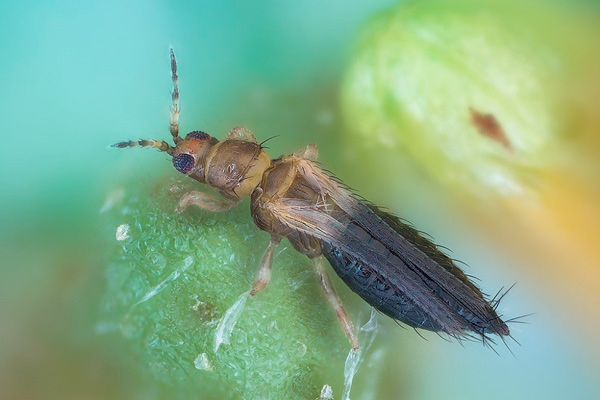
Thrips
Damage can appear on leaves, stems, buds, fruits and flowers. Thrips suck out plant cells and green chlorophyll. The feeding spots caused by thrips turn white because the tissue underneath has been excavated. However, the epidermis and cell walls remain intact. A kind of window is formed, which lets light through. The main symptoms are as follows: leaves have spots that are silvery-white, later turning brown; the leaf loses its thickness (paper-like); petals may develop dark streaks and spots, the so-called “color breaking“ appears, shedding occurs; ovaries and fruits become deformed; fruits become streaked with brown to silvery scars; at oviposition or feeding, spots of lighter “halos“ may appear at the puncture site; plants become stunted in their development.
In vegetable crops, tobacco thrips (Thrips tabaci) and Californian (western flower) thrips (Frankliniella occidentalis) are found. Thrips develop 8-10 generations per year; they overwinter mainly as adults; females lay their eggs in the parenchyma, just beneath the epidermis of leaves, petals or fruits; first-instar larvae are highly mobile and prefer leaves and the vegetative apex; during the second instar their mobility decreases; nymphs do not feed and are immobile, this stage takes place in the soil. Thrips look like small dark “splinters” on plants. They have an elongated, spindle-shaped body. Their coloration ranges from yellow to brown or black, depending on the species or developmental stage; if you try to approach them, they will likely jump or fly away. They are difficult to see clearly without a magnifying glass. Shake plants or flowers over a white background (paper) to see them clearly. Thrips can be difficult to control effectively with insecticides, partly because of their mobility, high reproductive potential, feeding behaviour and protected egg and nymphal stages.
Thrips are vectors of tomato spotted wilt virus (Tomato Spotted Wilt Virus - TSWV). Once infected at larval stage, adult thrips usually transmit tospoviruses for life. Non-infected adult thrips cannot acquire the virus. Virus infection occurs during the 1st or 2nd larval stage, the virus circulates and replicates in the salivary glands of the thrips.
Both larval and adult stages of thrips are vectors that can actively feed on virus-infected host plants, but only early instar larvae can acquire the virus, and later late-instar larvae and adults can transmit the virus after a latent period. Thus, each new generation of thrips vectors must acquire the virus as larvae. Adults transmit the virus to plants for the rest of their lives but do not transmit it transovarially (to their eggs).
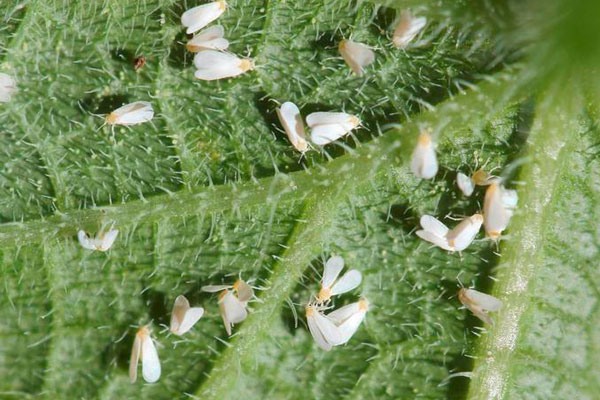
The greenhouse whitefly (Trialeurodes vaporariorum) is an extremely broad polyphage. It develops 10-12 generations per year. It overwinters on crops grown under cover. From there, in spring, it migrates into the field. Larvae and adults cause damage. They usually develop on the underside of leaves. During feeding, whiteflies secrete „honeydew”, as a result of which leaves become sticky and sooty mould fungi develop on them, which hinder photosynthesis. In addition to direct damage, they also transmit some viral diseases.
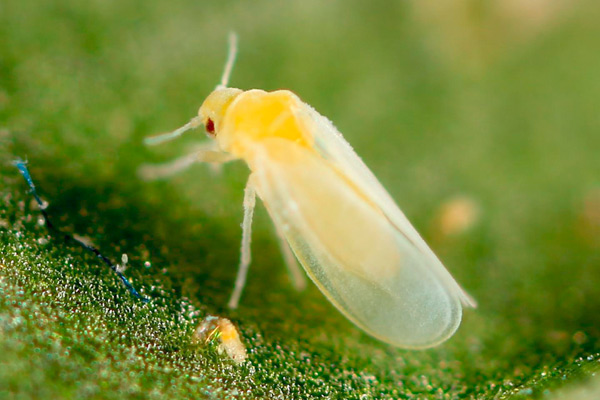
The tobacco whitefly (Bemisia tabaci) is still a quarantine pest for the country. Differences between the greenhouse whitefly and the tobacco whitefly:
- In adults of B. tabaci the wings resemble sails folded along the sides of the body, so the yellow-coloured body is more clearly visible.
- Females of B. tabaci lay their eggs randomly or singly, whereas the greenhouse whitefly lays its eggs in groups arranged in a circle.
- Larvae are difficult to distinguish.
- Nymphs differ in coloration, and in B. tabaci they lack wax filaments.
Viruses belonging to the genus Crinivirus are transmitted from plant to plant by whitefly vectors in a semi-persistent manner and have spread worldwide following a general increase in whitefly populations in many countries. Tomato chlorosis virus (ToCV) and tomato infectious chlorosis virus (TICV) are two criniviruses that have emerged worldwide and cause serious problems in tomato. While TICV is transmitted only by Trialeurodes vaporariorum, ToCV is transmitted by three whitefly species in two genera: Trialeurodes vaporariorum, T. abutilonea and Bemisia tabaci. Whiteflies are vectors of various economically important plant viruses such as Begomovirus, Geminivirus, etc., and transmit viral particles in a persistent and semi-persistent manner.
The epidemiology of vector-borne plant viruses includes the plant, the pathogens, the vectors, the environment and their interactions. Viruses survive under unfavourable conditions in alternative hosts such as annual and perennial weeds, abandoned crops and vegetative plant parts. Persistently transmitted viruses can also survive in the insect vector. Viruses are often transmitted via vegetative plant propagation when infected plants are used as a source. The interaction of host plants, vectors and viruses in a changing environment are the three main components of the “disease triangle“ and are subject to interactions that influence disease trajectories in crops. The epidemiology of vector-borne plant pathogens is often a complex process. More than one approach may be required to achieve adequate vector control.
Control measures should be based on reliability, epidemiological principles and deployment within integrated approaches that include phytosanitary measures, resistance of host plants, chemical and biological means. Integrated strategies should target vulnerable stages in the virus/vector/crop cycle. Cultivated plants cannot be cured once they are infected by a virus, so efforts to control viruses focus on prevention and reduction of infection and spread. Furthermore, there is no “one-size-fits-all“ approach to the management of all viral diseases, as different diseases have different ecological and epidemiological characteristics.
General options for managing insect vectors can be grouped into four components as 1) reducing populations of insect vectors; 2) reducing sources of viruses; 3) interfering with vector landing; 3) interfering with the transmission process.
Insecticides are more effective against persistently transmitted viruses because insects die before they have time to acquire and transmit the virus. Vectors of non-persistent viruses will be killed after feeding on plants sprayed with a systemic insecticide. These viruses can be transmitted within seconds, and many plants become infected before the insect dies. Some insecticides can excite insects and encourage movement and feeding on a larger number of plants, leading to increased transmission rates. The use of contact, fast-acting insecticides is a good solution depending on the specific situation. Alternating plant protection products with different modes of action is advisable; in this way the emergence of resistant populations is also avoided.
Preventive measures:
- Use blue and yellow sticky traps, pheromone traps. Install insect-proof nets in seedling compartments and greenhouses.
- Do not overfertilize plants, as this may lead to more damage. Avoid excessive application of nitrogen fertilizers;
- Keep plants well irrigated;
- Reflective mulches can help provide protection. Silver, grey and white films are suitable and most effective in terms of colour. They interfere with the ability of flying insects to locate plants;
- Grow plants that are well adapted to local conditions;
- Use resistant varieties;
- Destroy weeds that serve as a reservoir for viruses and as a refuge for vectors such as aphids, thrips, whiteflies, etc.;
- Border crops with a strip that is cultivated and treated with insecticides;
- Crop rotation and spatial isolation;
- Use repellent plants.
Plant protection products for pest control – an approach to reducing the risk of viral diseases.
Aphids (fam. Aphididae) - Azatin EC 100-150 ml/da; Ampligo 150 SC 40 ml/da; Delmur 50 ml/da; Deltagri 30-50 ml/da; Closer 120 SC 20 ml/da; Mavrik 2 F 20 ml/da; Neemik Ten 390 ml/da; Oikos 100-150 ml/da; Sivanto Prime 45 ml/da; Teppeki/Afinto 10 g/da; Flipper 1-2 l/da; Shirodo 15 g/da.
Thrips (Thrips tabaci; Franklinella occidentalis) - Azatin EC 100-150 ml/da; Dicarzol 10 WP 556 g/da; Exalt 200-240 ml/da; Limocid 800 ml/da; Minecto Alpha 100-125 ml/da; Neemik Ten 390 ml/da; Oikos 100-150 ml/da; Requiem Prime 500-1000 ml/da; Sineis 480 SC 10-37.5 ml/da, Naturalis 100-150 ml/da.
Greenhouse whitefly (Trialeurodes vaporariorum) - Abanto 75 ml/da; Azatin EC 100-150 ml/da; Brai 50-112.5 ml/da; Limocid 400 ml/da; Closer 120 SC 20-40 ml/da; Chrysant EC 75 ml/da; Minecto Alpha 100-125 ml/da; Natur Breaker 75 ml/da; Neemik Ten 390 ml/da; Oikos 100-150 ml/da; Orocid Plus 80-800 ml/da; Pyregard 75 ml/da; Prev-Gold 160-600 ml/da; Requiem Prime 500-1000 ml/da; Sivanto Prime 56 ml/da; Naturalis 75-100 ml/da.
Monitoring and prevention in crops are key aspects of protecting vegetable crops from pests – vectors of viral diseases. Timely implementation of plant protection measures reduces losses. When carrying out treatments, the principle of rotation of plant protection products from different groups with different modes of action must be observed in order to avoid the risk of resistant populations emerging.