

![MultipartFile resource [file_data]](/assets/img/articles/заглавна-компост-1.jpg)
The recovery of biodegradable materials is a means of waste management and is a key element of the circular economy. Depending on the input materials and the decomposition conditions (aerobic or anaerobic), two products are obtained: compost and biogas. Compost is a product obtained mainly from the degradation of plant waste under aerobic conditions. Biogas is a product of the degradation of plant or animal waste under anaerobic conditions. Compost and biomass from biogas production can be used for fertilization, for improving soil structure and as a substrate for growing seedlings and flowers.
Composts may affect plant health positively or negatively depending on the type of organic substance, the nutrient content, the diversity of microorganisms and the composting conditions. With the application of the organic product in the soil, nutrients are supplied, microbiological activity is increased and microbiological populations with antagonistic action are created, which explains the suppressive effect against several types of soil pathogens (Pythium spp., Phytophthora spp., Rhizoctonia spp. and Fusarium spp.)
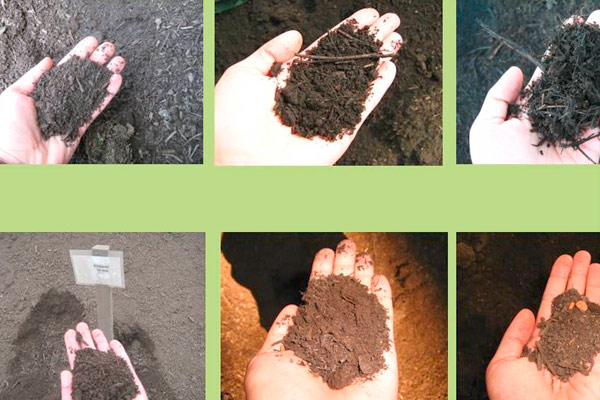
What is compost?
This is a solid product, brown to dark brown in colour, obtained from the aerobic degradation of organic materials. It is characterized by the presence of a vast number of microorganisms (bacteria, fungi, actinomycetes), as a result of which processes of degradation and formation of new compounds take place in the composting mixture. Compost must be treated as a living organism. High-quality compost has good agrochemical characteristics and improves the growing medium of plants, whereas low-quality compost may have a detrimental effect on them.
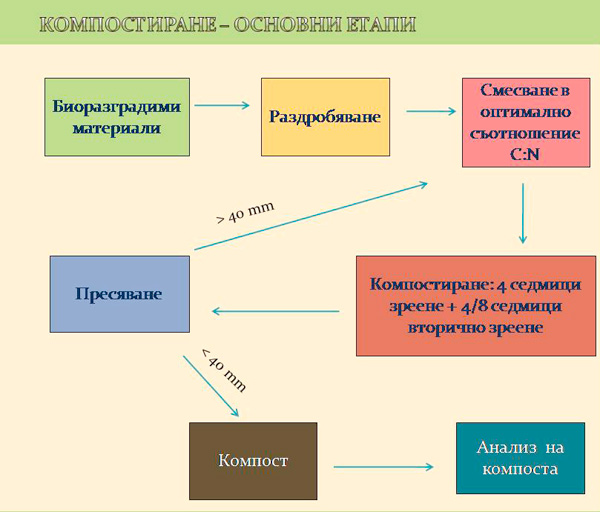
Main stages of composting
To ensure the production of quality compost, it is important to control the entire process from the collection of the green material to the storage and application of the final product.
The better the quality of the green material (fresh condition), the easier it is to produce compost. The green material should be collected and treated in the freshest possible condition.
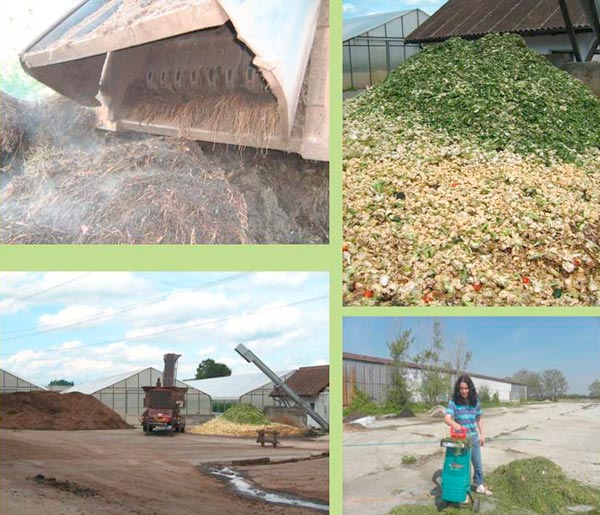
Shredding of plant materials is carried out by machines called shredders. The materials are cut or crushed depending on the working elements of the machine.
It is necessary to maintain a good structure of the composting mixture. It must be sufficiently loose to allow air access for the activity of microorganisms. Two problems may arise if the structure is not optimally compact: (1) no heat is released and (2) the composting material will dry out very quickly. The smaller the compost heap, the finer the structure of the materials should be and vice versa.
For a balanced course of degradation, the optimal C:N ratio must be observed. Both elements are particularly important for the life cycle of microorganisms and the composting process: carbon is a source of energy, and nitrogen is the basis for the formation of proteins. When the balance of the two elements in the composting mixture is disturbed, the process goes in an undesirable direction. When materials rich in carbon (dry) predominate, microorganisms do not have enough nitrogen to build up their population and the degradation of organic material cannot occur efficiently. In the second case, when the content of materials rich in nitrogen (fresh) is higher, it cannot be used effectively and undesirable odours are released. It is recommended that the composting mixture consists of 50–70% brown/dry materials – leaves, hay, branches, which are rich in C. They are the carbohydrates or energy food for the activity of microorganisms. Carbon dioxide is released. In the range of 30–50% of the biodegradable material heap should consist of green/fresh materials. They are juicy and moist and decompose very quickly. They contain nitrogen compounds that enable the multiplication of the microorganism population. Nitrogen is a key element in protein, which is necessary for the tissues of organisms. They are also a source of unpleasant odour during composting. Fresh materials should be mixed completely or in layers with dry brown materials. Too many green materials can lead to a sharp reduction in volume and compaction of the heap, thereby limiting oxygen access, the environment becomes anaerobic and rotting processes begin. As a result, the quality of the compost deteriorates, the product has an unpleasant odour and fermentation liquid is released.
To maintain an optimal balance of the composting mixture, up to 5% black materials – soil or old compost – should be included. They contain a large quantity of soil organisms and accelerate the composting process.
To build the compost heap, the different materials should be distributed in rows along the heap and then mixed with the compost turner so as to obtain a homogeneous mixture.
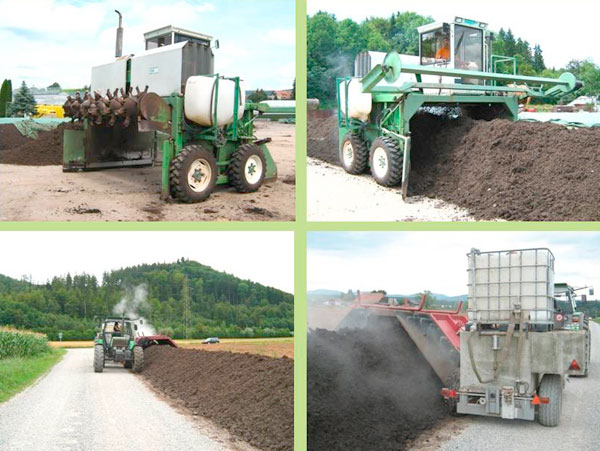
Mixing and moistening of the composting mixture
The two most important factors that must be controlled during composting are the moisture content of the material and the air supply/aeration. Moisture content can be determined by a manual field test. A small amount of material from inside the heap should be taken by hand and squeezed as hard as possible between the fingers. If water runs between the fingers, this is an indication that the compost is too wet. If, when the fingers are opened, the material falls apart, this is a sign that the compost is too dry. If the compost ball remains compact in the hand, then the moisture content in the compost is optimal.
The composting mixture needs a lot of water during the thermophilic phase. After the temperature drops, care must be taken when moistening the materials, because not much water evaporates and there is a risk that they will become too wet.
To ensure sufficient air, the composting mixture must be mixed periodically. The frequency of mixing depends on the materials and the size of the heap. At the beginning of fermentation, this should be done once or twice a week for about one month. Later, when biological activity decreases, the frequency of mixing can be reduced to once a week.
To monitor the activity of the process, it is important to measure the temperature periodically (twice each week) at the hot spot of the compost heap and to record it. The temperature data provide information on whether the fermentation is proceeding correctly and how advanced the process is. If the process proceeds correctly, the temperature in the heap at the beginning should be between 60°C and 70°C.
Mixing and moistening of the composting mixture are carried out simultaneously with specialized machines. At each mixing, the two indicators must be monitored: temperature and moisture.
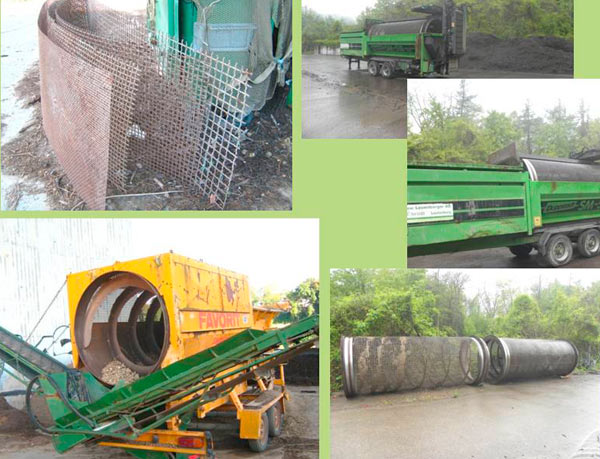
Screening of compost
The finished compost is screened through a sieve in order to remove coarser particles, which are returned again for further degradation in the composting heap.
The finished compost should have a particle size of 10 mm for fertilization and above 10 mm for improving soil structure.
At the end of the process, an analysis of the finished compost for the content of the main nutrients must be carried out and phytotoxicity tests must be performed.
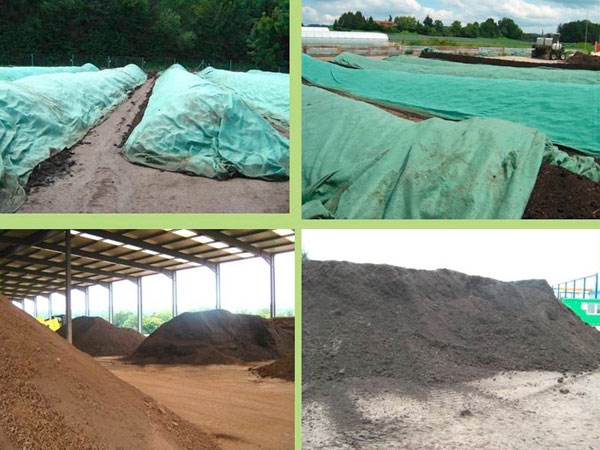
Storage of compost
During the storage of mature compost, aeration and moisture must be monitored. If the storage heap is higher than 200 cm, forced ventilation must be used. If the height of the heap is less than 200 cm, the air supply can be managed by turning the heap once a month. As regards moisture, it must be optimal and maintained within the range of 70–80% of field capacity in order for microorganisms to be active.
Compost is used as a fertilizer for open areas and as an enriching component in substrate mixtures for flowers and spice crops. The fertilization rate is recommended after analysis of the organic product for the content of the main nutrients, the soil nutrient status and the crop to be grown.
The process can be divided into three stages – decomposition, transformation and maturation.
Decomposition
In the first stage, microorganisms, mainly bacteria, participate, which in their life cycle use various chemical components of biodegradable waste. As they feed and multiply, they produce thermal energy that raises the temperature of the degrading materials. Microorganisms that develop well at this higher temperature take over the further degradation of the material until their food sources are exhausted. The decomposition phase with heat release is very important for killing pathogens and weed seeds in the compost.
Transformation
This stage begins when the temperature decreases due to reduced microbial activity at the end of the decomposition phase. In this process, fungi and actinomycetes participate, whose life activity takes place at a lower temperature and they complete the decomposition process. At this stage, most of the initial organic materials are already difficult to recognize.
Maturation
During this final stage, microbial activity subsides, the material cools down and provides an ideal environment for earthworms, insects and larvae to complete the process. The result is compost, a dark brown material with a pronounced soil-like smell.
Signs for recognizing finished compost
The finished product is dark brown in colour, a soil-like material with a specific soil aroma. It is homogeneous in structure.
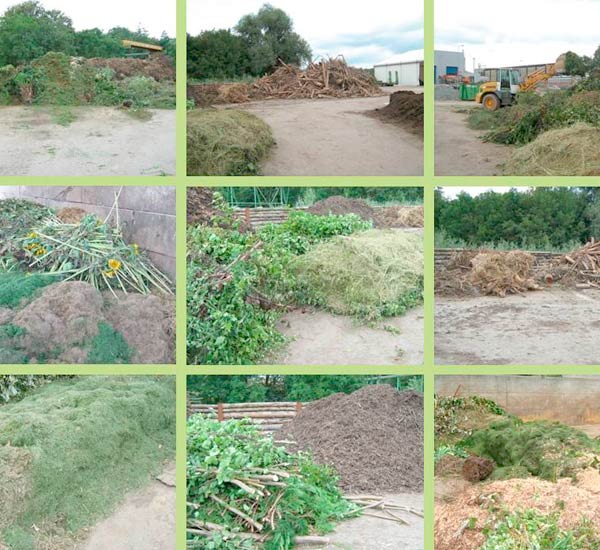
Biodegradable materials suitable for composting
Participants in the composting process
The beginning of the process starts with the activity of bacteria. They break down organic matter into a form assimilable by other organisms. For the process to proceed successfully, the conditions under which the highest bacterial activity is maintained must be monitored: optimal moisture and high temperature.
Actinomycetes develop mainly on woody materials. They give the compost its specific smell. As a result of their biochemical activity, they release antibiotic substances that kill certain pathogenic microorganisms.
Many types of mould fungi develop in the composting mass. The decomposition processes carried out by them are slower compared to those of bacteria. Their presence in the composting material means that the compost is developing well.
Worms are secondary decomposer organisms. Two types of worms are found in the composting mass: earthworms and tiger worms. Earthworms move in and out of the composting heap, while tiger worms live in the composting material itself.
Other participants in composting are: centipedes, slugs and snails, woodlice, ants, etc.
Requirements for compost quality
In Bulgaria, the “Ordinance on the Treatment of Biowaste” is regulated by Decree No. 235 of 15 October 2013, published in the State Gazette, issue 92/2013:
https://eea.government.bg/bg/legislation/waste/naredba-trbio/Nar%20za%20tretirane%20na%20BioO.pdf
The ordinance provides a description of the permissible biowaste for the production of compost and fermentation product. The quality requirements for the final product are indicated, specifying the limit values for the content of heavy metals in compost and the content of sewage sludge in the fermentation product. Guidelines are given for sampling protocols. Analytical methods are described for testing compost, fermentation product, organic soil improver and stabilized organic fraction from MBT and internal quality control (CEN standards). Guidance is provided for documentation and record keeping. The requirements for labelling of the packaging of compost, fermentation product, organic soil improver from the composting and anaerobic digestion process and the stabilized organic fraction from MBT are presented, as well as requirements for the information for the end user.
By Council of Ministers Decree No. 20 of 25.01.2017, the ORDINANCE ON SEPARATE COLLECTION OF BIOWASTE AND TREATMENT OF BIODEGRADABLE WASTE was adopted, which was published in the State Gazette, issue 11 of 31 January 2017, as amended and supplemented in the State Gazette, issue 47 of 5 June 2018, and as amended and supplemented in the State Gazette, issue 2 of 8 January 2021.