

![MultipartFile resource [file_data]](/assets/img/articles/заглавна-неприятели-царевица-1.jpg)
Maize is subject to attack by many pests that have a significant impact on yield formation and product quality, which is why the problems they cause are becoming increasingly important. Timely implementation of control measures against them is of great importance and, in order to be effective, must be based on a complex of activities, including a number of agrotechnical measures.
The phytosanitary status of the new areas where maize will be sown is of particular importance. In the field margins, ditches, borders and roadside sections, the destruction of weeds is a mandatory measure. These provide insects with favourable conditions for development and multiplication. In some cases, viral diseases accumulate there, which pests with piercing-sucking mouthparts can transmit into the crops.
To realise the biological potential of the varieties, good soil preparation, observance of crop rotation, sowing at optimal dates and at the required depth, balanced fertilisation with nitrogen, phosphorus and potassium fertilisers, and observance of spatial isolation – a minimum distance of 1 km – are necessary. To limit the spread of weevils around the fields, perimeter ditches with a depth of 30 cm are made. This measure is particularly effective against the grey beet weevil, which is unable to fly. If all these measures are carried out on time and with good quality, they can ensure a stand with optimal density.
Before sowing, the density of soil-dwelling pests (wireworms, false wireworms, white and grey grubs) must be determined.
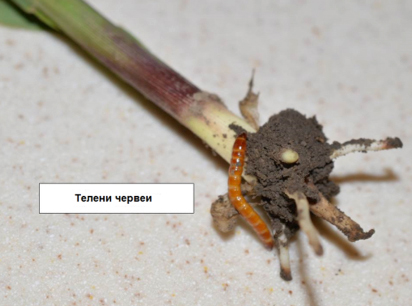
The larvae of beetles of the family Elateridae are called wireworms because their bodies are strongly chitinised and resemble a piece of rusty wire. The adult insects are known as click beetles or skipjacks because, when placed on their backs, the beetles jump and produce a sound similar to the tapping of a small hammer. Wireworms are among the most dangerous soil pests.
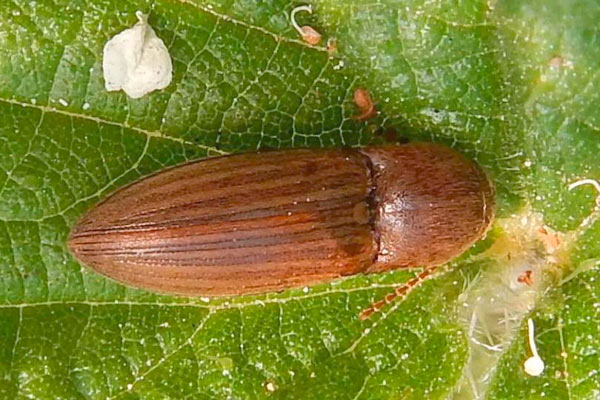
Common click beetle (Agriotes lineatus L.)
The following species are encountered:
Common click beetle (Agriotes lineatus L.)
Small click beetle (Agriotes sputator L.)
Dark click beetle (Agriotes obscurus L.)
Western click beetle (Agriotes ustulatus Schall.)
The most significant damage is caused by the larvae; they damage the sown seeds by gnawing and eating out the embryo and endosperm of the swollen seeds, leaving only the seed coat.
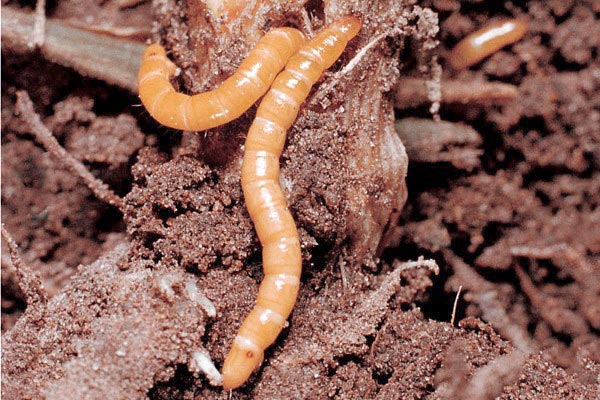
Larva of the common click beetle
In germinated seeds, the larvae damage the sprouts. The critical period for maize is from emergence to the formation of several leaves. At the 4th true leaf stage, the larvae also feed on the secondary roots. Damage is particularly severe during drought, when the larvae obtain not only food but also water from the plants.
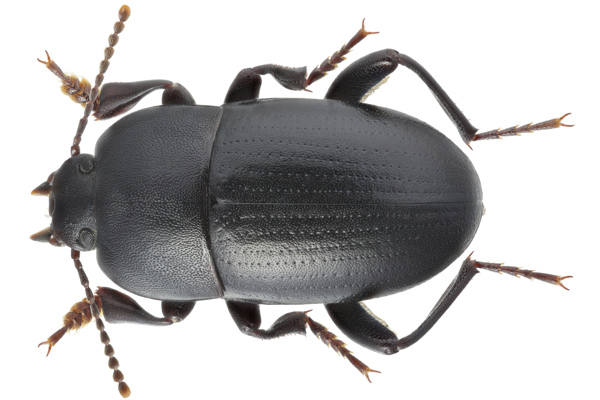
Maize darkling beetle (Pedinus femoralis L.)
False wireworms are often found in mixed populations with wireworms. These include the maize darkling beetle (Pedinus femoralis L.) and the common ground beetle (Opatrum sabulosum L.) Their larvae closely resemble wireworms. Their bodies are more lightly coloured, less strongly chitinised and the first pair of legs is longer than the other two pairs.
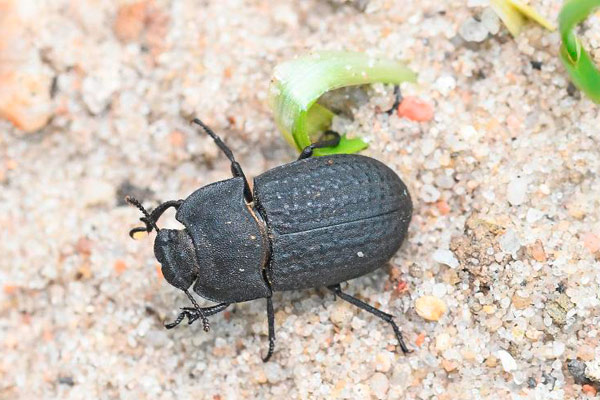
Common ground beetle (Opatrum sabulosum L.)
The beetles gnaw on young plants, the youngest tender leaves and the tender stems near the soil surface. Very often they gnaw or sever the growing point. As a result of this damage, a large proportion of young plants die. The stands are heavily thinned and yields decrease. The larvae live in the soil. They feed by eating out swollen seeds and the sprouts of young plants.
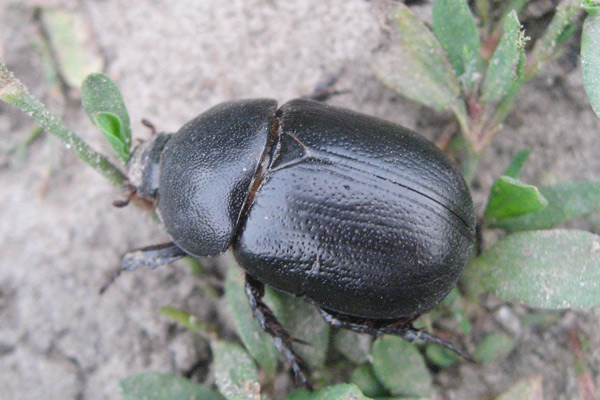
Maize dung beetle (Pentodon idiota Hrbst.)
Larvae of species of the genera Amphimallon, Anoxia, Melolontha, Pentodon and others (family Melolonthidae) damage the underground parts of maize. They prefer the underground stem, the roots and, less frequently, the lateral roots of the plants. Of these, the most important is the maize dung beetle (Pentodon idiota Hrbst.) The beetles gnaw the maize stems around the root collar in the form of small pits. In some cases, they sever them completely. As a result, the plants wilt, fall towards the damaged side and dry up.
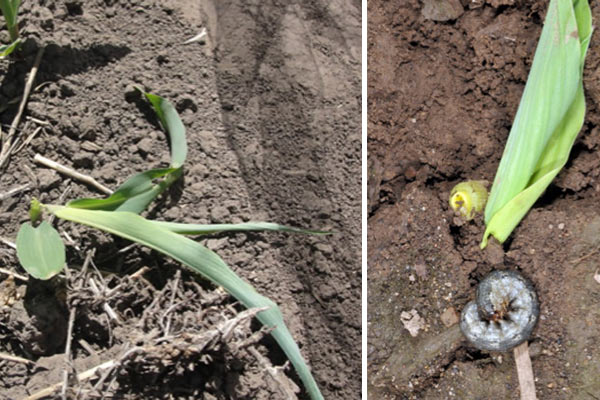
Damage caused by subterranean cutworm
Subterranean cutworms are also known as grey grubs. Species of the genera Agrotis and Euxoa are encountered. They destroy the sown seeds, gnaw the sprouts in the soil and sever the stems near or at the soil surface.
To assess the density of soil-dwelling pests (wireworms, false wireworms, grey grubs), soil excavations of 50 cm to 1 m in size and 25–30 cm in depth are carried out, and the numbers are converted per sq. m.
When densities of wireworms and false wireworms of 5–8 individuals/sq. m and of grey grubs of 0.2–0.4 individuals/sq. m are established, it is necessary to carry out chemical intervention. Pre-sowing seed treatment with insecticides from the group of synthetic pyrethroids may be applied: cypermethrin (Belem 0.8 MG/Colombo 0.8 MG – 1200 g/da), tefluthrin (Soilgard 1.5 GR – 1.22 kg/da; Force Evo – 1.2–1.6 kg/da), lambda-cyhalothrin (Ercole GR – 1000–1500 g/da; Trika Expert – 1000–1500 g/da). It is also possible to apply granular products using the applicators of the seed drills.
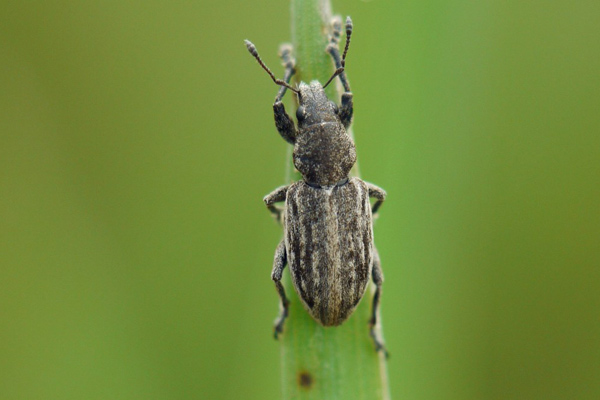
Grey maize weevil (Tanymecus dilaticollis Gyll.)
From maize emergence to the 5th–7th leaf stage, a serious threat is posed by the grey maize weevil (Tanymecus dilaticollis Gyll.) and the grey beet weevil (Tanymecus palliatus F.)
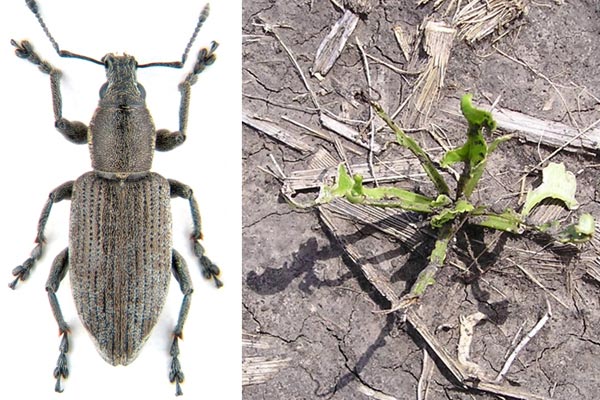
Grey beet weevil (Tanymecus palliatus F.) and damage caused by it
The beetles cause damage by gnawing the young shoots and stems below the soil surface, but most often by severing the stems above the soil. After leaf formation, they feed on the leaves, making coarse gnawing damage; at high densities they can destroy them completely, leaving only the central veins intact. After the appearance of the 3rd–4th leaf, the risk decreases, as the stems become tougher and the weevil feeds only on the leaves. The danger from the pest passes with the appearance of the 5th leaf.
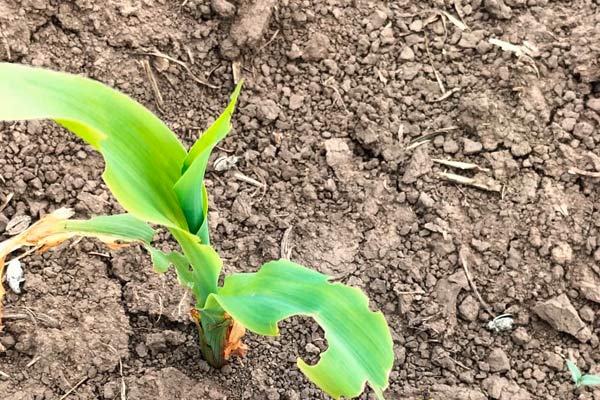
Damage by grey maize weevil (Tanymecus dilaticollis Gyll.)
The density of weevils (grey maize and grey beet) is assessed by the method of sample plots. A frame measuring 50 × 50 cm is used and 25 sample plots arranged in a checkerboard pattern across the field are examined. At a density of 2 individuals/sq. m or 40–50% damaged leaf area, treatment should be carried out with: acetamiprid (Mospilan 20 SP – 10 g/da).
In the 6th–8th leaf growth stage, monitoring of the crop continues for cereal leaf beetle, aphids, western corn rootworm and European corn borer. The density of these pests is determined by direct counting on individual plants.
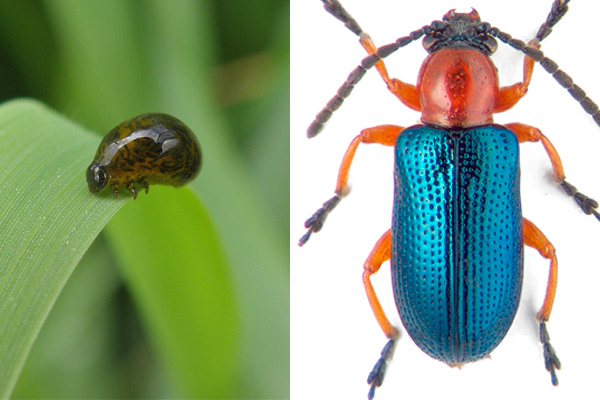
Cereal leaf beetle (Oulema melanopa L.)
The cereal leaf beetle (Oulema melanopa L.) also damages maize. The adults feed on the leaves, forming longitudinal strips and affecting both epidermises and the parenchyma tissue. The plants are depressed and lag behind in their development.
When cereal leaf beetle (O.melanopus.) is recorded at over 40–50 beetles per 10 plants, treatments with a contact insecticide should be carried out.
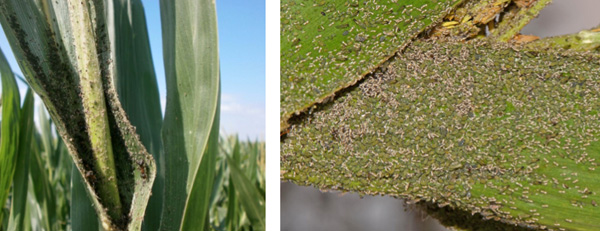
Apterous forms and damage by Rhopalosiphum maydis
Under favourable conditions, aphids multiply and form colonies most often on the leaves, the upper parts of the stems and the husk leaves of the cobs. After tasselling, if colonies are present on 10–15% of the plants in the crop, spraying is carried out with: deltamethrin (Deca EC, Desha EC, Dena EC, Poleci, Decis – 50 ml/da).

Adults of western corn rootworm (Diabrotica virgifera virgifera Le Conte.)
The occurrence and population density of adults of the western corn rootworm (Diabrotica virgifera virgifera Le Conte) are forecast using pheromone and ferocon traps.

Damage by western corn rootworm (Diabrotica virgifera virgifera Le Conte.)
When a high population density of beetles is established, at 10% silk emergence on the cobs, treatment is carried out with: deltamethrin (Deca EC/Desha EC/Dena EC, Poleci, Decis – 50 ml/da, Decis 100 EC – 7.5–12.5 ml/da), lambda-cyhalothrin + chlorantraniliprole (rynaxypyr) (Ampligo 150 ZC – 30 ml/da).
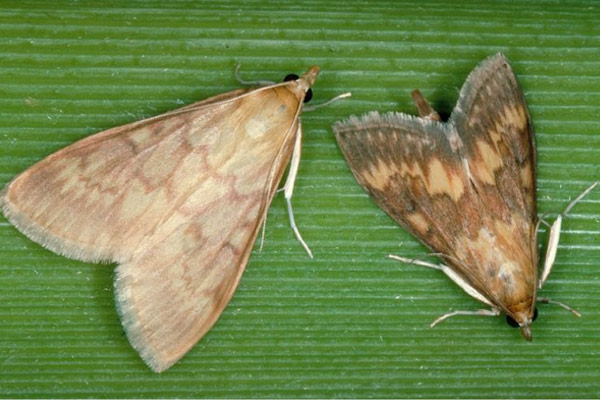
Female and male individuals of European corn borer (Ostrinia nubilalis Hb.)
Among the representatives of the Lepidoptera, an economically important species is the European corn borer (Ostrinia nubilalis Hb.)
Only the larvae cause damage. Initially, they feed in the leaf axils, then penetrate into the stem, where they gnaw galleries of various sizes. A significant proportion of the damaged plants break. The larvae also damage the tassel, feeding on the floral organs, and some of the larvae bore into the cob under the husk leaves and damage the kernels in the milk stage. Heavily damaged cobs die, while others remain underdeveloped.
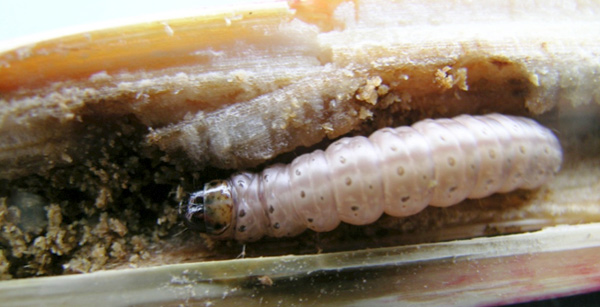
Eggs and larva of European corn borer (Ostrinia nubilalis Hb.)
The older larvae bore galleries in the stem. The damaged plants break and lodge. The larvae penetrate into the cob under the husk leaves and feed on the kernels in the milk and dough stages of maturity.
Chemical control against the European corn borer (O. nubilalis) is carried out at 1–2 larvae per plant or 3 egg clusters per 100 plants. Treatment is applied during mass hatching of the larvae with: deltamethrin (Deca EC/Desha EC/Dena EC, Poleci, Decis – 50 ml/da, Decis 100 EC – 7.5–12.5 ml/da), chlorantraniliprole (rynaxypyr) (Coragen 20 SC, Voliam – 10–15 ml/da), lambda-cyhalothrin + chlorantraniliprole (rynaxypyr) (Ampligo 150 ZC – 30 ml/da).
For control of the European corn borer (O. nubilalis), the egg parasitoid Trichogramma sp. can also be used. Due to the lower mobility of Trichogramma, releases are carried out several times. The first release is made in June, after the beginning of moth flight, the second – one week after the first, and the third – 7–10 days after the second. The rate is 18,000–20,000 individuals/da, colonised 3–4 times at 6–8 day intervals.
Cotton bollworm – a dangerous pest of agricultural crops
In the tasselling and silking growth stages, serious damage is also caused by the cotton bollworm (Helicoverpa armigera Hübner). In some years it multiplies massively and causes considerable damage. Initially, the larvae gnaw holes in the leaves, then feed on the silks of the cob, the floral parts of the tassel and finally on the kernels in the upper parts of the cob. When the silks are destroyed before pollination, the cobs remain non-standard.
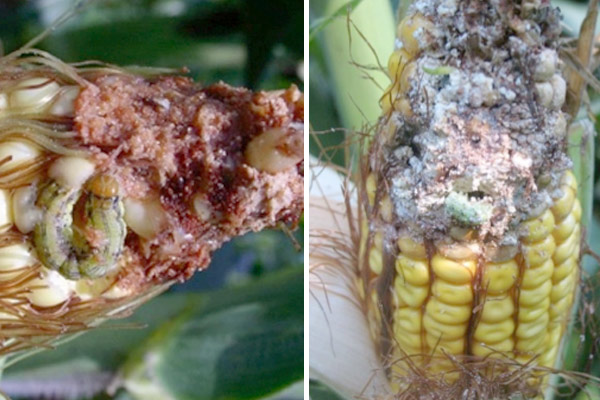
Damage by larvae of cotton bollworm (Helicoverpa armigera Hübner)
Damage to the cobs by cotton bollworm larvae favours the development of fungal pathogens of the genus Fusarium and the genus Penicillium. In 82% of the attacked cobs, the spread of the fungi starts from the feeding sites and gradually extends towards the base. Development of a whitish-pink mycelial growth is observed.
Treatments against cotton bollworm (H. armigera) are economically justified after the tasselling stage at 10 larvae per 100 plants for the first generation and 15 larvae per 100 plants for the second generation of the pest. Suitable products for control are: deltamethrin (Decis 100 EC – 7.5–12.5 ml/da), lambda-cyhalothrin + chlorantraniliprole (rynaxypyr) (Ampligo 150 ZC – 30 ml/da).
Against cotton bollworm larvae (H. armigera), products based on Bacillus thuringiensis can be used, as well as the bioproducts: Rapax – 100–120 ml/da, Helicovex – 20 ml/da, and the egg parasitoid Trichogramma sp. at 6–8 day intervals.
It is important to harvest the crop within a short period, chop the stalks with shredders and then plough under the plant residues.