

![MultipartFile resource [file_data]](/assets/img/articles/соя-1.jpg)
Experts from around the world, representing science, business and politics, are gathering from 18 to 23 June in Vienna to discuss the challenges in soybean production. The focus of the World Soybean Conference is the scientific research on soybeans and their role in sustainable development – from breeding and genetics to crop production and nutrition. “Soy offers a unique opportunity to replace animal protein with high-quality plant-based protein and thus bring about a revolution in nutrition,” explains Professor Johann Vollmann from the University of Natural Resources and Life Sciences (BOKU), Chair of the Scientific Advisory Board of the Congress.
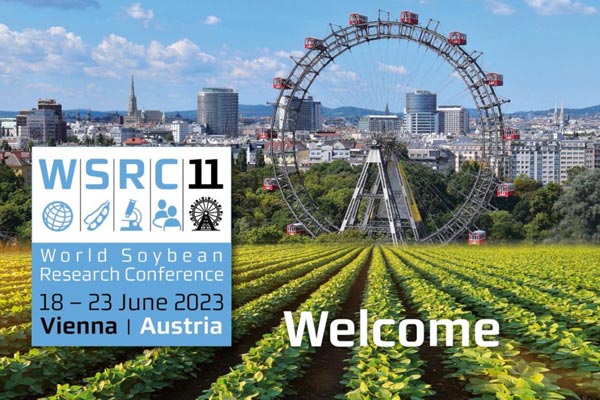
The 11th World Soybean Research Conference (WSRC) has started in Austria. The event is hosted by the organisation “Donau Soja” and the University of Natural Resources and Life Sciences (BOKU) in Vienna. Nearly 800 scientists, food and feed producers, processors and soybean experts from 51 countries are attending the international conference.
The central topics are breeding, agronomy, plant protection, processing, innovations and opportunities for expanding supply chains.
The conference was officially opened by Professor Johann Vollmann from the University of Natural Resources and Life Sciences (BOKU), Jingyuan Xia, Director of the Plant Production and Protection Division (NSP) at the Food and Agriculture Organization of the United Nations (FAO), Matthias Krön, founder and President of Donau Soja, and the Austrian Federal Minister of Agriculture Norbert Totschnig.
In his opening address, Professor Johann Vollmann stated: “This conference is a research conference with international teams of leading scientists from all major soybean-producing countries. Research and scientific cooperation on urgent measures to mitigate the adverse effects of climate change and to minimise the negative impact of soybeans on the environment in their large-scale cultivation for feed are key priorities in the near future for sustainable and efficient soybean production. This includes reducing production inputs through improvements in agronomic and genetic efficiency, new ways of using soy as animal feed and, not least, improved direct use of soy in the food industry. These topics will be addressed in more than 30 plenary sessions, workshops and poster exhibitions over the course of one week in the Austrian capital.”
From drones to dietary supplements for longevity
“Taste is the key argument here,” says Professor Vollmann. This is why he has been studying for years how soybean breeding can improve the taste of different varieties and adapt this subtropical plant to Central European conditions. Researchers at BOKU are working on a wide range of scientific topics – from plant protection and breeding to new food technologies. Special drones are also being developed to distinguish which soybean plants are better adapted to changing conditions than others. Another field in which Austrian scientists have been working for years is the development of products rich in spermidine – an anti-ageing compound contained in soybean seeds.
Spermidine is a natural polyamine that is vital for the cellular functions of the human body. It has the ability to induce autophagy in cells. Scientists believe that spermidine plays a significant role in promoting cellular longevity.
Matthias Krön from Donau Soja emphasised the international significance of the conference: “Soy is the most important protein supplier in the world for direct food and feed production. The way in which this miracle plant is cultivated, processed, traded and used plays an enormous role in the future of humanity. A sustainable future without hunger, overexploitation of land, loss of biodiversity and with a focus on regional production is only part of the modern challenges that scientists and soybean producers need to address. We, the European Soy Organisation, wish to discuss and find solutions in Vienna together with scientists from all over the world, with the largest soybean producers, processors and non-governmental organisations. Our aim is to increase the production of local soy in Europe, which can only be achieved with the support of science.”
Jingyuan Xia from FAO presented a new concept: “We propose a strategic approach for sustainable soybean production by optimising and minimising production systems and by addressing key existing challenges. This concept promotes the optimal use of natural resources and the minimisation of agricultural inputs through diversification of cropping systems, the introduction of innovations, new varieties, technologies and integrated approaches. In this way, improving soybean production contributes to achieving the Sustainable Development Goals and promotes international cooperation among relevant stakeholders.”
The Federal Minister of Agriculture Norbert Totschnig welcomed the international audience and underlined the role of Austria and Europe: “Austria is a small country with a total arable area of about 1.3 million hectares, but it is among the five largest soybean-producing countries in the EU. For Vienna, Austria and Europe it is an honour that the global soybean scientific community is meeting here to discuss scientific issues and to contribute to food security and the sustainable production of this valuable agricultural crop. My priority is to increase the level of European production, which can be achieved by expanding the arable area or by using protein resources more efficiently. Austria has already published its National Protein Crop Strategy and has also committed itself to the common EU Protein Strategy.”