

![MultipartFile resource [file_data]](/assets/img/articles/заглавна-домати-maritza.jpg)
Do you want to understand what distinguishes one variety from another? Come and explore together a collection of 250 tomato varieties at the beginning of July with a team of scientists from the Maritsa Vegetable Crops Research Institute (MVCRI) – Plovdiv.
In the course organized by the Institute, you will gain knowledge on tomato phenotyping, which will enable you to better understand the genetic diversity of this species. The course is suitable for researchers, agronomists, students, vegetable growers, citizens – amateur gardeners. The official language is English, but interpretation into Bulgarian will also be available.
For people attending online: the presentations will be published as short clips on YouTube, with English subtitles. All those who do not speak English can make use of YouTube’s automatic subtitle translation. Participants will be able to ask questions in real time.
The course will also emphasize teamwork and the creation of partnerships with research groups from different countries.
Participation is free of charge, but registration is required: https://bit.ly/harnesstom_tcourse
The training course itself is divided into two parts: the first part (3 July) will be blended – in person and online – and will consist of the visualization of a series of video clips explaining different phenotypic characteristics that enable the understanding of tomato diversity. The second part (4 July) will consist of actual phenotyping of a large and diverse collection of tomato accessions from the repository of the HARNESSTOM project and will be held in the greenhouses of MVCRI "Maritsa" – Plovdiv.
Project HARNESSTOM
Tomato is a typical model for classical breeding in modern vegetable production: it is widely cultivated and consumed, but with reduced genetic diversity and, for this reason, highly vulnerable to emerging diseases as well as to climate change.
Fortunately, tomatoes are rich in genetic resources to overcome these challenges. An international team of scientists and breeders is joining forces to generate solutions for the benefit of the food industry and society.
The HARNESSTOM project aims to demonstrate that increasing the use of genetic resources in tomato is key to food safety and security and can lead to innovative methods in the conservation and development of new varieties.
Building on results recently achieved in several different EU-funded projects for linking phenotypes/genotypes in large datasets from different germplasm banks and on the knowledge of the academic community, HARNESSTOM first collects, centralizes and classifies this vast wealth of information in an easy and accessible way, fully adapted to different types of users.
HARNESSTOM is developing four breeding programmes targeting the main challenges in the sector: 1. introducing resistance to major emerging diseases; 2. improving tomato tolerance to climate change; 3. improving quality; 4. increasing the resilience of traditional European tomatoes through joint activities of scientists from different countries.
An additional objective is to increase the speed and efficiency of breeding, which is necessary to respond to emerging challenges in a timely and effective manner. The joint leadership of both academia and industry in each of the work packages, and the participation of two non-governmental organizations representing different stakeholders, ensures that the project results will have an impact on innovation in industry as well as in society. There is also an effective management and communication platform that ensures the smooth implementation of the project and the protection of the interests of all stakeholders.
With a total budget of EUR 8.07 million, HARNESSTOM aims, during the programming period (2020–2024), to develop more sustainable and higher-quality tomatoes.
In the HARNESSTOM project, the main partner is the Maritsa Vegetable Crops Research Institute – Plovdiv, with about 500 genotypes that have been developed and are maintained at the Institute. Within the project, MVCRI „Maritsa" provides previously collected information necessary for the implementation of the project, such as yield, quality and fruit resistance. The main efforts of the team, led by Prof. Ivanka Tringovska, are focused on identifying and mapping new sources of tolerance/resistance to ToBRFV viruses in the Institute’s collection of tomato genotypes. Data from previous projects (G2P-SOL, TomGem) will be used and generated to enrich the tomato genebank. The task related to participation in the breeding of plants with improved resistance to ToMV of the local pink tomato variety „Bivolsko sarce” ("Oxheart") also includes a backcross breeding programme.
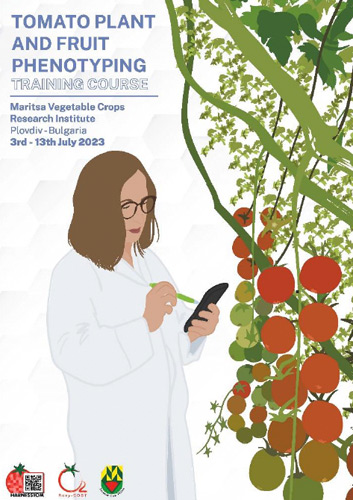
International online training course on phenotyping organised by Maritsa Vegetable Crops Research Institute - Plovdiv
This training course consists of two parts: the first part (3rd July) will be blended in person and on-line and will consist in the visualization of a series of videos explaining different phenotypic traits that allow understanding tomato diversity. This theoretical part will be completed with practical lessons in the greenhouse (4th July). The second part will consist in actual phenotyping of a large and diverse collection of tomato accessions from the repository of the HARNESSTOM project and this will take place at the greenhouses of the MVCRI. Trainees will be guided by expert trainers in the phenotyping activity. Students, technicians, researchers, farmers and citizens interested in plant phenotyping are invited to join this training course.
Place
Meeting in person will take place at: Maritsa Vegetable Crops Research Institute,
32 Brezovsko shosee Str., Plovdiv 4003, Bulgaria
phone: +35932951227
mobile: +359878465419
Contact email: Dr. Ivanka Tringovska ( dwdt@abv.bg )
Registration
Participation is free, but prior registration is required. Please register at: https://bit.ly/harnesstom_tcourse
Deadline for registration: 30/06/2023. For online participants, the link will be sent once registration has been completed.
Program
First day: 3rd July (on-line and in person activity)
09:00. Introduction to the Course. Antonio Granell, IBMCP
09:10. Brief introduction on phenotyping protocol. Andrea Mazzucato, UNITUS
Part I: THE THEORY OF PHENOTYPIC TRAITS
SESSION1: PHENOTYPING PLANT, INFLORESCENCE AND FLOWER TRAITS. Moderator: Joan Casals, UPV-FMA
09:20. Phenotyping of plant trait. María José Díez, UPV
09:35. Phenotyping of leaf traits. María José Díez, UPV
10:50. Phenotyping flowering and inflorescence traits. Andrea Mazzucato, UNITUS
11:05. Phenotyping flower trait. Andrea Mazzucato, UNITUS
11:20. Break
SESSION 2: PHENOTYPING FRUIT TRAITS. Moderator: Andrea Mazzucato, UNITUS
11:40. Brief introduction to fruit traits. Andrea Mazzucato, UNITUS
11:45. Phenotyping green fruit traits. Andrea Mazzucato, UNITUS
12:00. Phenotyping the red fruit: shape traits (I). Joan Casals, UPV-FMA
12:15. Phenotyping the red fruit: shape traits (II). Joan Casals, UPV-FMA
12:30. Phenotyping the ripe fruit: size and structure (I). Ivanka Tringovska, MVCRI
12:45. Phenotyping the ripe fruit: size and structure (II). Ivanka Tringovska, MVCRI
Second day: 4th July (in person activity)
SESSION 3: PRACTICAL LESSONS ON PHENOTYPING TOMATO
08:30 – 08:40. The phenotyping trial of the Repository of HARNESSTOM project. Ivanka Tringovska, MVCRI
08:40 – 11:30. Practical lesson in the greenhouses and laboratories of MVCRI. Ivanka Tringovska, MVCRI, Joan Casals, UPV-FMA,
Part II: PHENOTYPING THE REPOSITORY OF THE HARNESSTOM PROJECT IN THE GREENHOUSES (in person activity)
The phenotyping of the Repository of the HARNESSTOM project will take place from 5th July to 13th July. Trainees will be guided by trainers in the phenotyping activity.