

![MultipartFile resource [file_data]](/assets/img/articles/заглавна-листо-1.jpg)
Vegetable crops are attacked by a large number of pests belonging to different orders and families – aphids, thrips, whiteflies, bugs, caterpillars of various butterfly species, larvae of leaf-mining flies, various beetle species, mites, nematodes, slugs, woodlice, centipedes and others. The damage caused by these species may result from feeding – sucking sap and injecting enzymes, chewing parts of the underground and above-ground organs of the plants, cutting off whole plants and destroying them, perforating leaves, fruits, cotyledons and true leaves, feeding on floral parts (buds, inflorescences, flowers), gnawing on the root system, formation of swellings (galls) and other deformations on the above-ground and underground parts. Phytophagous insects feed on plants and their organs in different ways, while others cause damage during oviposition, construction of tunnels and shelters, and a third group transmits viruses, bacteria and fungal phytopathogens. This damage leads to rotting of plants, thinning of the stands, severe weakening and stunted growth, deterioration of product quality, sharp reduction in yields, etc. Sometimes, under heavy infestation, in years favorable for pest population increase, during outbreaks, the damage caused by them may lead to complete loss of the production.
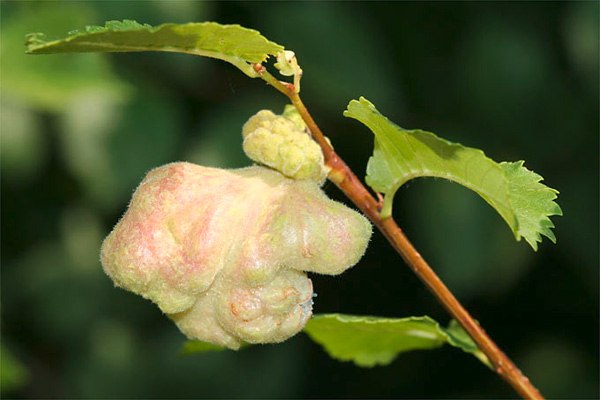
Galls are formed under the influence of substances secreted by pests and by the reaction of the plants, which is most often expressed in hypertrophy and hyperplasia, i.e. spontaneous cell proliferation.
During feeding, in addition to the various enzymes that they inject into the plants and thus prepare their food for easier assimilation, some sucking insects inject, through their salivary secretions, a number of other substances that adversely affect the plants. Such substances are certain phytotoxic auxins and growth inhibitors, free amino acids, as well as phytopathogens. These substances disrupt the normal physiological processes in plants and are often the cause of anatomical and morphological changes in individual plant organs. Frequently, the anatomical and morphological changes take the form of galls. Galls are formed under the influence of substances secreted by pests and by the reaction of the plants, which is most often expressed in hypertrophy and hyperplasia, i.e. spontaneous cell proliferation.
The damage caused by pests is expressed in a reduction of yield and deterioration of its quality and therefore is an economic concept that affects income and expenditure, whereas injuries are the external expression of the relationship between insects, pests and host plants.
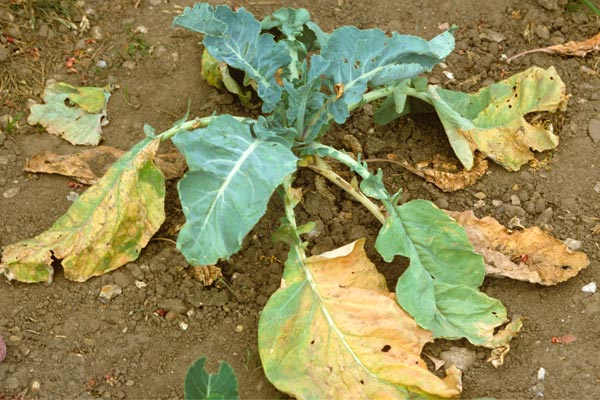
Chlorosis – lightening of individual leaf areas, pale yellow discoloration, which often occurs during the development of certain diseases, but may also result from the harmful activity of insects, such as aphids, whiteflies, mites, etc.
Some pests suck sap from the above-ground parts of plants, and often at the puncture sites the tissues fade, become speckled or deformed. Others gnaw in a specific way on individual plant parts (in the form of holes, tunnels, streaks), while a third group causes various deformations of the underground parts (roots, tuberous crops, root crops). By these visible changes, which are often associated with stunted growth, it is easy to distinguish damaged from healthy plants in the crop. Pests are almost always found at or near the site of damage. The detection of damage to vegetable plants is still not a sufficient condition for implementing control measures. It is a signal for the presence of pests whose population density must be monitored and followed. Control is required only when pest numbers on plants exceed the economic injury levels (EIL). These thresholds vary for individual pest species and crops. The detection of damage on plants is an indicator of the presence of a pest and a signal for determining its species and population density in the crop, as well as a prerequisite for making adequate decisions regarding plant protection measures.
The damage to plants caused by insects is diverse and is determined by the complex relationships between the pest and the host plant. The damage includes changes in the anatomical and morphological characteristics of plants, such as disruption of the integrity of leaves, stems and other organs, as well as changes in physiological processes such as transpiration, photosynthesis and respiration. Damage caused by pests is often so characteristic and specific that the species responsible can be identified on this basis.
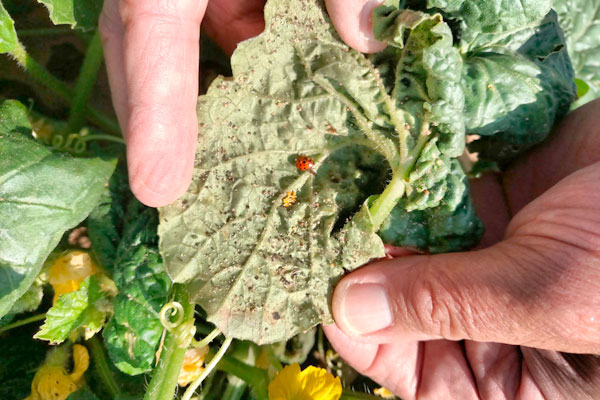
In aphids, honeydew is secreted, on which sooty saprophytic fungi develop, impairing the photosynthetic surface and reducing product quality.
Damage caused by pests can be direct and indirect
Direct damage includes chewing, mining, chlorosis, etc., while indirect damage results from feeding, as in the case of aphids and whiteflies, which excrete honeydew on which sooty saprophytic fungi develop, thereby impairing the photosynthetic surface and reducing product quality.
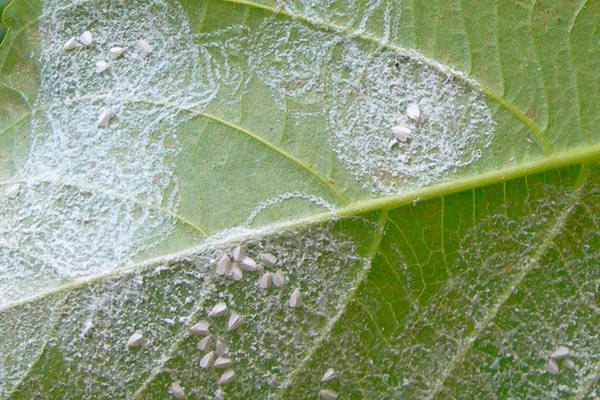
Whiteflies are vector carriers of viral and mycoplasma diseases.
Indirect damage – pests contaminate the production with excreta and cast skins; secondary rot processes often develop on the damaged sites, or these serve as entry points for pathogens. Some pests are vector carriers of viral and mycoplasma diseases, such as aphids, thrips, whiteflies, leafhoppers, etc.
The pattern of damage caused by pests in vegetable crops may vary, but it is always a sign of concern. Therefore, knowledge of the types of plant damage is the first indication for accurate diagnosis and identification of the pest species.
The types of damage caused by insects are diverse and can be systematized into different groups, both in terms of the manner in which they are caused and the plant’s response. One of the widely accepted classifications of damage types is as follows:
1. Damage to plants caused by insect feeding on their tissues and organs without prior preparation (chewing, perforation, mining, etc.);
2. Damage to plants caused by insect feeding on their tissues and organs after prior preparation (mechanical and physiological) (gall formation, discoloration, curling, deformation, etc.).
Very often, pests are difficult to detect in crops because they lead a hidden way of life or occur at low population densities. Damage caused by them may be detected late, sometimes at the end of the growing season when plants are destroyed, as is the case with damage from root-knot nematodes. An important condition for implementing successful control is knowledge of the type of damage that the pest can cause. Some of this damage is detected visually and, despite the great diversity, can be classified into several main groups:
DAMAGE TO LEAVES
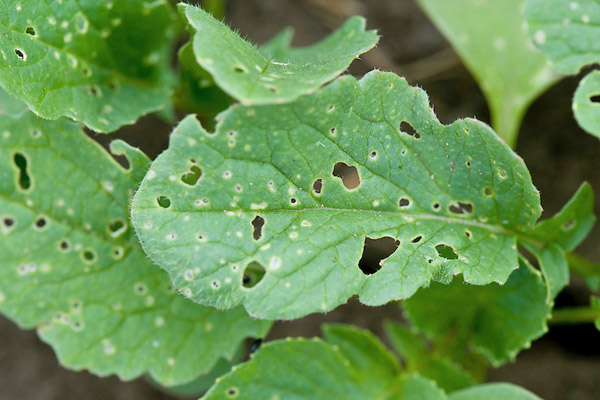
Leaf feeding damage caused by cabbage flea beetle
Chewing – the integrity of the leaf blade is disrupted; this may be complete (skeletonisation – only the venation remains), partial, coarse, irregular, window-like, with small or large holes, in the form of streaks, injuries, perforations. Such damage is characteristic of leaf-feeding caterpillars, weevils, cabbage flea beetles, etc.
Mining – the larval stages of some pests, such as leaf-mining moths and leaf-mining flies, feed on the parenchyma tissue of the leaves, leaving the epidermis almost unaffected. The shape of the mine is a characteristic feature used to identify different pest species. For example, the mines of leaf-mining flies are serpentine (and differ between species), whereas those of the tomato leafminer moth are wide and blotchy.
Deformations, curling or crinkling – these are based on damage caused by pests with piercing-sucking mouthparts, such as aphids, thrips, bugs, etc. Leaves curl and twist in various ways as a result of abnormal tissue growth or become crinkled.
Speckling – the damage is caused by mites, thrips, leafhoppers and other insects with piercing-sucking mouthparts. Light spots appear on the leaves, giving them a mottled appearance. At higher population densities, the spots merge and the leaves acquire a bronze tint and may dry out. Pests are usually observed on the underside of the leaves – aphids, whiteflies, thrips, mites, etc. At high population densities, they also move to the upper leaf surface.
Chlorosis – lightening of individual leaf areas, pale yellow discoloration, which often occurs during the development of certain diseases, but may also result from the harmful activity of insects, such as aphids, whiteflies, mites, etc.
DAMAGE TO STEMS
Chewing of tunnels in plant stems.
Chewing at the stem base. The stem is chewed below or above the soil surface (cutworms, wireworms, mole crickets, etc.).
Deformation of the stem.
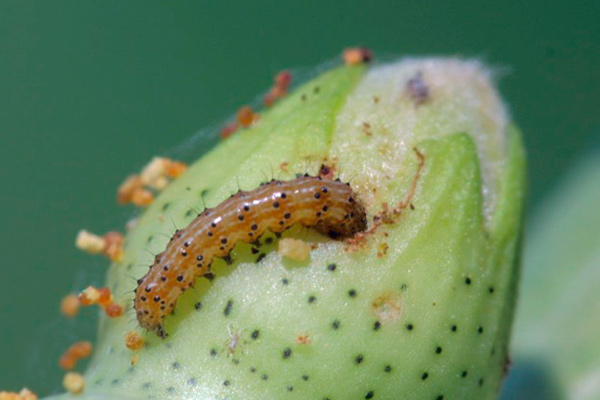
Buds damaged by cotton bollworm do not open and remain closed.
DAMAGE TO REPRODUCTIVE ORGANS (BUDS, FLOWERS AND FRUITS)
1. Chewing of buds. Chewing of flower buds. In unopened flower buds, stamens, pistil and other parts are destroyed. Damaged buds do not open and remain closed (cotton bollworm, etc.). Chewing of flowers. This may be: chewing of stamens and pistil (hairy beetle, etc.) and chewing of the entire flower (caterpillars of various moths).
2. Chewing of ovaries and seeds while they are still on the plant (pea moths and others).
3. Perforation of buds and fruits (cutworm caterpillars).
4. Hidden internal damage to seeds. The larval stage of insects develops inside the seeds. The entry hole is not visible. The exit hole is clearly visible as a perforation of the seeds (pea weevil, bean weevil, etc.).
5. Mining of fruits. There is a tunnel beneath the fruit skin. The skin above the mined area dries out (larvae of the tomato leafminer moth).
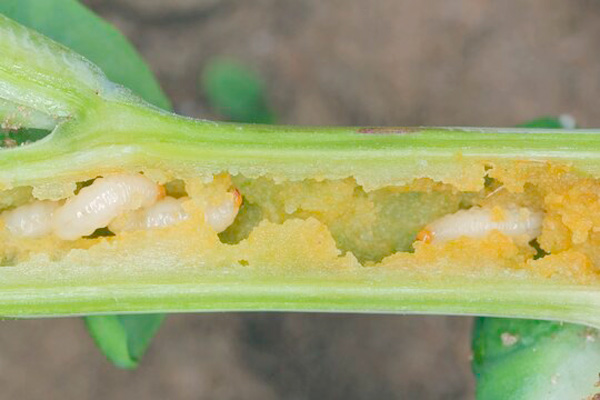
Internal root feeding damage caused by cabbage stem weevil
DAMAGE TO ROOTS AND UNDERGROUND PARTS OF PLANTS
External root feeding (caterpillars of subterranean cutworms, mole crickets).
Internal root feeding (cabbage fly, cabbage stem weevil).
1. Chewing of roots and tuberous organs. They show gnawed pits or longitudinal grooves (cutworms, white grubs, mole crickets) or chewed tunnels (wireworm larvae make various tunnels in potato tubers; larvae of the potato tuber moth make irregular tunnels in tubers, and the tuber skin above the damage sinks).
2. Internal damage to bulbs. The underground part of the stem and the bulb are chewed by larvae (onion fly).
Chewed bacterial nodules. The bacterial nodules of leguminous plants are completely chewed or only the outer shell remains (nodule weevils).
3. Formation of galls on plant roots (root-knot nematodes).
The issue of resistance is directly related to the damage caused by pests and the reaction of host plants. Based on the reaction of the host plant to pest attack, assessed as degree of damage, an evaluation of resistance can be made. Immunity is a complex phenomenon determined by numerous factors, both hereditary and external. If there are such relationships between plants and pests in which plants are not attacked by insects, this is referred to as natural immunity. Plant resistance to pests may be due to their anatomical and morphological or biochemical characteristics. Some of these traits are genetically determined and uniform under all conditions of plant growth and cultivation, while in other cases they are determined by environmental conditions, cultivation practices, fertilization, and the introduction of microorganisms that increase plant immunity. Permanent species and varietal characteristics include such plant traits as cuticle structure, biochemical composition, regenerative capacity, growth type, phenology, etc. The development of resistant plant varieties is a long process, but it is a strategic approach to pest control and occupies a priority place in breeding programmes.
Knowledge of plant symptomatology resulting from the harmful activity of pests in vegetable crops is an important step in identifying the species and implementing control measures, which in turn is a prerequisite for obtaining high yields and quality production.