

![MultipartFile resource [file_data]](/assets/img/articles/заглавна-череша-1-2023.jpg)
For the protection of trees and fruit yield from diseases and pests in cherry, a significantly smaller number of sprayings are carried out compared to apple. Nevertheless, the problem of residues and environmental pollution is also relevant in cherry production, bearing in mind that in this fruit species the period from flowering to harvest is considerably shorter than in apple.
In the phytopathological literature, 24 fungal diseases of cherry are described. Of those established in our country, cylindrosporiosis and brown rot are of greatest economic importance.
Brown rot in cherry is the second most economically important disease, and in some years it ranks first in Bulgaria and in a number of other countries where this fruit species is grown.
Three species of fungi of the genus Monilinia – M. laxa, M. fructigena and M. fructicola are the causal agents of brown rot in fruit species. M. fructicola is widespread in North and South America, Japan and Australia, where it causes serious damage to stone fruit species. For Europe, this pathogen is included in the list of quarantine diseases. After 2000, a number of researchers from France, Italy, Poland, Serbia and other European countries reported damage to fruit species caused by M. fructicola.
The species of the genus Monilinia belong to the order Helotiales, family Sclerotiniaceae.
In our country M. laxa and M. fructigena overwinter as compact mycelium in infected twigs and fruits. As early as the beginning of spring, sporulation starts, as a result of which by the flowering period a strong infectious background accumulates, which under favourable meteorological conditions during flowering and fruit ripening can lead to significant damage in certain cultivars. Optimal conditions for spore formation are created at high air humidity and temperatures between 15 °C and 20 °C for M. laxa and 24 °C -27 °C for M. fructigena. The spores are disseminated by raindrops or by insects.
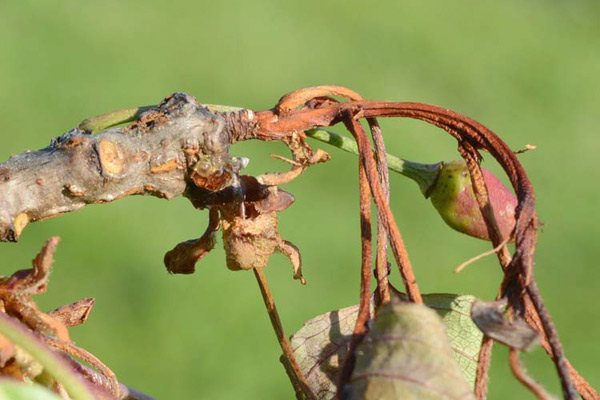
In the life cycle of the fungi of this genus there are three phases, which are very important in relation to the control of these causal agents of fruit rot in fruit species. The first phase is during flowering, when the fungi cause damage to blossoms and twigs, the second – during fruit ripening, and the third – during storage.
M. laxa and M. fructigena infect the blossoms, from where they penetrate into the twigs through the flower stalks. The infected blossoms turn brown, and later the infection spreads to the flower stalks and the respective twigs. Cankers are formed on the infected twigs, from which gum is exuded. On the fruits, the damage starts as a small, light brown spot, which rapidly enlarges and covers the entire fruit. With frequent showers and high air humidity, small grey tufts of conidiophores with conidia appear on the parts attacked by M. laxa, which are scattered over the entire affected area. On fruits damaged by M. fructigena, large sporulating tufts of conidiophores and conidia appear. The tufts are ochre in colour and arranged in concentric circles. The attacked fruits mummify and remain on the trees.
Among the fruit species, sour cherry and apricot are highly susceptible to early brown rot on blossoms and twigs, whereas sweet cherry cultivars are less severely attacked.
M. fructigena mainly infects through wounds caused by cracking under conditions of high air humidity or hail, as well as by birds and insects.
Fruit cracking depends on a number of factors related to the anatomical and physiological characteristics of the fruits, such as skin thickness, number of stomata per unit area, nitrogen concentration in the skin. In addition, it is mainly influenced by air humidity in the orchard, the frequency of rainfall and the duration of fruit wetness during ripening,
The measures for protecting cherry from the causal agents of rot of the genus Monilinia include sanitary pruning and fungicidal sprayings.
Sanitary pruning is applied to remove infected twigs, and in addition all mummified fruits must be removed from the canopy, collected and destroyed. These measures are applied annually, bearing in mind that infection is renewed by spores formed on infected twigs, branches and fruits. Sanitary measures alone cannot solve the problem of brown rot, which necessitates fungicidal sprayings to protect the trees from infection. The sprayings are carried out before bud break, at the phenological stages “pink bud”, “flowering” and immediately after flowering to protect the blossoms, young fruitlets and twigs, and later, to protect the fruits, they are carried out in the period before ripening.
Copper-containing fungicides – Bordeaux mixture – 1%, Bordeaux mix 20 WP – 375-500 g/da, Kocide 2000 WG – 180 – 280 g/da, Funguran OH 50 WP – 0.4%, Champion 50 WP – 300 g/da are suitable for pre-flowering spraying and are effective both against brown rot and against shot-hole disease and bacterial canker.
For flowering and post-flowering sprayings against brown rot, the following fungicides are included in the list of products authorised for use: Luna Experience – 63-75 ml/da, Chorus 50 WG – 45-50 g/da (0.045% - 0.05% with 100 l/da spray solution), Signum WG – 30 g/da, Difcor 250 EC – 20 ml/da, Delan 700 WG – 0.05%.
For cherry as well, it should be borne in mind that frequent use of systemic fungicides leads to the development of resistance in Blumeriella jaapii, Monilinia laxa and Monilinia fructigena, as a result of which these fungicides are no longer effective. To prevent the development of resistance, it is recommended to follow the instructions regarding the dose (concentration) and timing of application for each product, and the maximum number of sprayings permitted for a given pathogen and crop. Alternation of fungicides with different modes of action on the pathogens is mandatory.