

![MultipartFile resource [file_data]](/assets/img/articles/заглавна-броколи-1.jpg)
Broccoli belongs to the family Brassicaceae and is a variety of head cabbage (Brassica oleracea var. italica). In our country it is a relatively new crop, introduced into production over the past twenty years. Although broccoli is an easy crop to grow, its production in the country is still limited. This is due to insufficient research related to the agrobiological response of the crop and the technological and environmental possibilities for its production.
Scientific units such as the Institute of Agriculture – Kyustendil (IA-Kyustendil) and the Maritsa Vegetable Crops Research Institute must introduce good practices for this promising vegetable crop. Precisely because of the work of such scientific units, it is already known in Bulgaria that broccoli expresses its biological potential best when grown as a summer and autumn crop. The growth and development factors during the respective months can significantly favour the formation of standard flower heads.
Due to a number of nutritional and dietary qualities – rich in fibre, vitamin C, B-group vitamins, carotenoids, glucosinolates, phytochemicals and sulforaphanes, broccoli can be a promising crop for Bulgaria, and the increase of good practices in the cultivation of this vegetable will raise its popularity.
Therefore, the correct technology is an important prerequisite. We will present the technology for late production of broccoli by Chief Assistant Professor Dr. Desislava Todorova from IA-Kyustendil.
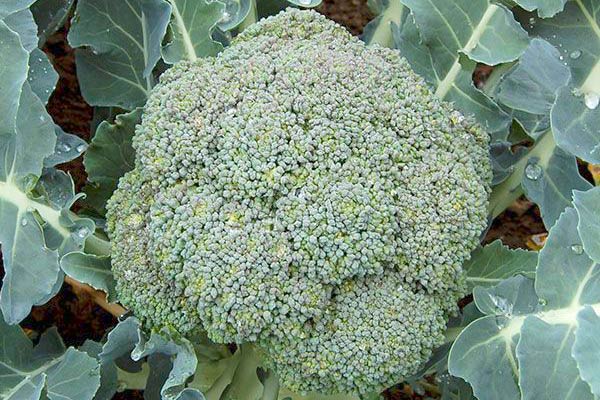
Fiesta F1
Which cultivars do you use for late production?
My main scientific work is related to four broccoli hybrids – the Japanese hybrids Marathon F1 and Parthenon F1 and the Dutch Fiesta F1 and Coronado F1. Colleagues from the Maritsa Vegetable Crops Research Institute in Plovdiv created the first Bulgarian broccoli cultivar “VCRI Iskra”, which I also grew as a trial plant. I am also satisfied with the results obtained from the cultivar Naxos F1, on which a graduate student I supervised successfully defended her thesis.
Nowadays it is relatively easy to purchase broccoli seeds. Quality seeds are usually offered by count, in packages of 1,000, 2,500 and more seeds. Currently, the seed market offers cultivars such as Triton F1, Marathon, Caesar, etc. I see that the breeding and supply of seeds from Japanese breeding programmes has advanced. There are already cultivars on the market such as Agassi, Ironman, Besty, Hapa and others.
Do you sow directly or use seedlings? How do you grow the seedlings?
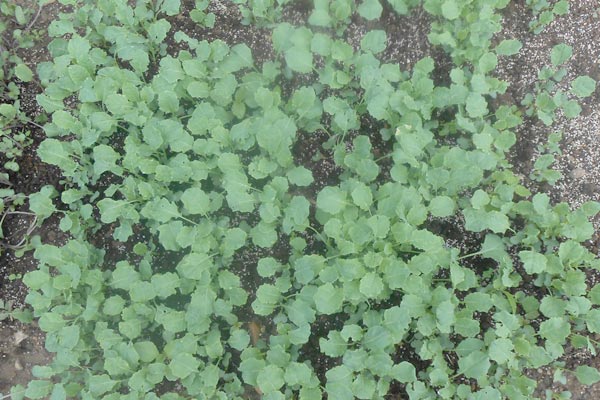
Both methods of growing broccoli are possible. In the country, cultivation through seedling production is predominantly used.
For successful broccoli production by direct sowing, the soil must be of light texture and must not form a soil crust that would hinder seed germination.
Seedlings are grown in open seedbeds in the field. Direct sowing is cheaper, but in seedling production the area can be used more efficiently.
Seedling production is carried out in an open seedbed by direct sowing of the seeds at a rate of 2 g/sq. m (growing area of 12.25 sq. cm/plant). The seeds are sown broadcast or in rows on the manure-soil mixture and covered with a 1.5–2 cm layer of manure-soil mixture.
During the seedling production period, the necessary practices are carried out to ensure plant protection against pests. Irrigation is applied at a rate of 4 l/sq. m per watering and a total rate for the seedling production period of 120 l/sq. m (for production of 30-day-old seedlings) to 180 l/sq. m (for production of 45-day-old seedlings). From 1 sq. m of seedbed area, about 300–350 standard plants are obtained.
How do you prepare the soil for planting?
Broccoli belongs to the vegetable crops that are not very demanding in terms of soil fertility, but it develops best on light, well-aerated soils with a neutral reaction and requires soils that can provide sufficient moisture throughout the growing period. Well-drained loam-sandy soils are suitable for early cultivars, while clay soils are suitable for late cultivars, as they are somewhat more tolerant to poor drainage.
The best results in the cultivation of brassica crops, including broccoli, are obtained on alluvial soils along river valleys, but on sandy soils without additional fertilisation it does not give satisfactory results.
After harvesting the preceding crop, the area is cleaned of plant residues or disked. Basic fertilisation is carried out with well-rotted farmyard manure or another organic product, superphosphate and potassium sulphate. Primary tillage is carried out followed by shallow tillage – cultivating and harrowing. Then the area is formed into beds and furrows or ridged, depending on the chosen planting scheme – bed-furrow or furrow surface.
What is the technological process of planting?
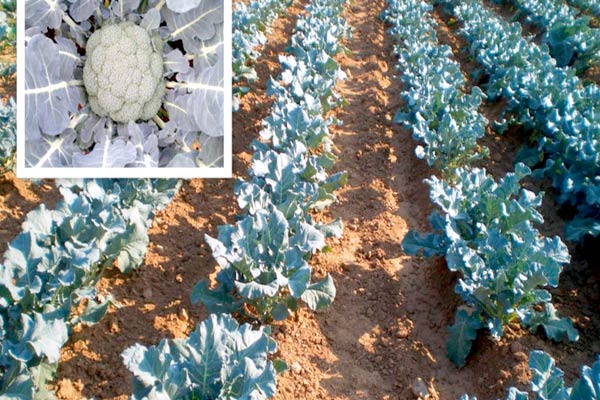
Before deciding to grow broccoli, it is important to become familiar with its biological requirements regarding the main agro-ecological factors. The planting date is a critical factor for successful broccoli production. Planting dates directly affect yield and certain quality parameters. The planting period is from 15 July to 15 August. Plant spacing is 70–80 cm between rows and 40–50 cm within the row between plants. The number of plants per decare is 2,500–3,500, and with denser planting, uniform but smaller flower heads are formed.
The planting technology is the same as for other brassica crops. Planting is usually done by hand, but on commercial areas mechanised planting can be applied. Irrigation immediately after planting is mandatory to ensure successful establishment of the seedlings. In case of plant loss, they are replaced with new ones.
What are the crop management practices after planting?
Crop management during the vegetation period does not differ from that for head cabbage. It includes hoeing, top-dressing, irrigation, and protection against diseases and pests.
Irrigation
The amount of irrigation water depends on soil parameters and the depth of the plant root system. For optimal development, broccoli requires 178 to 203 mm of water during the vegetation period.
As a method of preserving soil moisture and improving soil structure, in broccoli cultivation in our country mulching of the soil surface with various organic materials (wheat straw, crushed maize stalks, spent mushroom compost) is applied.
Plants need the most water during the formation and growth of the central flower heads and the formation of the lateral heads. Low air and soil humidity cause the formation of small, coarse flower heads with a fibrous structure.
Hoeing
Hoeing of broccoli can be done manually or mechanically. Manual hoeing is applicable for smaller areas, while machinery is used on large production areas. The equipment must be adapted to the width of the inter-row spacing and the position of the plants within the row so as not to damage them.
Top-dressing
The high requirements for soil nutrient availability in an easily assimilable form can be compensated by balanced organo-mineral fertilisation.
In my practice I have used the recommended fertiliser rates per decare, namely: 20–25 kg triple superphosphate, 15–20 kg potassium sulphate and 25–30 kg ammonium nitrate. Phosphorus and potassium fertilisers were applied during pre-plant soil preparation, while nitrogen fertiliser was applied twice, in two equal doses as top-dressing, together with the first hoeing and 20 days later.
The plant is highly demanding with regard to the content of organic matter and responds favourably to fertilisation with well-decomposed farmyard manure or vermicompost, after planting of the seedlings with ammonium nitrate applied twice – at the first hoeing of the plants and at the beginning of flower head formation.
Control of diseases, pests and weeds
Plant protection is carried out against the main diseases and pests, and treatments are performed based on the economic injury level (EIL). Control is implemented in an integrated manner, giving priority to cultural practices (crop rotation, healthy and disinfected seeds, destruction of diseased plants, etc.) and, when necessary, careful application of modern chemical products included in the list of the Bulgarian Food Safety Agency.
The main pests at the beginning of broccoli growth are flea beetles (Phyllotreta spp.), which, if not controlled in time, can completely destroy young plants. In the early stage, immediately after seed germination, their control is very important.
Another insidious pest is the cabbage cutworm, which cuts plants at the root collar or makes short tunnels in the stem. As a brassica crop, broccoli is also attacked by the caterpillars of the large white butterfly.
Among the diseases, downy mildew and black rot are of economic importance. Clubroot appears on heavy and acidic soils. An interesting physiological disorder in broccoli is hollow stem, which is thought to be caused by unbalanced fertilisation and irrigation and can adversely affect product quality.
Harvesting
Harvesting broccoli is a delicate topic for those who are not very familiar with it. The broccoli head consists of flower buds grouped into a compact head and a part of the stem attached to it. Cutting of the flower heads must be done when the buds are still closed and the head is compact and firm. Some cultivars do not form large heads and it is a mistake to wait for them to grow bigger, because they bolt and flowering begins.
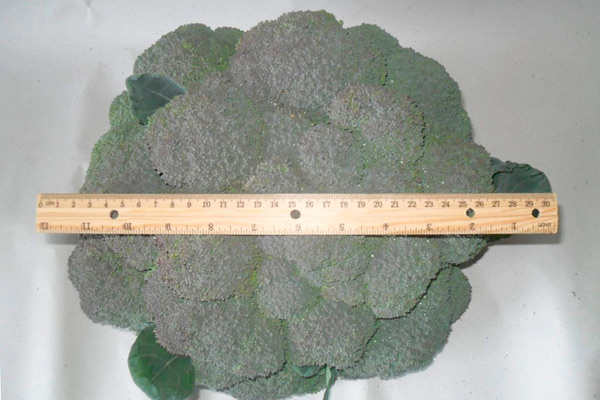
A diameter of the flower head above 10 cm is considered standard. Of course, over the years I have grown heads with a diameter of over 30 cm and a weight of about 2 kg.
In many cultivars, after cutting the central flower head, lateral flower heads, usually 8–10 in number, are formed in the leaf axils, which is a valuable advantage. They are a kind of opportunity to obtain an additional yield that can be marketed as bunch products by large producers.
In the home garden, lateral flower heads are an excellent opportunity for prolonged consumption of this highly beneficial vegetable.
Suitable hybrids, sown at optimum dates, form their production uniformly. Therefore, it is important that each cultivar or hybrid be tested with regard to sowing and seedling dates under the specific conditions of a given region.