

![MultipartFile resource [file_data]](/assets/img/articles/заглавна-ечемик-5.jpg)
In barley, the economically most important diseases are: net blotch – Pyrenophora teres (Dreshslera teres), leaf scald – Rhynchosporium secalis, leaf stripe – Pyrenophora graminea (Dreshslera graminea), loose smut – Ustilago nuda, and brown (leaf) rust – Puccinia hordei.
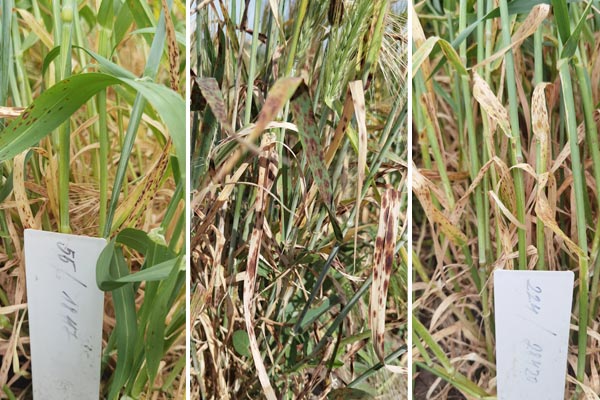
net blotch on barley
Net blotch
Over the past 6–7 years, net blotch has occurred annually in barley stands. The disease can be detected as early as autumn on the first leaves in the form of irregular brown spots limited by the venation. Under favourable conditions the spots expand rapidly, merge and form long streaks. Necrosis encompasses the entire leaves, but the affected tissues do not split, as in the case of leaf stripe. Severely affected leaves quickly scorch and dry out. In Bulgaria we have isolated and identified the two forms of Dreshslera teres – Dreshslera teres f. teres and Dreshslera teres f. maculata. In the second form, f. maculata, the spots are more rounded, denser and lack the net-like pattern. The pathogen survives under the seed coat and in plant residues. Primary infections are carried out by ascospores formed in pseudothecia on plant residues and infected seeds. In cool weather, conidia are formed on the spots, causing secondary infections in barley stands. Favourable conditions occur under cool and humid weather.
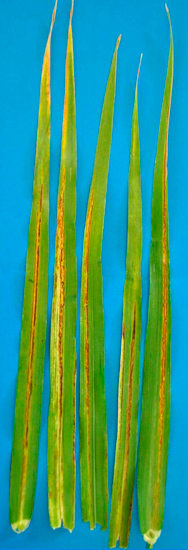
leaf stripe
Leaf stripe
The typical symptoms of the disease can be found in the second half of the growing season. Very rarely it can also be observed as seedling death after emergence. Symptoms appear on the leaves as pale yellow streaks. The lesions develop from the base towards the tip of the leaf blade and often merge. During heading the streaks turn brown, the blades dry out and split from tip to base. When moisture is present, the affected parts are covered with a dark, sooty sporulating growth. Plants often die before heading, and those that manage to head produce sterile spikes. Seed infection occurs during flowering and grain filling, when conidia landing on the spikes form hyphae that penetrate between the glumes and the seed coat. When infected seed is sown, the mycelium penetrates through the coleoptile and systemically invades the plants. The main means of spreading the infection is through the seed, but the pathogen can also survive on plant residues in the form of sclerotia or stromatic structures. From these, conidia are formed which cause infections and are an additional source of inoculum during barley flowering. The causal agent of the disease – Pyrenophora graminea – forms yellowish-brown multicellular conidia.
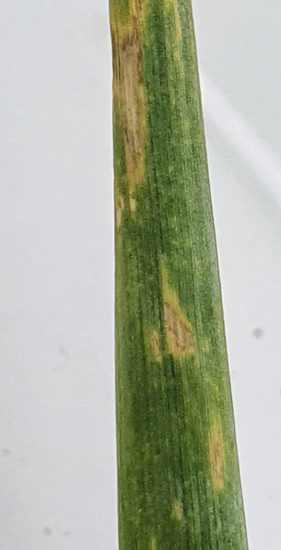
leaf scald on barley
Leaf scald
Symptoms of the disease are detected early in spring. On the lower leaves, elongated, longitudinally oriented spots with a grey-green colour and dark brown to black margins are observed. Later, the centre of the spots becomes light brown, and in rainy weather a greyish-white sporulating growth can be seen on the underside of the leaves. Under severe attack, the spots occupy most of the blade, the tissues between them turn yellow and the leaves become necrotic. The fungus survives in the soil in the form of stromatic structures from which conidia are formed. Favourable conditions for development occur with late sowing, frequent rainfall and failure to observe crop rotation.
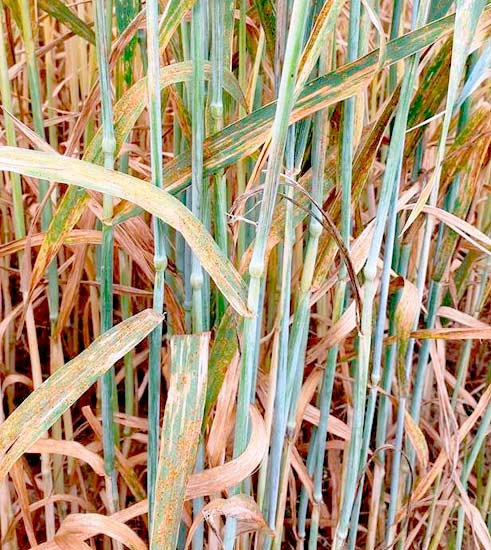
leaf rust on barley
Brown (leaf) rust on barley
The symptoms of the disease are similar to those on wheat. On the upper surface of the leaves scattered, small uredinia are formed. Under severe attack, the leaves quickly scorch and dry out.
The causal agent of the disease is the fungus Puccinia hordei, which under our conditions tolerates low temperatures well and overwinters as mycelium and uredospores in infected young barley stands. In spring, inoculum (uredospores) can be carried from southern regions and, under favourable conditions (water, dew), initiates an infection process in the crop.
Loose smut
The disease is easily detected at heading. From the sheath of the flag leaf emerges a spike that has been entirely transformed into a black smutty mass. As the teliospores disperse, coinciding with barley flowering, mass infections of the seeds occur.
Control of diseases in wheat and barley
When developing a strategy for controlling diseases in wheat and barley, an appropriate approach must be chosen in order to limit the infection pressure of the pathogens and thus reduce damage during the growing season. To ensure effective disease control, certain preventive measures must be followed, leading to the production of high-quality yield.
Crop rotation
Prolonged cultivation of the same crop on the same field leads to the accumulation of large amounts of inoculum in the soil, the emergence of new or increased losses from existing diseases, deterioration of the quality and quantity of production and even plant death. Alternation of crops is a particularly effective measure against highly specialized pathogens that survive on living plants or persist in plant residues. As a rule, it is advisable that the crop rotation for cereals be at least 2–3 years.
Choice of variety
An important measure in combating infectious diseases is the use of resistant or tolerant varieties, which would be beneficial against obligate parasites such as the causal agents of rusts and powdery mildew. At the same time, it should be noted that resistance to a particular disease does not guarantee protection against other phytopathogens, which necessitates the use of fungicides for control. Practice shows that even a fully resistant variety cannot remain such indefinitely. In fungi, through combinations or recombinations during the sexual process, mutants continuously appear in pathogen populations, leading to the emergence of races capable of infecting previously resistant varieties.
Seed treatment
At present, excellent fungicides for seed treatment are registered on the market, ensuring the use of material free from surface and systemic infections. High-quality implementation of this operation leads to complete elimination of the smut pathogens and provides an excellent start for the stands.
Sowing dates
All cereal crops must be sown at the optimum time for the crop. Sowing earlier than optimum, coinciding with favourable conditions for crop development, leads to rapid and vigorous growth. This results in lush stands, which is risky for the development and spread of infectious diseases.
Fertilization
Fertilization is a particularly important factor affecting the development of plant diseases, as it simultaneously influences both organisms – the pathogen and the host plant. It is known that unbalanced nitrogen fertilization, especially when high doses are used, prolongs the growing season, promotes vigorous leaf growth, results in turgid, thin-walled cells and poorly developed mechanical tissues. All this makes plants highly susceptible to Fusarium diseases and rusts. It is advisable to carry out soil analyses and, on this basis, to perform correct and well-justified fertilization. The use of potassium in cereals increases plant resistance to diseases by altering the structure and density of the cell cytoplasm.
Use of foliar fungicides
The use of fungicides for the control of infectious diseases must be based on expert analysis, taking into account proper diagnosis of the stand, including the following data: preceding crops, varietal composition, tillage, current condition of the crop, presence of pathogens, current meteorological conditions. As a rule in practice, farmers perform two fungicide treatments. The first is at the end of tillering – first node stage, and the second at the beginning of heading. Grain producers must be extremely careful when selecting the second fungicide, because from heading to the soft dough stage the infection pressure is extremely high. Agronomists must be particularly precise with the growth stage at fungicide application in order to achieve success also against the causal agents of Fusarium head blight.
In barley, in certain years an early spring treatment is carried out when infections occur, mainly from the causal agent of net blotch. Such treatment also limits the development of other phytopathogens on the crop. In my practice as a consultant, I have met farmers using up to five active substances from different pesticides for simultaneous control of diseases, pests and weeds. In such a case, complete inefficacy occurs, which exacerbates the problems and thereby reduces yields.
photos: Prof. Dr. Petar Chavdarov