

![MultipartFile resource [file_data]](/assets/img/articles/заглавна-chavdarov-1.jpg)
Diseases are capable of limiting the species diversity of plants grown in a given region or country, especially in cases of high susceptibility. The type and extent of losses caused by plant diseases depend on the plant species, the parasite, environmental conditions, the control measures undertaken, as well as on the combination of these factors, and may vary from slight and barely noticeable to total, 100-percent loss. Among all groups of phytopathogens causing diseases in wheat and barley, fungal pathogens play a dominant role. Their development and spread are mainly influenced by numerous factors such as meteorological conditions, cultivation of susceptible varieties, improperly selected fungicides, and accumulation of inoculum due to improperly organized crop rotation.
I will draw the attention of farmers to several infectious diseases which, in certain years, can seriously compromise the yield and quality of the harvested production.
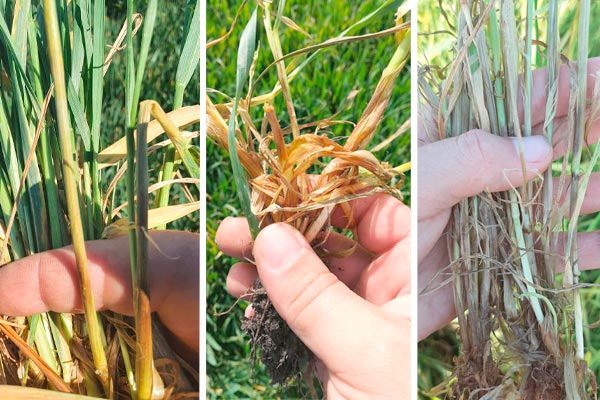
basal rot
Root and basal rot of cereal crops
The typical symptoms of these diseases can be caused by several species of phytopathogenic fungi. Most frequently, the following phytopathogens are isolated and identified from diseased plant parts: Rhizoctonia solani, Fusarium graminearum, Gaeumannomyces graminis, Cochliobolus sativus, Pseudocercosporella herpotrichoides.
The listed pathogens cause the following diseases: black root rot, helminthosporium root rot, basal rot and parasitic lodging, rhizoctoniosis and fusarium root rot. These fungi are often found in complexes on the affected plants.
Damage caused by these pathogens can be very easily detected against the background of healthy plants.
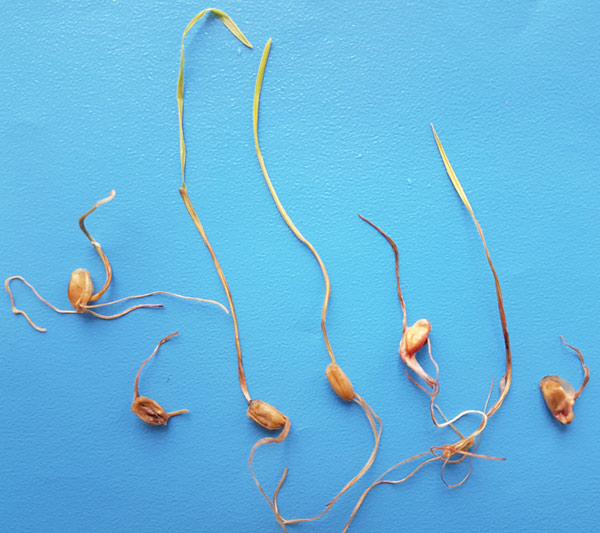
rot of young sprouts
Initially, infected plants lag behind in their development, have a chlorotic appearance, and subsequently become necrotic and dry out. This disease is often detected in patches in the fields, in lower and cooler areas where soil moisture remains for a longer period. When infected plants are pulled out, browning and softening of the roots are observed, which break easily. Another type of damage is the expansion of lesions on the stem and subsequent deep necrosis. In such cases the plants break and lean on the healthy ones. Very often these fungi can be detected in early growth stages of cereal crops. I have personally established infections as early as during the germination of the seeds. In conditions of moisture, white to pink or shiny mycelium may be observed on the affected tissues, reaching up to the first 1–2 internodes. In infected stands, depending on the stage of infection, thinning can be observed in case of early infection, while later the affected plants produce few tillers, white heads, small and shrivelled grains or sterility.
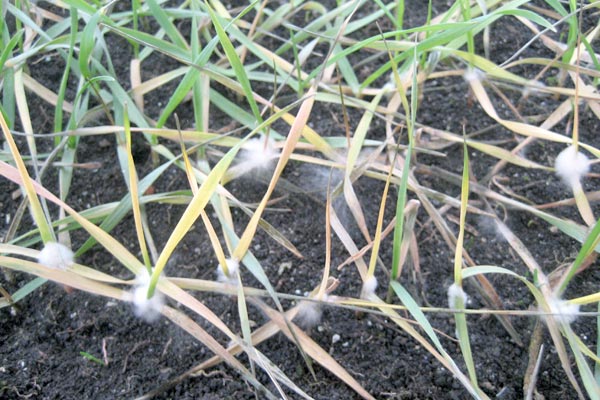
snow mold on wheat
Snow mold
In recent years this disease occurs very rarely. It is easily recognized, and in the fields it appears in patches. The disease can develop strongly in years with a prolonged winter period and a thick snow cover. Under such conditions, plants continue to respire but do not photosynthesize, as a result of which they weaken and are attacked by a number of weak parasites from the genera Fusarium, Pythium and Sclerotinia. Severely damaged plants die and the stands become thinned. When the snow melts, a white mold mycelium can be found on the exhausted plants. In additional analyses of infected plant material in the Phytopathology Laboratory of the Institute of Plant Genetic Resources – Sadovo over the years, I have mainly isolated and identified the phytopathogenic fungus Fusarium nivale. It is the main causal agent of the disease and has sickle-shaped curved conidia with 1–3 transverse septa.
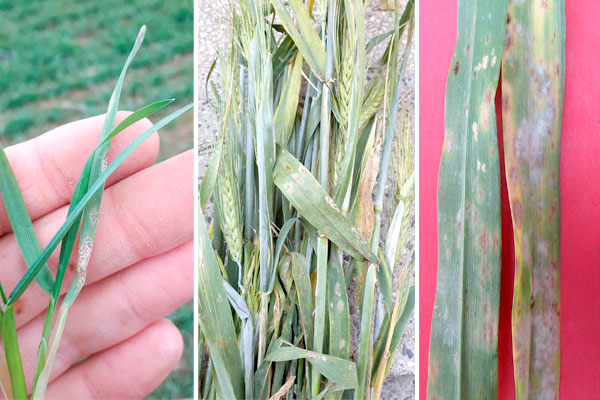
powdery mildew symptoms
Powdery mildew
This disease occurs annually in wheat cultivation. This fungus, like all other aerogenically transmitted phytopathogens in these crops, begins its development from the lower leaves of the plants. The causal agent of the disease is the fungus Blumeria graminis f. sp. tritici, which is an obligate parasite and develops exclusively on living plant tissues. Initially, small pustules of white powdery growth appear on the upper side of the leaves, which darken as they age, and in them small black fruiting bodies called cleistothecia can be seen. In cases of early infections and severe attack, the tissues under the pustules quickly turn yellow, become necrotic and the leaves scorch. In susceptible varieties, white mycelium can also be observed on the ear and glumes of the plants. In summer, the pathogen survives on volunteer plants, and in autumn it resumes its development by discharging ascospores and carrying out primary infections. The fungus overwinters as mycelium or cleistothecia.
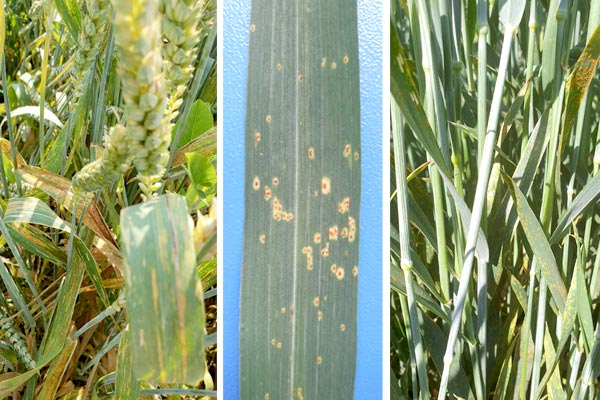
brown rust on wheat
Rusts on wheat
In cereal crops, rust diseases occupy a leading position because they occur every year, and in certain years they develop and spread epiphytotically. As a researcher in this field, I will focus on brown (leaf) rust – Puccinia triticina (Puccinia recondita) and yellow rust – Puccinia striiformis.
Brown leaf rust can be observed as early as the third-leaf stage in autumn and up to wheat ripening in the following year. Recent studies show that losses from it can reach up to 40.0%. Initially, scattered small dusty uredinia appear on the upper side of the leaves. In cases of severe attack, the leaves twist and scorch. Later, on the lower side of the leaves, the brown uredinia turn into black sori covered by the epidermis. In summer, the pathogen is preserved as uredinia on volunteer plants, and afterwards it can infect newly emerged young crops. If the fungus fails to overwinter under our conditions due to low temperatures, it may resume its development through spore transport by strong air currents from southern countries.
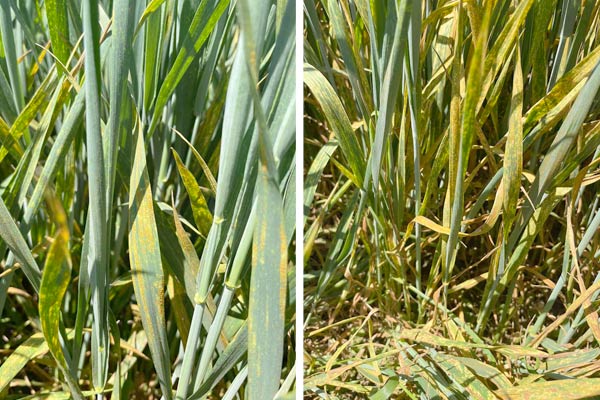
yellow rust on wheat
Over the past 5–6 years, yellow rust has begun to occur frequently not only in the fields of coastal regions, but also in production areas in Central Southern Bulgaria. Symptoms are observed mainly on the leaf blades, but under favorable conditions they can also be found on leaf sheaths, glumes and awns. On affected parts, lemon-yellow stripes are found, along which yellow uredinia are arranged parallel to each other, resembling machine stitching. The disease is caused by the fungus Puccinia striiformis. In its development this phytopathogen forms only uredospores and teliospores on its main host – cereal species. The pathogen survives unfavorable conditions as uredospores, which in turn carry out primary infections in spring.
The development of black stem rust – Puccinia graminis in the country is strongly limited due to the absence of the alternate host – barberry, and the inability of the fungus to complete its life cycle and overwinter successfully.
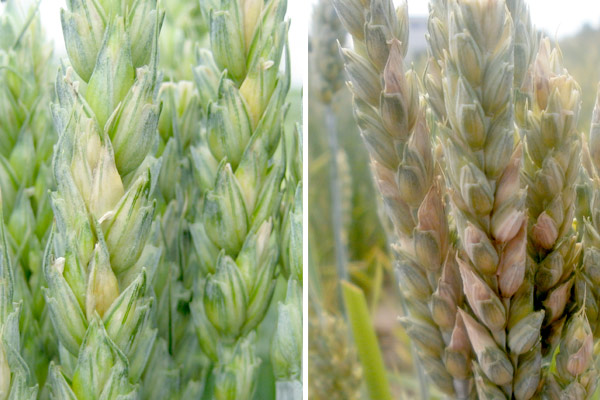
symptoms of fusarium head blight on wheat ears
Fusarium head blight
Symptoms of the disease appear as bleaching of individual spikelets or larger parts of the ear. Under suitable conditions after infection, a pale pink or orange-red mold growth can be observed on the infected areas, which may often cover the entire ear. The grain remains small, underdeveloped and with reduced quality. The causal agents of the disease are typical saprophytes and can develop on moist grain during the storage period. In addition to direct yield losses, a greater problem is associated with the presence of mycotoxins in the diseased grain, such as deoxynivalenol (DON), nivalenol (NIV), zearalenone (ZEN), moniliformin (MON) and others. These toxins can cause various food poisonings in both humans and domestic animals.
The following fungi of the genus Fusarium are most commonly found as causal agents of the disease: Fusarium graminearum, Fusarium avenaceum, Fusarium culmorum, Fusarium sporotrichiella, Fusarium sporotrichioides.
All these pathogens causing fusarium head blight are typical soil inhabitants that persist in plant residues or develop saprophytically in the soil by colonizing the roots of host plants.
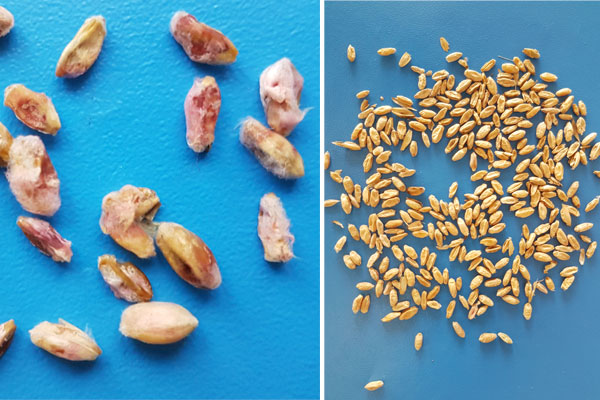
seeds infected with fusarium
Seeds are also a source of infection, which manifests itself as rot of the sprouts and young seedlings. Frequent crop rotation of wheat with maize leads to a strong increase of the inoculum and, consequently, to an increase in damage.
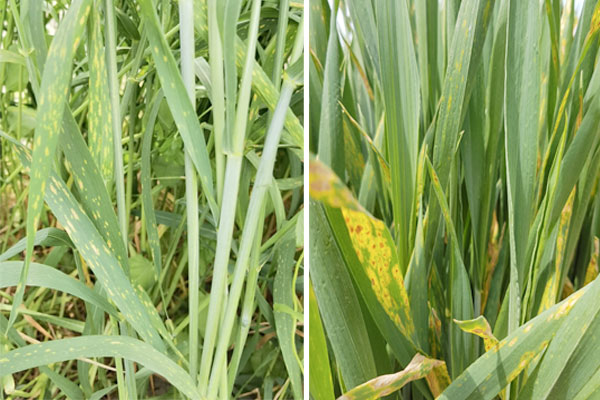
yellow-brown spots on wheat
Yellow-brown leaf spot
The disease is also known as yellow leaf spot and, in practice among grain producers, as helminthosporiosis of wheat. The disease occurs in spring and, in recent years, often appears first among all aerogenically transmitted fungal phytopathogens. Initially, typical symptoms appear on the lower leaves as small yellow spots. Later, the spots enlarge and become light brown with a yellow margin and an eye-shaped form. Under suitable conditions the spots rapidly cover the leaves and can reach the flag leaf and the ear.
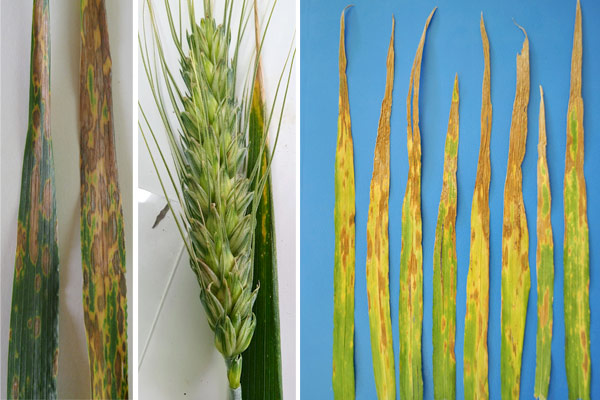
septorioses on wheat
Septorioses
This group of diseases includes two fungal pathogens with similar biological characteristics. Leaf blotch on wheat – Mycosphaerella graminicola (Septoria tritici) can be detected at the very beginning of vegetation. It is found on the lowest leaves as small light brown spots. In cases of severe attack and under favorable conditions, the spots coalesce and the leaves dry out, being covered with numerous brownish dots – the so-called pycnidia. In rainy weather and heavy dew, the fungus can be found on the upper leaves as well. Conidia are released from the pycnidia and cause mass infections until the end of the vegetation period. Later, black pseudothecia can be found on the stems of infected plants, in which the causal agent is preserved until autumn. Afterwards, under moist conditions, ascospores are released from the pseudothecia and carry out primary infections on young wheat stands.
The other pathogen – Phaeosphaeria nodorum (Stagonospora nodorum) is mainly found in the second half of the vegetation period, forming light green to yellowish spots on affected plant parts. Later, the spots elongate, become paler in the centre, have a narrow chlorotic halo and cause leaf scorch. In rainy weather, the causal agent can often be found on the ears where it mainly affects the glumes. Dark brown pycnidia are observed on the spots. Both phytopathogens are preserved in plant residues, and Stagonospora nodorum also in the seeds. Favourable conditions for the development and spread of both pathogens are created by cool and rainy weather.
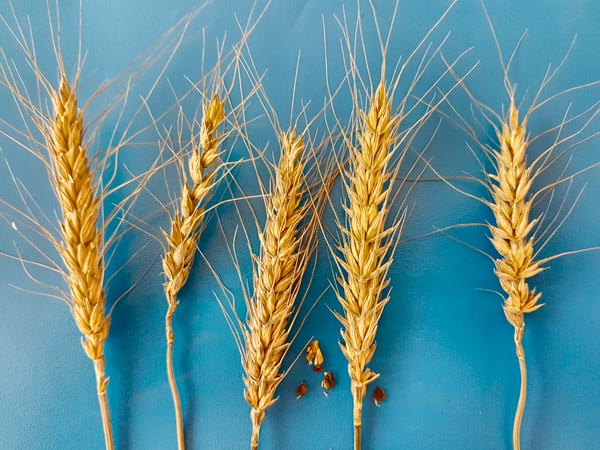
common bunt of wheat
Bunts of wheat
In wheat, the main bunt diseases are common (stinking, oily) bunt – Tilletia foetida, Tilletia caries, and loose smut – Ustilago tritici, as well as dwarf bunt – Tilletia controversa.
In the field, common bunt is difficult to detect because it almost does not affect the glumes. Infected plants remain green for a longer period, and the glumes and awns are more open. When the ear is crushed, instead of grains, sori filled with a brown powdery mass are found, which has an unpleasant odour and leaves an oily feeling on the skin. During harvesting, infected ears disintegrate, and the released teliospores contaminate healthy grains and the soil. Infection occurs from germination up to the third-leaf stage of the crop.
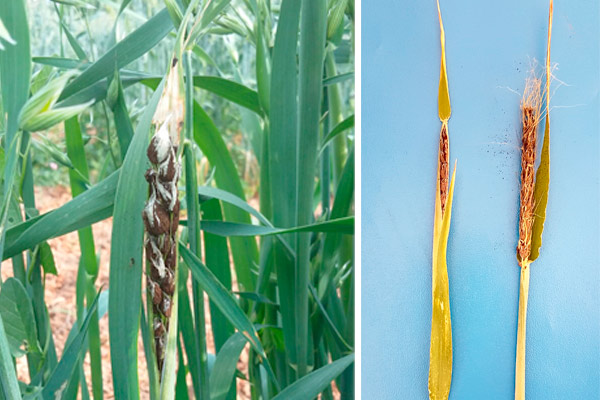
loose smut
Loose smut is extremely easy to detect because the ears of infected plants (except for the rachis) are transformed into a brown smutty mass. The causal agent of the disease infects at flowering stage, and from such seeds in the following year plants with smutted ears develop. Externally infected seeds do not differ from healthy ones. The pathogen can survive in dry grains for more than three years.
Control of diseases in wheat and barley
When developing a strategy for controlling diseases in wheat and barley, an appropriate approach must be chosen to limit the infection pressure of the pathogens and thereby reduce damage during the vegetation season. In order for disease control to be effective, certain preventive measures must be observed, leading to the production of high-quality yield.
Crop rotation
Continuous cultivation of the same crop on the same field leads to the accumulation of a large amount of inoculum in the soil, the emergence of new diseases or an increase in losses from existing ones, deterioration of the quality and quantity of production, and even plant death. Alternation of crops is a particularly effective measure against highly specialized pathogens that survive on living plants or persist in plant residues. As a rule, it is advisable for the crop rotation in cereals to be at least 2–3 years.
Choice of variety
An important measure in the control of infectious diseases is the use of resistant or tolerant varieties, which would be beneficial against obligate parasites such as the causal agents of rusts and powdery mildew. At the same time, it should be noted that resistance to a particular disease does not guarantee protection from other phytopathogens, which necessitates the use of fungicides for control. Practice shows that even a completely resistant variety cannot remain so indefinitely. In fungi, through combinations or recombinations during the sexual process, mutants continuously appear in pathogen populations, leading to the emergence of races capable of infecting previously resistant varieties.
Seed treatment
Currently, there are excellent fungicides registered on the market for seed treatment, thereby ensuring the use of material free from surface and systemic infections. High-quality performance of this operation leads to complete elimination of bunt pathogens and provides an excellent start for the stands.
Sowing dates
All cereal crops should be sown at the optimum time for the respective crop. Early sowing, coinciding with suitable conditions for crop development, leads to rapid and vigorous growth. This results in overgrown stands, which are at high risk for development and spread of infectious diseases.
Fertilization
Fertilization is a particularly important factor influencing the development of plant diseases, as it affects both organisms – the pathogen and the host plant. It is known that unbalanced nitrogen fertilization, especially when using high doses, leads to extension of the vegetation period, vigorous leaf mass development, water-saturated and thin-walled cells, and poorly developed mechanical tissues. All this makes plants highly susceptible to fusarioses and rusts. It is advisable to carry out soil analyses and, on this basis, to apply correct and well-justified fertilization. The use of potassium in cereals increases plant resistance to diseases by changing the structure and density of the cell cytoplasm.
Use of foliar fungicides
The use of fungicides for control of infectious diseases should be based on expert analysis, in accordance with proper diagnosis of the stand, including the following data: preceding crops, varietal structure, tillage, current condition of the crop, presence of pathogens, and current meteorological conditions. As a rule, farmers in practice carry out two fungicide treatments. The first is at the end of tillering – first node stage, and the second at the beginning of heading.
Grain producers must be extremely careful when selecting the second fungicide, because from heading to the wax ripening stage the infection pressure is extremely high. Agronomists must be very precise with the application stage of the fungicide in order to achieve success also against the causal agents of fusarium head blight.
Prof. Chavdarov wishes all farmers a successful agricultural year and high purchase prices!
Photos: Prof. Dr. Petar Chavdarov