

![MultipartFile resource [file_data]](/assets/img/articles/заглавна-weizen-1.jpg)
Abiotic stress causes major losses in agricultural production worldwide. Stress factors such as drought, low temperatures, heat and soil salinization have been the subject of intensive individual research. In most field situations, crop plants are exposed to a combination of different abiotic impacts. For example, in drought-affected areas many crops face a combination of drought and other stress conditions such as heat or salinity. Focusing on the molecular, physiological and metabolic aspects of stress combination is necessary to facilitate the development of field crops and to increase tolerance to natural environmental conditions.
IPGR – Sadovo, established 140 years ago, is a main breeding centre for Southern Bulgaria within the Agricultural Academy. Its scientific activity is related to the development of new varieties and cultivation technologies for wheat, peanuts, sesame, rice and triticale. The Institute also hosts the National Gene Bank with its full diversity of crops, which are conserved, maintained, reproduced and evaluated for various traits and qualities.
The scientific research work in the Plant Physiology Laboratory is mainly related to studies of the response to abiotic stress of breeding lines, varieties, local and foreign accessions of common winter wheat. Additional scientific activities, related to a lesser or greater extent to the main direction, include the assessment of genetic and morphological diversity of cereal and legume accessions in collections, investigation of the positive effect of cytokinins on the vigour of treated wheat and maize seeds under field conditions, physiological studies of the response of vegetable crops to the application of organic and mineral fertilizers, and observation of physiological growth characteristics when monitoring immunity reactions to various phytopathogens.
On the territory of IPGR-Sadovo one of the first meteorological stations included in the hydrometeorological network of our country was established. Observations of the main meteorological elements have been carried out since 1891. Stations were successively opened in Obraztsov Chiflik (1.01.1891), Plovdiv (1.07.1891) and Sadovo (1.09.1891). The climate here is of a transitional character – hot summer and mild winter, with rainfall maxima in May and June. One of the local features of the area is the frequent droughts, which are observed in all seasons and vary in duration and intensity.
In the Sadovo area during the summer period the maximum air temperature values often exceed 38oC–40oC, while in winter the minimum values drop to minus 20oC. An increase in the mean air temperature in all seasons is observed for the period 1991–2020 compared to 1961–1990, which is particularly characteristic for the months of June, July and August. The amount of precipitation in winter, autumn and spring is higher during the period 1991–2020, but the summer and more specifically the months with annual maxima – May and June – are drier compared to the period 1961–1990.
Autumn and spring precipitation is slightly higher, which favours the development of winter cereal crops and in particular wheat in the region. At the same time, in November over the last 3 years the amount of precipitation has decreased. The uneven distribution of precipitation and the constantly increasing mean monthly temperature lead to poor development and delayed tillering under low soil moisture in November and December, or to rapid development and risk of freezing at low negative temperatures at the end of winter. In the last few years, a persistent snow cover in Sadovo has not been observed, and a shift of snowfall towards the end of winter and the beginning of spring has been noted. The negative effects during the autumn–winter period are more difficult to overcome even under relatively favourable conditions during January–April and under the subsequent situation of reduced soil water storage.
The combination of higher summer values and lower summer precipitation has an adverse effect on the final stages of wheat development and on the vegetation of spring crops. Phenomena such as intensive rainfall, drought and dry winds are a cause of compromised yield and quality of seeds used as sowing material or for bread production.
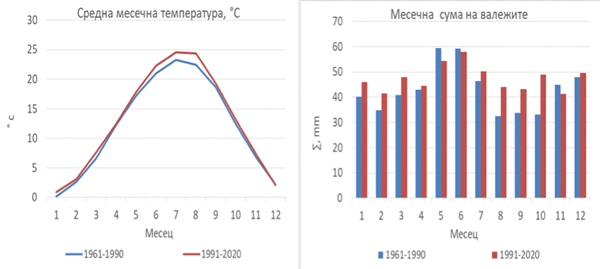
Mean monthly temperature and monthly precipitation totals for the Sadovo region for the periods 1961–1990 and 1991–2020
Several types of drought are defined, with agrometeorological drought being associated with plant stress due to low soil moisture. Agrometeorological drought causes major morphological, biochemical, physiological and molecular changes.
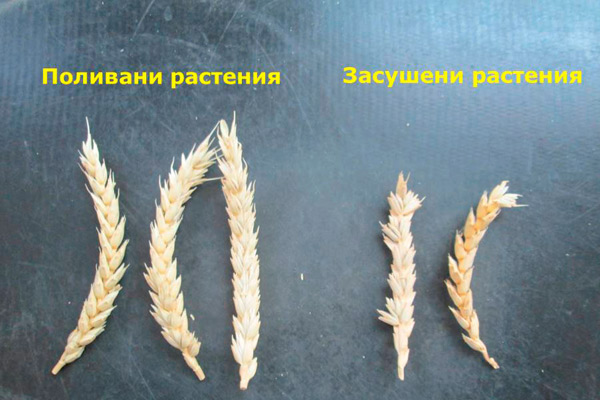
These changes have an adverse effect on growth and yield stability. Thorough investigation of the physiological mechanisms existing in plants for adaptation to water deficit and for maintaining growth and productivity during drought helps in screening and selection of tolerant genotypes and in the use of these traits in breeding programmes. This requires the development of varieties that are plastic to droughts and low negative temperatures, characterized by high productivity and quality. To solve this task, the breeding process must be supported by the application of classical and modern methods for evaluating the obtained genotypes and lines with regard to their stress resistance and by comparison with standard varieties or varieties developed before them.
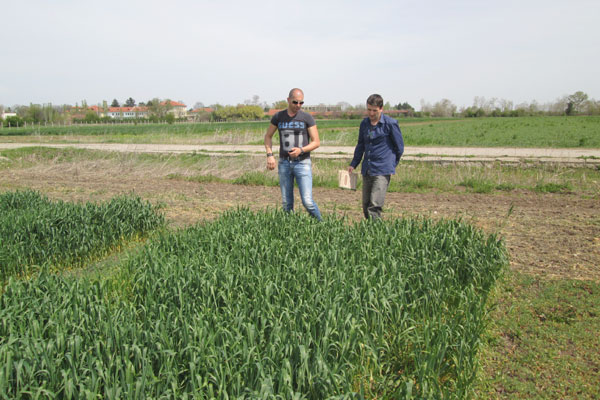
Physiological studies of plants in the field
In classical physiological methods, plant material is taken from the field or seeds from reproductions and examined in the laboratory.
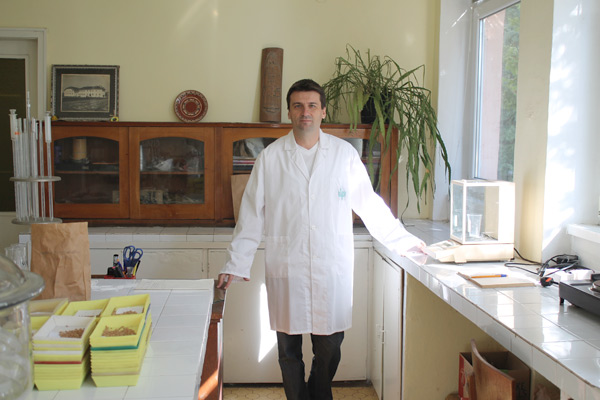
Physiological studies of plants in the laboratory
Analyses are carried out for relative water content, transpiration, dry and fresh leaf mass, biometric analysis of yield, germination and growth rate of seedlings under osmotic stress. These methods also include visual direct assessments of plant response in the field and in the greenhouse.
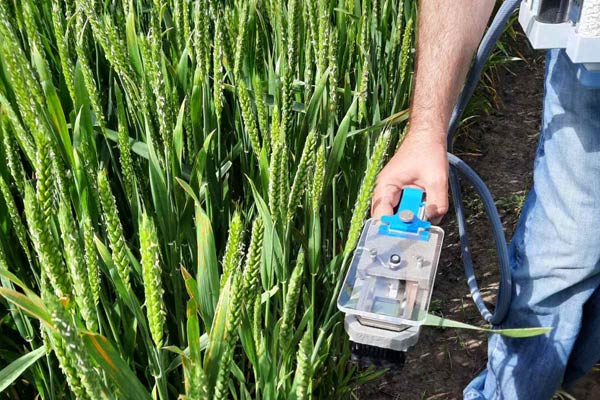
Measurement with portable photosynthesis system Lc pro T
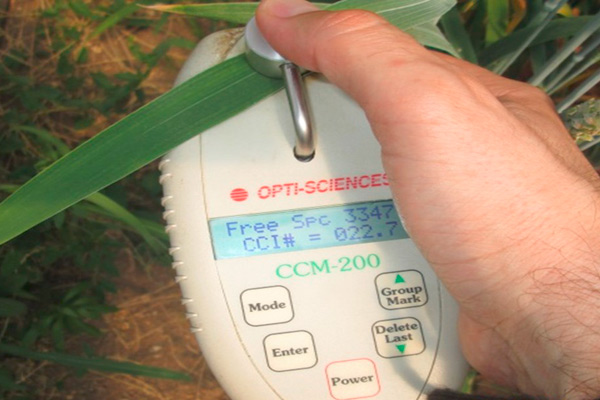
Measurement with chlorophyll meter
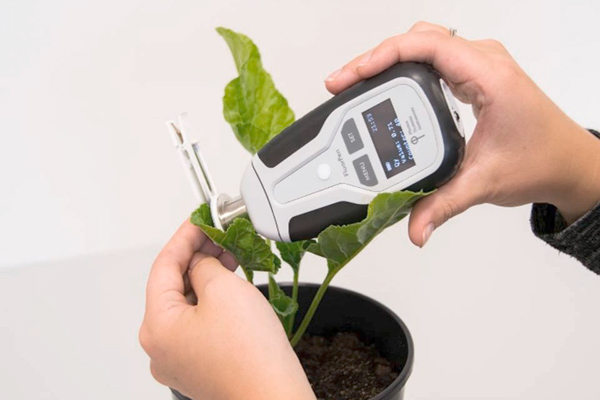
Measurement with fluorimeter

Measurement with infrared thermometer
Equipment used for the evaluation of breeding materials of common winter wheat in the Plant Physiology Laboratory
Modern methods include non-destructive assessments of leaf surface temperature, relative chlorophyll content, photosynthetic activity and degree of chlorophyll fluorescence, carried out with the help of high-tech equipment, partly available in the laboratory. For this purpose, an infrared thermometer, chlorophyll meter CCM 200 plus, portable photosynthesis system Lc pro T and fluorimeter FluorPen are used directly in the field and in pot experiments.
Some biochemical markers are also applied for indicating the plant response to imposed drought stress – quantitative determination of the level of lipid peroxidation, accumulation of hydrogen peroxide, quantitative determination of free sulfhydryl groups, total phenols, stability of cell membranes and changes in some enzymes associated with stress responses. The biochemical evaluation methods are carried out in collaboration with colleagues from other scientific organizations. When performing all types of assessments, the aim is to collect as much data as possible under field conditions or in pot experiments, while seeking correlative relationships with assessments carried out in the laboratory.
Each growing season, an average of 40 prospective lines and newly developed varieties of common winter wheat are tested for drought tolerance in the Plant Physiology Laboratory. The practical result of this scientific activity is that all common winter wheat varieties recognised after 2010 and developed at IPGR can be successfully grown under dry conditions and exhibit good to excellent drought tolerance. They use water more efficiently, have better photosynthetic activity and accumulate more biomass, are characterized by a higher habitus, and are able to fill the grain under moderate drought. And one more quality that should not be underestimated: most of them are early and medium-early and their development precedes the extreme droughts in June.
It is an indisputable fact that Bulgarian varieties are better adapted to local conditions compared to foreign ones. The wheat varieties bred in recent years at IPGR – Sadovo – Yaylzla, Sashets, Blan, Nadita, Nikolay, Nikibo, Gizda and Ginra – successfully combine high yield potential, good technological grain quality and resistance to abiotic and biotic stress.