

![MultipartFile resource [file_data]](/assets/img/articles/заглавна-нощенка-1.jpg)
The cotton bollworm (Helicoverpa armigera Hübner) is one of the most common above-ground noctuid moths and of the greatest economic importance. Climatic conditions in our country are favorable for its development; it often multiplies massively and causes significant damage to agricultural crops: tomato, pepper, maize, sweet corn, and in the past also cotton.
Host plants
The cotton bollworm (Helicoverpa armigera Hübner) is a polyphagous species, attacking more than 172 species of cultivated and wild plants belonging to 68 botanical families.
In Europe the cotton bollworm is a serious pest of a number of agricultural crops. In Spain and Portugal it is reported as an economically important species on tomatoes. In Italy, in addition to tomatoes, serious damage has also been established on pepper (30% damage to fruits and 70–80% to leaves and flowers, respectively). The pest attacks cotton particularly severely, with the larvae entering the bolls and, at higher population density, being able to cause 65% losses.
In South Asia, East Africa and Latin America, where soybean is one of the important legume crops, the cotton bollworm is the most economically important pest. Losses caused by it in certain years are extremely high and can reach 100%. In the USA the species has been recorded on maize.
Other reported hosts are castor bean, begonia, ornamental ash trees, sorghum and others.
Morphological characteristics
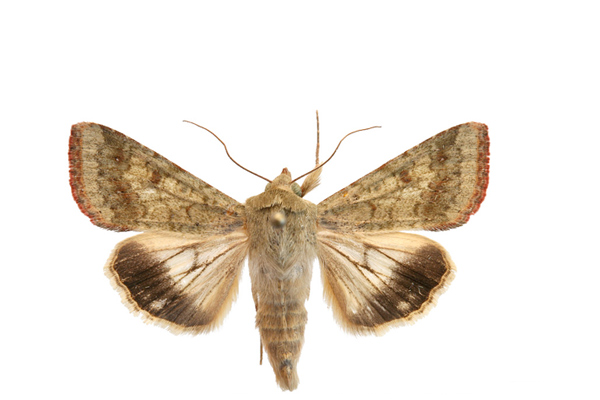
Adult insect of the cotton bollworm
The moth has a size of 30–40 mm. The forewings are light brown with three characteristic spots: reniform, round and wedge-shaped. The hindwings are lighter with a broad brown peripheral band and with the species-typical dark lunate spot in the middle.

Eggs of the cotton bollworm
The egg is hemispherical, greenish, with longitudinal ribs.
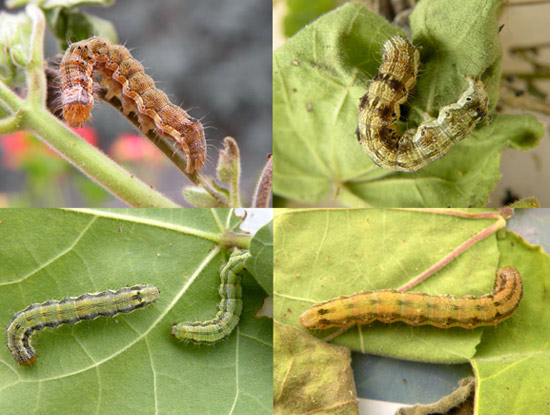
Larvae of the cotton bollworm
The larva varies in coloration – green, pink to violet-red. These color variations depend on the age of the larvae and the food on which they feed. Along its dorsum pass 4 dark and 3 light lines. It reaches 28–40 mm in length. The pupa is dark brown, ending with 2 small spines. It is 15–20 mm long.
Life cycle
The cotton bollworm appears in the second half of April, when the surface soil layer, where it overwinters as a pupa, warms up. The moths are active at night and during the day hide under plant leaves and plant residues. In order to reach sexual maturity, the female moths additionally feed on nectar from flowers. Their oviposition period is extended and lasts about 20 days. The females lay their eggs preferably on the upper parts of plants and on generative organs. In cotton, the most preferred phenophase is budding – at that time the buds are covered with hairs that secrete lactic acid, which attracts the moths, and in chickpea – throughout the entire vegetation period. The fecundity of the females depends on the plants on which the larva has fed, the environmental conditions (temperature and humidity), as well as on the nectar of the flowers in the plants, and varies from 500 to 2700 eggs. The larvae hatch after 7–10 days depending on temperature and start feeding. They develop through 6 larval instars in 20–25 days, after which they go into the soil and pupate in an earthen cell.
In our country the cotton bollworm develops three generations per year; the flight of the first generation is in April–May, of the second – in June–July, and of the third – in August–September. The full development cycle of the species in summer is about 40–50 days. The greatest damage is caused by the larvae of the second generation.
Damage
The cotton bollworm attacks mainly the generative organs of plants. In cotton, the larvae gnaw the buds and later the seeds and fibre in the young cotton bolls. As a result of the deterioration of fibre quality, its length is reduced and its elasticity is also decreased.
In tomatoes, the larvae make galleries in the fruits, eat out their interior and fill it with excreta. The attacked fruits remain smaller, often fall off, or various fungi and moulds develop on them, as a result of which they rot.
In maize, the larvae initially feed on the silk, then gnaw individual kernels in the cob. Damage caused by cotton bollworm larvae favours the development of fungal pathogens.
From the damaged cobs we have isolated fungal pathogens of the genus Fusarium and of the genus Penicillium. In 82% of the attacked cobs, the spread of the fungi starts from the feeding sites and gradually expands towards the base. Development of a whitish-pink mycelial growth is observed.
In the literature there are reports (Darvas et al., 2011) that cotton bollworm larvae feed on the mycelium of the fungus Fusarium verticillioides and in this way spread the infection on plants. In maize cobs, a number of mycotoxins have been identified: fumonisins, trichothecenes and zearalenone, which, when entering the food and feed of domestic animals, induce the development of gastrointestinal disorders.
In Asian countries, where chickpea is widely grown, the larvae gnaw the pods and the seeds inside them.
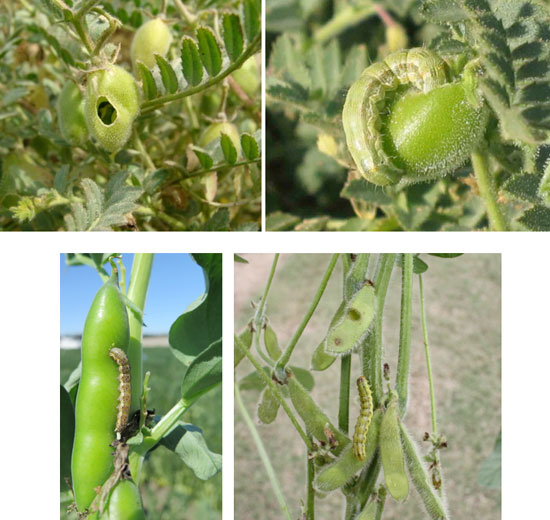
Damage to plants caused by cotton bollworm larvae on legume crops
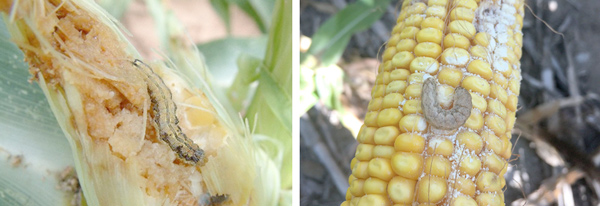
Damage to plants caused by cotton bollworm larvae on maize
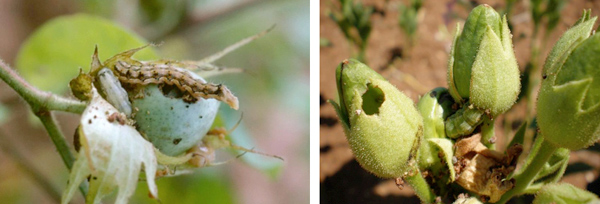
Damage to plants caused by cotton bollworm larvae on cotton
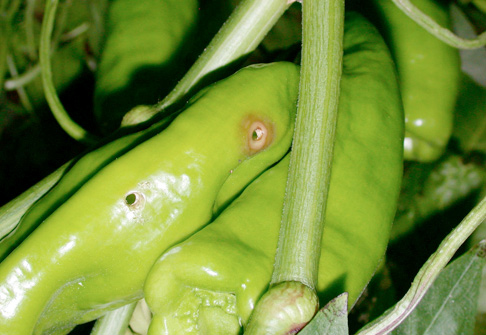
Damage to plants caused by cotton bollworm larvae on pepper
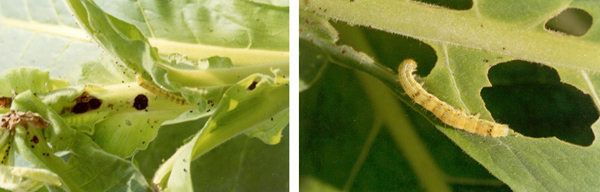
Damage to plants caused by cotton bollworm larvae on tobacco
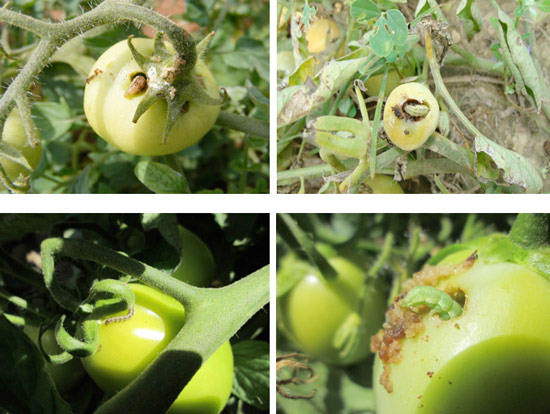
Damage to plants caused by cotton bollworm larvae on tomato
Control
• Crop rotations including suitable preceding crops.
• Technological practices ensuring optimal conditions for plant development.
• Effective weed control.
• Effective control of diseases and pests.
Chemical control against the cotton bollworm, which is the basis of pest management, includes the application of contact insecticides with stomach action. It must be carried out against the young larvae, before they bore into the generative organs.
The choice of product must be consistent with the period of its application. As a rule, at the beginning of the vegetation period it is advisable to use insecticides with a longer residual effect, and later, during harvest, to resort to insecticides with shorter pre-harvest intervals.
Suitable for control of the cotton bollworm are products with active substances: chlorantraniliprole (Altacor 35 WG – 8–12 g/da, tomato BBCH 71–89; Coragen 20 SC/Voliam – 14–20 ml/da, tomato BBCH 71–89; 10–15 ml/da, maize and sweet maize BBCH 14–55, BBCH 73–97), lambda-cyhalothrin + chlorantraniliprole (Ampligo 150 ZC – 0.04 l/da, tomato BBCH 51–89; 0.03 l/da, sweet maize BBCH 14–79; 0.03 l/da, maize BBCH 34–77), emamectin benzoate (Affirm 095 SG – 150 g/da), chlorantraniliprole + abamectin (Voliam Targo 063 SC – 80 ml/da, tomato BBCH 12–89), spinetoram (Exalt – 200–240 ml/da, tomato BBCH 14–89), cyantraniliprole + acibenzolar-S-methyl (Minecto Alpha – 125 ml/da, tomato BBCH 14–89; 100 ml/da, pepper BBCH 12–89), deltamethrin (Skato – 30–50 ml/da, tomato BBCH 50–83).
For control of the cotton bollworm, the viral preparation Helicoverpa NPV (Helicovex) (Nucleopolyhedrovirus /Hear NPV->7.5 x 10¹² viral particles of Helicoverpa armigera per litre) can be successfully applied. The first treatment must be carried out before the larvae hatch. The product is applied at a dose of 20 ml/da. It is advisable to carry out the treatments in the evening, at intervals of 8 sunny days. Good results are obtained with 3 sprays per generation.
Among the biological insecticides, the following can be used: Rapax (Bacillus thuringiensis, subsp. kurstaki strain EG 2348) – 100–200 ml/da, tomato and pepper BBCH 80).
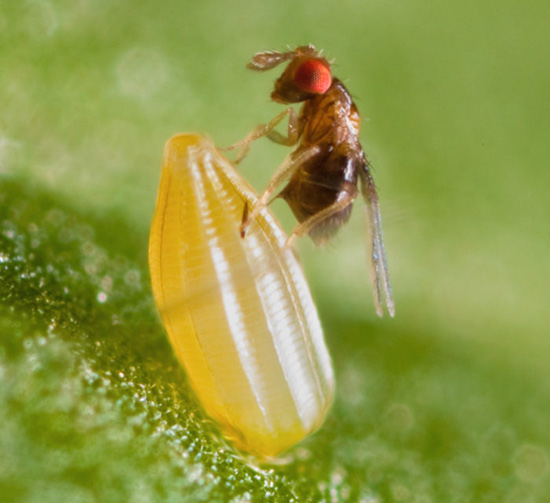
Against the eggs, seasonal colonization of Trichogramma sp. at a rate of 10,000–15,000 individuals/da every 6–8 days can be carried out.
A genetic control method against the cotton bollworm has been developed, using radiation sterilization leading to sterility.