

![MultipartFile resource [file_data]](/assets/img/articles/заглавна-дърво-май-2023.jpg)
At the beginning of May, the development of agricultural crops will proceed at below-normal temperatures and in the presence of good soil moisture reserves as a result of the above-normal rainfall in April.
The frequent rainfall in May will create conditions for an increase in the inoculum pressure of a number of fungal diseases: in wheat – rusts (brown, yellow) and fusarium head blight; downy mildews in vegetable crops and grapevine; blossom blight and shot-hole in stone fruits, scab in pome fruit species, etc. During the month, more suitable conditions for conducting plant protection sprayings will occur in the second half of the first ten-day period, in the middle and at the end of the second ten-day period, and during the last days of the month.
An increased probability of hail is forecast for May. In case of partial hail damage, it is advisable to treat the affected crops at the first opportunity with copper-containing fungicides to accelerate wound corking and reduce the risk of secondary infections.

Apple scab
In apple, usually two sprayings are carried out against scab and powdery mildew. The following are recommended: Bellis – 80 g/da, Sulgran – 750 g/da and Kumulus – 600–900 g/da against powdery mildew, and Chorus 50 WG – 0.03%, Difcor 250 EC – 15 ml/da, Coprattion Duo – 300 g/da, Scab – 300 ml/da and Captan 80 WG – 150–180 g/da against scab. For simultaneous control of both diseases, the following are suitable: Flint Max 75WG – 0.02%, Score 250 EC – 0.02%, Luna Experience – 20–75 ml/da, Thiovit Jet 80WG – 600 g/da, Reviona – 200 ml/da.
Scab-resistant cultivars – Prima, COOP-10, Frolina, Liberty, Jonafree, Jonathan, Pioneer, Macfree, Pilot, Topaz, Novamak, Sava, Rubinola, etc., are sprayed only against powdery mildew.
At high temperatures, sulfur-containing fungicides should not be used, as they may cause scorching in some cultivars.
During this period, green pruning must be carried out to remove shoots infected by powdery mildew.
In pear, sprayings are aimed at controlling scab and foliar spots (white and brown). One of the following fungicides is used: Difcor 250 EC – 15 ml/da, Luna Experience – 20–75 ml/da, Captan 80 WG – 150–180 g/da, Thiovit Jet 80WG – 600 g/da.
Quince is sprayed against brown rot. Effective fungicides are: Chorus 50 WP – 0.03%, Luna Experience – 20–75 ml/da, Difcor 250 EC – 20 ml/da, Topsin.
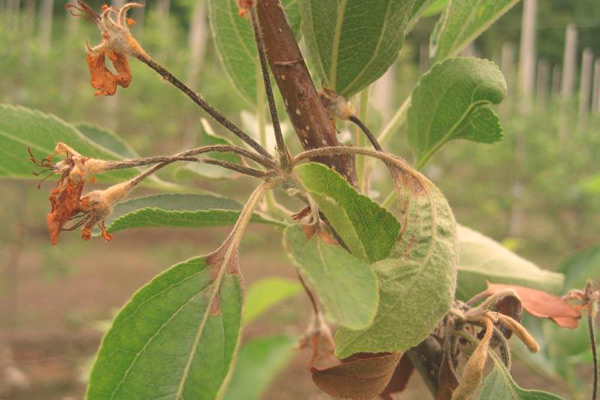
Fire blight in pome fruit species
In May, in most fruit-growing regions (under favourable conditions), symptoms of fire blight in pome fruit species appear on a large scale. It is a serious problem in pear, quince and apple. To limit the damage, pruning is carried out to remove infected branches and shoots (cutting 30–40 cm below the infection site), after which the wounds are coated with oil-based paint to which copper-containing products are added. Pruning tools are disinfected after each cut with denatured alcohol or in bleach diluted with water at a ratio of 1:10. In addition to pruning, to protect trees from infection, spraying is carried out with Bordeaux Mix – 375–500 g/da or Serenade – 400–800 ml/da.
Under favourable conditions for disease development – susceptible cultivars, cool and humid weather, as well as the presence of inoculum from the previous year – preventive sprayings are carried out at intervals of 5–7 days.
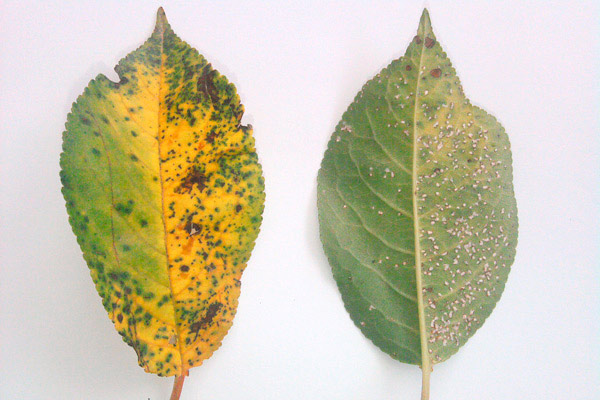
Cylindrosporiosis (white rust)
Sweet cherry and sour cherry are sprayed twice against cylindrosporiosis (white rust) and brown rot. Effective fungicides against cylindrosporiosis are: Signum WG – 30 g/da, Score 250 EC – 0.03%, Syllit 40 SC – 0.15%, Delan 700 WDG – 0.05% and Flint Max WG – 30 g/da.
In case of frequent showers during the ripening period and in the presence of severe infection by brown rot, one or two sprayings against it are necessary with: Signum WG – 30 g/da, Chorus 50 WG – 0.045%, Prolectus 50 WG – 80 g/da, Switch 62.5 WG – 72 g/da and Luna Experience – 50 ml/da. The fungicide Signum WG is also effective against cylindrosporiosis; therefore, it is recommended for simultaneous control of both diseases at the second post-bloom spraying in sweet cherry and sour cherry.
It is very important to observe the pre-harvest interval at the last spraying against brown rot.
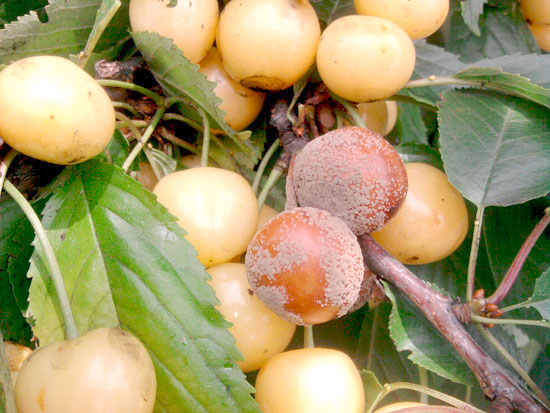
Brown rot in sweet cherry
In May, it is also necessary to take measures against fruit cracking in sweet cherry, which is a reason for attack by rot pathogens. Data from various countries where cracking is a problem show that spraying with CaCl2 reduces the percentage of cracked fruits. Usually, it is recommended to carry out three treatments with 0.5% CaCl2 during the fruit ripening period. Foliar fertilizers containing calcium are also recommended.
Three to four treatments are carried out, the first being performed about 8 weeks before harvest.
In a number of European countries and in the USA, spraying is also carried out against cracking with:
RainGard – this product contains fatty acids, vegetable esters, emulsifiers and water. When applied, it forms a film on the fruit skin that acts as a barrier to rainwater penetration and thus prevents cracking. Four to five sprayings are recommended, the first being carried out at fruit “colour break” or when they turn straw-yellow, and the remaining ones at intervals of 7–10 days. It has been established that this product reduces cracking by 50%.
SureSeal – a copolymer of stearic acid, cellulose and calcium, which forms a biofilm on sweet cherry fruits and protects them from cracking. Two sprayings are recommended – 4 and 2 weeks before harvest.
In plum, during this period spraying is carried out against brown rot with the fungicides: Difcor 250 EC – 20 ml/da, Captan 80 WG – 150–180 g/da, Chorus 50 WG – 0.045%, Geoxe – 40–60 g/da. Against rust, Signum WG – 45 g/da is approved, which is also effective against brown rot.
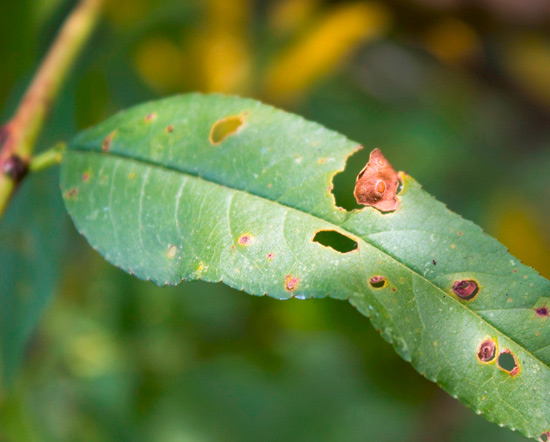
Shot-hole in peach
In peach, sprayings are aimed at controlling powdery mildew, shot-hole and brown rot. For powdery mildew, one of the following fungicides is used: Score 250 EC – 0.02%, Luna Experience – 50 ml/da, Topaz 100 EC – 0.03%, Thiovit Jet 80WG – 600 g/da. For control of brown rot, spraying is carried out with Delan 700 WDG – 0.05%, Chorus 50 WG – 0.045% or Luna Experience – 63–75 ml/da.
Apricot orchards are treated against brown rot and gnomonia. For brown rot, one of the following fungicides is used: Difcor 250 SC – 20 ml/da, Captan 80 WG – 150–180 g/da, Chorus 50 WG – 0.045%, Delan 700 WDG – 0.05%, Luna Experience – 63–75 ml/da, Signum – 60–75 g/da, of which Delan 700 WDG and Signum are also effective against gnomonia.
In raspberry, sprayings are aimed at controlling didymella, anthracnose, cane blight (leptosphaeriosis) and grey mould. One of the following fungicides is used: Dithane M 45 – 0.2%, Kocide 200 WG – 0.12%, Funguran OH 50 WP – 0.15% and CuproXat Gold M – 0.15%.
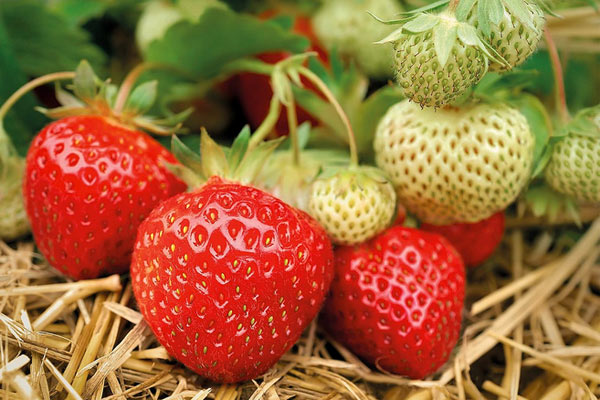
Strawberry plantations in May are sprayed against grey mould and powdery mildew. For grey mould, one of the following fungicides is used: Avalon – 200 ml/da, Switch 62.5WG – 100 g/da, Signum WG – 75 g/da, Captan – 150 g/da, Prolectus 50 WG – 80–120 g/da, Luna Sensation – 60–80 ml/da, Taegro – 18.5–37 g/da. To protect strawberry from powdery mildew, spraying is carried out with one of the approved fungicides: Cidely Top DC – 100 ml/da, Ortiva Top SC – 100 ml/da, Thiovit Jet 80WG – 500 g/da, Topaz EC – 50 ml/da. Cidely Top DC – 100 ml/da and Bordeaux Mix – 375–500 g/da are effective against white leaf spots.
PESTS
Aphids
Aphids
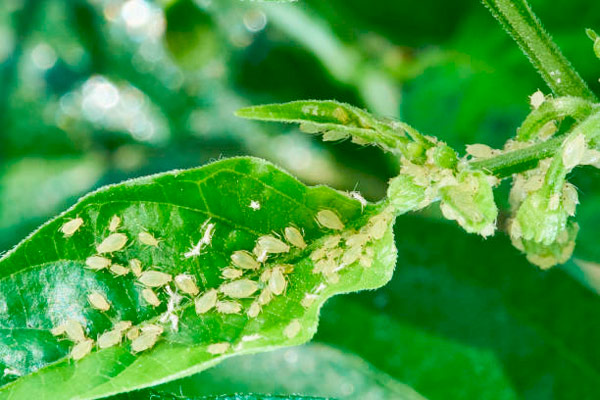
Aphids continue their harmful activity. They suck sap and inject saliva containing growth regulators, which causes more or less pronounced curling and deformation of the attacked parts. In case of severe infestation, damaged leaves dry up and fall, shoots become distorted and lag behind in their development, and fruits remain small and deformed.
Some species secrete abundant “honeydew” on which sooty fungi develop and they also transmit viral diseases to plants, which further increases their harmful impact.
Control of aphids is based on monitoring.
Control: Treatment is carried out at ETL:
• Apples, pears, plums – 10–15 colonies per 100 shoots;
• Sweet cherries, sour cherries – 10% infested shoots;
The following plant protection products are authorised: a.i. tebufenpyrad – Shirodo 25 g/da; a.i. flonicamid – Teppeki 14 g/da, Afinto 14 g/da, Hinode 14 g/da; a.i. pyrethrins – Abanto 75 ml/da, Chrysant EC 75 ml/da, Natur Breaker 75 ml/da, Pyreguard 75 ml/da for apricots, peaches, plums and sweet cherries; a.i. flupyradifurone – Sivanto Prime 90 ml/da for apples and pears; a.i. spirotetramat – Movento 100 SC 0.075–0.12% for apples and pears and 0.075–0.1% for apricots, peaches, plums and sweet cherries; a.i. sulfoxaflor – Closer 120 SC 20–40 ml/da for apples, pears, quinces, peaches and sweet cherries; a.i. azadirachtin – Oikos 100–150 ml/da, Neemik Ten 260–390 ml/da for apples.
Pome fruit species
Apple
Codling moth
Codling moth
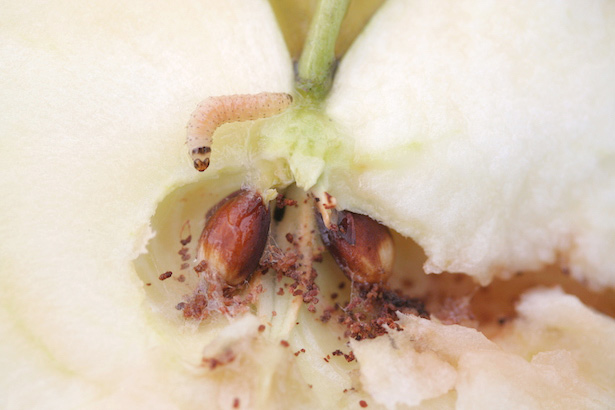
In May, moths of the first generation start laying their eggs, preferring smooth surfaces – the upper side of leaves (during this period fruits are strongly pubescent). Eggs are laid singly, preferably on the upper parts of the canopy. After hatching, larvae crawl and seek a suitable place to bore. Most often, they bore where fruit touches fruit or leaf touches fruit. After entering the fruit, the larva forms a gallery in the flesh, penetrates the seed chamber and feeds on the seeds. As a result of the damage, fruits drop prematurely.
Control: Chemical treatment is carried out at the beginning of egg laying with insect growth regulators and against larvae before they bore into the fruits.
Economic threshold level (ETL) – 3–5 moths/trap/week.
Authorised plant protection products: a.i. spinetoram – Delegate 250 WG 30 g/da; a.i. chlorantraniliprole – Coragen 20 SC 16–30 g/da, Voliam 16–30 ml/da; a.i. cypermethrin – Cyperfor 100 EC 30 ml/da, Sherpa 100 EC 30 ml/da, Afikar 100 EC 30 ml/da, Efcy-metrin 10 EC 30 ml/da; a.i. emamectin benzoate – Affirm Opti 200 g/da; a.i. spinosad – Sineis 480 SC 20–30 ml/100 l water; a.i. Granulovirus – CpGV-V22 3 x 10¹³ granules/litre – Madex Twin 10 ml/da;
Apple leaf miner moth
Moths of the overwintering generation appear in the second half of May and soon after their emergence lay eggs. The hatched larvae penetrate the parenchyma tissue of the leaves, on which they feed, immediately under the laid egg, where they form a round mine. Fully developed larvae gnaw a round hole on the underside of the leaf, descend on a silken thread and pupate in a white cocoon on the leaves, in the cracks of branches and on the trunk.
Control: Chemical control is carried out at the beginning of larval hatching.
ETL: in the phenophases “fruit set” and “fruit growth” – 2–3 eggs and mines per leaf.
Authorised plant protection products: a.i. chlorantraniliprole – Coragen 20 SC 16–30 g/da, Voliam 16–30 ml/da; a.i. emamectin benzoate – Affirm Opti 200 g/da; a.i. cypermethrin – Cyperfor 100 EC 30 ml/da, Sherpa 100 EC 30 ml/da, Afikar 100 EC 30 ml/da, Efcy-metrin 10 EC 30 ml/da, a.i. chlorantraniliprole 45 g/l + abamectin 18 g/l – Voliam Targo 063SC 75 ml/da and others.
Pear
Pear psylla
At the beginning of May, adults appear. Adults and nymphs suck sap from buds and leaves, secrete abundant honeydew, shoots blacken and they transmit a mycoplasma disease, as a result of which pear trees dry out and die.
Control: Chemical control is directed against adults and nymphs. ETL: in the phenophase bud burst – green tip – “mouse ear” – 2–3 individuals/100 buds; at flower bud stage – larvae and adults – 2–3% infested rosettes.
Authorised plant protection products: a.i. tebufenpyrad – Shirodo 25 g/da; a.i. spirotetramat – Movento 100 SC 0.12–0.15%; a.i. spinosad – Sineis 480 SC 30–35 ml/100 l water, a.i. chlorantraniliprole 45 g/l + abamectin 18 g/l – Voliam Targo 063SC 75 ml/da.
San José scale
In May, first-generation crawlers appear. Together with adult females, they suck sap from branches, twigs, fruits and, less frequently, from leaves. On fruits, red, round spots appear, with the scale shield visible in the centre.
Control: Control is directed against young crawlers, before scale formation at ETL: 0.5 larvae per one-metre shoot or 2–3% infested fruits.
Authorised plant protection products: a.i. sulfoxaflor – Closer 120 SC 40 ml/da.
European red mite
European red mite
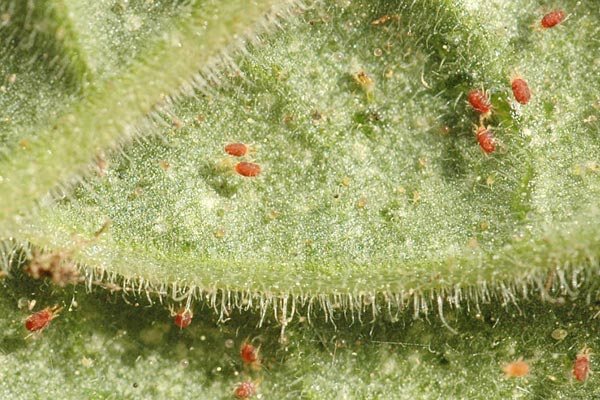
For fruit crops, the European red mite is an economically important species. In May, larvae, nymphs and adults are harmful, sucking sap mainly from the underside of leaves. As a result of the damage, chlorophyll in the leaves decreases and they acquire a mosaic appearance.
Control: Chemical control in the phenophases “fruit set” and “fruit growth” is carried out at ETL: 3–4 motile forms per leaf.
Authorised plant protection products: a.i. abamectin 18 g/l – Vertimec 018 EC 100 ml/da in apple; a.i. chlorantraniliprole 45 g/l + abamectin 18 g/l – Voliam Targo 063SC 75 ml/da; a.i. hexythiazox 31.2 g/l + fenpyroximate 62.4 g/l – Nissorun Plus 120 ml/da.
Stone fruit species
Sweet cherries
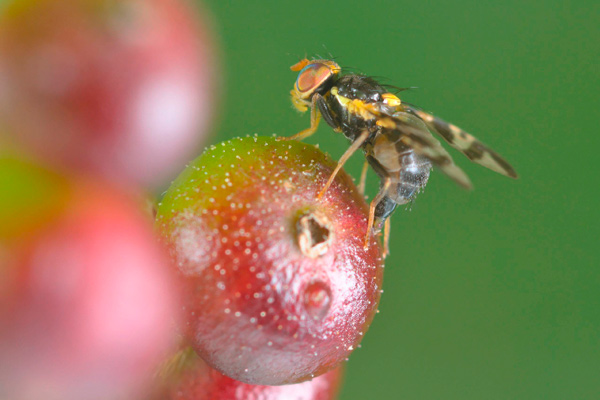
Cherry fruit fly
Cherry fruit fly
It is the economically most important pest of sweet cherry. Flight of adults begins at the beginning of May. Females lay their eggs in ripening fruits. The larva is harmful, feeding on the flesh of the fruit. Damaged fruits darken, rot and collapse at the site of damage.
Control: Chemical control of cherry fruit fly is carried out against adults before they lay eggs, approximately 10–12 days after the beginning of flight. Yellow sticky traps and “Rebell” type traps can be used for monitoring.
Authorised plant protection products: There are no registered insecticides; the following products may be used: a.i. cypermethrin – Cyperfor 100 EC 30 ml/da, Sherpa 100 EC 30 ml/da, Afikar 100 EC 30 ml/da, Efcy-metrin 10 EC 30 ml/da; a.i. spinosad – Sineis 480 SC 20 ml/da.
Plums
Plum fruit moth
In May, flight of first-generation moths continues. Females lay eggs on the young fruits. Larvae hatch one week after egg laying, bore into and feed on the flesh of the fruit, forming galleries directed towards the stalk. Damaged fruits stop growing, acquire a violet hue and drop together with the larvae.
Control: Chemical treatment is carried out at the beginning of egg laying with insect growth regulators and against larvae before they bore into the fruits.
ETL for the first generation: 2–3 moths/trap/week or 1–1.5% fresh entries.
Authorised plant protection products: a.i. spinetoram – Delegate 250 WG 30 g/da; a.i. chlorantraniliprole – Coragen 20 SC 16–30 g/da, Voliam 16–30 ml/da; a.i. emamectin benzoate – Affirm Opti 250 g/da.
Peaches

Damage caused by oriental fruit moth
Oriental fruit moth
Flight and oviposition of the first generation continue until the end of May. Females lay eggs singly on the underside of leaves and on young shoots. Larvae are harmful, causing fruit worminess and mining of shoot tips. Damage is similar to that caused by larvae of the peach twig borer.
Control: Chemical treatment is carried out at the beginning of egg laying with insect growth regulators and against larvae before they bore into the fruits.
ETL:
• Young orchards – 1–1.5% infested shoots;
• Bearing orchards – 1.5% damaged shoots and fruits
Authorised plant protection products: a.i. spinetoram – Delegate 250 WG 30 g/da; a.i. chlorantraniliprole – Coragen 20 SC 16–30 g/da, Voliam 16–30 ml/da; a.i. chlorantraniliprole 45 g/l + abamectin 18 g/l – Voliam Targo 063SC 75 ml/da; a.i. emamectin benzoate – Affirm Opti 200–225 g/da; Granulovirus – CpGV-V22 3 x 10¹³ granules/litre – Madex Twin 10 ml/da.
Peach twig borer
In May, flight of first-generation moths begins. Females lay eggs on shoots, fruits and leaves. Damage to shoots consists of tunnelling of their apical part, as a result of which they dry out.
Control: When ETL is reached: 3% damaged shoots and fruits by larvae.
Authorised plant protection products: a.i. chlorantraniliprole – Coragen 20 SC 16–30 g/da, Voliam 16–30 ml/da; a.i. chlorantraniliprole 45 g/l + abamectin 18 g/l – Voliam Targo 063SC 75 ml/da; a.i. spinosad – Sineis 480 SC 20 ml/da.