

![MultipartFile resource [file_data]](/assets/img/articles/заглавна-рапица-1.jpg)
Alongside its high advantages as an oilseed crop, rapeseed serves as a host to a large number of harmful species, which in certain years can multiply massively and are capable of causing significant economic losses. For this reason, the phytosanitary status of the area where rapeseed will be sown is of particular importance. In and around rapeseed fields, it is mandatory to destroy cruciferous weeds, which are a food source for cruciferous flea beetles, the cabbage stem flea beetle and other pests.
For the expression and development of the biological potential of the plants, very good soil tillage, appropriate crop rotations, observance of spatial isolation from species of the family Brassicaceae, sowing at optimal depth and within optimal time limits with healthy seeds are required. To maintain an optimal nutrient regime, balanced fertilisation with nitrogen, phosphorus and potassium fertilisers, the use of resistant varieties, and intercropping of crops are important. Pest control is carried out by placing traps to establish the onset of appearance of the cabbage seed weevil, the stem weevils of the genus Ceuthorynchus, the pod midge, and by placing yellow trays at plant height inside the rapeseed fields. When carried out on time and at a high level, these measures can ensure a stand with optimal density.
Rapeseed is a crop with a long vegetation period – 280–320 days, therefore plant protection measures must be adapted to the phenological stages of development.
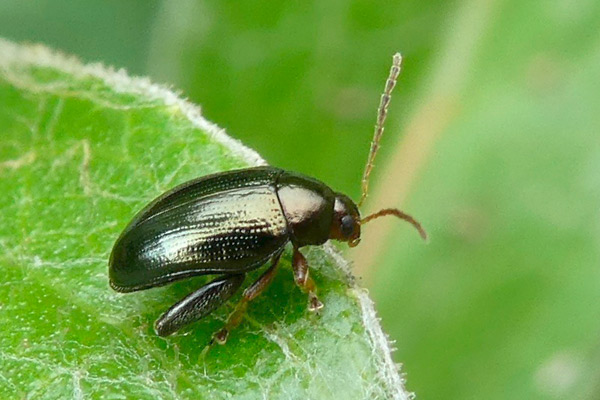
Small striped flea beetle (Phyllotreta atra L.)
In autumn, at the cotyledon and rosette formation stages, significant damage is caused by cruciferous flea beetles of the genus Phyllotreta: small striped flea beetle (Phyllotreta atra L.), wavy-striped flea beetle (Phyllotreta undulata Kutsch.).
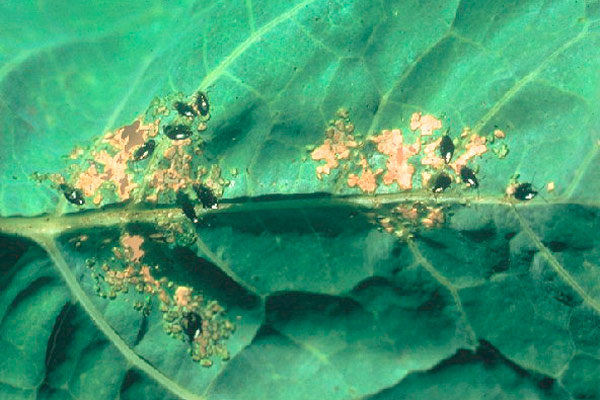
Damage caused by the small striped flea beetle
They multiply massively in warm and dry weather, attacking the young and tender leaves, as a result of which the damaged plants appear riddled like a sieve and dry out. The pests cause considerable damage in autumn, which leads to poor accumulation of nutrients in the plants, necessary for overcoming the extreme conditions during the winter.
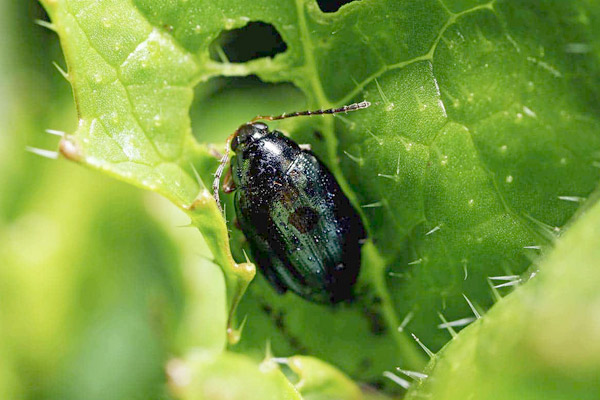
Cabbage stem flea beetle (Psylliodes chrysocephala L.)
During the same period, adults of the cabbage stem flea beetle (Psylliodes chrysocephala L.) also occur. Adults that have fallen into summer diapause become active at rapeseed emergence and gnaw round holes in the leaves and stems. Damage is significant in dry and warm weather. Attacked plants lag behind in their development.
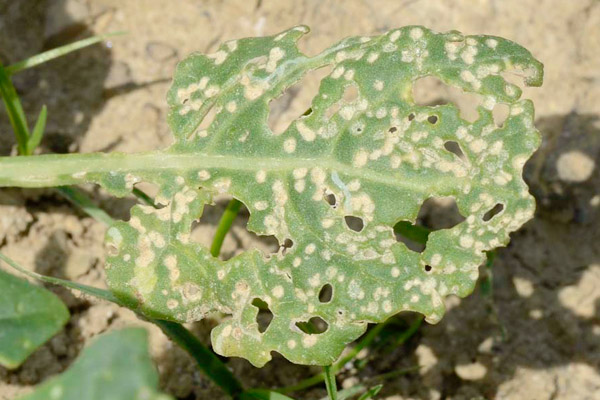
Damage caused by the larvae of the cabbage stem flea beetle
Part of the larvae hatch in autumn and another part – in spring. Those hatched in autumn bore into the leaf petioles and feed on their interior. In parallel with them, damage from the turnip sawfly (Atalia rosae Christ.) and the rape leaf beetle (Entomoscelis adonidis Pall.) is also observed. Economically more significant are the damages caused by the false caterpillars of the third generation of the turnip sawfly. They scrape off the lower epidermis in separate places and later make peripheral feeding damage on the leaves. In cases of mass multiplication, only the main vein remains unaffected. The damaged plants die and the stands are compromised already in autumn. In a warm autumn and prolonged drought, the damage from this pest is significant, as the roots are unable to maintain plant turgor. After the first autumn rains, adults of the rape leaf beetle move to the rapeseed areas and feed on the leaves.
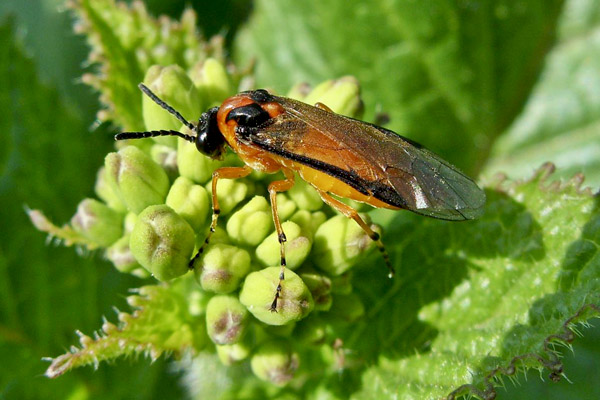
Turnip sawfly (Atalia rosae Christ.)
The density of cruciferous flea beetles of the genus Phyllotreta, the turnip sawfly, the cabbage stem flea beetle and the rape leaf beetle is recorded using the sample plot method. When a density of 2 individuals/m² of cabbage stem flea beetle, 2–3 individuals/m² of turnip sawfly and 3–5 individuals/m² of ground flea beetles is established, it is necessary to treat with products with a broad spectrum of activity and long residual effect such as: deltamethrin (Deka EC, Deka EC, Desha EC, Dena EC, Poleci, Decis – 30 ml/da; Decis 100 EC – 5 ml/da, Meteor – 60–80 ml/da), cypermethrin (Cyperkil 500 EC, Citrin Max, Cypret 500 EC, Poli 500 EC – 5 ml/da). The appearance and multiplication of cruciferous flea beetles can be forecast on cruciferous weeds, shepherd’s purse, Capsella bursa-pastoris, and other species, which serve as intermediate hosts.
In spring, with the warming of the weather, the average daily temperatures rise, rapeseed resumes its development and begins to form the main stem. At this time, the harmful activity of cruciferous flea beetles and the cabbage stem flea beetle continues. In the rapeseed agrocenosis, the ornate cabbage bug (Eurydema ornata L.) and the common cabbage bug (Eurydema oleraceum L.) are found. Adults and nymphs of the bugs suck sap from the leaves, leaf and flower stalks, and pods, as a result of which white spots are formed at the feeding sites.
In spring, caterpillars of the large white butterfly (Pieris brassicae L.), the small white butterfly (Pieris rapae L.), and the cabbage moth (Mamestra brassicae L.) are also observed. They mainly damage the leaves, gnawing holes in them. When densities above the economic threshold are established, treatment with selective insecticides is carried out.
In the bud formation, flowering and pod formation stages, the following pests are established: pollen beetle (Meligethes aeneus F.), hairy beetle (Tropinota hirta Poda), stem weevils of the genus Ceutorhynchus: cabbage stem weevil (Ceutorhynchus napi Gyll.), turnip stem weevil (Ceutorhynchus pallidactylus Marsh) (synonym Ceutorhynchus quadridens), cabbage seedpod weevil (Ceutorhynchus assimilis Payk.), cabbage aphid (Brevicoryne brassicae L.) and brassica pod midge (Dasyneura brassicae Winn.).
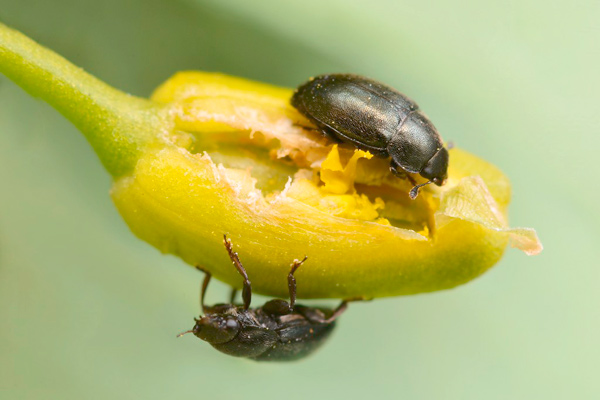
Pollen beetle (M. aeneus)
The pollen beetle (M. aeneus) is present annually in rapeseed fields and in certain years multiplies massively. It appears in rapeseed fields immediately after the formation of flower buds and is found there until the end of flowering. Larvae and adults feed on unopened flower buds, destroying the stamens and petals. The pods formed from damaged flowers become snail-shaped. At a pest density of 2–4 individuals/plant, the species may multiply massively. This necessitates weekly monitoring.
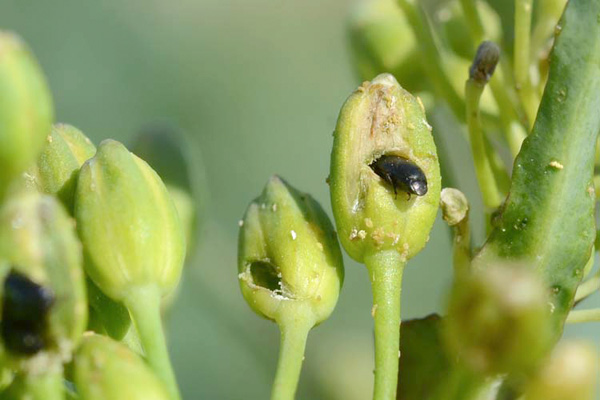
Damage caused by the pollen beetle
Damage from the pollen beetle starts from the periphery of the stand towards its interior. Therefore, it is recommended to spray when a density of 1–2 individuals/m² and 15–20% infested plants is established, and only at the edge of the stand – a strip 10–12 m wide, with insecticides with a longer-lasting effect. By carrying out these peripheral treatments, the migration of the pollen beetle towards the interior of the stand is impeded, while at the same time aiming to preserve beneficial species, natural pollinators and honey bees, which are still at lower densities. Peripheral treatments can occupy an independent place in the overall system of measures for the control of this species. It is known that a large part of the adults initially move over the weed vegetation, then settle on the field margins and only later move towards the interior of the block.
The resistance of the pollen beetle to the active chemical substances used complicates its successful control. Therefore, it is recommended to use products from different chemical groups. Authorised insecticides in our country are: cypermethrin (Cyperkil 500 EC, Citrin Max, Cypret 500 EC, Poli 500 EC – 5 ml/da), cypermethrin + piperonyl butoxide (Masan – 25 ml/da), deltamethrin (Meteor – 60–80 ml/da).
Against the pollen beetle in other countries where rapeseed is grown, the following bioinsecticides are used: Spinosad and Pyrethrum, entomopathogenic fungi: Metarhizium anisopliae and Beauveria bassiana, and entomopathogenic nematodes: Steinernema feltiae.
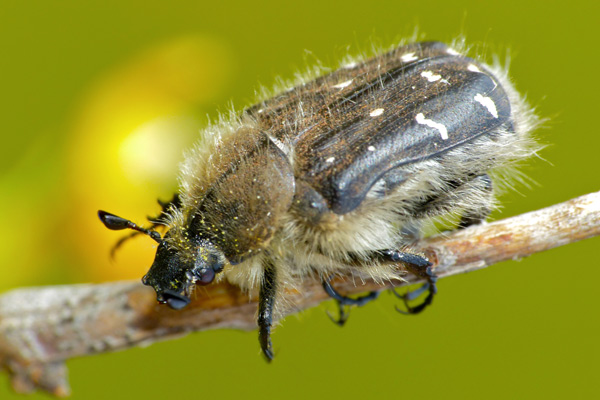
Hairy beetle (T. hirta)
During flowering, damage to the flowers is caused by the hairy beetle (T. hirta). Its presence in the rapeseed agrocenosis is due to its broad feeding specialisation and its ability to move from preferred fruit tree hosts (quince, apple) to flowering cruciferous crops.
Stem weevils of the genus Ceutorhynchus: cabbage stem weevil (C. napi), turnip stem weevil (C. pallidactylus, C. quadridens), cabbage seedpod weevil (C. assimilis) are frequently encountered in rapeseed fields.
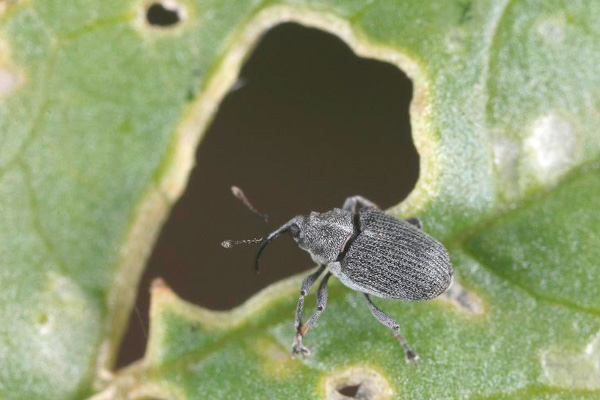
Cabbage seedpod weevil (C. assimilis)
The cabbage seedpod weevil may appear as early as the beginning of flowering, but its mass movement onto rapeseed occurs during full flowering. When densities of stem weevils of 2–4 individuals/m² are established, treatment with a contact insecticide is necessary.
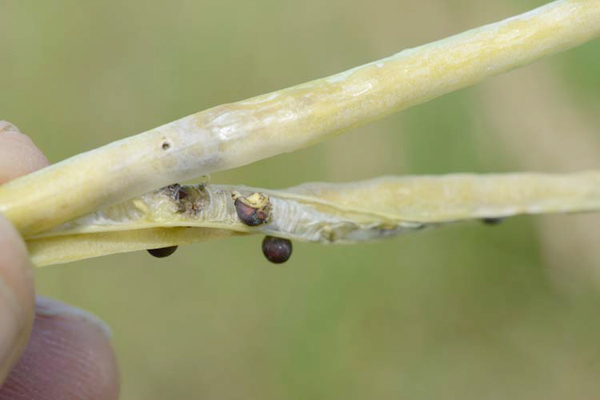
Damage caused by the cabbage seedpod weevil
At pod ripening, the cabbage aphid (B. brassicae) is also observed; it forms dense colonies on the inflorescences, pods and shoot tips. As the plants age and climatic conditions deteriorate, the aphid migrates to other host plants.
In recent years, alongside the cabbage seedpod weevil, the brassica pod midge (D. brassicae) has also been encountered. Its larvae feed on the inner side of the pod walls and cause their premature splitting and seed shedding.
Attention! The period from bud formation to pod formation is critical for rapeseed – during this time its generative organs must be protected. And this coincides with the foraging period of honey bees, which makes control measures more difficult.