

![MultipartFile resource [file_data]](/assets/img/articles/заглавна-кора-1.jpg)
Euplatypus parallelus (Fabricius) and Pochazia shantungensis Chou & Lu 1977 are pests of particular significance due to their wide range of hosts, which includes economically important fruit and ornamental crops that are widely distributed in Europe. Because of the high risk of their introduction and spread through international trade, they are included in the Alert List of new pests (Alert List) of the European and Mediterranean Plant Protection Organization (EPPO).
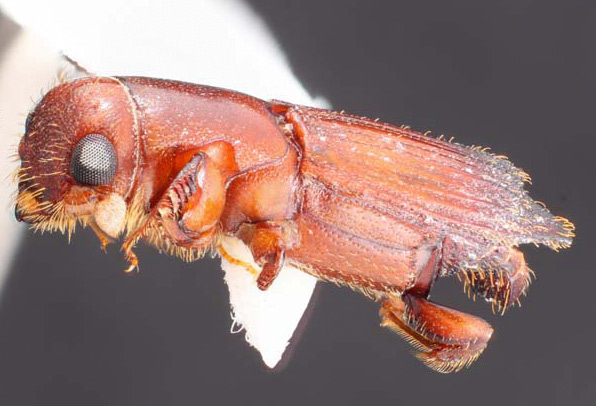
Euplatypus parallelus (Fabricius) (Coleoptera: Curculionidae: Platypodinae)
The pest is an ambrosia beetle that is reported to cause high mortality of various ornamental trees. The species is associated with fungal pathogens of the genus Fusarium. In Europe E. parallelus has been intercepted several times on wooden packaging material from India, timber of Entandrophragma cylindricum (sapele mahogany) from Congo, and logs of Tetraberlina bifoliata from Cameroon. Beetles have been caught in traps placed at the port of La Rochelle (France).
Distribution
E. parallelus originates from Central and South America and has spread to Africa, Asia and Oceania, probably through the trade in timber. In Asia it was first recorded in the 1970s in Sri Lanka and has since been reported from much of the continent, most recently in India (2012) and China (for the first time on Hainan Island in 2016 and Yunnan in 2019).
It is widely distributed in:
North America – Mexico, USA (California, Florida, Hawaii, Texas), Central and South America, the Caribbean and Oceania (Australia, Papua New Guinea).
Africa – Angola, Cameroon, Chad, Congo, Côte d'Ivoire, Equatorial Guinea, Gabon, Ghana, Guinea, Kenya, Madagascar, Nigeria, São Tomé and Príncipe, Senegal, Seychelles, Sierra Leone, South Africa, Tanzania, Togo, Uganda, Zaire.
Asia – Bangladesh, Brunei Darussalam, Cambodia, China, India, Indonesia, Laos, Malaysia, Philippines, Saudi Arabia, Singapore, Sri Lanka, Taiwan, Thailand.
It has not yet been detected in Europe.
Hosts
The species is polyphagous, without preference for specific plant families. It attacks 82 species from 25 families: Anacardiaceae, Apocynaceaе, Arecaceae, Bignoniaceae, Bombacaceae, Burseraceae, Caesalpinaceae, Euphorbiaceae, Leguminaceae, Meliaceae, Mimosaceae, Moraceae, Cecropia, Ficus, Nyctaginaceae, Oleaceae, Papilionaceae, Pinaceae, Polygonaceae, Sapindaceae, Taxodiaceae, Ulmaceae, Verbenaceae.
It mainly damages a large number of tropical and subtropical woody plants, such as: Acacia spp. (acacia), Ficus spp. (fig trees), Anacardium occidentale (cashew), Areca catechu (betel nut), Cocos nucifera (coconut), Eucalyptus spp. (eucalyptus), Hevea brasiliensis (rubber tree), Khaya senegalensis (African mahogany), Mangifera indica (mango), Persea americana (avocado), Tectona grandis (teak), Pinus oocarpa and others.
Damage
Damage is caused by the adults and larvae, which form galleries deep in the wood, and by the pathogenic fungi associated with the pest. External symptoms are entry holes on the trunk and branches, which are usually compacted with white cork-like formations. Accumulation of wood dust at the base of the trunk of affected trees, wilting, leaf fall and dieback of entire trees are often observed. The internal walls of the galleries are dark in colour due to the action of the symbiotic fungal pathogens transmitted by the insect (for example Fusarium spp.).
E. parallelus attacks both weakened and dying (stressed by various factors) plants and healthy trees.
The negative impact resulting from the development of the pest is associated with a deterioration of the commercial value of the timber, a reduction in the production of ornamental and fruit species and, in cases of heavy infestation, the death of trees.
Biology
There is limited information on the biology of the insect, but observations have been made on the life cycle of E. parallelus on rubber trees in Brazil. It has been established that the males create mating chambers in which they copulate with one female. She gnaws lateral branches – galleries – and lays her eggs in them in small groups. The larvae feed and excavate galleries under the bark and in the wood of the trees, which end in pupal chambers. Several overlapping generations occur simultaneously in this species. It spends approximately 9 months of its life cycle in the host, in the different stages of its development.
Morphology
Adult beetles are 3.8–4.5 mm long and are yellowish-brown to brown in colour, with the elytra narrowed posteriorly and strongly elongated, and with darker brown apices.
Dispersal
There is no detailed information on the natural spread of E. parallelus.
It is most commonly transported with wood, wooden packaging material and host plants for planting from countries where the pest is present. The species usually attacks plants with a diameter of more than 10 cm.
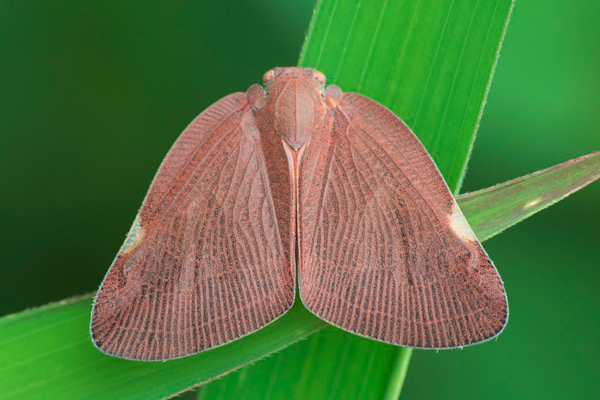
Pochazia shantungensis Chou & Lu 1977 (Hemiptera: Ricaniidae)
The species is classified as invasive, as it affects agricultural holdings and attacks both ornamental and fruit trees. The country of origin is China; it is also distributed in the Republic of Korea. It has been detected during import of host plants into Turkey and France.
Distribution
Pochazia shantungensis was first described in China in 1977. It was introduced into the Republic of Korea in 2010 and has spread rapidly since then.
It was first detected in 2018 in the European part of Turkey (subsequently it was also found on the Asian side of the Istanbul area) and in southern France.
Hosts
P. shantungensis is an extreme polyphagous species, with records of attacks on more than 200 plant species in 81 families, among which representatives of the genus: Acer, Aster, Ailanthus, Albizia, Alnus, Amorpha, Angelica, Arachniodes, Aralia, Boehmeria, Bothriochloa, Broussonetia, Brucea, Camellia, Capsicum, Castanea, Chaenomeles, Chenopodium, Clematis, Cornus Corydalis raddeana, Corylus heterophylla, Cucurbita, Diospyros, Echinochloa, Eleutherococcus, Euonymus, Ginkgo, Helianthus, Hibiscus, Humulus, Ilex, Impatiens, Juglans, Ligustrum Lycium, Malus, Morus, Paulownia, Persicaria, Phytolacca, Polygonum, Populus, Prunus, Pseudocydonia, Pyrus, Quercus, Rhododendron, Ricinus, Robinia, Rosa, Rubus, Rumex, Salix, Smilax, Solanum, Taxus, Toxicodendron Vaccinium, Veronica, Viburnum, Vitis, Zelkova, Ziziphus and others.
It attacks some major fruit species such as Malus domestica (apple), Pyrus communis (pear), Juglans regia (walnut).
Damage
This pest directly causes damage to plants by sucking sap from the leaves, as well as by damaging young shoots during oviposition. Indirectly, it induces the development of sooty mould on the leaves as a result of honeydew excretion.
Biology
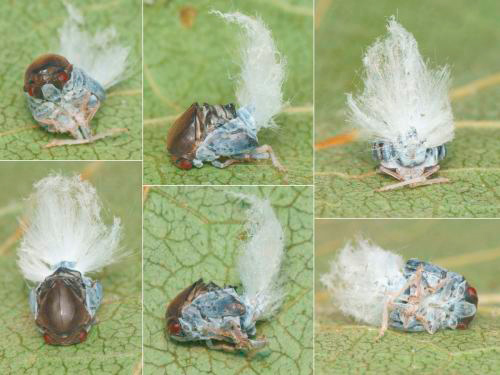
The species develops one generation per year in the Republic of Korea and two generations per year in China. It overwinters in the egg stage, arranged in a zigzag pattern on the bark of tree branches. They are covered with white waxy filaments. After overwintering, in May nymphs appear, which prefer herbaceous plants. The last developmental stages and adults are found on woody species. Adults are observed from the end of June to the beginning of July.
Morphology
The body length of P. shantungensis may vary depending on sex. Males usually have a body length of 7.5–7.8 mm and up to 14.4 mm in forewing span. Females are larger, with a body length of 8.3–8.8 mm, and with a forewing span of up to 15.3 mm. The colouration of these insects varies from dark brown to black. The forewings are dark brown but have an elliptical white spot on both outer edges.
Dispersal
There are no data on the natural spread of P. shantungensis, but adults can fly and have a high degree of mobility. Nymphs are also mobile. Over long distances the pest is spread through trade in plants for planting.