

![MultipartFile resource [file_data]](/assets/img/articles/junge-weizen-1.jpg)
The application of effective and selective herbicides is an essential part of the agronomic practices in winter cereal crops (wheat, barley, oats, rye, triticale). The changing meteorological conditions necessitate a differentiated strategy for chemical weed control. The meteorological conditions are unique every year. This requires us to be familiar with the requirements and behaviour of agricultural crops, especially with their reaction to herbicides. The main characteristics are the phytotoxicity, selectivity and persistence of herbicides and herbicide mixtures.
Autumn application of herbicides is a prerequisite for higher efficacy. In this period, weeds are in early stages of their development. On the other hand, this treatment may lead to symptoms of phytotoxicity on cereal crops at low temperatures. In practice, a strong increase of less significant species is often observed. The reasons for this phenomenon most often are the long-term underestimation of their low density, the systematic incorrect choice of chemical products, or the prolonged use of the same and insufficiently effective herbicides. In many varieties of winter cereals, symptoms of phytotoxicity to certain herbicides have been established. This feature is important for making an accurate choice. It has been proven that in a normal, warm and humid autumn, with early sowing, more than 80% of the weeds emerge simultaneously with wheat and barley. With autumn treatment, the crop is freed in time from weed competition and the effectiveness against them is higher.
The herbicides registered in our country can be used already in the autumn, in normally established cereal stands. They must be in good condition at the beginning of the tillering growth stage, in the absence of negative daytime and night-time temperatures. We consider as most urgently requiring autumn treatment those wheat stands that are infested with grass weeds, especially species of ryegrass, brome, fescue, etc. Autumn treatment of wheat must be carried out only on areas that are free from root-suckering weeds such as creeping thistle and field bindweed. Fields infested with these species must be treated with glyphosate-containing herbicides (Roundup) outside the vegetation period.
After sowing, before emergence of wheat and barley, herbicides based on pendimethalin are recommended – Stomp Aqua, Sharpen 330 EC – 250-300 ml/da, Pendinova, Pendigan 330 EC – 400-600 ml/da; based on diflufenican + chlorotoluron – Constel – 450 ml/da; based on diflufenican + flufenacet – Battle Delta – 60 ml/da and others. These products can also be used early post-emergence and exhibit a mixed spectrum of activity.
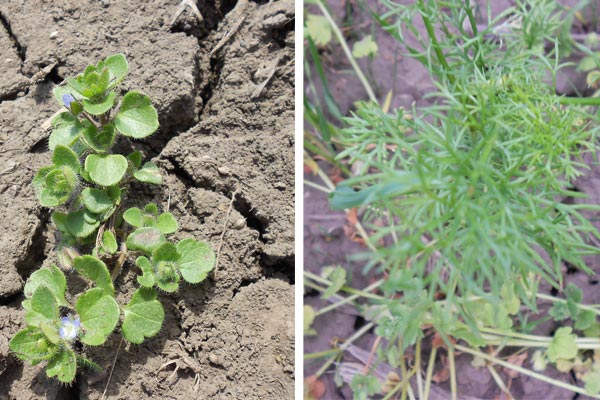
They affect weeds such as blackgrass, wild oat-grass, annual meadow-grass, speedwell, shepherd’s needle, corn poppy, wild radish, chickweed, chamomile, cleavers, field madder, mustard, violet, field pansy, wild vetchling, fumitory, red dead-nettle, couch grass and others. Wild oat is moderately sensitive.
Against annual ryegrass species, the herbicide Constel is recommended, but only in wheat. Before emergence, as well as after the 3rd leaf stage of wheat and barley, it is possible to use the chlorosulfuron-containing product Eagle 75 WG (Glean 75 WG) at rates of 2-2.5 g/da and 1-1.5 g/da. Weeds sensitive to the chlorosulfuron-based herbicide are field madder species, coriander, black mustard, shepherd’s purse, field pansy, chamomile, corn poppy, common couch, wild mustard, chickweed, common fumitory, goosefoot species, wild radish, cornflower, summer adonis, common fumitory, volunteer sunflower, wild vetchling, ivy-leaved speedwell, three-horned cleavers, field violet, shepherd’s needle, blackgrass species, annual ryegrass species and others. During warm autumn days, after the 3rd leaf stage of wheat, for control of major grass weeds the following can be used: Axial 050 EC (pinoxaden) – 60-90 ml/da, Traxos 50 EC (clodinafop + pinoxaden) – 120 ml/da, Puma Super 7.5 EW (fenoxaprop-p-ethyl) – 100-120 ml/da and Scorpio Super 7.5 EW – 100 ml/da. The herbicides are effective against species of wild oat, shepherd’s needle, blackgrass, annual meadow-grass and others. Only Axial 050 and Traxos control annual ryegrass species.
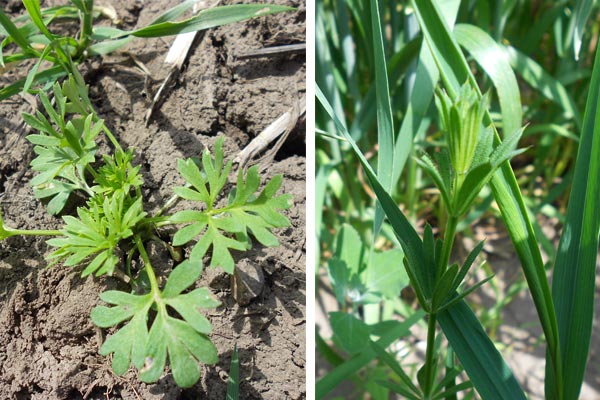
Against broadleaf species in wheat and barley, after the beginning of tillering of the crops, the following are recommended: Derby Super (florasulam + aminopyralid) – 2.5-3.3 g/da, Cameo Max (tribenuron + thifensulfuron) – 4 g/da, Arat (tritosulfuron + dicamba) – 10 g/da, Biathlon 4 D (florasulam + tritosulfuron) – 4-5.5 g/da, Ally Max (metsulfuron + tribenuron) – 3.5 g/da, Sekator OD (amidosulfuron + iodosulfuron) – 10-15 ml/da, Buctril Universal (2,4-D + bromoxynil) – 100 ml/da, Mustang 306.25 SC (2,4-D + florasulam) – 60-80 ml/da, Ergon WG (metsulfuron + thifensulfuron) – 5-9 g/da, Akurat Extra WG (metsulfuron) – 5 g/da, Belure T (tribenuron) – 2 g/da, Beflex (beflubutamid) – 50-63 ml/da, Omnera OD (fluroxypyr + metsulfuron + thifensulfuron) – 75-100 ml/da, Tripali WG (tribenuron + metsulfuron + florasulam) – 5 g/da and others.
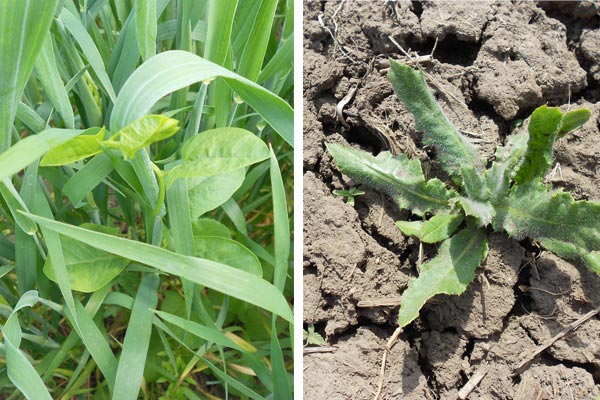
The products control: common cleavers, corn cockle, field madder, corn poppy, coriander, red dead-nettle, wild mustard, shepherd’s purse, wild vetch, larkspur species, summer adonis, field madder, stem-embracing dead-nettle, field pansy, chamomile species, wild radish, common couch, chickweed, common fumitory, goosefoot species and others. Moderately sensitive weeds are ivy-leaved speedwell, cornflower and creeping thistle.
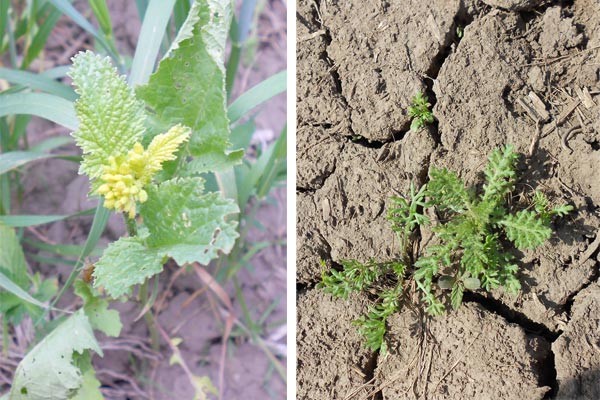
In cases of mixed weed infestation at the beginning of wheat tillering, the following are applied: Palas 75 WG (pyroxsulam) – 20-25 g/da, Corello Duo (pyroxsulam + florasulam) – 26.5 g/da, Hussar Max OD (iodosulfuron + mesosulfuron) – 100 ml/da, Pacifica Expert (amidosulfuron + iodosulfuron + mesosulfuron) – 30-50 g/da, Zerrate (pyroxsulam + clodinafop) – 25 g/da, Atlantis Flex 20.25 WG (propoxycarbazone + mesosulfuron) – 20-33 g/da, Axial One EC (florasulam + pinoxaden) – 100 ml/da and others. The listed herbicides can also be applied at the stem elongation growth stage (first-second node), provided that the sensitive weeds have not overgrown. Broadleaf weeds are most sensitive at the 3rd–5th leaf stage, and grass weeds up to the beginning of tillering. Palas 75 WG, Corello Duo and Zerrate show high efficacy against the winter–spring weeds soft brome and meadow fescue. They have excellent effect against shepherd’s needle, wild oat, blackgrass, annual ryegrass, shepherd’s purse, three-horned cleavers, coriander, corn poppy, chickweed, field madder, wild mustard, dead-nettle species, chamomile species, wild radish, goosefoot species and others.
Against broadleaf weeds in oats, herbicides based on MCPA can be used, which are more tolerant to the crop compared to 2,4-D. Other registered products are: Biathlon 4 D, Buctril Universal, Lontrel, Omnera, Refine Extra, Starane Gold, Tripali, Flurostar and others. From the herbicides registered in our country against wild oat in cultivated oats, none of the products can be used. Control of this weed must be carried out by agronomic measures or by using herbicides in the preceding crop.
In rye and triticale, all herbicides for control of grass and broadleaf weeds listed for wheat and barley can be applied.
Chemical weed control is part of plant protection that must be continuously studied. The aim is to introduce new products with high efficacy and selectivity.