

![MultipartFile resource [file_data]](/assets/img/articles/заглавна-градинарство-1.jpg)
In horticulture, achieving optimal yields from plants with high product quality, low production costs and reduced incidence of diseases and pests can be accomplished through the use of alternative means, methods and practices that protect human health and are environmentally friendly. Their application requires minimal expenditure of resources and is based on a comprehensive approach through the use of natural resources, compliance with the biological requirements of plants, utilization of crop production residues, proper crop rotation and their combined cultivation. Some of these practices were used by ancient gardeners and are still easily applicable and effective for small farms and gardens.
Soil fertility can be increased directly by applying organic sources of nutrients – farmyard manure, compost and vermicompost. Farmyard manure often contains weed seeds that cause weed infestation of the crop, which is why the use of compost and vermicompost for fertilizing the cultivated crops is recommended.
The three organic sources are characterized by a specific and variable composition of nutrients.
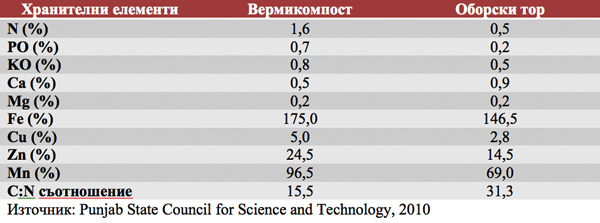
Table 1 Comparative characteristics of vermicompost and farmyard manure
The quality of farmyard manure is affected by several factors: the type of animals reared, their feed and the time of manure removal from the farm. Farmyard manure is used as feed for Californian red worms to obtain the final product – vermicompost. In this case, the origin and composition of the farmyard manure influence the quality of the vermicompost. Compost is obtained as a result of the decomposition of plant residues. Its characteristics are influenced by the type of raw materials for composting and their ratio in the composting mixture.
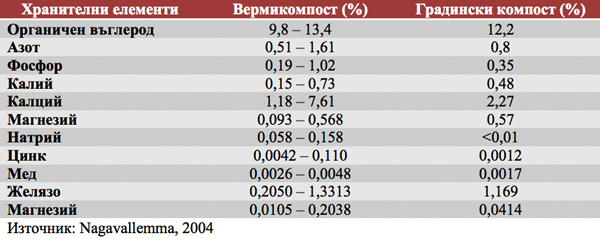
Table 2 Comparative characteristics of vermicompost and compost
Proper crop rotation on the same area and adherence to established crop rotations are another essential factor that positively affects soil fertility. Crop rotation in the fields, the so‑called crop rotation, combines alternating plants with shallow and deep root systems, application of fertilizer rates according to biological requirements, and cultivation of leguminous crops, thereby increasing soil fertility. Prolonged cultivation of vegetable crops of the same species and family in the same place leads to one‑sided depletion of nutrients, resulting in reduced yields. This is the reason why developed crop rotations are used on the farm for proper crop alternation and to avoid monoculture cultivation.
Crop rotation is also very important for reducing losses from diseases. Continuous planting of vegetable crops from the same family in the same place provides an opportunity for accumulation of pathogens. This necessitates growing the same species or closely related crops on one plot only once every three to five years. Monoculture cultivation also leads to undesirable weed infestation of the areas.
Growing healthy plants with minimal use of plant protection products can be achieved by choosing a suitable site with a sunny exposure providing 6–8 hours of sunshine, while avoiding proximity to trees so as not to cause shading of the plants. The orientation of the crop rows in the field is of essential importance for the health status of the plants. It is recommended that they be oriented in the direction of the wind, which will ensure aeration between them and prevent moisture retention – a key factor for the occurrence of fungal pathogens.
Many plant diseases can be transmitted by seeds and compromise the harvest. Therefore, seeds must be obtained only from healthy plants or purchased from seed companies. Seeds available on the market are often, but not always, treated with fungicides. This treatment provides protection against soil‑borne pathogens that attack germinating seeds and young seedlings, but they do not have a protective function during the entire seedling production period. When seedlings are purchased, they must be carefully inspected and only visibly healthy plants, with good habitus and without damage and insects on them, should be selected.
Regions and micro‑regions in the country are characterized by specific agro‑climatic conditions. For growing healthy plants and obtaining high yields, it is important to select suitable vegetable crops and varieties in accordance with the climatic conditions.
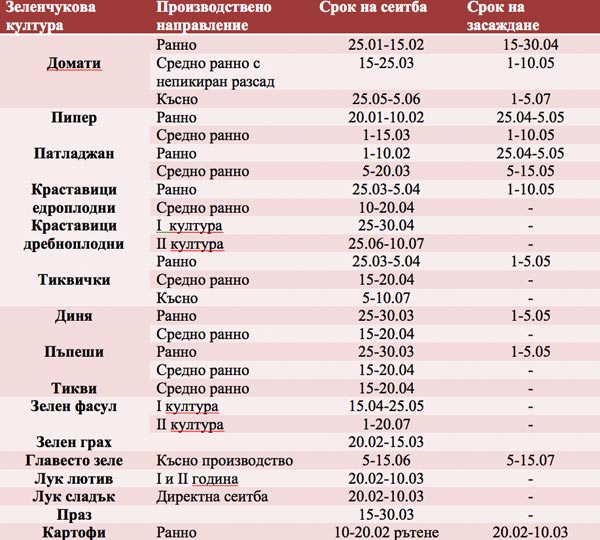
Table 3 Sowing/planting dates for the main vegetable crops
Each vegetable crop has specific requirements for temperature conditions; therefore, in order to grow and develop an optimal habitus, it must be cultivated within periods corresponding to its biological requirements. Planting dates can be an effective tool for managing plant diseases. Sowing seeds at low soil temperatures can cause their rotting or disease of young plants. Crops grown during the warm season are most susceptible to damage from low temperatures and, conversely, seeds of some late crops may fail to germinate when sown at high temperatures.
Adhering to the optimal spacing between plants and growing them on trellises or other structures can reduce the incidence of many fungal and bacterial diseases that proliferate during prolonged wet periods. Plants should be grown according to established schemes specific to each crop, which ensure a certain number of plants per decare, in order to provide good air circulation. At higher densities and a greater number of plants than recommended, favourable conditions are created for reduced aeration, increased humidity and multiplication of pathogens.
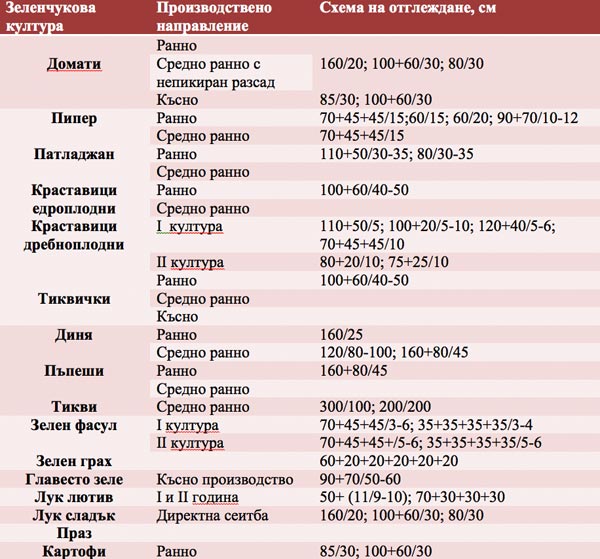
Table 4 Planting schemes for vegetable crops
Maintaining an optimal irrigation regime is an agrotechnical practice of essential importance for the health status of plants. Constantly moist soils contribute to the occurrence of pathogens such as seed rot, damping‑off and root rot. To form a healthy root system in the early growth stages, plants should be irrigated with a higher irrigation rate only when necessary, not more than once a week. In hot and dry weather, the irrigation rate should be increased, and in cooler weather it should be reduced. Drip irrigation slowly releases water and is the most efficient method of irrigation. Surface (gravity) irrigation is effective for small‑area plantings. Sprinkler irrigation is the least preferred in terms of efficiency and disease prevention. If sprinkler irrigation is used, watering should be done on sunny mornings, when the leaves will dry the fastest. Soil moisture should be maintained at 80–90% of field capacity. Work in the garden should be avoided when plants and soil are wet. Bacterial and fungal diseases spread easily from one plant to another via hands and clothing when the above‑ground plant parts are wet.
Soil moisture can be preserved through the use of mulch. Mulch has two other valuable properties: it suppresses weed development and protects plants from soil‑borne pathogens. Materials such as straw, bark, leaves, shredded paper or polyethylene prevent soil from splashing onto plant parts and fruits that touch the soil surface and protect them from pathogen attack. In particular, for tomatoes, pumpkins, cucumbers and melons, mulch prevents fruit rot. Some mulching materials, such as straw, leaves, shredded wood or bark, will also add beneficial organic matter as they decompose on the soil surface.
Weeds can be another source of diseases and pests. Some weeds can serve as reservoirs for viruses that are transmitted by aphids to vegetable crops, as well as hosts for pests. Weeds can also compete for nutrients and sunlight. Good weed control will increase air movement in the garden and reduce humidity, which favours disease development.
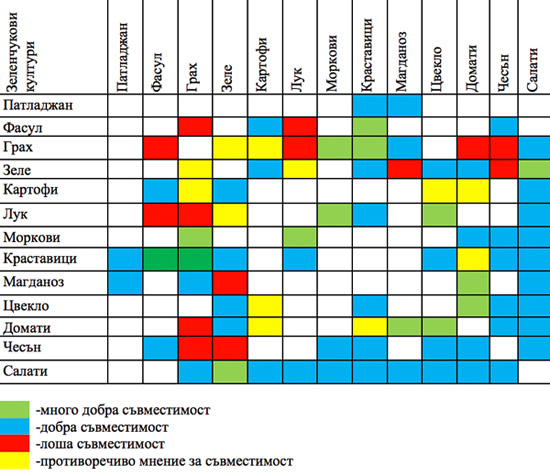
Table 5 Possibilities for companion growing of vegetable crops
Another approach to reducing the incidence of pests is companion growing of vegetable crops. It is not always successful due to the specific mutual influence of some of them. Therefore, very careful selection of the species to be grown together is necessary.