

![MultipartFile resource [file_data]](/assets/img/articles/заглавна-tabakpflanze-1.jpg)
Tobacco production is still a significant branch of agriculture in Bulgaria. In the country, the following varietal groups are cultivated – Oriental tobacco, Kaba Kulak, Virginia and Burley. When growing tobacco, the complex interaction between genotype and agro-ecological conditions, as well as the presence of various types of phytopathogens, must be taken into account. Some of these are viral diseases, and the damage they cause to the main agricultural crops, including tobacco, is substantial.
Tobacco is a natural host for more than 20 viruses, among which the most economically important and causing significant damage to tobacco production are TMV (Tobacco mosaic virus) and ToMV (Tomato mosaic virus), genus Tobamovirus; TSWV (Tomato spotted wilt virus), genus Tospovirus; CMV (Cucumber mosaic virus), genus Cucumovirus; AMV (Alfalfa mosaic virus), genus Alfamovirus; TRSV (Tobacco ringspot virus), genus Nepovirus; PVY (Potato virus Y), TEV (Tobacco etch virus), TVMV (Tobacco vein mottling virus) and Pepper veinal motle virus (PVMV), genus Potyvirus.
In Bulgaria, the economically most important viral diseases of tobacco are tomato bronzing (necrosis), speckle, cucumber mosaic and common tobacco mosaic.
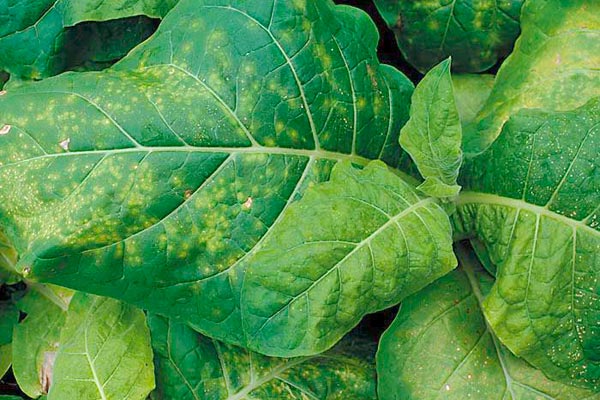
Tomato bronzing (necrosis)
The causal agent of bronzing is the Tomato spotted wilt virus (TSWV), which is characterized by high genetic variability. In Bulgaria, the disease was first recorded in 1952 in the Gotse Delchev and Sandanski tobacco regions, where in the first years of its occurrence it caused losses of 30 to 50%. Under our conditions, the tobacco thrips (Thrips tabaci Lind) plays an exceptional role in the spread of TSWV. To a lesser extent, the virus is also spread by some species of the genus Frankliniella. The disease occurs in two forms: necrotic bronzing, which is a problem in Northeastern Bulgaria, and classical bronzing, widespread in Southern Bulgaria. To date, all attempts using methods of classical genetics and breeding to develop stable resistance to TSWV have been unsuccessful. One of the ways to create such resistance is sexual hybridization between cultivated varieties and some of the resistant wild species, such as the highly immune N. alata and N. sanderae. This is a difficult process to implement due to the great remoteness of the species.

Common tobacco mosaic in tobacco
The disease common tobacco mosaic in tobacco is caused by Tobacco mosaic virus (TMV) and Tomato mosaic virus (ToMV). These viruses are extremely stable and are spread mechanically, through seeds, plant residues, nutrient solutions, grafts, by contact between plants, contaminated tools and irrigation water. They are preserved for long periods in the soil and after lyophilization of leaves from infected plants. Symptoms in different tobacco species range from masked to typical mosaic, chlorosis, deformations, necrosis, and growth retardation, which are sometimes combined. Overall, the expression of symptoms depends on the variety, strain, external environmental conditions and the developmental stage of the plant. Resistance to tobamoviruses in tobacco is encoded by two dominant non-allelic genes and is stable and long-lasting.

Cucumber mosaic in tobacco
Cucumber mosaic in tobacco is caused by Cucumber mosaic virus (CMV). Often in tobacco it is not possible to visually distinguish the symptoms caused by Tobacco mosaic virus and Cucumber mosaic virus. Identification of CMV is easy and rapid on test plants Chenopodium amaranticolor, Chenopodium quinoa, Phaseolus aureus, on which typical local lesions appear 3 to 5 days after inoculation. During the growing season, Cucumber mosaic virus is transmitted in a non-persistent manner by more than 80 aphid species, and in tobacco it is most frequently transmitted by cotton (melon) aphid (Aphis gossypii Glov) and peach aphid (Myzus persicae sulz). Enormous variability has been described in Cucumber mosaic strains and isolates, which are classified into groups I and II. The chlorotic type of the disease is due to Cucumber mosaic strains from group I. The necrotic type is caused by strains from group II. Up to now, no sources of resistance have been identified in species of the genus Nicotiana.
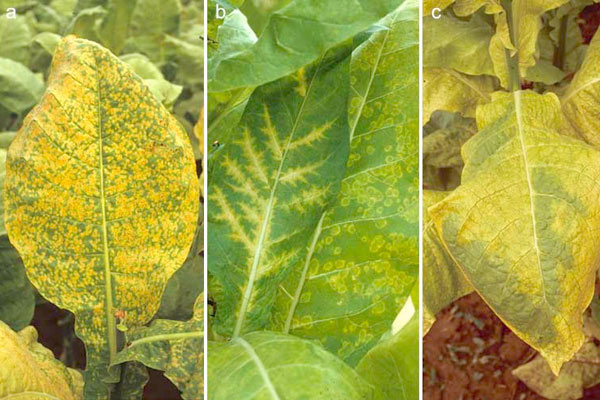
The disease „Speckle” in tobacco
The disease „Speckle” is caused by viruses of the genus Potyvirus, PVY, TEV, TVMV and PVMV, which are often found as a viral complex in tobacco. They induce symptoms of speckle and etching on tobacco plants, depending on the type of infection. There is evidence that in the country these viruses are distributed individually and in all possible combinations of mixed infections. The main vectors responsible for their spread in tobacco are aphids of the genera Acyrthosiphon, Aphis, Myzus, Neomyzus. Resistance to potyviruses is encoded by two recessive allelic genes va1 and va2 and is significantly more stable than that to TSWV. Strains overcoming this resistance appear rarely and cause significantly lower losses, as the symptoms are milder, and the necrotic strains of the virus induce mosaic.