

![MultipartFile resource [file_data]](/assets/img/articles/заглавна-присадки-1.jpg)
Grafting is both a new and an old technology for vegetable cultivation through the use of resistant rootstocks to improve yield and product quality. This technology was first introduced in Japan and Korea. At present, a large share of watermelons, melons and cucumbers are grown from grafted plants. For the needs of greenhouse production of the main species from the family Solanaceae – tomato, pepper, eggplant, grafted plants are also used and their quantity is continuously increasing.
The objective of grafting has been significantly expanded and includes: resistance to stress and diseases, increased plant vigour, yield and harvesting period. Grafting of vegetable crops enables their cultivation under non-traditional conditions and in dynamic agro-ecosystems. It is a biological strategy for disease management. It has been proven to be effective against several soil-borne diseases, including Fusarium, Verticillium and bacterial wilts, some downy mildews and root-knot nematodes. It is important to note that grafted vegetables do not have increased resistance to foliar pathogens.
Grafting is one of the tools for sustainable vegetable production through the use of resistant rootstocks. It reduces dependence on plant protection products for organic production. The first attempt to graft vegetable crops was made with watermelon (Citrullus lanatus) onto pumpkin rootstock (Cucurbita moschata) at the end of the 1920s. The production and demand for grafted vegetable plants is continuously increasing in Asia, in Europe, as well as in North America. Watermelon is one of the vegetables for which grafting is carried out most intensively worldwide.
The grafting process is accompanied by various problems, which are usually related to the grafting operation itself and the production of grafted seedlings. The most important problems are human labour and the different techniques. Of crucial importance are the process of grafting itself and the subsequent period, related to the take of the grafts and rapid healing of the plants within 7 to 10 days.
The main prerequisites for vegetable grafting are:
1. Selection of the appropriate rootstock: It must have the same stem size (diameter). Grafting should be carried out at the 2–3 true leaf stage;
2. Compatibility with the scion: This is very important, because compatible rootstocks and scions minimise plant losses even at a later stage of growth. Rapid callus formation between scion and rootstock leads to the formation of conductive vessels in the grafted plant.
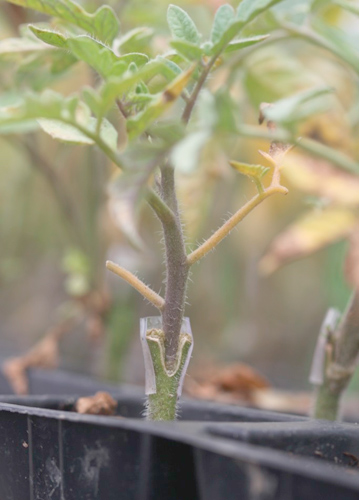
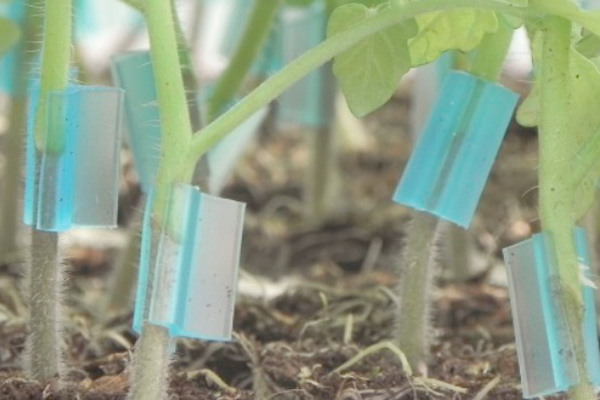
3. Grafting aids: Commonly used aids for performing grafting are clips, tubes, pins and grafting blades.
4. Nursery chambers: Used for growing seedlings before grafting. They should be covered with a fine polyethylene mesh. They must have a double door, and the upper half of the structure should be covered with a separate UV-resistant polyethylene film to prevent penetration of UV light.
5. Healing of grafts: This process is the most important because it provides favourable conditions to promote callus formation on the grafted plants. In the growth chamber, the temperature should be 28-29oC and 95% relative humidity for 5-7 days in a partially shaded place (darkness for 1-2 days) to promote callus formation between rootstock and scion. This helps to form a better union at the grafting point by reducing transpiration, maintaining high humidity, optimal temperature and reduced light intensity.
6. Acclimatisation of grafted plants: After the callus has formed and the wounded surfaces have healed, the plants can be placed in a greenhouse with a fogging system, or under a transparent plastic chamber for acclimatisation and prevention of leaf scorching and wilting.
Grafting methods
Several methods have been developed and are used for vegetable grafting:
1. Cleft grafting: This is a widely used method for grafting vegetables. In this method, plants of the selected cultivars are cut back at the 1–3 true leaf stage, and the stem of the rootstock is cut at an oblique angle to form a conical wedge. To ensure contact between scion and rootstock, after placing the scion in the cleft made, clips are used.
2. Tongue approach grafting: This method is most widely used by farmers and small nurseries. It requires more space and labour compared to other methods, but it achieves a higher rate of seedling take. The grafted plants have an even growth rate. It is not suitable for rootstocks with hollow hypocotyls.
3. Hole insertion/top grafting: This is the most popular grafting method for cucurbits, because both scions and rootstocks must have hollow hypocotyls. To achieve a high graft take, relative humidity should be maintained at 95% and the optimal temperature at 21-36oC until planting out.
4. Single cotyledon grafting: This method is adopted by commercial nurseries and is applicable to most vegetables. Grafted plants should be kept in the dark at 25oC and 100% humidity for three days for callus formation. This method was developed for robotic grafting of courgettes/zucchini.
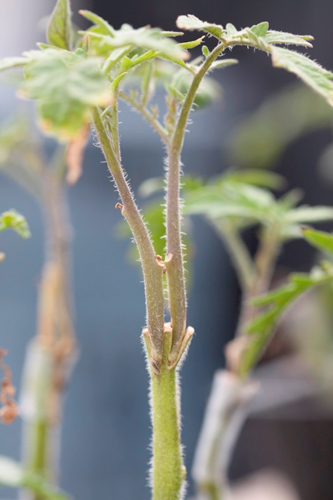
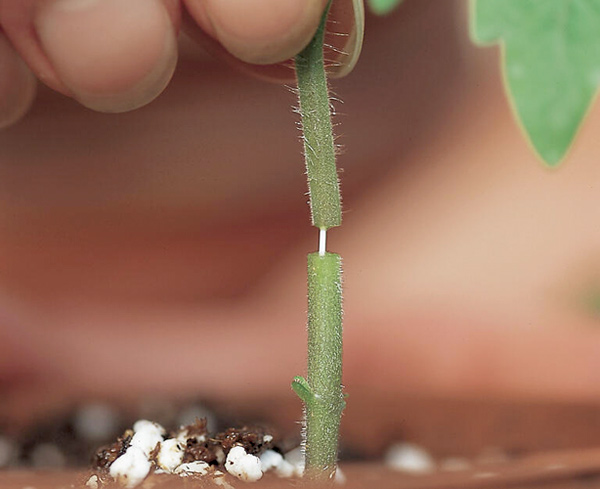
5. Tube grafting: This method is similar to the first one, but in this case the joined plants are held together with an elastic tube instead of clips. It is popular for tomatoes.
6. Pin grafting: In this method, specially designed pins are used to support the scions and rootstocks. The pins are made of natural ceramics so that they can remain on the plant without any problem.
In order to achieve higher success rates with grafted plants, certain conditions must be provided:
- Water loss from the scion during the first 2 days can lead to its wilting and to unsuccessful grafting. Therefore, humidity in the chambers must be maintained to prevent water loss.
- Grafted transplants should be covered for 5-7 days with black polyethylene to increase humidity, reduce light intensity and promote the healing process.
- Grafted plants should not be exposed to direct sunlight during the graft take period.
Effect of grafting on tomato yield and quality
Tomato is one of the most important vegetable crops in the world and grafting is an important cultural practice for it. Continuous cropping is inevitable in its production, especially under protected cultivation, and this reduces yield and product quality. An increase in yield of up to 62% has been recorded in this crop when grafted plants are used, but quality characteristics, e.g. fruit shape, skin colour, skin smoothness, texture and soluble solids content, are influenced by the rootstock. It is assumed that fruit quality is affected due to the rootstock-scion interaction.
Effect of tomato grafting on resistance/tolerance to biotic and abiotic stress.
The main objective of vegetable grafting worldwide is to provide resistance to soil-borne diseases. Corky root, Fusarium, Verticillium and bacterial wilts and root-knot nematodes are among the causes of damage from biotic stress in vegetable production and especially in greenhouse production. The most common disease controlled through grafting is Fusarium wilt in tomato, caused by different pathovars of Fusarium oxysporum. Most greenhouse tomato growers use grafting techniques to reduce susceptibility to corky root and to increase yield through enhanced plant vigour.
A similar effect has been observed from tomato grafting, where a susceptible cultivar grafted onto Beaufort drastically reduces infestation by root-knot nematodes. Abiotic stress significantly affects tomato production both in the open field and under greenhouse conditions. It includes low and high temperatures, drought and high humidity, hypoxia, salinity, heavy metal contamination, excess and deficiency of nutrients and pH stress in the soil. These conditions cause various physiological and pathological disorders, which lead to a serious yield reduction. Grafting can provide resistance and/or tolerance in tomatoes under such conditions. Soil or water salinity is one of the main abiotic stresses that reduce crop growth and productivity worldwide. Grafting tomato plants for enhanced salt tolerance is a promising practice for increasing yields under saline soil conditions.
Grafting of cucurbit vegetable crops
The objective of grafting in cucurbit crops is to control Fusarium wilt, provide drought resistance and tolerance to waterlogging. At present, watermelon is one of the vegetables for which grafting is carried out most intensively. Successful grafting includes survival rate, compatibility and the effect on quantitative and qualitative characteristics – tolerance/resistance to biotic and abiotic stress.
Scion compatibility and survival rate
Scion compatibility is defined as a sufficiently close genetic relationship between rootstock and scion to form a successful graft, assuming that all other factors (technique, timing, temperature, etc.) are satisfactory.
Effect of grafting on biotic stress
Grafting plays an important role in controlling biotic stress through the use of different rootstocks. Grafting watermelon onto other cucurbit rootstocks to provide resistance to soil-borne diseases is very successful. Rootstocks for squash include bottle gourd Lagenaria vulgaris and Сucurbita moschata × Cucurbitamaxima. Both are highly resistant to Fusarium oxysporum, which causes significant yield losses. Research results show that disease-susceptible cucurbit lines can also be grafted onto Luffa to improve performance. By grafting melons, races 1 and 2 of Fusarium oxysporum f. sp. melonis can be controlled. It has been demonstrated that by using Verticillium-resistant rootstocks in watermelon, the onset of disease symptoms can be delayed by three weeks, thus allowing watermelon fruits to reach maturity. When screening watermelon plants grafted onto wild watermelon rootstocks (Citrulluslanatus var. citroides), resistant or moderately resistant responses to the nematode Meloidogyne incognita have been identified. The watermelon cultivar “Crimson Sweet“, grafted onto the rootstocks “Emphasis“ and “Strong Tosa“, has an increased growth rate and improved tolerance to V. dahliae.
Grafting of susceptible cucumber cultivars, e.g. Brunex F1 and other hybrids from Dutch breeding onto Cucurbita ficifolia, C. moschata and C. maxima × C. moschata provides effective control against root and stem rot. The incidence of attack is reduced by 75-100%. It has been established that the rootstock C. moschata, used for courgettes/zucchini, provides high tolerance to root-knot nematodes. When assessing the effect of different pumpkin rootstocks on cucumber growth and yield in soil infested with root-knot nematodes, it has been found that the type of rootstock (Strongtosa and Shintosa) is the reason for obtaining higher yields, ranging from 260% to 280% compared to non-grafted plants. Grafted cucumber survives better and provides good yield and quality. So far, immune forms against soil pathogens have not been identified, but some studies have found that sources belonging to the family Cucurbitaceae exhibit resistant or tolerant responses.
During the period 2014-2015, at the Maritsa Vegetable Crops Research Institute, Plovdiv, breeding materials from the family Cucurbitaceae were screened: Gergana, Kiara F1, TG, TD (Cucumis sativus); CM 720, SB-2, SB-3, Turban (C. maxima); Muscatna 51-17, Carotina, (C. moschata); Turban × Muskatna 51-17, CM 720 × Carotina (C. maxima × C. moschata); Mesten (Lagenaria siceraria). Screening tests were carried out with local pest isolates. The results obtained show that Carotina is resistant to Meloidogyne spp. Cucumber lines TG and TD and Lagenaria exhibit a resistant response to soil-borne pathogens. The tested material can be used directly for grafting cucumber plants, and can also serve as a basis for initiating a breeding programme for rootstocks with tolerance to Meloidogyne spp., Fusarium spp. and Pythium spp.
Role of grafting in watermelon
At present, watermelon is one of the vegetables for which grafting is carried out most intensively worldwide.
1. Effect of grafting on watermelon yield and quality
The highest number of fruits is observed in grafted watermelons on pumpkin rootstock (2.6 fruits). In terms of watermelon fruit quality, it is known that grafting onto different rootstocks increases fruit firmness and thereby extends shelf life.
2. Grafting watermelon for resistance/tolerance to biotic and abiotic stress
It has been established that bottle gourd rootstocks are resistant to diseases. Accordingly, grafting watermelon onto cucurbit rootstocks to provide resistance/tolerance to soil-borne diseases is very successful. Watermelon plants grafted onto wild watermelon rootstocks (C. lanatus var. citroides) are resistant or moderately resistant to the root-knot nematode Meloidogyne incognita. Grafted watermelons have the potential to survive under abiotic stress. When grafting for salinity tolerance, the rootstocks show yield increases of up to 81% under greenhouse production in the Mediterranean region.
Role of grafting in eggplant
Eggplant (Solanum melongena) is widely distributed and cultivated in tropical and temperate regions of the world and is amenable to grafting. Eggplant is susceptible to numerous diseases and pests, in particular Ralstonia solanacearum, Fusarium and Verticillum, nematodes and insects.
1. Effect of grafting on eggplant yield and quality
Similar to the above-mentioned crops, grafting in eggplant is aimed at increasing yield. In recent years, however, consumer interest in the quality of vegetable crops has been increasing worldwide. This includes physical properties, taste and health-related compounds. Although there are many contradictory reports on changes in fruit quality as a result of vegetable grafting, the oxalic acid content in eggplant fruits differs significantly depending on grafting and cultivar. The average oxalic acid content in the cultivar Faselis is 18% lower than that of Pala. Grafting leads to a reduction (9%) in the average oxalic acid content in both cultivars. There are many reasons why rootstocks affect scion quality. The most obvious is incompatibility between scion and rootstock. Therefore, rootstock/scion combinations must be carefully selected for specific climatic and geographical conditions.
2. Grafting eggplant for resistance/tolerance to biotic and abiotic stress
Grafting eggplant onto an appropriate rootstock is an environmentally sound solution for combating biotic stress. When planting grafted and non-grafted eggplant in soil infected with the causal agent of Verticillium wilt, higher yields were obtained from the grafted plants. Heavy metals such as cadmium, arsenic, lead and mercury, which are introduced into the soil from industrial sources, are harmful both to plants and humans. A study carried out in Japan shows that approximately 7% of eggplant fruits contain cadmium at concentrations exceeding the internationally permissible limit for fruits and vegetables. Therefore, grafting vegetables onto appropriate rootstocks can limit the accumulation of heavy metals in the above-ground parts, thus mitigating the adverse effect on crop performance and human health. Grafting Solanum melongena onto Solunum torvum reduces cadmium concentrations in leaves and stems by 67–73% compared to grafting onto Solanum integrifolium or planting non-grafted plants.
Role of grafting in pepper
Pepper is one of the most popular vegetables. Some soil-borne fungal pathogens and root-knot nematodes are among the main problems limiting its production worldwide. Yields and quality are significantly reduced by Fusarium oxysporium, Verticillium dahliae, Phytophthora capsici and Meloidogyne spp. when growing pepper in protected cultivation and in the open field. Soil sterilisation, solarisation and the use of chemical fungicides and nematicides are common and traditional methods of controlling these diseases and pests. However, they are applicable mainly in greenhouse production. Grafting is considered one of the most important alternative methods for controlling soil-borne diseases in pepper cultivation. The effectiveness of this method depends on the level of resistance of the rootstocks to diseases. Grafting onto resistant rootstocks can provide a positive effect against Fusarium, Verticillium and bacterial wilts, against P. capsici and root-knot nematodes. Rootstocks can also provide major advantages in vegetable production through strong growth, high yield and tolerance or resistance to abiotic stress factors such as salinity, drought, high and low temperatures.
The use of grafted plants is not widespread in pepper cultivation. Suitable rootstocks have been identified that show a significantly lower degree of disease incidence from the listed pathogens compared to other rootstocks and control plants.
Problems encountered during vegetable grafting.
The various problems associated with the production and management of grafted transplants are:
a) The technique is labour-intensive and requires specially trained workers;
b) It requires precise assessment of the sowing time of the rootstocks and the sowing time of the scions; c) It requires a controlled environment for healing of the grafts;
d) Grafting can increase the risk of spreading pathogens in the nursery, especially seed-borne ones;
e) Workers performing grafting in a greenhouse or in the growth chamber face problems of heat stress and discomfort, especially during April-June, September and October.
Innovations in vegetable grafting
Many innovations in vegetable grafting have been developed and introduced: Double-grafted and single-grafted tomatoes; tomato scions are grafted onto potato rootstocks using cleft grafting; a technique has been introduced for producing double-grafted tomato plants – two scions are grafted onto one rootstock. The rootstocks Big Beef or Geronimo are used for this purpose. The idea is to plant fewer plants per decare, which also reduces the cost of seedlings per decare.
Grafting robots: The fully automated model developed in the Netherlands can graft 1000 tomato or eggplant plants per hour and has additional functions, such as automatic selection of matching rootstocks and scions, which is important for increasing the success rate. The first commercial model of a grafting robot has been available for cucurbits since 1993.
Future knowledge required for grafting:
a) There is insufficient information regarding the use of other rootstocks and their compatibility with open-field cultivars;
b) High production costs: The high price of grafted seedlings is the result of intensive labour for propagation, a longer production phase and additional costs for the rootstock. These costs often discourage potential users of grafted seedlings;
c) Controlled environment: Controlled conditions increase the possibility of manipulating the organisation of production and the survival rate
Status of vegetable grafting worldwide
Labour intensity and high production costs for grafting are a problem for the widespread dissemination of vegetable grafting technology outside Asia. The development of efficient production techniques for grafted seedlings and the establishment of new rootstocks with desirable traits, compatible with selected scions, contributed to the introduction of the technology in Europe in the early 1990s mainly through the marketing efforts of international seed companies and through information exchange between research communities. As a result, the areas in which grafted plants are introduced have increased rapidly over the last two decades. East Asia is the largest market for grafted vegetables due to the high concentration of cucurbits and other vegetables. In Korea, Japan and China, 99%, 94% and 40% of watermelon, respectively, are produced using grafted plants. In the family Solanaceae, about 60-65% of tomatoes and eggplants and 10-14% of peppers are produced using grafted plants. In the Netherlands, all tomatoes under soilless cultivation are grafted. Currently, vegetable grafting is expanding worldwide, especially in Eastern Europe, North and South America, India and the Philippines. In China, more than 1500 commercial nurseries produce grafted plants. Canada exports such plants to Mexico. All this shows that international trade in grafted vegetable transplants is rapidly increasing.
For farmers, vegetable grafting has become a crucial tool for overcoming soil-borne diseases and other pests. In the 1990s, almost 60% of the open-field areas and greenhouses in Japan producing melons, watermelons, cucumbers, tomatoes and eggplants were organised with grafted seedlings. In Korea, these areas exceed 81%. In Japan, more than 500 million grafted seedlings are produced annually, and in the USA – over 40 million plants, with the majority of them used for hydroponic cultivation. In Greece, grafting is particularly popular in the southern regions, where the ratio of production area using grafted plants to the total production area is 90-100% for early watermelon cultivation and 40-50% for melons under low tunnels, 2-3% for tomatoes and 5-10% for cucumbers. Representatives of the family Solanaceae are less frequently grafted: about 60–65% of tomatoes and eggplants and 10–14% of peppers. Under greenhouse cultivation, the percentage is higher – almost all cucumbers, watermelons and tomatoes are grafted. A similarly high ratio of grafted to non-grafted plants exists in Mediterranean countries, especially those with zones of intensive production, such as Spain, Italy, Turkey and Israel. In the Netherlands, almost all tomatoes grown hydroponically are grafted. In France, mainly tomatoes and eggplants are grafted to improve resistance to soil pathogens and nematodes. Vegetable grafting is continuously expanding in many countries around the world, especially in Eastern Europe, North and South America, India and the Philippines. In Mexico, grafting was first introduced in tomatoes and later in other vegetable crops. Currently, Canada and Mexico have several large-scale grafting nurseries that produce millions of grafted plants annually.