![MultipartFile resource [file_data]](/assets/img/articles/заглавна-Paprika-bunt-1.jpg)
Pepper (Capsicum annuum L.) was brought to our lands at the beginning of the 16th century. Gradually, along with other vegetables such as cabbage, onion, garlic, radish, etc., which Bulgarians cultivated, pepper spread rapidly and became a favourite vegetable crop because of the high nutritional and dietary qualities of its fruits. These, sweet and hot, contain many valuable nutrients, vitamins, pigments, minerals, phenols, fibres, essential and aromatic substances, which give the characteristic pepper aroma and taste. The most valuable components of pepper are the vitamins C, A, E, P, the minerals K, P, Zn, Mg, folic acid, etc. In terms of vitamin C content, which varies from 50 to 400 mg% depending on the varietal type and fruit maturity, pepper is equal to blackcurrant, exceeds citrus crops such as lemon and orange several times, as well as almost all vegetables. The concentration of vitamin C increases and reaches its maximum when the fruits are at botanical maturity, while the accumulation of vitamin P (rutin) is completed at technical maturity.
In recent years, interest in bioactive substances with powerful antioxidant activity has increased. Such are the carotenoids, of which pepper is very rich and from which vitamin A is subsequently formed. Among them, the carotenes capsanthin and capsorubin predominate in the red fruits of pepper, β-carotene – in the orange ones, and the xanthophylls lutein and zeaxanthin – in the yellow-coloured and green fruits. These components have numerous health benefits, including protecting the retina of the eye and reducing the risk of cataract occurrence. Another powerful bioactive compound is capsaicin, which is contained in the hot fruits of pepper. It has anti-inflammatory action and helps accelerate metabolism, thereby contributing to weight regulation. These substances find application in the food, cosmetic and pharmaceutical industries as natural colourants and flavourings and are included in the composition of various medicinal products and food supplements. All this demonstrates the importance for human health of consuming pepper in all its forms, colours and tastes.
Pepper varieties developed at the Maritsa Vegetable Crops Research Institute
Bulgaria is known for its varietal diversity, breeding achievements and traditions in the cultivation of this crop, and the role of Bulgarian gardeners in creating diverse forms and spreading pepper in Europe and worldwide is universally recognised. For over 90 years, lines and varieties of pepper have been developed at the VCRI “Maritsa“ – Plovdiv, most of which for decades were the main ones for the country, and some of them are still in demand and cultivated in the country and offered to producers.
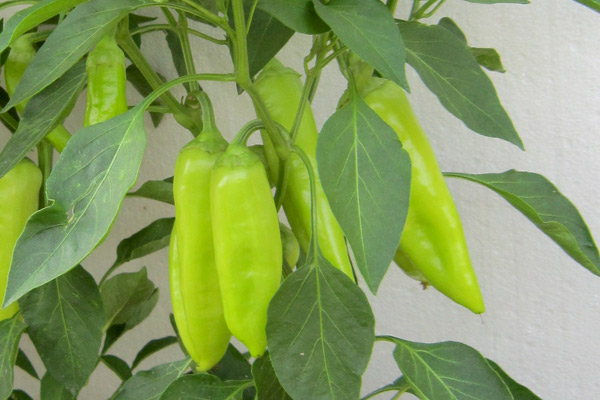
Albena
An early Bulgarian variety originating from Zlatен медал 7 (Golden Medal 7). Suitable for early and medium-early field production as well as in protected cultivation facilities. When the weather turns colder, it does not form anthocyanin on the fruits and stem. The fruits are pendent, slightly flattened, 13-18 cm long, 5-7 cm wide at the base, with an average weight of 75-80 g. The mesocarp is 4-5 mm thick. The vegetation period to technical maturity is 105-110 days.
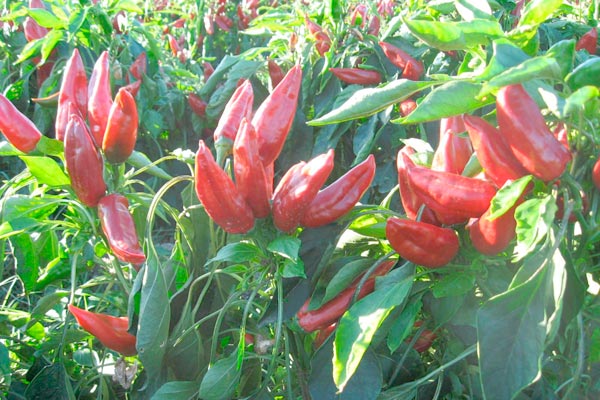
Buketen 50
Developed at VCRI “Maritsa”. It is suitable for medium-early field production. The fruits are erect. Compared to Gorogled 6 it has higher earliness and more concentrated ripening, as well as higher pigment content (180-230 ASTA units). The vegetation period from emergence to 70% concentrated ripeness of the fruits is about 145 days. It has high resistance to Verticillium wilt. It is intended for the production of high-quality red pepper for grinding.
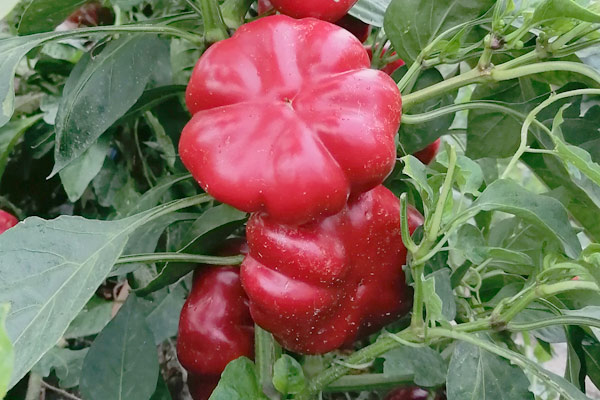
Bulgarian Ratund
Traditional Bulgarian variety. Suitable for medium-early and late field production. The plant is 35-45 cm high with two to three branches. The fruits are flattened with three to four slightly pronounced segments. The average fruit weight is 90-100 g. The mesocarp is tender, juicy and sweet. The vegetation period to technical maturity is 115-120 days, and to botanical maturity – 140-150 days. It is intended for consumption fresh and processed (pickles, lutenitsa, etc.).
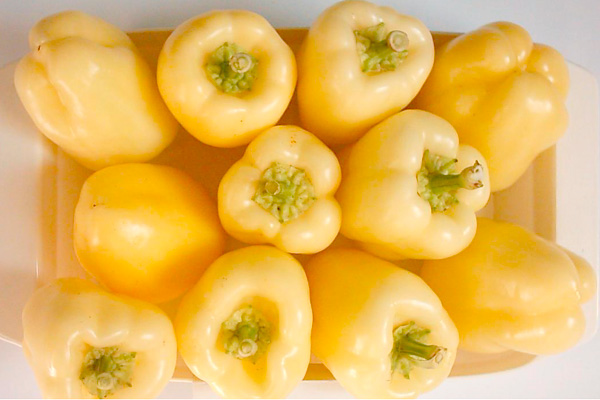
Byal Kalinkov
Bulgarian variety from the group of Broad peppers, Kalinkov (Dolma) type. Suitable for early and medium-early field production as well as in protected cultivation facilities. The fruits are erect, three-lobed, 9-11 cm long and 5-6 cm in diameter at the base. The pericarp is about 6 mm thick, with a thin skin. At technical maturity the fruits are waxy white, and at botanical maturity – red. The vegetation period is about 110-115 days to technical and 135-140 days to botanical maturity. It is intended for consumption fresh and processed.
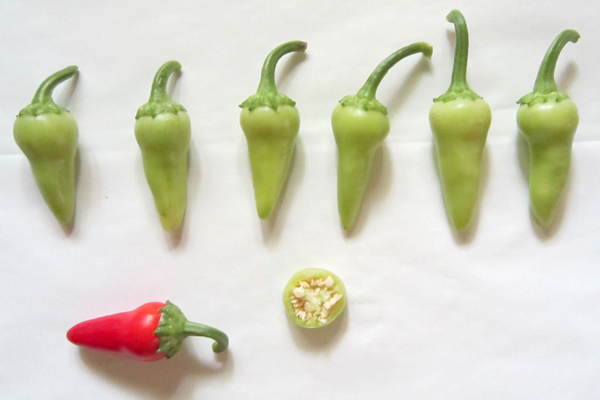
Byala Shipka
Local variety, Shipka type. Intended for medium-early and late field production, as well as in protected cultivation facilities. The fruits are small, conical, 5-7 cm long and 1.5-2.5 cm wide at the base. At technical maturity they are whitish green, and at botanical – red. The vegetation period to technical maturity is 95-100 days and to botanical – 144 days.
Gorogled 6
Developed at VCRI ”Maritsa” for the production of red pepper for grinding. It is suitable for medium-early field production. The fruits are erect, conical, with a relatively wide base. They are 8-10 cm long and 3-3.5 cm in diameter at the base. The variety is characterised by high dry matter content (25-30%) and pigment content at harvest. The vegetation period to 70% concentrated ripeness is about 160 days.
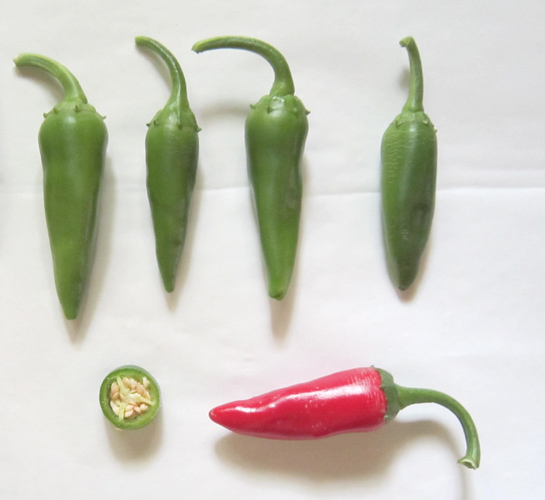
Dzhulyunska Shipka 1021
Developed at VCRI “Maritsa”, Shipka type. Very early and high-yielding variety. Intended for early and medium-early field production, as well as in protected cultivation facilities. The fruits are pendent, small, 4-6 cm long and 1.5-2.5 cm wide at the base. They are short conical in shape with a slightly rounded tip. Their surface is smooth with a strong gloss. They have a strongly hot taste. At technical maturity they are dark green, and at botanical – intensely red. The fruit weight is from 8 to 11 g. The vegetation period to technical maturity is 90-95 days.
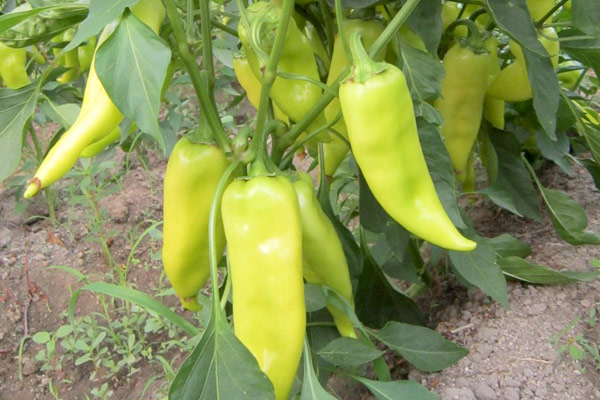
Zlaten Medal 7 (Golden Medal 7)
Developed at VCRI ”Maritsa”. Intended for early and medium-early field production, as well as in protected cultivation facilities. The fruits are pendent, long. At technical maturity they are light green, and at botanical – red. The mesocarp is juicy, tender, sweet and pleasantly aromatic. The vegetation period is 105-110 days to technical maturity. The produce is intended for consumption fresh and processed.
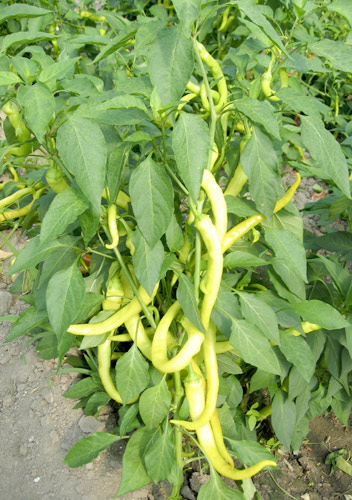
VCRI Delikates
Horn-shaped type. Bred at VCRI "Maritsa" from the Chorbadiyski variety. Suitable for early, medium-early and late field production, as well as in protected cultivation facilities. The fruits of VCRI Delikates are sweet, very long, narrow at the base and transversely wrinkled. It is relatively higher yielding than the initial variety. The vegetation period to technical maturity is about 100 days, and to botanical – 135 days. The produce is intended for consumption fresh and processed (pickles, etc.).
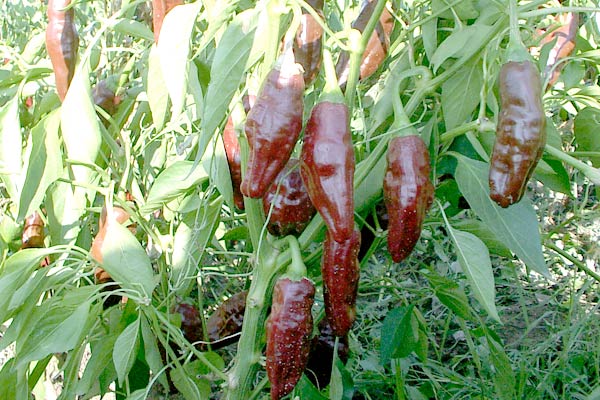
VCRI Kalin
High-yielding variety of VCRI ”Maritsa” for the production of pepper for grinding. Suitable for medium-early field production. It has relatively sparse foliage and pendent fruits with three to four locules, 7-9 cm long and 1.5-2.5 cm wide. The colour of the fruits at botanical maturity is chocolate brown, but under strong light it acquires a slight reddish hue. It is distinguished by very good storability of the finished product under warehouse conditions.
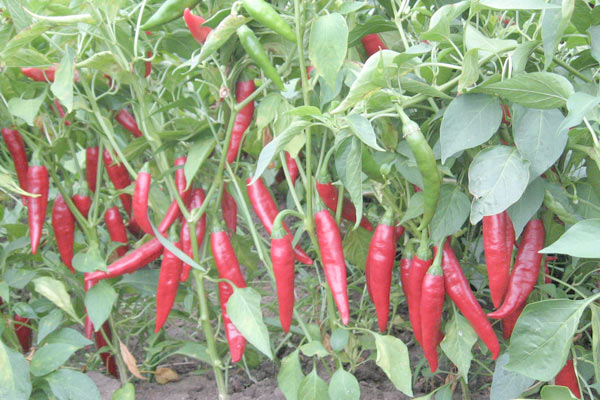
VCRI Rubin
High-yielding variety for the production of red pepper for grinding, developed at VCRI "Maritsa". Suitable for medium-early field production. The fruits are pendent, at technical maturity dark green, and at botanical – intensely red. The dry matter content is about 22%, and the pigment content – 170-220 ASTA units. The vegetation period from emergence to 80% red fruits is about 155 days. The produce is of high quality, intended for the production of ground pepper and oleoresin.
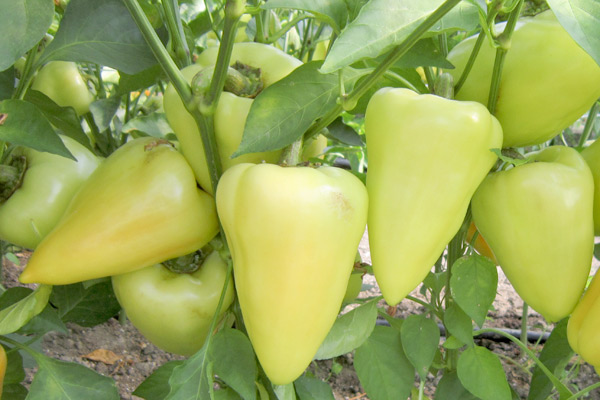
Kaloyan
Developed at VCRI “Maritsa”. The variety is suitable for early and medium-early field production, as well as in protected cultivation facilities. The fruits are pendent, 7-8 cm long, wide to very wide, single-lobed, with sweet taste. The pericarp thickness is 5-6 mm. At technical maturity they are light green, and at botanical – red. The variety is resistant to Verticillium wilt. It is intended for consumption fresh and processed.
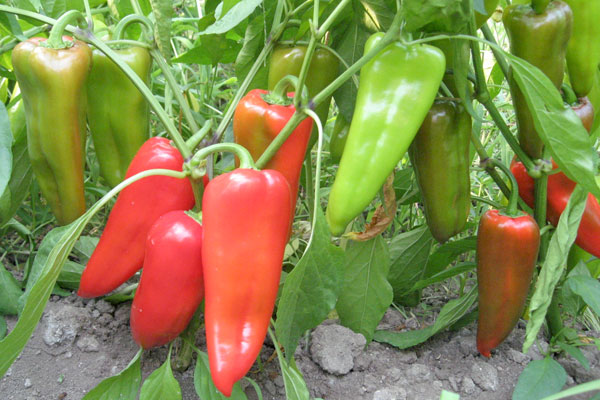
Kapia UV (Vertus)
Developed at VCRI “Maritsa”. The variety is suitable for medium-early field production. The fruits are pendent, long (13-18 cm), Kapia type, flattened on two or three sides, similar to the initial variety Kurtovska Kapia 1619. It differs from it by the lighter colour of the fruits. The pericarp is tender and juicy. The vegetation period is about 140-145 days. The variety is resistant to Verticillium wilt.
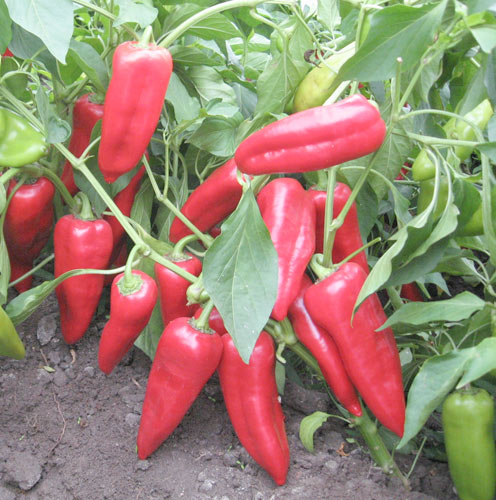
Kurtovska Kapia 1
High-yielding Kapia type variety, developed at VCRI "Maritsa". Suitable for medium-early field production, as well as in protected cultivation facilities. The fruits are pendent, smooth, 12 to 16 cm long and about 5 cm in diameter at the base. After roasting, they peel very easily. The yield, pericarp thickness and average fruit weight are higher than those of Kurtovska Kapia 1619. It slightly surpasses the standard variety in resistance to Verticillium wilt. The produce is intended for consumption fresh and processed (roasting, marinating, purees, lutenitsa, etc.).
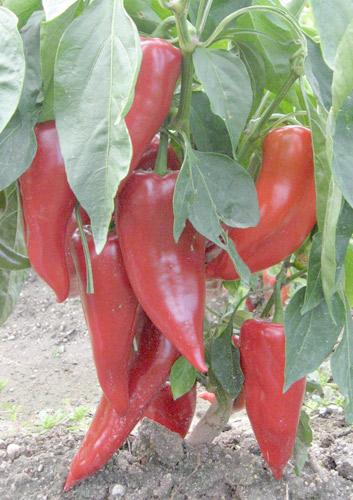
Kurtovska Kapia 1619
Developed at VCRI ”Maritsa”, Plovdiv. For decades it has been one of the most widespread varieties in our country. It is suitable for medium-early production. The fruits are large, pendent, long, flattened on two or three sides, Kapia type. The mesocarp is tender, sweet, juicy, with a pleasant aroma. The vegetation period to botanical maturity is 140-150 days. The produce is intended for consumption fresh and processed (roasting, marinating, purees and lutenitsa).
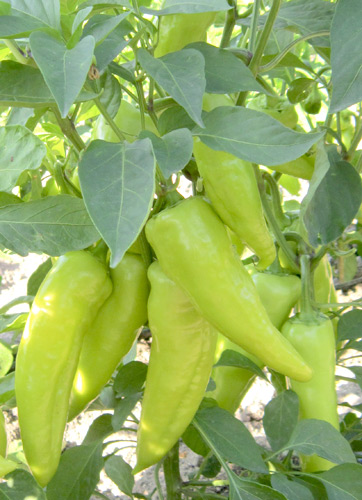
Milkana F1 High-yielding early-ripening hybrid variety, developed at VCRI “Maritsa”. Suitable for greenhouse, early and medium-early field production, and also in greenhouses. The fruits are pendent, uniform, conical, long to very long, single-lobed with a rounded base. At technical maturity they are light green, and at botanical – red. The average weight is 75-85 g, and the fruit wall thickness – about 4 mm. The vegetation period is 95-105 days. It is resistant to Verticillium wilt. The produce is intended for consumption fresh and processed.
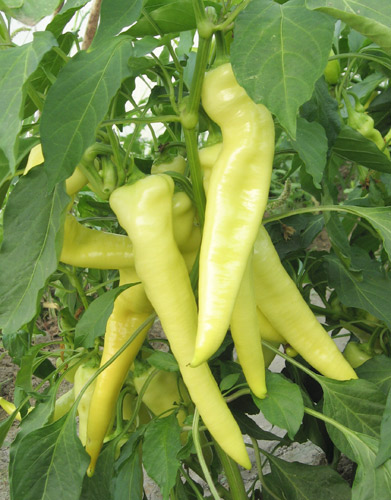
Sivria 600
Developed at VCRI ”Maritsa”. For decades it has been one of the main pepper varieties in the country and is still offered and sought after by consumers. Suitable for early, medium-early and late field production. The fruits are pendent, amber-yellow at technical maturity and light red at botanical maturity. They are 18-20 cm long, 4-5 cm in diameter at the base and with an average fruit weight of about 70 g. The vegetation period to technical maturity is 105-110 days, and to botanical – about 135 days. It is intended for consumption fresh, for cooking and pickles.
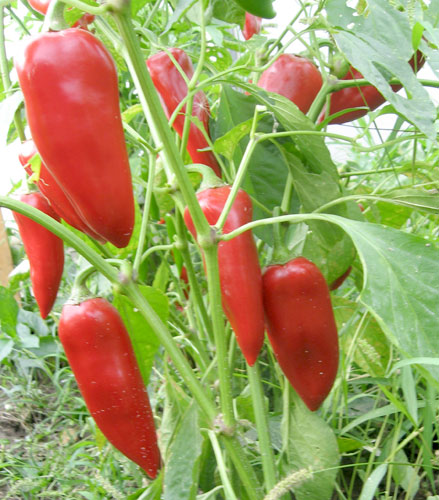
Sofiyska Kapia
Developed at VCRI “Maritsa”. It is suitable for early and medium-early field production. The fruits are pendent, with a regular Kapia-shaped form, 5-7 cm wide at the base, rounded towards the peduncle. The mesocarp is 4-5 mm thick, sweet and juicy. At technical maturity the fruits are dark green, and at botanical – dark red. After roasting, the fruits peel very easily. It is a relatively early variety from the Kapia group – the vegetation period is about 130-135 days to botanical maturity.
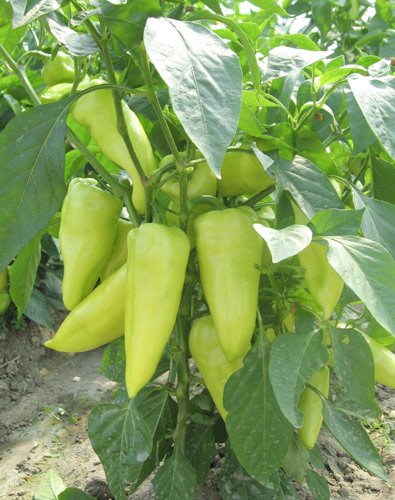
Stryama
High-yielding variety, developed at VCRI “Maritsa”. Suitable for greenhouse, early and medium-early field production. The fruits are pendent, smooth, conical, 12 to 16 cm long and about 5 cm in diameter at the base. The mesocarp is thick, with sweet taste, and the skin is delicate and not noticeable when consumed fresh. At technical maturity they are light green, and at botanical – red. The vegetation period to technical maturity is about 105 days, and to botanical – 125 days. The variety has high field resistance to Verticillium wilt. It gives high yields also under organic production conditions.
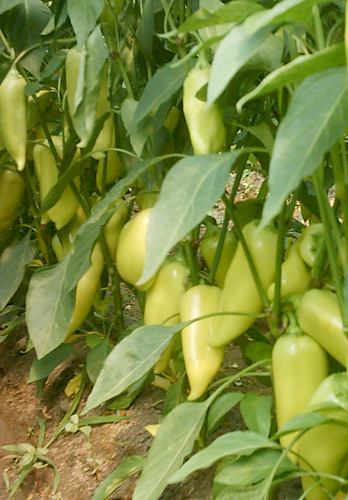
Hebar
Developed at VCRI “Maritsa”, suitable for greenhouse, early and medium-early field production. The fruits are pendent, uniform, with regular conical shape and significantly thicker pericarp. They are 11-15 cm long and 5-6 cm in diameter at the base. At technical maturity they are light green, and at botanical – red. The vegetation period is about 105 days to technical maturity and about 130 days to botanical maturity. It has relatively high field resistance to Verticillium wilt.

Chorbadiyski
Traditional Bulgarian variety of horn-shaped type. Suitable for early, medium-early and late production. The fruits are pendent, slightly hot, 13-24 cm long, with a transversely wrinkled surface and about 1.5-2 cm in diameter at the base. At technical maturity they are yellow-green, and at botanical – red. The vegetation period to technical maturity is about 100-105 days, and to botanical maturity 130-135 days.
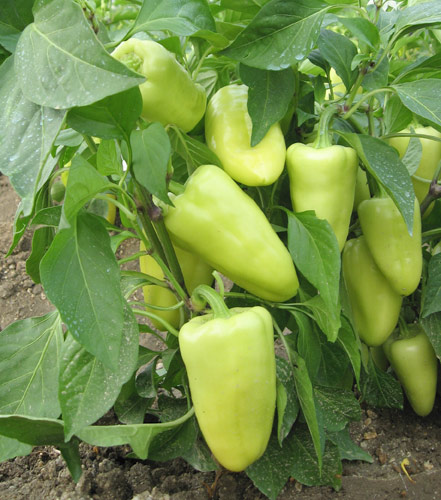
Yasen F1
High-yielding hybrid variety, developed at VCRI “Maritsa”. Suitable for greenhouse, early and medium-early field production. It forms pendent fruits, conical, 12-14 cm long, 5-6 cm wide, with a rounded tip and sweet taste. At technical maturity they are light green, and at botanical – red. The skin is thin and not noticeable when consumed fresh. The produce is intended for consumption fresh and processed.
These varieties and more than 1400 other accessions – populations, lines and varieties of local and foreign origin are maintained at VCRI «Maritsa», which is a prerequisite for successful breeding activities.
Newly developed varieties of VCRI „Maritsa“
In recent years, in response to the demand from producers, processors and consumers for high-yielding and high-quality, disease-resistant varieties, we have developed the varieties and candidate varieties: Ivaylovska Kapia, Ruevit, Baltovska Kapia and Dan-Dan.

Ivaylovska Kapia
A relatively new high-yielding variety developed at VCRI „Maritsa“, jointly with the Experimental Station for Irrigated Agriculture, Pazardzhik. It is suitable for medium-early field production, but also performs successfully in protected cultivation facilities for obtaining earlier produce. The fruits are pendent, Kapia-shaped, long to very long, wide to very wide, large, with sweet taste. The colour of the fruits before maturity is green to dark green, and at maturity – deep red. The fruits are very attractive and distinguished by a glossy and smooth surface. It is also characterised by higher chemical-technological qualities of the produce – pigment content in fresh produce, ease of peeling, pericarp thickness and overall sensory score after processing as roasted Kapia. The produce is of high quality and intended for consumption fresh and processed – roasting, marinating, purees, lutenitsa, etc.
Ruevit
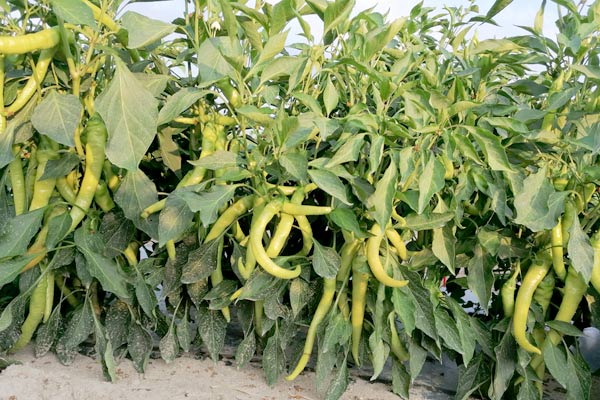
The candidate variety successfully completed the first year of testing for Distinctness, Uniformity and Stability (DUS) at the Executive Agency for Variety Testing, Field Inspection and Seed Control (IASAS). It was developed at VCRI „Maritsa“, jointly with the Center of Plant Systems Biology and Biotechnology (CPSBB). It is an indeterminate pepper variety of horn-shaped type. Suitable for early and medium-early field production, as well as in protected cultivation facilities. The fruits are pendent, hot in taste, 16-18 cm long, about 2-2.5 cm wide, 2-2.5 mm fruit wall thickness, average weight 25-30 g and a smoother surface. The variety is highly productive, with about 20-30% higher yield than the control variety Chorbadiyski, and resistant to Verticillium wilt. The produce is intended for consumption fresh and processed (pickles, etc.).
Baltovska Kapia
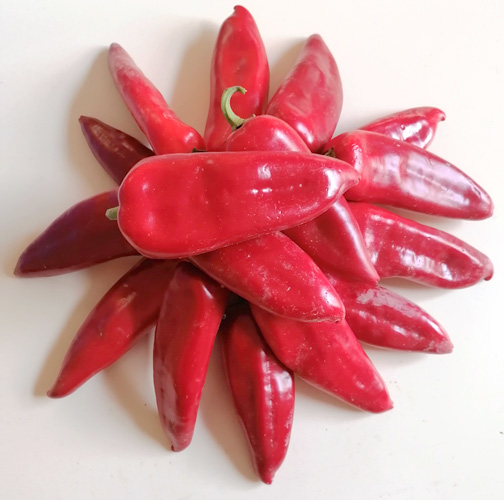
The candidate variety successfully completed the first year of DUS testing at IASAS. It was developed at VCRI „Maritsa“, jointly with CPSBB. It is suitable for medium-early field production, as well as in protected cultivation facilities. The fruits are Kapia type, pendent, single-lobed, with a non-enveloping calyx and sweet taste. They are predominantly two-loculed; in longitudinal section their shape is medium triangular, and in cross-section – angular. At technical maturity the fruits are green, and at botanical – red. They are 13 to 15 cm long, 4-5 cm in diameter at the base on average, with about 4 mm fruit wall thickness and an average weight of 75-85 g. It is characterised by high productivity, with a total yield of 4500 - 5500 kg/da and stable homogeneous resistance to tobacco mosaic virus (TMV, pathotype 0). The produce is intended for consumption fresh and processed – roasting, peeling, purees, lutenitsa, etc.
Dan-Dan
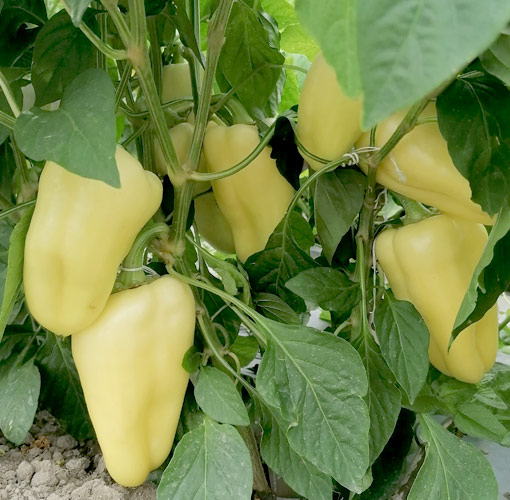
This is our newest proposal; the candidate variety has been submitted for DUS testing at IASAS for the first year. It was developed at VCRI „Maritsa“, jointly with CPSBB. It is suitable for early and medium-early field production, as well as in protected cultivation facilities. The plants are of indeterminate growth, 55 to 75 cm high, with a strong stem and predominantly three well-foliated primary branches. They have very weak anthocyanin colouring at the stem nodes and hypocotyl in the seedling stage. The fruits are sweet, Kalinkov type, pendent, three-lobed up to three in one with a rounded tip and non-enveloping calyx. They are predominantly three-loculed; in longitudinal section their shape is trapezoidal to rectangular, with 3 tips, less often broad-conical with a rounded tip. At technical maturity the fruits are greenish white to waxy white, and at botanical – red. They are 10 to 12 cm long, 6.5-7.5 cm wide at the base, with 4.5-5.5 mm fruit wall thickness and an average weight of 100-120 g. The candidate variety is highly productive, with an average total yield of 1.10 kg per plant. It is characterised by homogeneous resistance to Pepper mild mottle virus (PMMoV). The produce is intended for consumption fresh and processed (stuffing, etc.).
Production directions
Pepper production is predominantly carried out in the open field – early, medium-early and late field production.
Early field production is mainly oriented towards obtaining produce intended for consumption fresh. The differences from medium-early production are mainly in the choice of variety, sowing and planting dates, seeding rate and the need for pricking out the seedlings. An alternative to producing seedlings on-farm is to purchase ready seedlings from specialised nurseries. There they are grown under controlled conditions, according to the seedling stage and respective requirements. All other elements of the technology – land preparation, base fertilisation, care during the vegetation period, including top-dressing, weed, disease and pest control, etc., are the same as those in the technology for medium-early field production. It should be noted that the varieties used must have a shorter vegetation period, high vigour, adaptability and tolerance to temperature fluctuations.
Medium-early field production is of greatest economic importance and covers about 65-75% of the areas planted with pepper. The largest share in this production is held by Kapia-type varieties, which are used at technical and botanical maturity. Along with them, varieties of other types – Ratund, Kalinkov (Dolma), Conical, Horn-shaped and Shipka – are also well accepted. Pepper is mainly grown through preliminary production of non-pricked seedlings. The seeds are sown in unheated protected cultivation facilities (glass or polyethylene greenhouses and/or low tunnels).
Medium-early field production by direct sowing
This is a production system applying a non-transplanting technology, used mainly for varieties of red pepper for grinding, which have a short vegetation period and ripen relatively uniformly. In recent years some producers have applied it also for green pepper varieties. In this way the costs of labour and materials associated with seedling production are saved, which account for about 30% of all costs. Important elements for applying this method of production are the high sowing quality of the seeds of the chosen variety, the availability of specialised equipment, including a precision seeder for small vegetable seeds, well-prepared and weed-free fields, provision of optimal soil moisture and herbicides with good efficacy.
Late field production is very limited, mainly in regions where the first autumn frosts occur after 20 October. Varieties with a short vegetation period are used, and their produce is intended mainly for marinating, pickling, etc.
The high biological value and excellent taste qualities of pepper fruits determine the importance of this vegetable crop. The need for year-round supply of the market with fresh fruits and the greater possibilities for controlling growing conditions determine the cultivation of pepper also in protected cultivation facilities, heated and unheated, with different coverings – glass, polyethylene, polycarbonate, etc. This has led to an increase in the share of greenhouse areas occupied by pepper. In principle, when grown in heated protected cultivation facilities, seedlings are produced by pricking out, while in unheated facilities both pricked and non-pricked seedlings are possible, but in all cases planting distances are increased, fertiliser rates are higher, growing is carried out on supporting structures, etc.
Unfortunately, in the last one to two years, problems related to the supply and high prices of energy sources, soil fertility enhancers and plant protection products have led to a collapse in greenhouse vegetable production, particularly in heated protected cultivation facilities. These factors, albeit to a lesser extent, also affect pepper production in open fields. A significant and so far difficult-to-solve problem in all production directions is the shortage of workers, especially experienced ones, since it is well known that the Vegetable Production sector requires more labour. To support this sector, various national and European programmes exist and are being introduced to reduce the impact of these unfavourable, production-limiting factors.
A crucial point for obtaining high yields is the purchase of high-quality seeds with proven origin from the respective variety-maintaining organisation. Producers often make mistakes in choosing suitable fields without taking into account the type of preceding crop, they do not observe the sowing and planting dates, are not familiar with the biological requirements and cultivation technology of the crop and do not carry out timely plant protection measures. In recent years, during planting and the active vegetation period, high temperatures, heavy rainfall, large amplitudes between day and night temperatures and long periods of low relative air humidity during July and August have often been observed. In pepper production, these specific meteorological conditions may be combined with the occurrence and attack of viral, bacterial and fungal diseases and pests which were previously unknown or not of economic importance. These are objective factors that slow plant growth and development, worsen the phytosanitary status, and reduce the quality and quantity of the obtained produce. Therefore, knowledge and application of all elements of the pepper production technology are crucial for obtaining high pepper yields.
* The photos are copyrighted, may not be distributed and are subject to protection.