

![MultipartFile resource [file_data]](/assets/img/articles/заглавна-череша-1.jpg)
Weed vegetation is one of the main limiting factors for the growth and development of fruit trees. Weeds compete with the trees for the main vegetation factors (water, light and nutrients), and favour the development and spread of a number of pests and diseases, including viral ones.
Effective weed control must be applied from the beginning of the vegetation of fruit trees. The beginning of March is the appropriate period for the application of soil herbicides. Numerous studies have been conducted regarding the effect of applying herbicides and herbicide systems for weed control in fruit plantations. The results show that with a proper combination of a selective herbicide, at an appropriate dose and time of application, effective weed control is achieved without exerting a depressing effect on tree development.
Young plantations (1–3 years old)
Before vegetation, at the end of February and the beginning of March, treatment with one of the following soil herbicides is recommended: pendimethalin (Stomp 33 EC – 400 ml/da; Stomp New 330 EC – 400–500 ml/da; Sharpen 33 EC – 400 ml/da; Pendigan – 400 ml/da), napropamide – Devrinol 4F – 400 ml/da; oxyfluorfen (Goal 2E – 300–400 ml/da; Goal 4F – 150–200 ml/da, etc.).
Fruit plantations after the 3rd year
Before vegetation, at the end of February and the beginning of March, treatment with one of the following soil herbicides is recommended: pendimethalin (Stomp 33 EC – 600 ml/da; Stomp New 330 EC – 600 ml/da; Sharpen 33 EC – 600 ml/da; Pendigan – 600 ml/da); napropamide – Devrinol 4F – 800 ml/da; oxyfluorfen (Goal 2E – 300–400 ml/da; Goal 4F – 150–200 ml/da; Galigan 240 EC – 150–200 ml/da; Oxygan 240 EC – 150–200 ml/da).
Soil herbicides are applied after the first soil cultivation, before the beginning of tree vegetation. For their effective action, soil moisture is required. Herbicides based on the active substance oxyfluorfen have a contact soil and foliar effect, therefore soil cultivation in the tree row strip is not required for the application of these commercial products. Their foliar effect is less effective on emerged grass weed species.
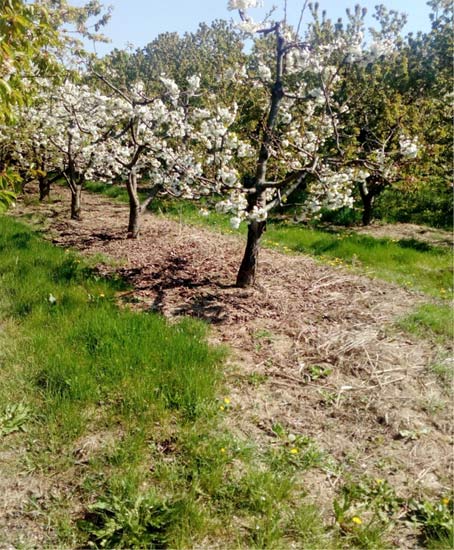
Fruiting cherry plantations treated with Pledge 50 WP – 40 g/da
As an option for weed control in perennial plantations, the application of the active substance flumioxazin – commercial product Pledge 50 WP – can also be recommended. This herbicide has a contact soil and foliar effect and, at an appropriate dose, successfully controls a large number of grass and broadleaf weed species. Pledge 50 WP is registered in some European countries for use in orchards and vineyards. The long-lasting soil activity of the product ensures weed-free areas throughout the entire vegetation period. Treatment is carried out only in the rows, while the inter-rows are cultivated mechanically or sown with grass. In orchards, Pledge 50 WP is applied alone at a dose of 40 g/da when weed infestation is mainly from broadleaf weeds. At the Fruit Growing Institute – Plovdiv, studies have been conducted on the efficacy and selectivity of Pledge 50 WP in a number of fruit crops. The results show that at a dose of 40 g/da, applied early in spring in the presence of vegetating weed vegetation at initial stages, flumioxazin provides very good weed control for about 5 months. Analyses have been carried out regarding the risk of contamination of soil and plants with flumioxazin, which show that after the expiry of the effective residual period of Pledge 50 WP, no residual quantities are detected in the soil or in the fruit produce.
The application of Pledge 50 WP may be either soil-applied early in spring or during vegetation. For vegetative application, it is advisable that treatment be carried out at earlier stages of weed development. For soil application of Pledge 50 WP in orchards with drip irrigation, the product has a residual effect of 6 months, as its action is activated by soil moisture.