

![MultipartFile resource [file_data]](/assets/img/articles/epp-заглавна-1.jpg)
The reduction in potato yields is due to attacks by a large number of diseases and pests. Among them are plant-parasitic nematodes. The group of these pests also includes root-knot nematodes of the genus Meloidogyne. They can cause significant damage to potatoes, both in warm and in cool climatic zones, depending on the nematode species. Root-knot nematodes have more than 3000 plant species as hosts, including many vegetables, potatoes and weeds. These pests reduce potato production worldwide by about 5%. Losses in individual fields can be much higher. Of the more than 100 described species of root-knot nematodes, six are of major economic importance for potatoes: M. hapla, M. incognita, M. javanica, M. arenaria, M. chitwoodi and M. fallax. In our country the main harmful species are M. hapla, M. arenaria and M. incognita.
The damage caused by root-knot nematodes to potatoes is expressed not only in gall formation on the roots, but also in reduced quality, size and number of tubers. The attacked tubers have poor commercial appearance and are unfit for the market.
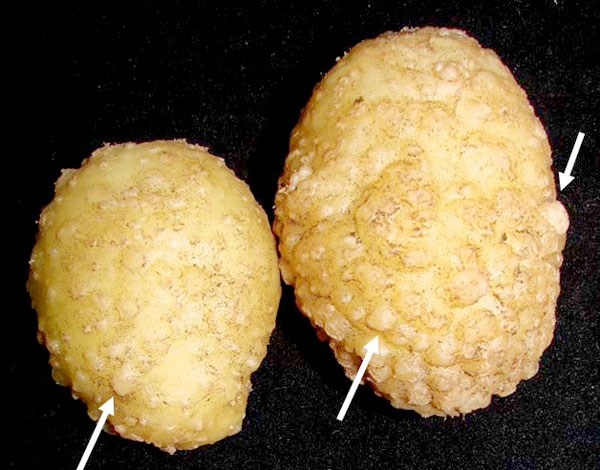
Damage from root-knot nematodes on tubers
The presence of root-knot nematodes can hardly be diagnosed by symptoms on the above-ground plant parts. Depending on the nematode population density, infected plants may show varying degrees of growth suppression and wilting. Symptoms are most pronounced when the crop is grown on sandy soils and in warm climates above 25ºC. Galls of various shapes and sizes are observed on the roots of the attacked plants. On the surface of the tuber, swellings resembling warts are formed and the skin has a rough external appearance.
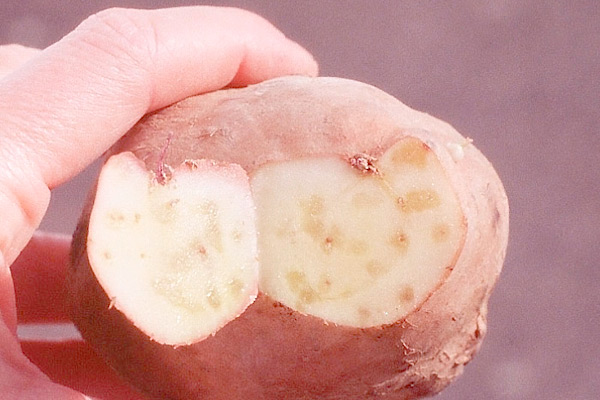
Adult females and damage in the fleshy part of the tuber
In the fleshy part of the tuber, immediately beneath the skin, adult females can be observed as white, pear-shaped bodies. The tissue around them turns brown, which is indicative of the presence of eggs. This damage makes the potato production unsaleable.
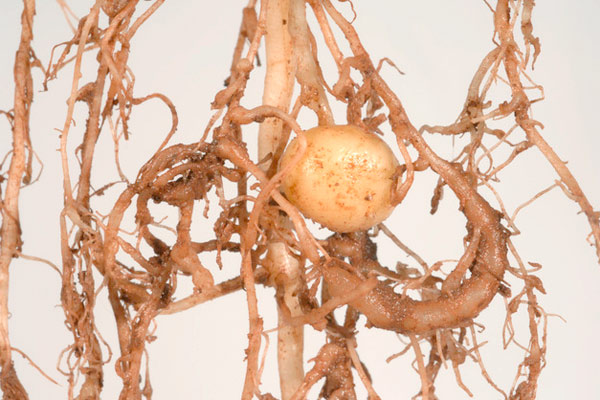
Galls on roots
Nematodes cause direct damage, but they also contribute to secondary infections by fungal pathogens, which can lead to plant death. Synergistic relationships between Meloidogyne spp. and fungi causing plant diseases occur mainly in countries with warm climates and include the genera Verticillium, Fusarium and Rhizoctonia.
Root-knot nematodes are spread through infected tubers, soil, cultivation machinery and irrigation water.
Control of root-knot nematodes is very difficult because they are soil pests and their attack is usually established only at harvest.
For successful nematode control, certain phytosanitary requirements must be observed:
- Use of healthy planting material and fields free from the pest.
- Washing and disinfection of soil-cultivating implements.
- Weed control, where weeds are hosts of root-knot nematodes.
- Crop rotation with resistant crops or crops that are not hosts, such as grasses (Sudan grass) or cereals (barley, rye, wheat). There are still no potato varieties that are resistant to root-knot nematodes.
- Monitoring of crops to detect symptoms of root-knot nematode infestation.
Control of root-knot nematodes is traditionally carried out mainly by chemical means (Vydate 10 G, Basamid granulate).
For biological control, bacteria of the genus Bacillus and Pseudomonas, fungi of the genus Trichoderma and Aspergillus, entomopathogenic nematodes from the families Steinermatidae and Heterorhabditidae can be used.

Common vetch (Vicia sativa L.), in addition to being used for the control of root-knot nematodes, has great agrotechnical importance, as it is an excellent predecessor of many other crops in crop rotation. After vetch, a second crop can be sown, since the stand is cut very early and the fields remain free from weeds. As a leguminous crop that meets part of its nitrogen requirements through symbiotic nitrogen fixation, it is capable of enriching the soil with significant amounts of nitrogen. Besides these advantages, vetch can also be sown in mixed stands.
An alternative option for the control of root-knot nematodes is the use of cover crops such as mustard, Tagetes, vetch, etc. Incorporation of species from the family Brassicaceae (biofumigation) limits infestation by Meloidogyne spp.
The optimal option for controlling root-knot nematodes in potatoes is an integrated pest management system, including agrotechnical, biological and chemical methods.