

![MultipartFile resource [file_data]](/assets/img/articles/gardening-1.jpg)
Diseases in Seedling Production
Tomato seedlings are susceptible to damping-off, early blight, leaf mould and grey mould. Cucumber seedlings may be attacked by powdery mildew and downy mildew. Pepper seedlings are most frequently affected by early blight.
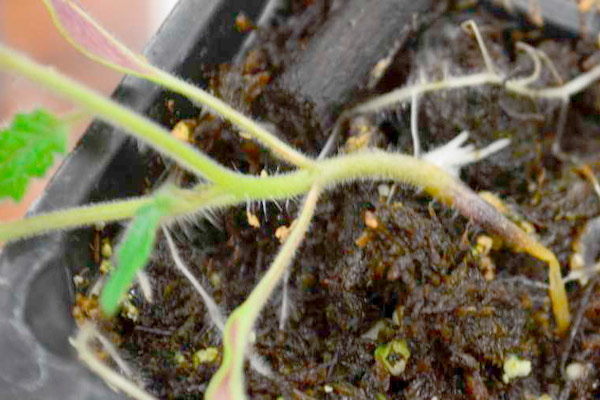
Damping-off in Seedlings
It occurs in all vegetable crops grown from seedlings – tomatoes, peppers, cucumbers, eggplants, lettuce, etc. It develops year-round in the production of seedlings for different production purposes. It appears when growing conditions for the plants are unfavourable – low air and soil temperatures, waterlogging, excessive nitrogen fertilization, etc. The pathogens can affect the swollen seeds and cause their rotting. Sometimes they attack very young, still unemerged sprouts, which die very quickly. Because these processes occur in the soil, the damage cannot be observed. Seedlings emerging under such conditions are poorly established. It is caused by fungi of the genera Pythium, Phytophthora, Fusrium, Pyrenochaeta lycopersici and Colletotrichum atramentarium, which have different temperature requirements.
At first appearance, the initial diseased plants are removed and destroyed outside the seedling compartment; Spots with diseased plants are drenched with a 3% solution of copper sulphate or ammonium nitrate – 3-4 l/m2; The remaining plants are treated with registered fungicides – Beltanol 400 g/da, Proplant 722 SL 0.1%; application of bioproducts Trichodermin or Fuzaclin; use of resistant rootstocks.
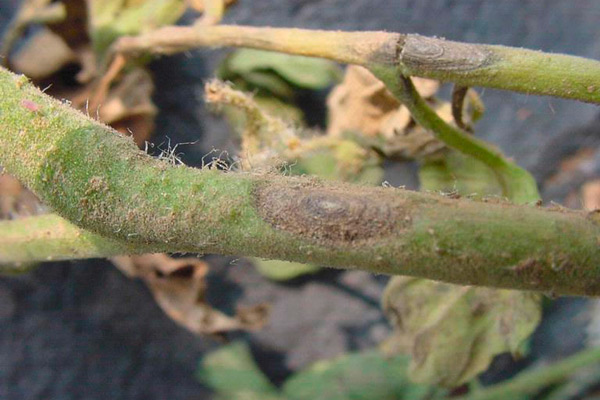
Early blight (Alternaria porri f. sp. solani) in tomatoes and peppers
Infection by this pathogen occurs in the presence of high air humidity. On the leaves of tomatoes and peppers small watery spots appear, reaching 5-7 mm in diameter. Later they dry up, turn dark brown to black, with a concentric structure, merge and the leaf scorches. The spots on the stem and petioles are similar, with the characteristic concentric structure. At high relative air humidity the affected areas are covered with a black coating of the fungal sporulation.
Control
Seed disinfection; Production of seedlings in sterile or disinfected substrate; Maintaining an optimal temperature and humidity regime in cultivation facilities; Regular ventilation of the facilities; Treatment with plant protection products upon appearance or when favourable conditions are present;
Authorized PPPs: Azaka 80 ml/da; Dagonis 100 ml/da; Copforce Extra 200 g/da; Ortiva Top SC 100 ml/da; Polyram DF 0.2%; Prev-Gold 200-600 ml/da; Sinstar 70-80 ml/da; Taegro 18.5-37.0 g/da; Tazer 250 SC 80-200 ml/da.
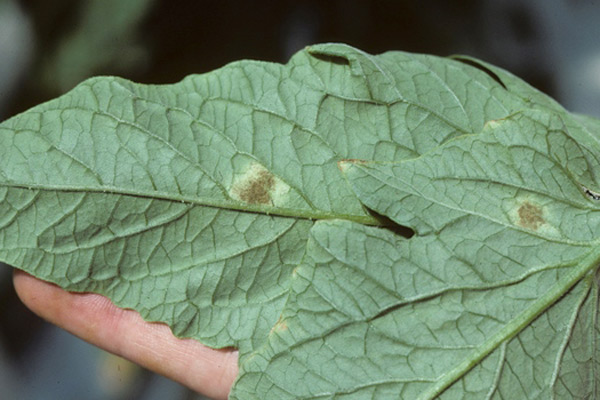
Leaf mould (Fulvia fulva) in tomatoes
On the upper side of the leaves relatively large, light spots of irregular shape appear, with indistinct margins. Later they turn yellow. Under high air humidity their lower surface is covered with a light coating of the fungal sporulation, which later darkens and becomes velvety brown. When the number of spots on a leaf is considerable, they coalesce and the leaf scorches. Under favourable conditions the plants may become defoliated. The disease develops at high air humidity.
Control
Growing resistant varieties; Maintaining optimal air humidity in the seedling compartment; Regular ventilation; Destruction of plant residues and weeds, as the pathogen survives in them. When necessary – treatment with PPPs.
Authorized PPPs: Eminent 125 ME 40-60 ml/da; Zoxis 250 SC 70-80 ml/da; Ortiva Top SC 100 ml/da; Signum 100-150 g/da; Sinstar 70-80 ml/da; Folpetis 50 SC 250 ml/da.
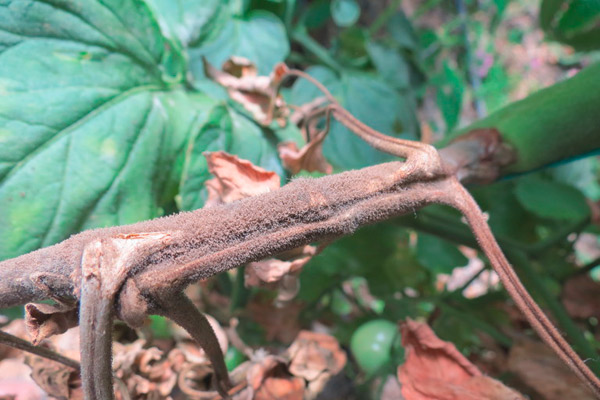
Grey mould (Botrytis rot) (Botrytis cinerea) in tomatoes
It attacks plants at all stages of their development. On the petioles and tips of the leaf blades, light brown elongated spots appear. At high air humidity the spots are covered with abundant grey-brown mycelium and fungal sporulation. High air humidity provides a favourable environment for disease development.
Control
Maintaining optimal air humidity in the seedling compartment; Regular ventilation; Destruction of plant residues and weeds, as the pathogen survives in them; During side-shoot removal, no parts of the shoots should be left. It is advisable to carry it out in sunny weather and after the dew has dried; Affected plant parts are collected in bags and destroyed outside; At increased air humidity and appearance of first spots, treatment with PPPs is carried out;
Authorized PPPs: Avalon 200 ml/da; Geox WG 50 g/da; Erune 40 SC 200 ml/da; Julieta 250 g/da; Pretil 200 ml/da; Prolectus 50 WG 80-120 g/da; Signum 100-150 g/da; Switch 62.5 WG 100 g/da; Folpetis 50 SC 250 ml/da; Fontelis SC 240 ml/da.
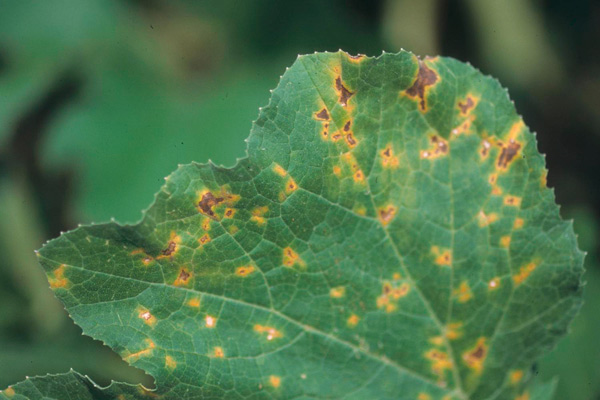
Downy mildew (Pseudoperonospora cubensis) in cucumbers
This disease is of major importance in cucumber growing throughout the entire vegetation. On the upper side of the leaves yellowish spots of irregular shape appear, delimited by the veins. In wet weather they are watery, and their lower surface is covered with a loose grey-violet coating of the fungal sporulation. Later the spots enlarge, merge and the entire leaf scorches. At high air humidity in the seedling compartment, the disease can affect the entire plant in a short time and severely reduce yield.
Control
Maintaining an optimal air and moisture regime. Regular ventilation of the compartment. If possible, turning on the heating in the early hours of the day. Removal of the first diseased leaves and their destruction outside the greenhouse. When necessary, treatment with PPPs.
Registered PPPs: Enervin SC 120 g/da; Zoxis 250 SC 70-80 ml/da; Infinito SC 120-160 ml/da; Corsate 60 WG 20-30 g/da; Prev-Gold 160-600 ml/da; Taegro 18.5-37.0 g/da.
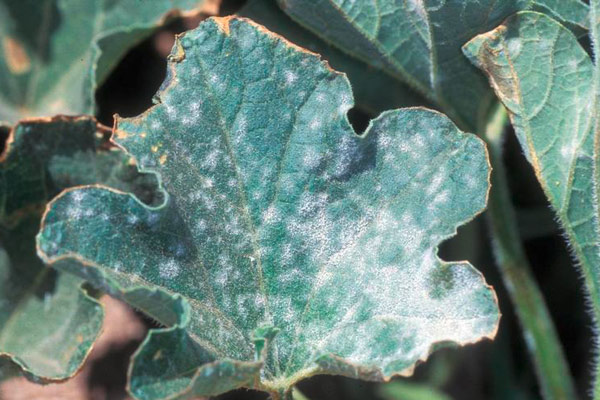
Powdery mildew in cucumbers (Podosphaera xanthii)
On the leaves small light spots of irregular shape appear, dusted on the upper side with a white powdery coating of the fungal sporulation. Later the spots merge. The leaves scorch. Spots can be observed on both the upper and lower surfaces of the leaves and on the petioles. Under severe attack the plants become defoliated. It occurs under limited light, low air humidity and unbalanced fertilization. The winter months are favourable for its occurrence.
Control
Growing resistant varieties; Cleaning plant residues from the previous vegetation; Balanced nitrogen fertilization; Maintaining an optimal temperature and humidity regime; Treatment with PPPs at the appearance of the first spots;
Authorized PPPs: Vivando 20 ml/da (0.02%); Dagonis 60 ml/da; Domark 10 EC 50 ml/da; Zoxis 250 EC 70 ml/da; Collis SC 40-50 ml/da; Legado 80 ml/da; Ortiva Top SC 100 ml/da; Sivar 80 ml/da; Sonata SC 500-1000 ml/da; Trunfo 80 ml/da; Phytosev 200 ml/da; Fontelis SC 240 ml/da.
Pests in Seedling Production
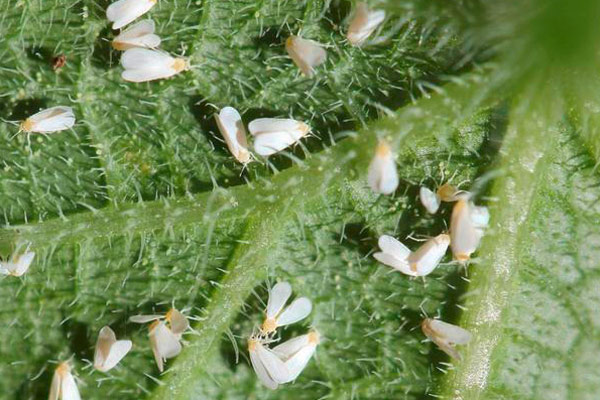
Greenhouse whitefly (Trialeurodes vaporariorum)
Larvae, nymphs and adults cause damage. They suck sap mainly from the lower side of the leaves. During feeding the larvae excrete large amounts of sugars in the form of „honeydew”, as a result of which the leaves become sticky. Sooty mould fungi develop and the physiological processes of the affected plants are disrupted.
Control
To monitor the appearance and population density of the whitefly, yellow sticky traps should be used; At the appearance of the first specimens, treatment with PPPs is carried out.
Authorized PPPs: Abanto 75 ml/da; Azatin EC 100-150 ml/da; Brai 50-112.5 ml/da; Limocid 400 ml/da; Chrysant EC 75 ml/da; Natur Breaker 75 ml/da; Neemik Ten 390 ml/da; Oikos 100-150 ml/da; Orocid Plus 80-800 ml/da; Pyreguard 75 ml/da; Prev-Gold 160-600 ml/da; Requiem Prime 500-1000 ml/da; Sivanto Prime 56 ml/da.
Aphids (Aphididae)
Adults and larvae cause damage by sucking sap from the lower side of the leaves, the growing tip and stems of the plants. They prefer young, succulent and fresh tissues. Under heavy infestation the leaves curl strongly and become deformed. The plants lag in their development. On the “honeydew” excreted by aphids, saprophytic sooty mould fungi develop. Aphids are vectors (carriers) of viral diseases.
Control
Upon detection of the first specimens in the seedlings, treatment with PPPs should be carried out; The last treatment is conducted immediately before planting at the permanent site; Destruction of weed vegetation in and around the beds, which is a reservoir for preservation and a source of virus infection.
Authorized aphicides: Azatin EC 100-150 ml/da; Ampligo 150 ZC 40 ml/da; Delmur 50 ml/da; Deltagri 30-50 ml/da; Closer 120 SC 20 ml/da; Mavrik 2 F 20 ml/da; Neemik Ten 390 ml/da; Oikos 100-150 ml/da; Sivanto Prime 45 ml/da; Tepeki/Afinto 10 g/da; Flipper 1-2 l/da; Citrin Max/Cyperkill 500 EC 10 ml/da; Shirudo 15 g/da.
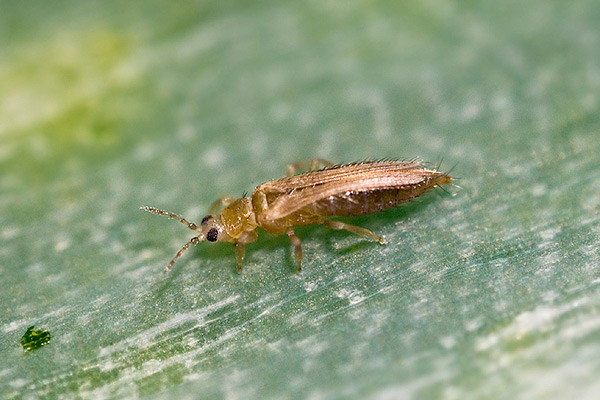
Thrips: onion thrips and western flower thrips (Thrips tabaci; Frankliniella occidentalis)
In seedling production, mainly onion thrips (Thrips tabaci) and western flower thrips (Frankliniella occidentalis) occur. Adults and larvae cause damage by sucking sap from the leaves and the growing tip. At the feeding sites small, silvery white spots with black dots appear. At high population density the spots enlarge and merge. The leaves dry out. The plants lag in their development. The nymph stage of the pest develops in the soil, and the eggs are laid in the leaf tissue. Thrips transmit the viral disease tomato spotted wilt (bronzing).
Control
For monitoring, blue sticky traps should be used, which, in larger numbers, reduce pest density; Upon appearance, treatment with PPPs is carried out.
Authorized PPPs: Azatin EC 100-150 ml/da; Dicarzol 10 SP 556 g/da; Exalt 200-240 ml/da; Limocid 800 ml/da; Neemik Ten 390 ml/da; Oikos 100-150 ml/da; Requiem Prime 500-1000 ml/da; Sineis 480 SC – 10-37.5 ml/da.
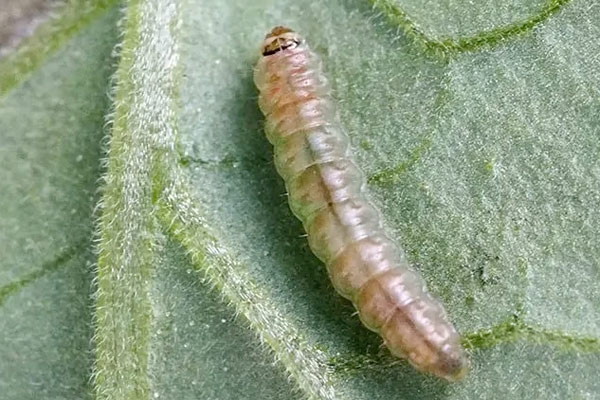
Tomato leafminer moth (Tuta absoluta)
Caterpillars cause the damage. They prefer the leaves most. Symptoms of the presence of the moth are short and wide mines on the leaves, in which caterpillars and excrement located at one end can be seen. Under heavy infestation the mines merge and the leaves dry out.
Control
Use of pheromone traps and black sticky boards for timely detection of the pest, reduction of population density and implementation of adequate control measures. At low density, one of the biological control agents Macrolophus pygmaeus or Nesidiocoris tenuis may be introduced. Upon detection of the first specimens, treatment with PPPs is carried out.
Authorized PPPs: Altacor 35 WG 8-12 g/da; Ampligo 150 ZC 40 ml/da; Affirm 095 SG 150 g/da; Voliam Targo 063 SC 80 ml/da; Delmur 50 ml/da; Exalt 200-240 ml/da; Coragen 20 SC 14-20 ml/da; Neemik Ten 390 ml/da; Neem Azal T/S 0.3%; Oikos 150 ml/da; Rapax SBS 100-200 ml/da; Sineis 480 SC 10-25 ml/da.
All requirements for application (registered PPPs, quality spraying, dosages, pre-harvest intervals), transport and storage of chemical plant protection products must be observed. Hygiene and safety standards for working with toxic substances must be complied with. A treatment log must be kept in accordance with the requirements of the BFSA.