

![MultipartFile resource [file_data]](/assets/img/articles/начална-1б.jpg)
The National Research Programme “Healthy Foods for a Strong Bioeconomy and Quality of Life”, funded by the Ministry of Education and Science, has the main task of stimulating targeted scientific research and policies in the field of agriculture, food and the bioeconomy, which help to address the three main challenges facing these sectors today: ensuring viable food production in response to the globally increasing demand; ensuring sustainable management of natural resources and climate action, and balanced development of the bioeconomy in rural areas and their communities.
Within the Round Table held at the end of last year in Sofia, organized by the team of the NRP “Healthy Foods for a Strong Bioeconomy and Quality of Life”, Assoc. Prof. Galina Mihova, PhD – cereal crop breeder at the Dobrudzha Agricultural Institute, General Toshevo, presented the results of four-year trials on wheat in the period 2018-2022. The aim of the team in which she participates is to increase the productive potential by seeking a balanced combination between yield components and resistance to different types of stress. A new focus is the development of winter wheat genotypes suitable for organic production.
In her presentation “Back to Bulgarian Breeding for Higher-Quality and Sustainable Wheat Production in a Risky Environment”, Assoc. Prof. Galina Mihova, PhD, shared how biotic stress as a result of the increased frequency of extreme climatic events affects wheat varieties developed in different regions of the Old Continent, including those created in the country’s breeding centres.
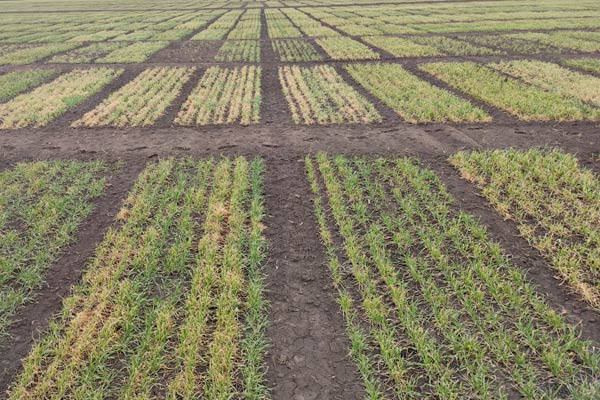
Damage from recurrent spring frosts
The growing season of wheat is approximately 9 months; the biological characteristics of the crop are governed by several main factors – temperature, light and moisture, and any disturbance leads to serious risk for this crop. Within the NRP, the team of scientists formed a working collection including a large number of varieties from different agro-geographical regions of Europe, with the aim of observing the reaction of the varieties under different stress conditions. Bulgarian breeding shows low productive tillering, but has a high grain set per spike, number of grains per spike and 1000-kernel weight. In a large part of foreign varieties, the main structure-determining component is productive tillering. At the same time, however, they are characterized by a smaller number of grains per spike and lower absolute grain weight.
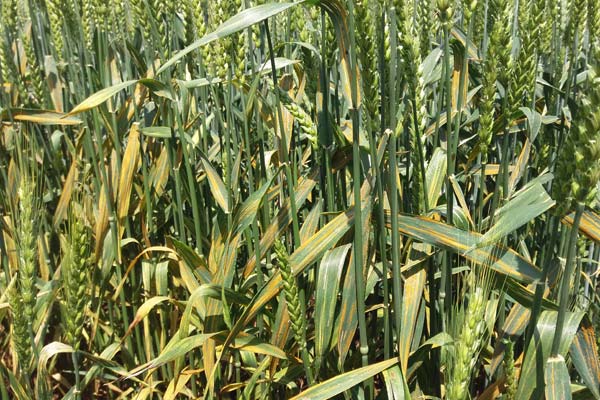
Development and damage from yellow rust
In recent years, the main risk factors for wheat have been drought during different stages of development, high average daily temperatures during the winter months leading to lodging of the stands, significant temperature amplitudes during the resumption of vegetation, as well as late spring frosts. We are witnessing a deteriorated phytosanitary situation, massive spread of weed associations and pests, and diseases with a high economic damage threshold, including yellow rust – a disease with high harmfulness, for which conditions for development are increasingly frequent. These circumstances require the introduction of innovative production technologies and breeding approaches aimed at increasing productivity in all possible ways.
There is no ideal wheat variety, there is an ideal varietal structure
The goal is to achieve sustainable production and high added value. The first step is the correct establishment of the varietal structure. “We must rely on varieties with mutually complementary characteristics. The use of certified seed material is mandatory. Only in this way can the genetic potential of the variety be guaranteed and there are no other mechanisms for its compensation,” Assoc. Prof. Mihova shared in her lecture.
Data from the last five years show that, under the conditions of Northern Bulgaria, wheat yield is determined mainly by the sum of active temperatures from heading to the end of vegetation, i.e. when its productive potential is realized. It is of particular importance that these are within appropriate limits during grain filling.
In Southern Bulgaria, a high dependence of yield has been established on the sum of precipitation after the transition of temperatures through 5 degrees up to heading, when productive tillering is formed and biomass accumulates during stem elongation.
Under the conditions of General Toshevo, the varieties Dragana, Kalina, Kiara, Korona and Kosara stand out with high average productivity. In the varieties Lazarka, Merilin and Pchelina, a yield of over 8 tonnes per hectare has been achieved, and these are wheat varieties from group A. They are characterized by excellent technological and baking qualities. The combination with high productivity is undoubtedly a significant breeding success.
The results under the conditions of Southern Bulgaria are also very good. The experiments conducted in Sadovo show a somewhat different differentiation of the varieties. The effect of the factors “genotype” and “genotype x location” is significant. “The potential of a variety cannot be judged when it has been tested in only one location. It is mandatory to test it under different conditions in order to establish its specific reaction under stress. Varieties with high yield stability over the years are Niki, Pchelina, Laska, Tina, Mustang, Kiara,” commented Assoc. Prof. Mihova.
The specific features of regional breeding are the faster resumption of vegetation during the spring months, earlier dates of heading, flowering, pollination and fertilization, and a dynamic relationship between the duration and rate of grain filling. Bulgarian breeding is characterized by a slightly taller stem, but under stress, short varieties do not perform as well and cannot adequately supply a well-grained spike. In the new varieties, another production problem has been successfully overcome – lodging. They have strong and elastic stems.
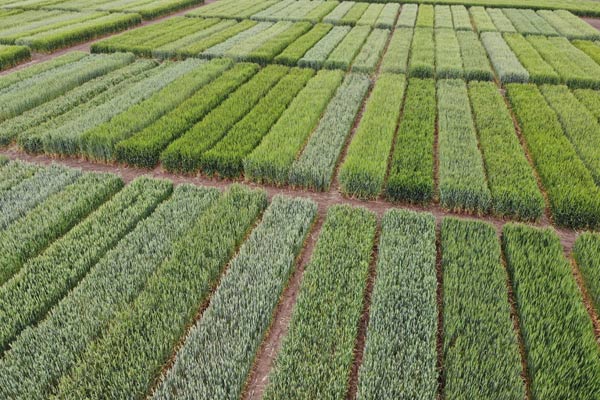
Breeding field of the Dobrudzha Institute
“Our varieties are efficient, they are not demanding, they do not require ‘luxury’ conditions. They achieve high yields with less fertiliser and pesticide input. The achieved productive potential creates high added value compared to what has been invested,” Assoc. Prof. Mihova concluded.
In the business programme of the Agricultural Academy at AGRA 2023, in the panel "Agriculture in a Changing Climate", Assoc. Prof. Mihova, PhD, Dobrudzha Agricultural Institute - General Toshevo, Agricultural Academy, will present in detail to the guests of the exhibition her research in the lecture "Back to Bulgarian Breeding for Higher-Quality and Sustainable Wheat Production in a Risky Environment".