

![MultipartFile resource [file_data]](/assets/img/articles/картофи-лук-заглавна.jpg)
Post-harvest diseases of vegetables, commonly known as storage diseases, are mainly caused by microscopic fungi and bacteria. Compared to fruits, bacterial diseases predominate in vegetables. The reason is that they contain lower amounts of acids. The majority of the causal agents of post-harvest diseases exist as saprophytes in the soil or in the atmosphere and, under certain conditions, parasitize vegetables. The main cause for their development is the storage conditions. Like all pathogenic microorganisms, they develop under specific optimal conditions related to the temperature regime, the relative air humidity in the premises where the produce is stored, light, etc. The optimal temperature for development of the pathogens is most often in the range of 18-28°C, and the air humidity – above 75%. Storing vegetables in the temperature range of 2-7°C and at low air humidity prolongs their shelf life and creates unfavorable conditions for pathogen development. Therefore, by properly selecting the temperature and humidity regimes, the occurrence and development of post-harvest diseases can be significantly limited.
Storage diseases of potatoes
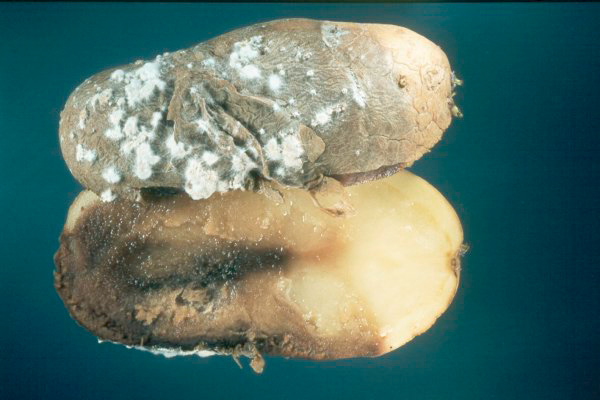
Dry rot (Fusarium solani., f. roseum)
This is a typical disease that spreads mainly on stored tubers. It penetrates them through wounds caused by soil cultivation operations or by other pathogens. The symptoms of damage are sunken rotten areas of various shapes and sizes, darker in color. As a result of water loss, the skin gradually becomes wrinkled. The disease starts from one end and gradually the entire tuber becomes mummified. It is caused by a fungus that is present in all arable areas. The pathogen survives in the soil and in the tubers stored in warehouses. Well-ripened tubers are more resistant. Susceptibility to the disease increases during storage. To limit its spread, it is recommended that lifting and transporting of potatoes be carried out carefully so as not to injure the tubers. Development is inhibited at a temperature of about 4°C, while at temperatures above 8°C the pathogen becomes active. Spraying (mainly of seed potatoes) with low concentrations of thiobendazole plant protection products immediately after lifting reduces the development of the disease.
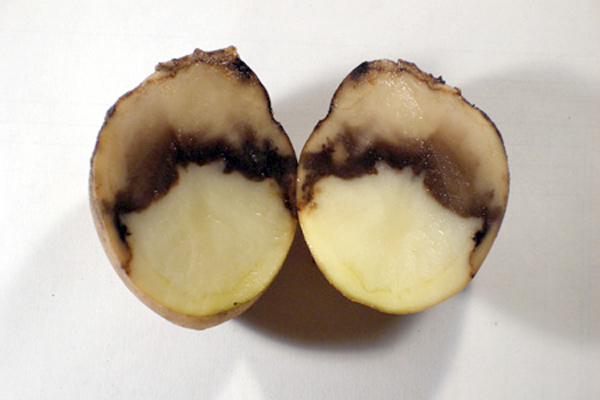
Soft rot of tubers (Erwinia carotovora)
Like dry rot, soft rot also manifests mainly during storage of the tubers. In wet years it can also develop in the field. It is caused by a bacterium that penetrates the tubers through wounds, lenticels or injuries caused by insects. The affected tissue becomes translucent and soft. Later it darkens and within 5-6 days the entire tuber rots and emits an unpleasant odor. From the diseased tuber the infection can spread to neighboring healthy ones and affect a large part of the stored produce. The causal bacterium develops in the temperature range of 15-29°C. Temperatures below 7°C inhibit its growth. Therefore, proper storage under optimal conditions limits the development of this pathogen.
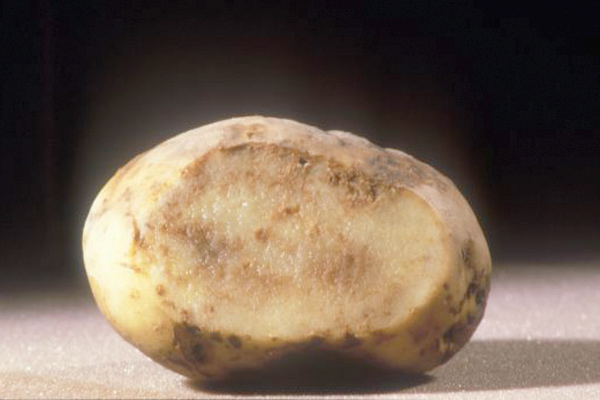
Fungi of the genera Phytophthora and Pythium can also cause rot of tubers during their storage. The pathogens enter the potatoes through wounds or lenticels and during harvest carried out at high temperatures. Diseased tubers must not be placed in potato stores for storage.
Ring rot of potatoes – an insidious disease
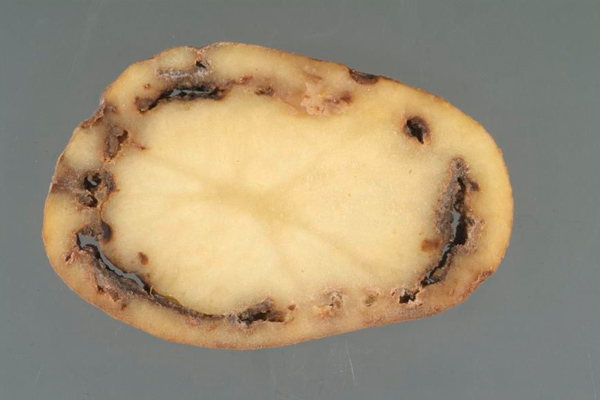
Ring rot (Clavibacter michiganensis subsp. sepedonicus)
It causes darkening of the vascular bundles just beneath the skin. It cannot be detected unless the tuber is cut. Infected tubers can easily be attacked by secondary infections and rot in the soil or in the potato store. The disease spreads easily in stored produce. The pathogen is suppressed at temperatures below 4°C and above 29°C. The optimal temperature for its development is in the range of 18-24°C.
Storage diseases of onion and garlic

Neck rot (Botrytis alii, B. squamosa, B. byssoidea)
The first symptoms are detected at onion lifting. The most significant development of the disease is recorded during storage of the produce. Slightly sunken, dry spots appear in the area of the root neck. In these parts the scales appear boiled – soft and brownish. Later they are covered with abundant mycelium and the pathogen affects the entire bulb. It rots and becomes mummified. Sometimes sclerotia are formed, visible to the naked eye – solitary or in small groups. Through the planting material the fungus passes into the soil and survives there as saprophytic mycelium. White onion cultivars are more susceptible to this disease compared to colored ones. Well-dried bulbs are difficult to infect. To limit its spread, onions should be harvested in dry and warm weather. Only healthy bulbs should be selected. The produce should be stored at a temperature of 0-2°C.
In garlic the disease appears first in the area of the root neck, near the soil surface, when climatic conditions are favorable. Mass formation of sclerotia is observed at the time of lifting. Mycelium and sclerotia of the fungus are formed on the surface of the bulbs or between the cloves.
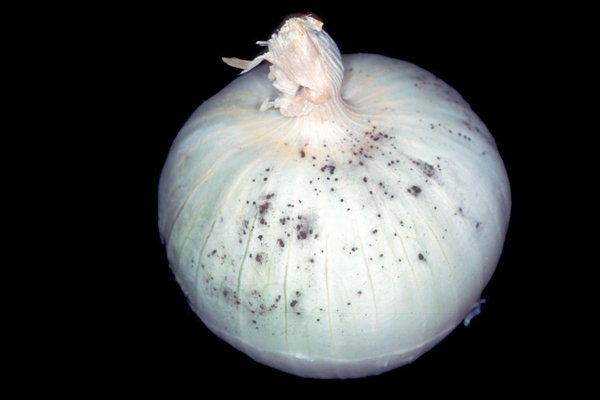
Black mould (Aspergillus niger. )
It develops during transport or storage. The causal fungus is part of the saprophytic microflora of the soil and of the dry scales of the bulbs. It enters them through wounds in the root neck or roots. Lesions or black streaks are observed on the outer scales, and the root neck also turns black. Under severe attack, the entire bulb blackens and shrivels. Later, putrefactive bacteria may penetrate the diseased areas and cause watery bacterial rot. High storage temperatures are favorable for the development of the disease. External symptoms may be absent on the bulbs, but on cross-section the central parts are gray or black in color.

Bacterial rot (Erwinia carotovora)
During storage, individual scales of the bulbs rot. The rot is soft, and the affected tissue has a crumbly consistency. Sometimes the entire scale may remain as a skin. The bacterium causing this rot is specialized on onion. It attacks the bulbs up to the time they are placed in storage.
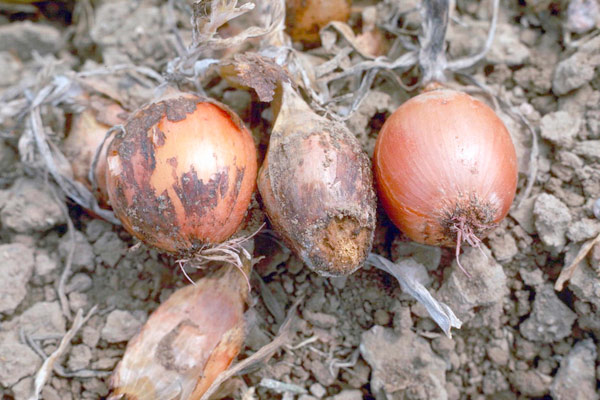
Fusarium basal rot (Fusarium oxysporum f. sp. cepae)
It starts developing during the vegetation period. The affected bulbs may show no symptoms of the disease at harvest. Subsequently, they rot during storage in warehouses. The spots that appear initially are colorless and watery. Later they turn brown and are covered with white mycelium. In infected garlic, reddish-purple discoloration of the stem, cloves or bulbs is observed.
Control:
- Avoid mechanical injuries to the bulbs during harvest;
- Harvest should be carried out in dry and hot weather;
- The bulbs should be dried after lifting;
- Treatment with plant protection products before placing in storage provides protection against diseases.
- Optimal storage conditions: temperature – 0-1°C, relative humidity 70-75%.