

![MultipartFile resource [file_data]](/assets/img/articles/заглавна-бял-имел.jpg)
One of the Christmas traditions decrees that every home should be beautifully decorated during the festive season. An important part of the Christmas atmosphere are the plants that symbolize the holiday. Besides the well-known Christmas tree, there are several other plants that are not only part of the Christmas spirit, but are also highly sought after in pharmacology and folk medicine.
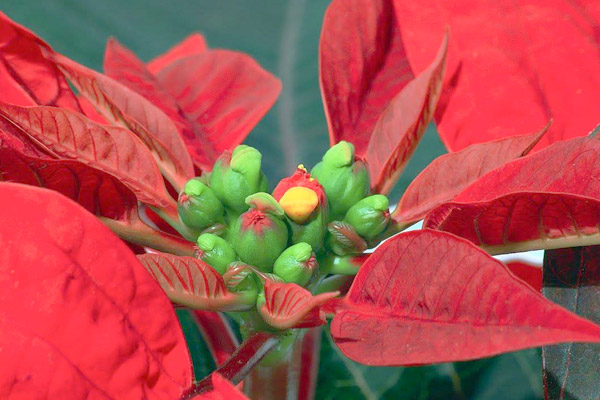
The poinsettia (Euphorbia pulcherrima), or poinsettia as is the commercial name of the plant, blooms at Christmas and its bracts form the shape of a star. In its wild state, the poinsettia is an evergreen shrub reaching a height of up to 3–4 m, unlike the ornamental indoor hybrids, which reach a height of only 30–40 cm. The most common varieties grown at home are Freedom, Cortez, Star and Lilo and their respective multicoloured forms. In recent years, the Millennium variety has also become popular – with large red flowers, bred by the German company Fischer.
Its leaves are elliptical with clearly defined veins and long petioles. At the tips of the stems, the leaves change and form a rosette that turns red and resembles a “star”. The true flower consists of several small florets located in the centre of the coloured rosette.
The plant originates from the tropical regions of Mexico and Guatemala, but the flower with purple leaves has become a traditional Christmas symbol in America, Western Europe and, for several years now, also in Bulgaria.
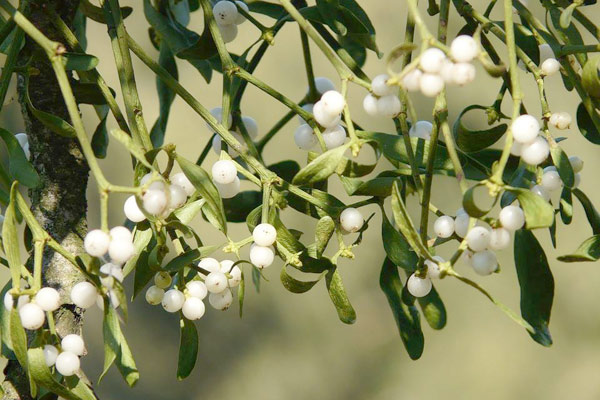
European mistletoe is a beautiful plant associated with the legends surrounding Christmas, one of which is the kiss under the hanging mistletoe. The tradition originates from Scandinavian mythology, where mistletoe is a symbol of beauty, health and fertility. In fact, Viscum album is a plant species from the family Santalaceae Santalaceae, and is included in the list of medicinal plants. It is one of the particular types of parasitic plants because it has green leaves that can carry out photosynthesis, but it needs a host plant from which to absorb water and mineral salts. It is called a hemiparasite.
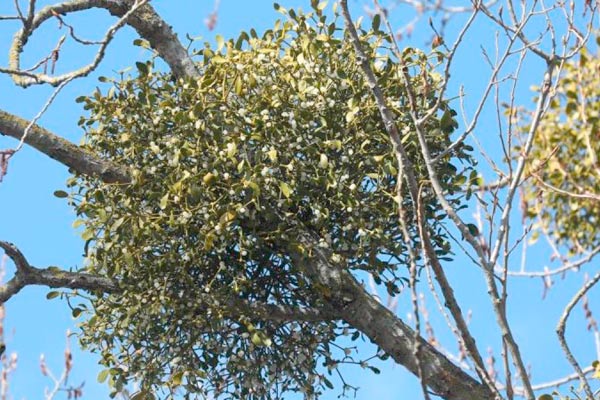
European mistletoe is one of the few parasitic plant species in Europe that parasitizes directly on the stems of host plants.
In modern medicine, the leaves together with the twigs, or only the leaves, are used; they are harvested in March and April.
In folk medicine, European mistletoe is considered a herb that helps enrich the body with calcium, which is important for the skeletal system. It regulates blood pressure (in both hypertensive and hypotensive patients) and improves heart health, helps with hormonal imbalance in women in the period shortly before and after the onset of menopause, eliminates metabolic disorders, is used for the treatment of atherosclerosis and epilepsy. European mistletoe also treats irregular menstruation, kidney diseases, female infertility, bronchial asthma, nervous disorders, panic attacks and anxiety, bronchial asthma, dizziness, impaired balance, insomnia and headache.
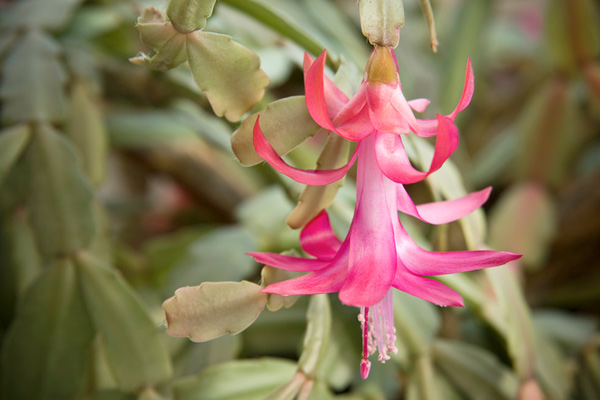
The Christmas cactus is a favourite houseplant with bright flowers, which has received its name because of its flowering period: from the beginning of November to the end of January. It is also called Christmas cactus because the plant belongs to the family Cactaceae. Its botanical name Schlumbergera comes from the famous French cactus breeder Frédéric Schlumberger.
In its natural environment, it is a small shrub whose stems are repeatedly divided fan-shaped. At the front tip of the terminal segments, flower buds and flowers are formed. It grows in six varieties that occur in the mountains of Eastern Brazil.
It originates from the humid Brazilian forests, where it blooms as an epiphyte on the trunks and roots of trees in the height of the tropical summer, which coincides with the coldest time of winter in Bulgaria.
Schlumbergeras have aerial roots that absorb water from the humidity in the air and nutrients from raindrops. The flowers are funnel-shaped, usually pink or whitish-pink (however, cultivars grown in nurseries may also have orange, yellow or red flowers), and have 20–30 petals.
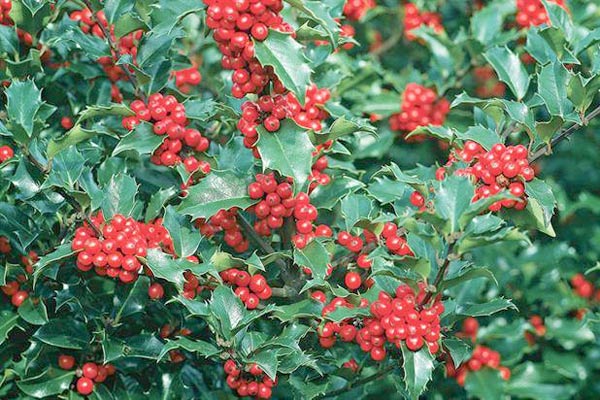
Holly (Ilex), or Samodivski boxwood, also called Ilex, is an evergreen spiny shrub usually reaching a height of up to 3 m, but it often attains the size and form of a tree, 10–12 m tall. Its Latin name Ilex comes from “evergreen oak” (Quercus ilex). It is related to the laurel forests that once covered the Mediterranean region.
The plant is shade-loving and is found mainly in moist and shady forests of eastern beech, predominantly in the subtropical and the transitional to temperate Mediterranean zones. In Bulgaria it is found mainly in the forests of the Strandzha Mountain and to the west in the area of Malko Tarnovo in the reserves “Vitanovo” and “Sredoka”, but also in the Rhodopes, Sredna Gora, Strandzha and Belasitsa; overall it is a rather rare plant. Ilex also likes sun. Some of its variegated forms require more light. It prefers moist soils. It reproduces with great difficulty – both from seeds and from cuttings. This is probably why Ilex is such a rare and valuable species.
Holly (Ilex aquifolium) is well known for its attractive evergreen foliage and bright red fruits, which make it a popular choice for gardens and landscaping. Very often, cut branches of holly are used in floriculture for Christmas decorations, wreaths or beautiful baskets and bouquets, in combination with other plants. However, not everyone knows that it is a favourite food of deer, which like to nibble on the tender leaves of the lower branches.
Interestingly, in forest conditions, holly has developed a unique defence mechanism to protect itself from hungry deer. When the leaves of the Christmas plant are bitten by deer, the tree responds by producing spiny leaves on the lower branches, which are less palatable to forest animals. This allows the tree to continue to grow even under constant threat from herbivores.
The pointed leaves that start to grow in response to the increased interest from deer are much tougher than the smooth, glossy leaves that holly trees produce under normal conditions. The pointed leaves are also less nutritious than the normal leaves, which means that deer are less likely to eat them.
The defence mechanism in holly is also effective against pests and pathogens, and is an astonishing example of how plants have evolved to adapt to their environment.
In pharmacology, the leaves of the plant are used. They contain alkaloids and theobromine and have a laxative action and a diaphoretic effect, a fever-reducing effect in pleurisy, scarlet fever, typhoid and measles, and a diuretic effect – in ascites, gout and rheumatism. Their application is internal, as an infusion or decoction, and in homeopathy – for the treatment of joint and eye diseases.
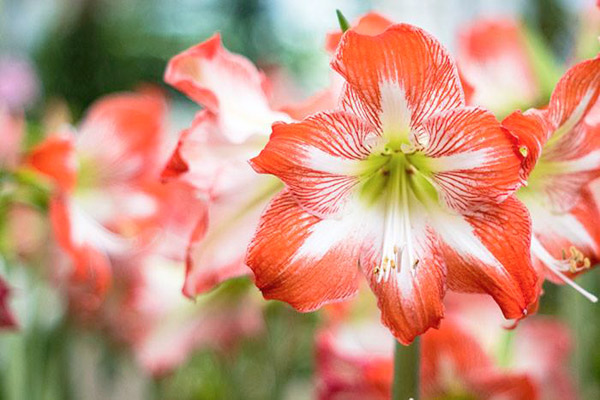
Hippeastrum (Hippeastrum) is a genus of bulbous monocotyledonous plants from the family Amaryllidaceae. Their common name is amaryllis, but they should not be confused with the plants assigned to the true genus Amaryllis, which belong to the same family. Unlike them, the natural distribution of Hippeastrums is in the tropical and subtropical zones of the Americas, where they grow mainly as geophytes, although epiphytic representatives are also found. Hippeastrums are among the most widespread ornamental plants, and today many diverse cultivars with differently shaped and coloured flowers have been bred.
Amaryllis is a potted bulbous flower with huge red, pink and yellow flowers, and in many countries it is customary to give this plant as a gift for the Christmas holidays. It symbolizes warmth and hospitality.
Planting time: from October to the end of April. They are planted in not very wide pots; it is sufficient to have two fingers’ width between the bulb and the edge of the pot, but it is advisable for the pots to be deeper. The bulbs are not buried completely; one-third of the bulb must remain above the soil surface. In summer they develop a large root system, which grows from the base of the bulb, therefore the pot must be deep. Of all bulbous plants, amaryllis is the easiest to make bloom. This can be achieved indoors or outdoors and over an extended period of time, from December to the end of June.