

![MultipartFile resource [file_data]](/assets/img/articles/заглавна-съхраняване-плодове.jpg)
The main diseases developing during storage in pome fruit species are:
Fruit scald – the disease develops during storage. It is caused by high concentrations of toxic substances and has a non-infectious etiology. Initially, the damage appears as a light brown spot on the fruit skin, but later it enlarges, covers the entire surface and penetrates to a depth of about 1 cm into the fleshy tissue of the fruit. More severe development occurs under conditions of poor ventilation and disturbed temperature regime, when large amounts of methyl alcohol, acetaldehyde, acetic acid and other poisonous gases accumulate. Strong manifestation is observed when immature fruits are harvested from orchards heavily fertilized with nitrogen and abundantly irrigated.
Another disease of pome fruit species is Jonathan spot – due to disturbed gas exchange during preservation and storage of the fruits and, less frequently, in the orchards. On the fruit skin, at the site of the lenticels, rounded, slightly sunken spots appear. The tissues under the skin wilt and dry out. The manifestations intensify in vigorously growing trees, after severe pruning, unbalanced nitrogen fertilization, and abundant irrigation towards the end of the vegetation period.
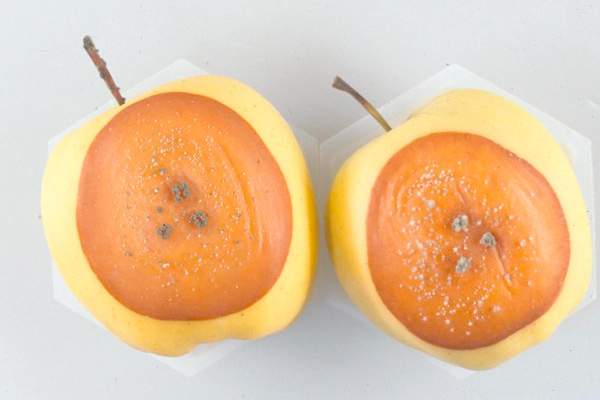
Spots and rot on a fruit of the apple cultivar Golden Delicious, caused by soft (Penicillium) rot.
Penicillium or soft rot of fruits (Penicillium expansum). This disease is the most widespread on fruits during storage and transportation. It is caused by fungi of the genus Penicillium, leading to the appearance of straw-yellow, watery spots with an alcoholic odour on the fruit surface. The rot quickly affects the entire fruit and penetrates in depth. On the rotten tissues a pale green mould is formed, which later acquires a bluish tint. As a result of the damage, the fleshy part of the fruit becomes pulpy. Favourable conditions for the development of soft rot are created at high humidity during preservation and transportation of the fruits.
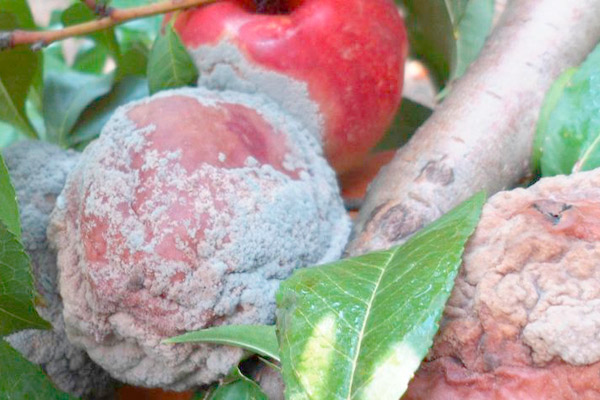
Grey mould (Botrytis) on apples, causing extensive decay during storage
Grey (Botrytis) rot of fruits (Botrytis synerea)
The disease occurs on the fruits of pome fruit species. It is considered the second most important disease after soft (blue) rot, causing decay of fruits after harvest and during their storage under refrigerated conditions. When fruits are transported for storage, those infected with Botrytis rot become completely rotten. The infection often spreads from fruit to fruit during storage, forming „piles” or „clusters” of rotten fruits. Most often the infection exists on individual fruits in the orchards and develops during storage, as the spores of the fungus are preserved in solutions used to protect the fruits from other diseases developing in the flesh. Therefore, the addition of effective fungicides to these solutions will partially prevent the spread of the disease.
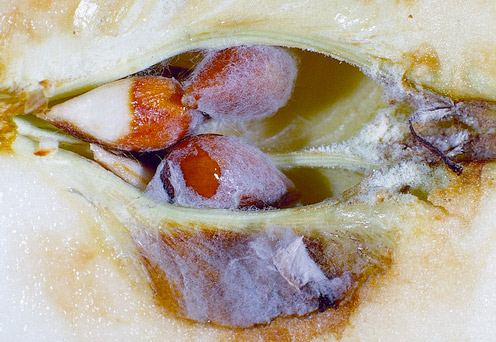
Interior of an apple with symptoms of rot around the seed core and seed cavity filled with mould
Another disease is core rot of apple, which is caused mainly by fungi of the genus Alternaria spp. The symptoms arise in the orchards, but the infected fruits have no external symptoms and appear normal during storage. When an infected fruit is cut in half, the seed cavity or core is observed to be filled with fungal mould. Symptoms with reddening of parts of the fruit flesh are rarely observed, after prolonged storage.
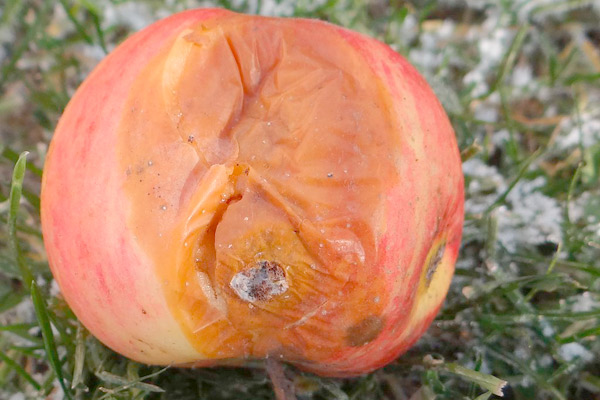
Bitter rot (Trichotecium roseum) occurs most frequently during storage of fruits. Fruits with an open calyx reaching the seed core are more massively attacked. The symptoms may be hidden – internal and external. The internal symptoms are detected when the fruit is cut. The seed core is filled with pink mycelium, and brown rot is visible on the flesh. In case of external manifestation, brown rot with pink pustules on the surface develops at the site of injury or damage.
Control measures used to protect fruits of fruit species against diseases during storage
- To comply with the requirements for technological and optimal harvest maturity of the cultivar, cultivar susceptibility, as well as all prophylactic and agrotechnical practices (such as pruning, appropriate fertilization, regulation of irrigation before harvest, etc.), which protect plants from the occurrence of diseases.
- During harvest the fruits should not be injured and only healthy fruits should be stored. When symptoms of rot appear, infected fruits should be removed in a timely manner in order to avoid infection and the risk of decay of the remaining fruits.
- For the control and limitation of soft and grey rot it is effective to spray the trees with fungicides with preventive and curative action, such as Folicur 250 EW – 0.1 %. The last spraying should be carried out immediately before harvesting the fruits.
- Spraying the trees with a 0.6 % solution of CaCl2 before harvest, three times, at two-week intervals depending on the cultivar, or dipping the fruits in a 1 % solution of CaCl2 for 2 minutes against Penicillium rot. After drying, the fruits should be stored as soon as possible in a cold store, at an optimal temperature of 0 to 1-2°C and relative humidity of 85 - 90 %, taking care not to injure them.
- Disinfectants are also used: sodium hypochlorite – 0.4 % or a solution of benomyl – 0.2 % for 2 minutes, in which the fruits are soaked, as well as disinfection of fruit stores with sulphur dioxide and formalin.
- There is also the possibility to use bioagents (strains of Trichoderma) in conducting the control of grey mould, as well as the use of biological control agents against soft rot, which can replace fungicide treatments and prevent the development of resistance to them.