

![MultipartFile resource [file_data]](/assets/img/articles/заглавна-поле-зима.jpg)
Why in traditional agrometeorology people associate bread with deep snow in winter and with precipitation in May
Two opposing records have been registered over the past 5 years: the highest and the lowest average wheat yield. The increased frequency of extreme meteorological events is indicated by scientists as a direct result of climate change. From year to year, conditions are becoming increasingly difficult to predict and do not allow yield stability in crops grown outdoors and without irrigation. This article focuses on the cereal crops from which bread is produced: when the agricultural year begins and ends; which meteorological conditions determine the quantity and quality of the harvest. It also examines the relationship of these factors with climate change, as well as the distribution of precipitation totals and temperature during the two critical periods for cereal crops – the autumn‑winter and spring periods – over the last two years in the country. Attention is paid to the bidirectional links between wheat and climate.
Briefly about cereal crops worldwide and in Bulgaria
Many documents related to the “Crop Production” sector warn that climate change will affect the growth, development and productivity of agricultural crops and, in particular, wheat. Its impact will differ in Southeastern Europe and in different parts of the world, but overall the effect in our country is expected to be rather adverse.
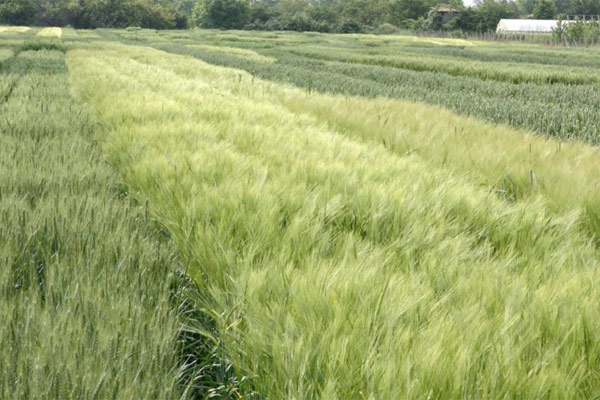
Educational experimental field of the Agricultural University of Plovdiv. Source: author’s personal archive
Winter cereal crops are characterized by broad plasticity and adaptability to different soil types and conditions. Worldwide, favourable conditions for their cultivation exist in zones between 30° and 55° N and 25° and 40° S, with annual precipitation totals between 300 mm and 1100 mm, while in our agricultural regions these values range between 400 and 800 mm. Since ancient times, the cultivation of food and raw materials has been the main reason for sedentarization, population growth and the emergence of wealthy cities. As a strategically important crop, wheat lies at the foundation of the emergence of social organization related to agricultural land and the rights to its use.
Archaeological sources show that wheat was cultivated in the southeastern parts of Turkey, Syria, Israel and Egypt (Lev-Yadun S et al. 2000). Among the most well-known ancient relatives of the crop are einkorn wheat (Triticum monococcum), spelt (Triticum spelta) and Khorasan wheat (Triticum turanicum).
At present, at least 75% of global grain production is due to the cultivation of wheat, maize and rice.
The largest wheat producers are China, India, Russia and the USA. According to information from the Food and Agriculture Organization of the United Nations – FAO, for the last two decades (2000–2020) the largest share, amounting to 17%, is reported in China, immediately followed by India with 12.5%, while Russia and the USA account for 8.4% each. Among the European countries, France is the leader (5.4%), followed by Germany (3.5%) and Ukraine (3.1%). Bulgaria’s share is 0.7%.
Common soft wheat is used for the production of bread and bakery products, and durum wheat – for pasta. Cereal crops are used for the production of alcohol and beer, starch, semolina, concentrated feed and supplementary products for agriculture. Wheat and cereal foods contain a specific plant protein – gluten, which imparts elasticity and good properties to the flour.
What is the importance of wheat for Bulgarians? Bread is an indispensable part of the table and life of Bulgarians. Ritual loaves are products associated with most customs and holidays, with fertility, birth and funerals.
The share of wheat in Bulgaria exceeds 50%, compared to other cereal grain crops.
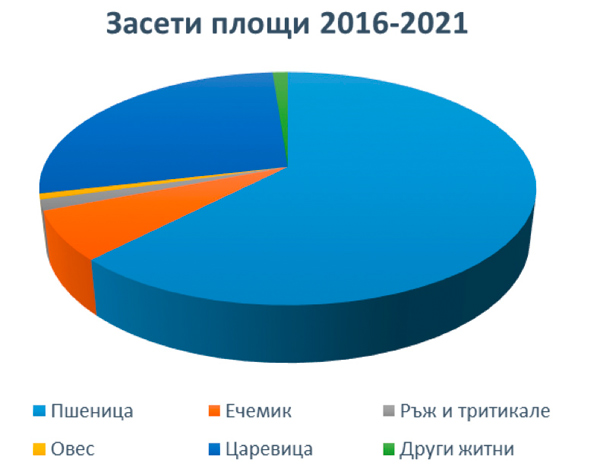
Distribution of cereal crops. Source: Chart compiled based on data from the Ministry of Agriculture, Department “Agrostatistics”.
Farmers prefer wheat because it covers large areas and, as a rule, the investments made in its cultivation are recovered within a single growing season. By comparison, maize is grown on half as much land in our country, is associated with higher costs, more labour and greater risks due to frequent summer droughts.
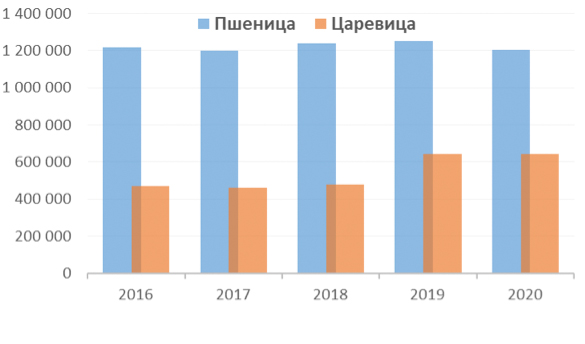
Areas with wheat and maize in hectares. Source: Chart compiled based on data from the Ministry of Agriculture, Department “Agrostatistics”.
Where is wheat grown in Bulgaria and which are the most widespread varieties?
In Bulgaria, wheat is grown in Northern Bulgaria, the Upper Thracian Plain, Southeastern Bulgaria and the Sofia Field. In the remaining agricultural regions of the country, at altitudes up to 1000 m, it is also represented in a suitable manner. In recent years, the regions with the highest degree of favourability have been parts of the Fore-Balkan and Northeastern Bulgaria along the line Vidin, Montana, Dobrich, Veliko Tarnovo, Yambol, Sliven and the Eastern Rhodopes (Georgieva, 2014).
The most widespread cereal crops in Bulgaria are:
- common wheat (T. aestivum L);
- barley (Hordeum vulgare);
- triticale (a hybrid between rye and wheat)
- as well as durum wheat (T. durum Desf.), which is less widespread.
Two-row barley is suitable for fields at higher altitudes, while rye can be grown in foothill regions and on poorer soils. High temperatures at the beginning of summer, combined with low relative humidity and wind, often lead to scorching, and hot and humid weather is the cause of fungal diseases. A specific feature of the species is the need for temperatures around and below 0°C during the winter period. Values >25°C during the reproductive period can have an adverse effect on development and yields. Overwintering cereal crops are also known as autumn-sown crops, and their vegetation takes place in the cooler periods of two calendar years – autumn‑winter and spring.
Is it appropriate to increase the share of durum wheat or is it a disappearing species in our country?
This species is more widespread in Mediterranean countries, under dry and hot climate conditions and on poorer soil types. In Bulgaria, it occurs in Southern Bulgaria, in the regions of Stara Zagora, Yambol, Haskovo and in parts of the Black Sea coast. Its main disadvantage is its significantly lower productivity. One of the advantages of durum wheat is its later sowing time. This is beneficial because at the end of summer and the beginning of autumn the fields are often not yet freed from the preceding crops, and the soil is unsuitable for tillage due to drought. It usually has a taller stem and low lodging resistance, but breeding work is underway to develop shorter varieties. Given the observed trends towards increasing air temperatures in the country, this type of wheat deserves attention.
How is the climate changing in Bulgaria?
At the end of the last and the first two decades of the current century, a well-established significant trend towards an increase in the mean air temperature has been observed in the country, as well as changes in the amount and seasonal distribution of precipitation in the main agricultural regions of Southern and Northern Bulgaria. The frequency of extreme events of meteorological origin has increased significantly (Malcheva et al., 2022, Nikolova et al., 2022). According to the latest World Bank development report, published at the beginning of 2019, Bulgarian agriculture is expected to be affected by climate change now and over the next 30-year period.
Yields are affected by extreme events such as drought, warmer winters; dry winds; hail, intense rainfall and waterlogging, strong winds in the later growth stages. The successful development and good yields of winter cereal crops are determined by the timing of pre-sowing soil preparation and sowing, as well as by the combination of heat and moisture during the period from germination to the stage of mass tillering, and during the stages of heading, flowering and milk maturity. The months of April and May are identified by specialists as critical, because they are very closely linked to yield. This is why, in traditional agrometeorology, people associate bread with deep snow in winter and with precipitation in May. Data show that the biology of these plants is such that if there is not enough soil moisture during the period of ear emergence and flowering, yields will be low.
What is the influence of meteorological conditions on wheat yield and quality?
A good example of this influence in Bulgaria are the hydrothermal regimes during two consecutive agricultural years – 2019–2020 and 2020–2021. Analyses of data from the Ministry of Agriculture (MZHГ) show that the amount of grain produced in the country over the last 5-year period was highest in 2021 and lowest in 2020 (Agricultural Report 2021). In the Northeastern and Southeastern regions, yields during the second agricultural year were twice as high. The South Central region had the most stable values. In both years, the highest yields were recorded in the Northwestern administrative region.
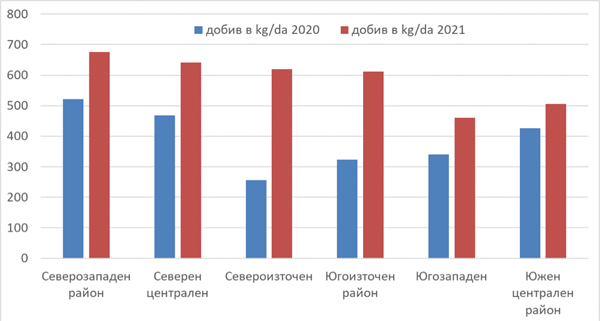
Yields in kg/da by regions, harvests 2020 and 2021.
2020 is one of the two warmest years in the world and also in Bulgaria (NIMH Bulletin, 2021). In our country, a positive temperature anomaly compared to the norm was recorded during the autumn period, exceeding 5°C in some places (from 5.1°C in Vidin to 6.8°C in Sliven). The summer drought of 2020 extended into autumn, leading to a delay in pre-sowing soil preparation and delayed sowing of autumn-sown crops throughout the country. In the same year, a prolonged dry period from 25 May to 3 September was recorded. Subsequently, the precipitation in winter and early spring replenished soil water reserves across the country.
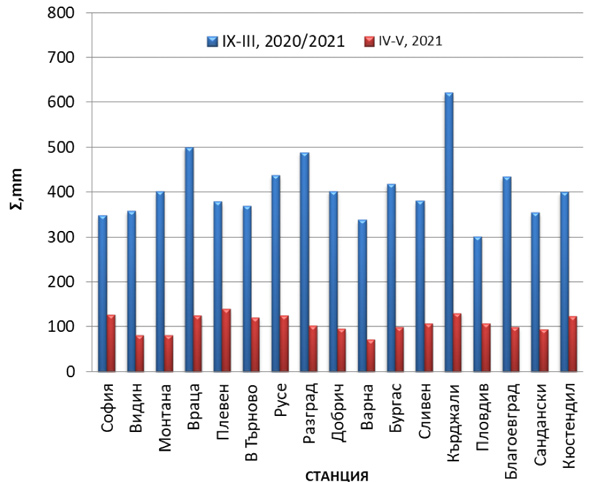
Precipitation totals in mm during autumn‑winter moisture accumulation and spring development 2020/2021.
It has been established that a total precipitation of about 300 mm during this period is sufficient to provide plants with water before the onset of the reproductive phase (Kazandzhiev et al., 2012). The total precipitation recorded in 2021 from sowing to tillering exceeded 300 mm at all stations. The highest amounts were recorded in Southeastern Bulgaria, Kardzhali, i.e. in a region that is not typical for grain production, with Mediterranean influence and a pronounced summer minimum. Despite the dry period at the beginning of the agricultural year, the warm winter favoured more active vegetative processes and the crops compensated for the delay. The total precipitation for the period October–March ranged from 332 mm for Plovdiv to over 634 mm for Kardzhali during the second agricultural year 2020–2021. These amounts are substantial and this is an important prerequisite for a good start of stem elongation. As a result, and due to vegetative season precipitation, yields in 2021 were the highest for the entire 5-year period.
What were wheat yields in 2021–2022?
Analyses and processing have not yet been completed, but preliminary data indicate a higher total quantity of about 790 million tonnes, or about 15 million tonnes more compared to the previous year, for all regions of the world combined (Fig. 7). Nevertheless – as a result of meteorological conditions – specifically for the European Union, Russia, Ukraine, including Bulgaria, yields in the previous 2020–2021 year remain slightly better. Countries such as India and the USA have had better harvests this year, and yields in China do not differ from those in 2020–2021.
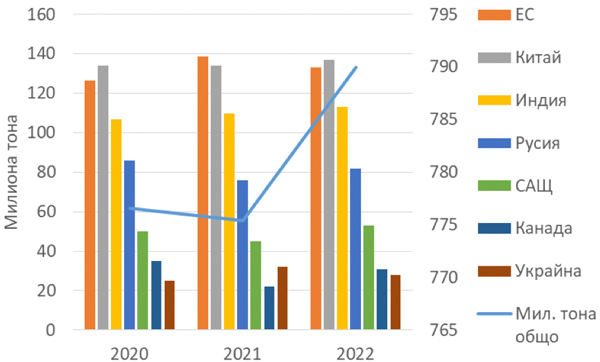
Yields for 2022 according to preliminary FAO expectations
In this agricultural year, everything indicates that the intense droughts in Europe did not significantly affect wheat. In terms of timing, they occurred later than the critical phenophases and affected yields of rice, maize and spring crops. The uncertainty in the wheat market was caused not so much by extreme climatic events as by the economic crisis and the war in Ukraine.
How can wheat cultivation be adapted to climate change?
Trends in the change and dynamics of meteorological elements highlight as a priority the cultivation of suitable varieties and crops that are well adapted to specific climatic regions.
As in the past, so in the future wheat will remain a major crop in the sector. However, climate change affects the growth and development conditions of cereal crops as well. In the future, deep snow in winter in Bulgaria may remain only a fond memory, and snow cover in the higher parts of the country may appear with the arrival of spring. Accurate weather forecasts and specialized forecasts for the phenological development of the crop and the occurrence and spread of economically important diseases and pests for each individual growing region are necessary. Modelling is a good method that can contribute to yield stability.
Detailed and more precise studies on expanding the range of distribution in altitude will not lose relevance. For wheat, as for most agricultural crops, efforts are directed towards organic production and increasing sustainable practices. Breeding work related to the physiological responses to stressful meteorological events and fertilization is of key importance. An interesting fact is that wheat has 16 billion base pairs, or a genome 5 times more complex than that of humans.
Can irrigation in wheat cultivation be effective?
At present, wheat in Bulgaria is grown under conditions of natural moisture and relies solely on precipitation totals. This is the main reason for unstable yields. In the current state of our irrigation systems, this measure seems unrealistic. Like any other crop, wheat will respond well to irrigation. Economic analyses can be carried out for suitable irrigated preceding crops that leave better soil moisture reserves, as well as financial justifications for irrigating areas at moisture‑critical stages of their phenology.
The relationship between crop production, meteorological conditions and climate change is bidirectional
Therefore, increasing attention is being paid to harmful emissions and energy consumption in soil tillage. A practice with a negative impact on the climate, soil and biodiversity is monoculture cultivation. Crop rotation must unequivocally be prioritized. According to survey data from BANSIK of the Department “Agrostatistics”, in 2020 wheat after wheat was grown on only 6.5% of the area, compared to 7.5% in 2019. It was noted that for the 2020 harvest, good crop rotation was implemented on about 93% of the wheat area. After row crops, 74.3% of the wheat area was sown, compared to 67.8% in the previous year. Fallow accounted for 1.7% of the wheat crop rotation in 2020. Suitable preceding crops reduce tillage costs, diseases and pests, can enrich the soil and be a source of additional income. Good preceding crops for cereals are most often row crops (sunflower), legumes and vegetable crops.
Which varieties are tolerant to stress factors and suitable for organic farming?
Tolerance to stress factors largely overlaps with the requirements for varieties intended for organic production. It is considered that organic farming implies a much more diverse environment compared to conventional farming and requires adaptability and yield stability (Bozhanova & Dechev, 2009; Uhr et al., 2017).
Emphasis is placed on 4 groups of critical traits in favour of sustainable agriculture:
- efficient use of nutrients;
- competitiveness against weeds;
- resistance to diseases and pests; and
- yield and quality stability.
Among the newest selections in Bulgaria is the variety “Blan”, which is medium-early, about 90 cm in height, resistant to lodging and stress factors such as late frosts and dry winds. It is suitable for regionalization throughout the country and is suitable for organic production. The varieties “Sashets” and “Farmer” have very good drought tolerance as well as good characteristics for organic production. Another trait currently preferred is a shorter and stronger stem, which shows high lodging resistance. Varieties with complex qualities such as ecological plasticity and stable yields include “Farmer”, “Diamant”, “Boryana”, “Nikobo”.
However, despite the high yields and good economic qualities of our varieties, a reference to the list in the agricultural report of the Ministry of Agriculture shows that Bulgarian farmers still prefer varieties from foreign producers (Agricultural Report 2020).
And if this were a fairy tale, it would certainly not end like the story in “The Little Wheat Loaf”. The loaf will not roll down the wide white road, because snow is becoming increasingly rare in winter. When it reaches the field, it will not ask the little grains whether they are sleeping under a warm blanket, because there is no blanket and the period is warming, and the plants are not in deep dormancy, as in winter they make up for the lag caused by autumn droughts.
Source: Are the yields of winter cereal crops resilient to climate change? Climateka
The author, Nadezhda Shopova, is part of the Climateka editorial team. She is an assistant at the Climate Section of the “Institute for Research on Climate, Atmosphere and Water” at the Bulgarian Academy of Sciences (IRCAW at BAS). She is an agricultural engineer by education with a specialization in Viticulture and Horticulture, a graduate of the Agricultural University of Plovdiv. She has interests in biometeorology and biometeorological monitoring, agrometeorology and agroclimatology, and the adaptation of agriculture to climate variability and change.
The article uses materials from:
- Bozhanova, V. & Dechev, D. (2009). Problems and perspectives related to the cultivation of cereal crops by organic methods. Proceedings of Scientific Conference, 4–5 June 2009, Stara Zagora. Selskostopanska nauka, 1, 322–327 (Bg).
- Georgieva V. (2014). Author’s abstract of the dissertation “Study of natural moisture of main soil types for the cultivation of winter wheat in Bulgaria”.
- Kazandzhiev V, Georgieva V, Zholeva D. (2012). Assessment of agrometeorological conditions for growing winter cereal crops in Bulgaria. Bul.J.Meteo&Hydro17/5, 1–24
- Malcheva, Kr., Bocheva L., Chervenkov Hr. (2022). “Spatio-Temporal Variation of Extreme Heat Events in Southeastern Europe”. Atmosphere 13, no. 8: 1186
- Lev-Yadun S, Gopher A, Abbo S. Archaeology.(2000). The cradle of agriculture. Science, 2000 Jun 2;288(5471):1602–3. doi: 10.1126/science.288.5471.1602. PMID: 10858140.
- Nikolova N., Ratchev, G., Gera M., Krenchev D., M & Matev, S. (2022). Extreme air temperatures at the southwestern slope of Pirin Mountain (Bulgaria). l’Acad ́emie bulgare des Sciences, Tome 75, No 1, GEOPHYSICS, Meteorology
- Uhr, Z., Ivanov, G. & Rachovska, G. (2017). Suitability of wheat varieties for organic farming systems. Rastenievadni nauki (Bulgarian Journal of Crop Science), 54(1), 3–14 (Bg).
- Monthly hydrometeorological bulletin. National institute of meteorology and hydrology of Bulgaria, 2008–2021, Sofia, ISSN 1314-894X (print) ISSN 2815-2743 (online), http:// bulletins.cfd .meteo.bg/
- https://www.consilium.europa.eu/bg/policies/climate-change/
- GEOGRAPHY OF GRAIN PRODUCTION IN BULGARIA (kabinata.com)
- https://geografia.kabinata.com/17.htm
- https://www.fao.org/3/cb9180en/cb9180en.pdf
- operativen_analiz_2022-03-02_cUb88rd.pdf (government.bg)