

![MultipartFile resource [file_data]](/assets/img/articles/Growing-lettuces-from-seed-обща.jpg)
The high prices of heat sources in recent years have forced producers in the country to change the schemes for growing vegetables in protected cultivation facilities. A large part of them have switched to a regime without winter heating. As an early spring crop, tomatoes are usually grown, and in late summer and autumn – cucumbers. In late autumn and winter the areas are occupied by lettuce, spinach, onions and green garlic. They develop well at lower temperatures and do not require heating.
Low solar radiation, high relative humidity and low temperatures lead to an increase of soil and air humidity in greenhouses. As a result, conditions are created for the development of diseases and pests for which these conditions are favourable.
The most common diseases of lettuce and head lettuce are:
Anthracnose (Marssonina pannattoniana (Berlese) Magnus)
It is observed more often at earlier planting dates in the autumn. It may appear during the entire vegetation period of the crop. On the older leaves small, water-soaked spots appear. On the veins and petioles the spots are sunken, pale yellow-brown. In humid weather they are covered with a pale pink coating of mycelium and sporulation of the fungus. The pathogen persists in the soil and is also transmitted by seeds. The spores are spread by water droplets. For these reasons, infestation is more frequently observed in stands whose seedlings have been grown outdoors.
Control
Introduction of a 3–4-year crop rotation where possible. Seed disinfection. Maintenance of an optimal air-water regime. Formation of water droplets on the leaves should not be allowed. Removal of diseased leaves during transplanting and at the appearance of the first spots. In case of established infestation, treatment is carried out with Bordeaux mix 20 WP 375–500 g/ha.
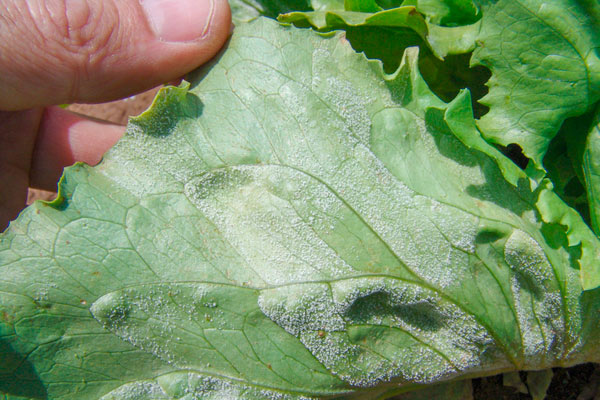
Downy mildew (Bremia lactucae Regel)
A characteristic feature of the causal agent of this disease is that low temperatures and high air humidity are favourable for its development. It occurs both in protected cultivation facilities and in the open field. Large chlorotic spots appear on the leaves, delimited by the veins. Their lower surface is covered with a loose, sporulating coating. It also develops on the petioles. The affected tissues on them become necrotic. The temperature range for the development of the pathogen is 1–15oC. At high air humidity, when the plants are covered for a long time with dew droplets, the disease develops on a mass scale and causes major losses.
Control
Upon appearance of the first spots the diseased leaves are removed and destroyed outside the greenhouse. The plants are sprayed with Bordeaux mix 20 WP 375–500 g/ha; Vitene Triplo R 400–450 g/ha; Golbex WG 250 g/ha; Keefol WP 250 g/ha; Limocid 300 ml/ha; Melody Compact 49 WG 185 g/ha; Polyram DF 120–200 g/ha; Revus 250 SC 60 ml/ha; Taegro 18.5–37.0 g/ha. Regular ventilation of the facilities to reduce air humidity.
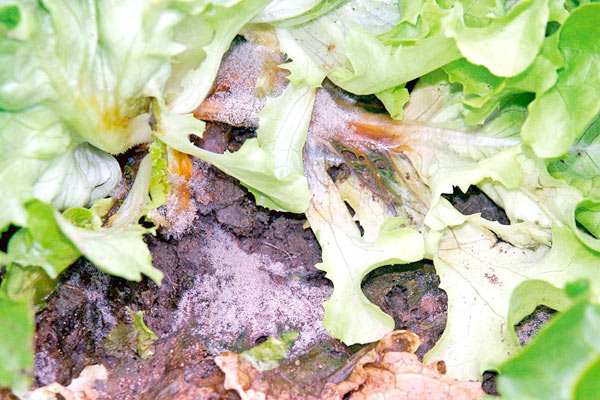
Grey mould (Botrytis cinerea Pers.)
This is the most widespread disease of lettuce grown in protected cultivation facilities and in the open field. It attacks plants in all stages of their development – from seedling stage to harvest. In young seedling plants it causes damping-off by affecting the stem base. The attacked plants lie down on the soil surface and the affected parts are covered with a grey, sporulating coating of the fungus. In adult plants it most often attacks the lowest, oldest leaves. Large water-soaked spots are formed on them. They may also be located at the base of the leaf and at the tip. Later the spots turn yellow and are covered with a greyish sporulating coating. Sometimes the pathogen affects the entire head and the plant dies. Later, large black sclerotia are formed on the dead tissues, by which the fungus persists in the soil for a long period.
Control
Removal of the first diseased plants. Reduction of soil and air humidity. Regular ventilation of the facilities. Upon appearance, treatment of the plants with Avalon 200 ml/ha; Geox WG 50 g/ha; Polyversum 10–30 g/ha; Pretil 200 ml/ha; Signum 60–75 g/ha; Fontelis SC 150 ml/ha.
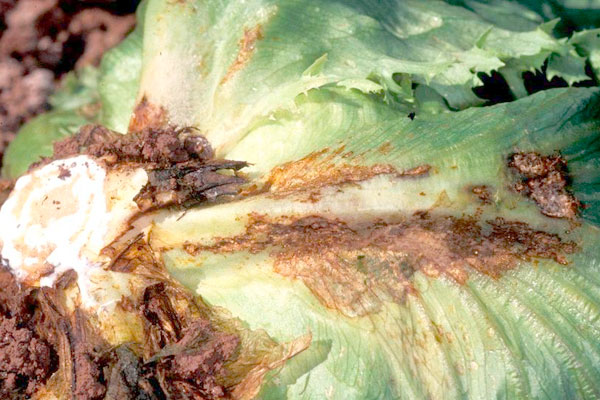
Bacterial diseases (Xanthomonas campestris pv. vitians (Brown) Dowson; Pseudomonas viridiflava (Burkholder) Dowson )
This is a disease of greatest importance for the post-harvest losses of lettuce. It is caused by pectolytic and fluorescent bacteria. The damage can be significant because part of the diseased plants die, while the remaining ones have impaired market quality and may also die during storage and transportation. The first symptoms on affected plants are brown to greenish-black rot of the midrib, initially on one and later on several inner leaves. The disease can develop very rapidly and affect a large number of plants. Most often the plants are attacked immediately before harvest.
Control
It is mainly aimed at good prevention. It is necessary to maintain optimal air temperature and humidity. The facilities should be ventilated regularly. The first diseased plants should be pulled out and destroyed outside the greenhouse. The spots are burned with a 2% solution of copper sulphate. Spraying of plants with copper-containing plant protection products is not recommended, but if necessary they may be treated with Bordeaux mix 20 WP 375–500 g/ha.
Pests damaging lettuce and head lettuce:
Aphids (Myzus persicae, Macrosiphum euphorbiae) – they feed on the leaves, forming dense colonies; at the site of damage the leaves turn yellow and become deformed. During feeding, aphids secrete honeydew on which black saprophytic fungi develop, contaminating the produce and impairing its quality. The lettuce loses its commercial appearance. Aphids are vectors of viral diseases.
Control
Destruction of weed vegetation. The stands are regularly inspected and, if necessary, sprayed with: Abanto 60 ml/ha; Azatin EC 100–150 ml/ha; Delmur 50 ml/ha; Krisant EC 60 ml/ha; Natur Breaker 60 ml/ha; Neemik Ten 260–390 ml/ha; Oikos 100–150 ml/ha; Pyregard 60 ml/ha; Sivanto Prime 63 ml/ha; mineral oils or plant extracts.
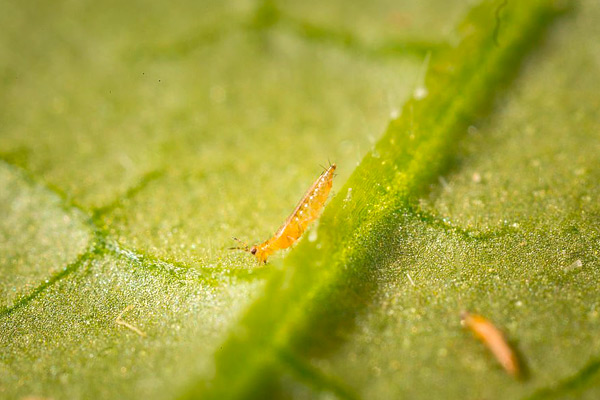
Thrips (Thrips tabaci, Frankliniella occidentalis) - the adults and larvae cause damage by sucking sap from the leaves. At the feeding sites small, silvery white spots with black dots appear. At high population density the spots enlarge and merge. The leaves dry out. The plants lag in their development.
Control
Use of healthy, pest-free seedlings. Destruction of weed vegetation. Regular inspection of the fields. Spraying with: Dicarzol 10 SP 556 g/ha; Exalt 200 ml/ha; Lamdex Extra 42–80 g/ha.
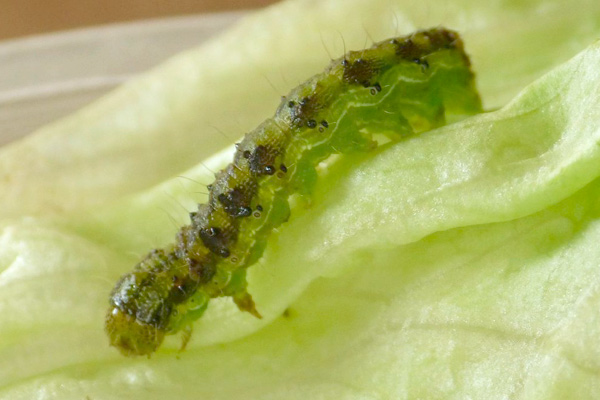
Cutworms: subterranean (Agrotis ipsilon, Agrotis segetum) and above-ground (Helicoverpa armigera, Mamestra oleraceae, Autographa gamma) – the caterpillars (1st and 2nd instar) skeletonise the leaves, and those of the subterranean cutworms in the subsequent instars cut the plants at soil level.
Control
Regular soil cultivation, which leads to a significant reduction in the population density of this pest through mechanical destruction of a large part of the pupae. Regular cleaning of weed vegetation. Treatment with insecticides is effective when directed against young caterpillars. The following plant protection products can be used: Altacor 35 WG 8–12 g/ha; Azatin EC 100–150 ml/ha; Delmur 50 ml/ha; Exalt 200 ml/ha; Neemik Ten 260–390 ml/ha; Oikos 100–150 ml/ha.
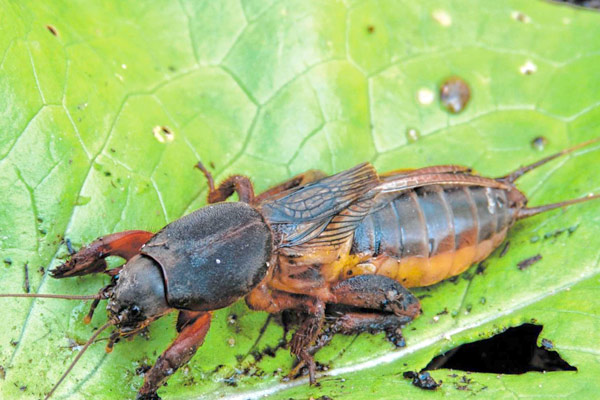
Mole cricket (Gryllotalpa gryllotalpa) – it causes damage as early as February in greenhouses, particularly where it is introduced with soil-manure mixtures and farmyard manure. It prefers loose, moist, humus-rich soils. The mole cricket makes underground tunnels, undermining and lifting the plants. The larvae, as well as the adults, feed on the underground parts of the plants, gnawing the root system and eating the young sprouts. The damaged plants dry out.
Control
There are no authorised plant protection products against this pest in lettuce and head lettuce. If necessary, products registered for other crops may be used: Belem 0.8 MG (Colombo 0.8 MG) 1.2 kg/ha.
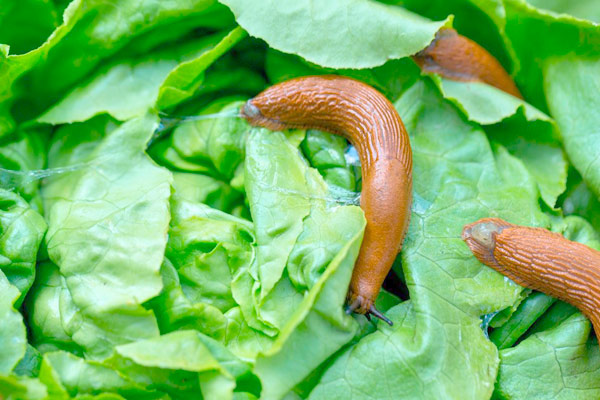
Slugs (Limacidae) – non-insect, polyphagous pests. They gnaw the lettuce leaves, making irregular holes. They are particularly dangerous at high humidity. More easily warmed soils favour higher activity of slugs. Dry conditions lead to a decrease in the population density of these pests. During their movement on the plants they leave a white trail of slime, which is indicative of their presence.
Control
Regular soil cultivation. Optimal plant density. On small areas – mechanical collection (placing traps made of plant residues, wet paper, attractive liquids, etc.).
On lettuce and head lettuce grown in greenhouses, although more rarely, damage from leaf-miner flies, greenhouse whitefly and two-spotted spider mite may also be observed.
Control of lettuce pests is integrated. Prevention and the cultivation and transplanting of healthy plants are the most effective. All preventive and agronomic measures known and applied in other crops are implemented, such as the use of mineral or peat-mineral substrates in seedling production, ensuring an optimal nutrient and temperature-humidity regime, application of optimal agronomic practices, etc.
Lettuce is a crop with a short vegetation period. The application of chemical plant protection products must be rational and careful, strictly in compliance with the pre-harvest intervals. Seedlings may be treated with systemic and broad-spectrum plant protection products, but after transplanting chemical treatments should be limited. In such cases, if necessary, products with a short pre-harvest interval are used, with a view to protecting the produce from contamination with toxic residues.