

![MultipartFile resource [file_data]](/assets/img/articles/заглавна-cop27.jpg)
From 6 to 18 November, the 27th Conference on Climate Change – COP27 – is taking place in Egypt. The meeting is attended by 120 world leaders, delegates from 196 countries and a total of over 33,000 registered participants – among them not only politicians, but also observers, experts and activists. This year’s COP is the second most visited after COP26 in Glasgow last year. This is indicative of the growing public attention and engagement with climate change in recent years.
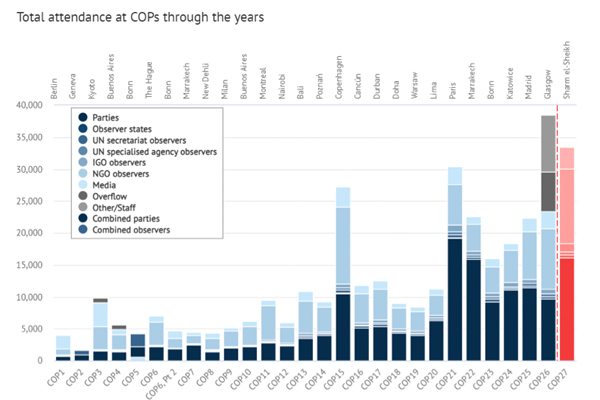
The number of officially registered participants at all climate change conferences so far. The data for COP27 are based on preliminary participant lists from the UN. Source: Carbon Brief.
Western leaders declare readiness to complete what was started in Glasgow
During the first days of the climate change conference in Egypt, a summit of world leaders was held. At it, they put on the agenda the issues facing the conference – the need for immediate action in the field of climate, implementation of existing pledges and support for developing countries. At this stage there are no new major legally binding agreements. President Rumen Radev also took part in the summit, heading the Bulgarian delegation, and he proposed that Bulgaria host the conference in 2024.
Key moments from the summit
During the first two days of the conference – 7 and 8 November, the summit was held, at which the heads of the country delegations made statements on the main problems and potential solutions. In practice, they set the tone of the conference.
The meeting was opened with a sharp speech by UN Secretary-General António Guterres, who warned of the continuing rise in the Earth’s temperature. In his words, humanity is “in a battle for its life” and we continue to accelerate “on the highway to climate hell”. He also stressed that despite conflicts such as the one in Ukraine, this should not divert attention from climate change.
He called for the creation of a “Climate Solidarity Pact” – an agreement between developed and developing countries, under which the richer support the poorer. Guterres stated that developed countries must take the lead, but that the so‑called emerging economies (countries undergoing rapid growth and industrialisation that still do not have the characteristics of a developed economy) also play a critical role. Guterres pointed to the USA and China as key to the implementation of this pact. The Secretary-General concluded his speech with the message: “Humanity has a choice. Cooperate or perish. It will be a Climate Solidarity Pact or a Collective Suicide Pact.”
A similar‑in‑spirit statement was made by former US Vice President and climate activist Al Gore, who spoke out against plans for new deals for the extraction and transport of natural gas and stated that humanity must stop using “the thin blue atmosphere as an open sewer”. Gore called the extraction of fossil fuels a “culture of death”.
Positive signals were sent by the President of France Emmanuel Macron. He stated that the war in Ukraine would not deflect the country from its climate goals and called on wealthy countries to compensate poorer ones, which are also the most affected by climate change. He also called for a ban on deep‑sea fuel extraction – at depths below 200 metres – since this practice entails significant and, at this stage, unclear risks for marine habitats.
A similar message was heard from German Chancellor Olaf Scholz. He reaffirmed his country’s commitment, stating that after the short‑term return to coal, necessitated by the war in Ukraine and the gas shortage, the year 2030 would be the final date for phasing out its consumption. Germany will also increase its support for environmental programmes to 6 billion dollars, of which up to 2 billion will go to forest conservation.
An interesting fact was the presence of both the current British Prime Minister Rishi Sunak, who at the last moment decided to head the United Kingdom’s delegation, and former Prime Minister Boris Johnson. Unlike Sunak, Johnson attended as a guest and was particularly critical of the development so far of the situation around the climate negotiations – according to him, after this year’s increase in fuel prices a “corrosive cynicism” has developed and we cannot afford weak and hesitant actions.
Progress on the leading topic “Loss and Damage”?
At the beginning of the conference, limited progress was noted on the issue of “Loss and Damage” – compensation for losses caused by climate change in less developed countries. Government negotiators agreed to begin formal discussions on this issue, with a set goal of adopting a final decision and a deadline no later than 2024. However, this appears to be yet another postponement, given that the topic of “Loss and Damage” is one of the focal points of COP27.
On the second day of the meeting, President of the European Commission Ursula von der Leyen called on other developed countries to follow what she considers the good example of the European Union in financing mitigation and adaptation measures, as part of the 100 billion US dollars per year pledged in 2009.
The meeting was marked by the absence of the Presidents of the USA and China, although they have sent delegations. The absence of Joe Biden can be explained by his commitments related to the recently concluded midterm elections in the USA for Congress and the Senate.
During the first days of the conference, no major commitments and agreements, such as the “Global Methane Pledge”, were announced, but the main issues were brought into focus – the need to strengthen Nationally Determined Contributions and financial support for developing countries.
After the summit, most of the leaders left the conference and entrusted the task of negotiations to their delegations. Until the end of the conference, discussions are forthcoming in line with the planned thematic days. 9 November was Finance Day, and 10 November was designated as Science and Youth Day.
Finance Day
During Finance Day, UN experts published a list of projects with measures in poor countries with a total value of 120 billion dollars, which investors could support. One such project is, for example, the Water Infrastructure Improvement Plan in Mauritius, worth 10 million dollars.
France and Germany signed agreements to provide a concessional loan of 300 million euro to South Africa to support the energy transition to clean energy.
Italy, the United Kingdom and Sweden were among the countries that pledged more than 350 million dollars to finance nature‑based solutions in countries such as Egypt, Fiji, Kenya and Malawi. The United Kingdom also stated that it would allow the postponement of payments for countries affected by extreme weather events.

Activists attending COP27 call for an end to fossil fuel subsidies. Source.
US envoy John Kerry presented a plan for the purchase of carbon credits from developing countries in support of the transition to clean energy. This practice would be part of the widely criticised emissions trading – there are concerns that it does not lead to significant emission reductions and functions on the principle of “the polluter pays”.
At the same time, Chinese envoy Xie Zhenhua stated that the USA “has closed the doors” to climate negotiations and that it is necessary to reopen them. At this stage, talks between the countries are at an informal level. This comment comes against the backdrop of deteriorating relations between the world’s two largest economies and emitters. Xie Zhenhua further noted that China would contribute to a “Loss and Damage” fund, although in his view the country is not obliged to do so. According to analysts, however, this should not be interpreted as an official intention, since the country already contributes to mitigation measures and to dealing with extreme events.
At the same time, the Austrian Minister for Climate Action and Energy stated that her country would provide 50 million euro in additional support for “Loss and Damage”. New Zealand offered similar support amounting to 20 million New Zealand dollars.
New reports and criticism of the conference
Immediately before and during the first days of the conference, numerous reports from various organisations were published.
According to a new report published on Tuesday, supported by the UN and entitled “Finance for Climate Action”, developing countries will need a total of 2 trillion dollars per year by 2030 for full financing of support for mitigation, adaptation and loss and damage measures.
And in another new report by the international association Oxfam, it is stated that billionaires are responsible for 1 million times more emissions than the average person. According to the study, the investments of just 125 billionaires are responsible for 393 million tonnes of CO2 per year, equivalent to the annual emissions of 85 million cars. And this is 1 million times more than the total emissions of the “poorest” 90% of the world’s population (each with an annual income of less than 173,000 euro).
As in previous years, this year too concern is raised by the presence at the events, and even the support, of large corporations, in some cases even those involved in fossil fuel extraction. The fact is that Coca‑Cola, one of the largest corporate polluters in the world, is among the sponsors of COP27, which has led to accusations of so‑called greenwashing. It also turned out that a record number of fossil fuel lobbyists – a total of 636 – are present at the conference. For this reason, activists at the forum called for the expulsion of the “criminal” representatives from the conference.
In a statement, Kwami Kpondzo, representative of Friends of the Earth Togo, emphasises that the sharp increase in the number of industry delegates during the climate negotiations reinforces the idea that industry views COP as merely a carnival and not as a space where solutions are sought to the ongoing and looming climate crisis.
Criticism was also directed at the President of the World Bank, David Malpass, who attended the meeting and had previously stated that he did not know whether climate change was real.
The conference continues to draw attention to the issue of human rights in Egypt, where numerous political activists are imprisoned. Olaf Scholz raised the issue of the fate of the imprisoned activist Alaa Abd el‑Fattah, who has already been on hunger strike for over 220 days in protest against the conditions in which he is being held.
Despite the restrictions on demonstrations this year, activists held protests even in the Blue Zone of the negotiations.
The Bulgarian delegation
Our country is represented by 23 delegates, headed by President Rumen Radev. During the conference
he stated that Bulgaria is firmly committed to the goals of the Paris Agreement.
According to him, the transition to climate neutrality must be well thought out, gradual, socially and economically just, so as to increase people’s well‑being rather than reduce it. He added that Bulgaria will continue to develop and rely on renewable energy, green hydrogen solutions and energy‑saving and energy‑storage technologies. Radev also expressed readiness for Bulgaria to host COP29 in 2024.
In his view, this is Bulgaria’s commitment to progress on the issue of climate change in our region and beyond. In addition, according to preliminary plans, in 2024 the host of the meeting should be a country from Eastern Europe. This idea was in fact already announced in June this year by the then Deputy Prime Minister for Climate Policies and Minister of Environment and Water Borislav Sandov.
Conclusions
During the first days of the conference, no major agreements were signed or pledges made, but at least in words most leading world leaders uphold the goals of the Paris Agreement and the need to deepen commitments. It remains to be seen whether by the end of the conference there will be a new legally binding climate agreement among the countries of the world.
The following thematic days of the conference are forthcoming:
• 11 November – Decarbonisation Day.
• 12 November – Adaptation and Agriculture Day.
• 14 November – Gender Day and Water Day.
• 15 November – Energy Day and Civil Society Day.
• 16 November – Biodiversity Day.
• 17 November – Solutions Day.
Source: What were the most important events from the first days of COP27? Klimateka
The author, Nikolay Petkov, is part of the Klimateka editorial team. He holds a Master’s degree in “Meteorology” from the Faculty of Physics of Sofia University “St. Kliment Ohridski”. His Master’s thesis is on “Climate indices – analysis of the climate over Southeast Europe in the recent past and present”. He works at the environmental association “Za Zemyata” (For the Earth) as a coordinator and expert.